Category Archives: food bourne outbreak

USA – Outbreak Investigation of E. Coli O157:H7 – Spinach (November 2021)

FDA

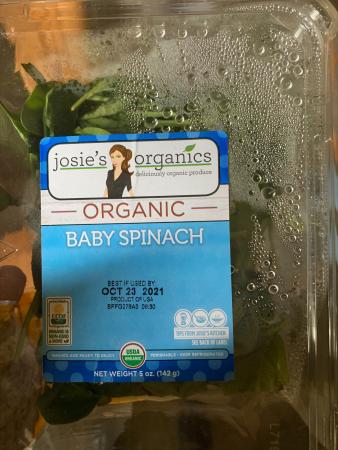
Outbreak Investigation of E. Coli O157:H7 in Spinach (November 2021): Sample Image of Josie's Organics Baby Spinach

The FDA and CDC, in collaboration with state and local partners, are investigating illnesses in a multistate outbreak of E. coli O157:H7. According to the CDC, as of November 15, 2021, 14 people infected with the outbreak strain of E. coli O157:H7 have been reported from nine states. Illnesses started on dates ranging from October 13 to October 27, 2021. 10 people in this outbreak report eating spinach in the week before becoming sick and six people reported Josie’s Organics brand.

On November 15, 2021, the Minnesota Department of Agriculture reported that, as part of this outbreak investigation, a sample of Josie’s Organics Baby Spinach collected from the home of an ill person tested positive for E. coli O157:H7. This sample had a “Best If Used By” date of October 23, 2021. Whole Genome Sequencing (WGS) analysis determined that the strain of E. coli O157:H7 present in the product sample matches the outbreak strain.

FDA traced the supply chain for this positive product sample back to a small number of farms in two different geographic regions and deployed Investigators along the supply chains of interest. FDA continues tracing back reported spinach exposures to identify if spinach from additional farms could have been implicated.

FDA and state partners are working with the firm to determine if additional products could be affected. This is an ongoing investigation and additional information will be provided as it becomes available.

Recommendation

Consumers, restaurants, and retailers, should not eat, sell, or serve Josie’s Organics Baby Spinach with a “Best If Used By” date of October 23, 2021. Josie’s Organics Baby Spinach is sold in a clear plastic clamshell with the Best If Used By Date on the top label.

Although this product is past expiration and should no longer be available for purchase, consumers should check their homes for product and discard it. If consumers froze fresh Josie’s Organics Baby Spinach, they should discard it.


Case Count Map Provided by CDC
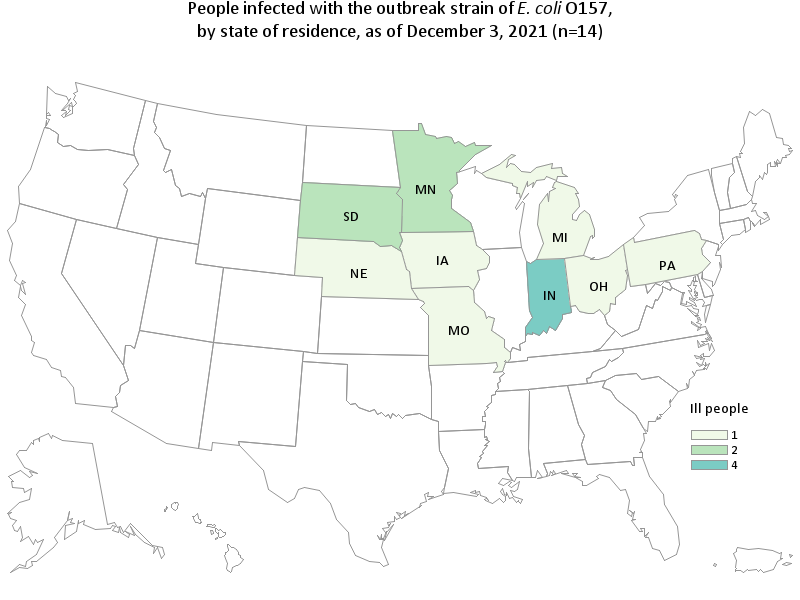
Outbreak Investigation of E. Coli O157:H7 in Spinach: Case Count Map Provided by CDC (December 3, 2021)

Case Counts

Total Illnesses: 14
Hospitalizations: 4
Deaths: 0
Last Illness Onset: October 27, 2021
States with Cases: IA (1), IN (4), MI (1), MN (2), MO (1), NE (1), OH (1), PA (1), SD (1)

Research -A Severe Gastroenteritis Outbreak of Salmonella enterica Serovar Enteritidis Linked to Contaminated Egg Fried Rice, China, 2021

Frontiers in Microbiology

Salmonella contamination of eggs and egg shells has been identified as a public health problem worldwide. Here, we reported an outbreak of severe gastrointestinal symptoms caused by Salmonella enterica serovar Enteritidis (S. enteritidis) in China. We evaluated the outbreak by using epidemiological surveys, routine laboratory testing methods, and whole genome sequencing (WGS). This outbreak occurred in a canteen in Beijing, during March 9–11, 2021, 225 of the 324 diners who have eaten at the canteen showed gastrointestinal symptoms. The outbreak had characteristical epidemiological and clinical features. It caused a very high attack rate (69.4%) in a short incubation time. All patients developed diarrhea and high fever, accompanied by abdominal pain (62.3%), nausea (50.4%), and vomiting (62.7%). The average frequency of diarrhea was 12.4 times/day, and the highest frequency of diarrhea was as high as 50 times/day. The average fever temperature was 39.4°C, and the highest fever temperature was 42°C. Twenty strains of S. enteritidis were recovered, including 19 from the patients samples, and one from remained egg fried rice. Antibiotic susceptibility test showed that the 20 outbreak strains all had the same resistance pattern. PFGE results demonstrated that all 20 strains bore completely identical bands. Phylogenetic analysis based on WGS revealed that all 20 outbreak strains were tightly clustered together. So the pathogenic source of this food poisoning incident may was contaminated egg fried rice. Resistance gene analysis showed that the outbreak strains are all multi-drug resistant strains. Virulence gene analysis indicated that these outbreak strains carried a large number of virulence genes, including 2 types of Salmonella pathogenicity islands (SPI-1 and SPI-2). Other important virulence genes were also carried by the outbreak strains, such as pefABCD, rck and shdA. And the shdA gene was not in other strains located in the same evolutionary branch as the outbreak strain. We speculated that this is a significant reason for the serious symptoms of gastroenteritis in this outbreak. This outbreak caused by S. enteritidis suggested government should strengthen monitoring of the prevalence of outbreak clone strains, and take measures to mitigate the public health threat posed by contaminated eggs.

Introduction

World Health Organization (WHO) estimated the global burden of foodborne diseases, the results showed that almost 1 in 10 people fall ill every year from eating contaminated food and 420,000 die as a result (Dewey-Mattia et al., 2018). Salmonellosis is one of the most frequently reported foodborne diseases worldwide. In particular, disease caused by non-typhoid Salmonella is a global public health problem, whether in a high-income country or a low-income country (Feasey et al., 2016). Each year, approximately 40,000 Salmonella infections are reported to the United States Centers for Disease Control and Prevention (CDCs) (Vaughn et al., 2020). Salmonella enterica serovar Enteritidis (S. enteritidis) is the predominant Salmonella serotype accounting for between 40 and 60% of laboratory-confirmed illnesses of salmonellosis in recent years (Quick et al., 2015). Salmonella enteritidis typically cause a self-limiting gastroenteritis with the symptoms of diarrhea, fever, abdominal cramps, and dehydration (Jiang et al., 2020). Salmonellosis is mainly caused by eating eggs and egg products contaminated with S. enteritidis (90%) and has become a serious health problem. It has been attributed to this serovar’s unusual ability to colonize ovarian tissue of hens and to be able to present within the contents of intact shell eggs (Chousalkar et al., 2018).

Here we reported a severe gastroenteritis outbreak of S. enteritidis linked to contaminated egg fried rice. There were 225 cases of diarrhea and fever in a short period of time in a canteen in Beijing within 3 days. Epidemiological investigations and laboratory tests confirmed that the outbreak was caused by S. enteritidis and was related to the undercooked egg fried rice. At present, such a large-scale outbreak with severe clinical symptoms of S. enteritidis caused by undercooked eggs is rarely reported (Li et al., 2020). Therefore, we reported the outbreak and examined its molecular characteristics using whole genome sequencing (WGS).

India – 4 more norovirus cases in Thrissur

The Hindu

Norovirus Food Safety kswfoodworld

Four more cases of norovirus were reported from a college in Thrissur on Tuesday. The infection was reported in four day scholars of the college.

Though 57 cases have been reported from the college earlier, they were in college hostels. The Health Department has asked the college authorities to make the classes online.

According to preliminary investigation, the infection spread from the drinking water distributed in the hostel.

India – Suspected Norovirus infection for 52 students in St. Mary’s College, Thrissur

The Hindu

Norovirus infection has been suspected for 52 students in the hostel of St. Mary’s College, Thrissur. Health officials suspect that the infection must have spread through the food or drinking water distributed in the hostel.

South Africa – Suspected food poisoning leaves 2 dead, 29 others ill after eating funeral food

News 24

The Gauteng health department says it is dealing with a cluster outbreak of suspected food poisoning cases following the funeral of an elderly woman in Kagiso.

The department’s spokesperson Kwara Kekana said they were working closely with the West Rand District in investigating the incident.

According to Kekana, the  poisoning was suspected to have emanated from a funeral at Kadima Street on Saturday, 13 November.

“Food was served around 11:00 and reports of sudden vomiting and diarrhoea began at around 16:00 on the same day,” said Kekana.

“On Sunday evening, there were rumours of eight cases of people with symptoms and one death.”

“Water and food samples have also been collected and the District Health Services is awaiting results,” Kekana added.

Meanwhile, last week, the Department of Health initiated an urgent investigation into possible food poisoning in Mpumalanga, Eastern Cape, and Gauteng following the deaths of children after allegedly consuming noodles.

Australia – More than 100 sick in Australia as oysters recalled – Vibrio parahaemolyticus

Food Safety News

KSWFOODWORLD

Seven Australian states have recorded more than 100 Vibrio illnesses linked to raw oysters from South Australia.

There are 56 people sick in South Australia since September and three have been hospitalized. Western Australia has 17 cases since late September, Victoria reported 31 illnesses since the first week of October and 15 infections have been recorded in New South Wales. Further illnesses have also been reported in Queensland and the Northern Territory.

Two cases of Vibrio parahaemolyticus were identified in the Australian Capital Territory in people who had recently consumed oysters. Investigations are ongoing to find out where they were sourced from.

Argentina – Salmonella alert issued in Salta, Argentina

Outbreak News Today

The Ministry of Health of the Nation and the Ministry of Public Health of Salta issued an epidemiological alert for the increase in cases of paratyphoid fever (caused by the salmonella bacteria) in the province, in order to inform about the risk situation and intensify prevention and control activities.

The isolates were confirmed by the National Reference Laboratory (LNR) as enteric salmonella subspecies enteric serovar Paratyphi B.

In the National Health Surveillance System, from epidemiological week 1 to 45 of 2021, 1,088 notifications of Typhoid and Paratyphoid Fever were registered, of which 1,069 correspond to residents in the province of Salta, mainly in the capital city and municipalities surrounding.

South Africa – Suspected food poisoning at local funeral: At least 29 in hospital, two dead.

Krugersdorpnews

The West Rand District Health Department says the investigation into a suspected mass food poisoning is continuing after more than 29 people were admitted to hospital and at least two people died after attending the same funeral.

USA – Core Outbreak Table Update

FDA

Date Ref Pathogen Product(s) Total Investigation Status
11/24/2021 1044 Salmonella     Javiana Not Yet Identified 19 Active
11/17/2021 1043 E. coli O157:H7 Spinach See Outbreak Advisory Active
9/15/2021 1031 Salmonella Oranienburg Red, Yellow, and White Onions See Outbreak Advisory Active
9/15/2021 1025 Salmonella Thompson Seafood See Outbreak Advisory Active


India – Norovirus: Dakshina Kannada, Kodagu on high alert

The Hindu

In the wake of Norovirus cases being reported in 13 students of a veterinary college in Wayanad district of neighbouring Kerala, Karnataka has directed health officials in the border Dakshina Kannada and Kodagu districts to be on high alert.

In a circular issued on Tuesday, the State Joint Director (Communicable Diseases) has said people need to be vigilant about the contagious virus.

The Norovirus is a group of viruses that cause gastrointestinal illness. The virus causes inflammation of the lining of the stomach and intestines, as well as severe vomiting and diarrhoea, similar to cholera, the circular stated.