Category Archives: E.coli O26

Research – Evaluation of the use of ampicillin- and streptomycin-resistant Shiga toxin-producing Escherichia coli to reduce the burden of background microbiota during food safety studies

Wiley Online

Tracking artificially seeded foodborne pathogens in foods with high background microbiota is challenging. Wheat flour and its subsidiary products are known to carry a high native microbial load, which could interfere with tracking and enumeration of target organisms in such matrices. Shiga toxin-producing Escherichia coli (STEC) serogroups O26, O121, and O157:H7 were transformed with the pGFPuv plasmid encoding ampicillin resistance (+Amp) and green fluorescent protein and were additionally conferred resistance to streptomycin (+Amp + Strep) through exposure to incremental concentrations of the antibiotic. Growth characteristics of these antibiotic-resistant strains were compared to those of the nonresistant native strains (NR). The supplementation of ampicillin and ampicillin + streptomycin in growth media was evaluated for its ability to suppress growth of the native microbial load of three different commercial cake mixes. Antibiotic supplementation in growth media was successful in suppressing the native microbiota of the cake mixes, while the growth characteristics of the +Amp + Strep variants of the three STEC strains did not differ significantly from the NR strains (p > .05). These results indicate that STEC strains with ampicillin and streptomycin resistance markers have improved trackability over their wild-type counterparts when isolated from food matrices with high background microbiota. These strains would be advantageous for use in laboratory experiments on STEC survival in wheat and wheat derived products as their detection and enumeration can occur without interference from native microbial load.

Research – Attachment of Shiga Toxin-Producing Escherichia coli (STEC) to Pre-Chill and Post-Chill Beef Brisket Tissue

MDPI

Shiga toxin-producing Escherichia coli (STEC) has caused numerous foodborne illness outbreaks where beef was implicated as the contaminated food source. Understanding how STEC attach to beef surfaces may inform effective intervention applications at the abattoir. This simulated meat processing conditions to measure STEC attachment to adipose and lean beef tissue. Beef brisket samples were warmed to a surface temperature of 30 °C (warm carcass), while the remaining samples were maintained at 4 °C (cold carcass), prior to surface inoculation with an STEC cocktail (O26, O45, O103, O111, O121, O145, and O157:H7). Cocktails were grown in either tryptic soy broth (TSB) or M9 minimal nutrient medium. Loosely and firmly attached cells were measured at 0, 3, 5, and 20 min and 1, 3, 8, 12, 24 and 48 h. TSB-grown STEC cells became more firmly attached throughout storage and a difference in loosely versus firmly attached populations on lean and adipose tissues was observed. M9-grown STEC demonstrated a 0.2 log10 CFU/cm2 difference in attachment to lean versus adipose tissue and variability in populations was recorded throughout sampling. Future research should investigate whether a decrease in intervention efficacy correlates to an increase in firmly attached STEC cells on chilled carcasses and/or subprimals, which has been reported. View Full-Text

Research – High Occurrence of Shiga Toxin-Producing Escherichia coli in Raw Meat-Based Diets for Companion Animals—A Public Health Issue

MDPI

Feeding pets raw meat-based diets (RMBDs) is becoming increasingly popular but comes with a risk of pathogenic bacteria, including Shiga toxin-producing Escherichia coli (STEC). In humans, STEC may cause gastrointestinal illnesses, including diarrhea, hemorrhagic colitis (HC), and the hemolytic uremic syndrome (HUS). The aim of this study was to evaluate commercially available RMBDs with regard to the occurrence of STEC. Of 59 RMBD samples, 59% tested positive by real-time PCR for the presence of Shiga toxin genes stx1 and/or stx2. STECs were recovered from 41% of the 59 samples, and strains were subjected to serotyping and virulence gene profiling, using whole genome sequencing (WGS)-based methods. Of 28 strains, 29% carried stx2a or stx2d, which are linked to STEC with high pathogenic potential. Twenty different serotypes were identified, including STEC O26:H11, O91:H10, O91:H14, O145:H28, O146:H21, and O146:H28, which are within the most common non-O157 serogroups associated with human STEC-related illnesses worldwide. Considering the low infectious dose and potential severity of disease manifestations, the high occurrence of STEC in RMBDs poses an important health risk for persons handling raw pet food and persons with close contact to pets fed on RMBDs, and is of concern in the field of public health.

Research – Epidemiological investigations identified an outbreak of Shiga toxin-producing Escherichia coli serotype O26:H11 associated with pre-packed sandwiches

Cambridge Org

In October 2019, public health surveillance systems in Scotland identified an increase in the number of reported infections of Shiga toxin-producing Escherichia coli (STEC) O26:H11 involving bloody diarrhoea. Ultimately, across the United Kingdom (UK) 32 cases of STEC O26:H11 stx1a were identified, with the median age of 27 years and 64% were male; six cases were hospitalised. Among food exposures there was an association with consuming pre-packed sandwiches purchased at outlets belonging to a national food chain franchise (food outlet A) [odds ratio (OR) = 183.89, P < 0.001]. The common ingredient identified as a component of the majority of the sandwiches sold at food outlet A was a mixed salad of Apollo and Iceberg lettuce and spinach leaves. Microbiological testing of food and environmental samples were negative for STEC O26:H11, although STEC O36:H19 was isolated from a mixed salad sample taken from premises owned by food outlet A. Contamination of fresh produce is often due to a transient event and detection of the aetiological agent in food that has a short-shelf life is challenging. Robust, statistically significant epidemiological analysis should be sufficient evidence to direct timely and targeted on-farm investigations. A shift in focus from testing the microbiological quality of the produce to investigating the processes and practices through the supply chain and sampling the farm environment is recommended.

France – Product recall: Rocamadour aop 105g (3x35g) from the MONOPRIX GOURMET brand – STEC E.coli O26

Oulah

ENCOUNTERED PROBLEM

Presence of Escherichia coli STEC O26: H11

PROPOSED SOLUTION

People who hold the product in question are asked not to consume them – and more particularly young children, pregnant women, immunocompromised people and the elderly – and to return them to the point of sale where they were purchased.

People who have consumed it and who present symptoms such as diarrhea, abdominal pain or vomiting should consult their doctor as soon as possible, mentioning this consumption and the possible link with the bacterium Escherichia coli.

In the absence of symptoms within 10 days after consuming the affected products, there is no need to worry and consult a doctor.

The E. coli bacterium is naturally present in the digestive microflora of humans and warm-blooded animals. Some strains of E. coli are pathogenic, and can be responsible in humans for various disorders ranging from mild diarrhea to more serious forms such as hemorrhagic diarrhea or severe kidney damage such as HUS, mainly in young children.

FURTHER INFORMATION

▸ Names of models or references
ROCAMADOUR AOP 3X35G MONOPRIX GOURMET


▸ Affected products

GTIN Lot Dated
3350030108557 131-1 Date of minimum durability 06/24/2021

▸ Packaging
Wooden box wrapped with 3 cheeses


▸ Start / end date of marketing
From 05/22/2021 to 06/23/2021


▸ Health mark
FR 46.204.002 CE


▸ Geographical area of ​​sales throughout
France


MONOPRIX distributors


▸ Consumer service contact
0800084000


▸ Source
CASINO GOODS PURCHASES

Research – Fate of Salmonella and Enterohemorrhagic Escherichia coli on Wheat Grain

Journal of Food Protection

Wheat flour has been connected to outbreaks of foodborne illnesses with increased frequency in recent years, specifically, outbreaks involving Salmonella enterica and enterohemorrhagic Escherichia coli (EHEC). However, there is little information regarding the survival of these pathogens on wheat grain during long-term storage in a low-moisture environment. This study aims to evaluate the long-term survival of these enteric pathogens on wheat grain over the course of a year. Hard red spring wheat was inoculated with strains of four serovars of Salmonella enterica (Enteritidis , Agona, Tennessee, and Montevideo) and six serotypes of EHEC (O157:H7, O26:H11, O121:H19, O45:NM, O111:H8, and O103:H2) in triplicate, sealed in Mylar bags to maintain the water activity, and stored at room temperature (22 ± 1°C). The survival of each pathogen was evaluated by plating onto differential media . Viable counts of strains from all four serovars of Salmonella (Enteritidis , Agona, Tennessee, and Montevideo) were detected on wheat grain stored at room temperature (22 ± 1°C) for the duration of the study (52 weeks). Viable counts of strains from EHEC serotypes O45:NM, O111:H8, and O26:H11 were only detected for 44 weeks and strains from serotypes O157:H7, O121:H19, and O103:H2 were only detected for 40 weeks until they passed below the limit of detection (2.0 log CFU/g). D -values were found to be significantly different between Salmonella and EHEC (adj. p ≤ 0.05) with Salmonella D -values ranging from 22.9 ± 2.2 to 25.2 ± 1.0 weeks and EHEC D -values ranging from 11.4 ± 0.6 to 13.1 ± 1.8 weeks. There were no significant differences amongst the four Salmonella strains or amongst the six EHEC strains (adj. p > 0.05). These observations highlight the wide range of survival capabilities of enteric pathogens in a low-moisture environment and confirm these pathogens are a food safety concern when considering the long shelf life of wheat grain and its products.

Ireland – E. coli O26 outbreak sickens young children in Ireland

Food Safety News

Health officials in Ireland are investigating an E. coli O26 outbreak at a childcare facility.

Officials with the Department of Public Health Mid-West of the Health Service Executive (HSE) said the agency is managing the outbreak of Shiga toxin-producing E. coli (STEC) and highlighted the importance of effective hand hygiene and well water treatment.

The agency added that there are fewer than five patients at the childcare facility in Limerick and the incident is under control.

STEC, also known as Verotoxigenic E. coli (VTEC), can cause serious illness in children under 5 and the elderly. The serious outcomes of illness shows the importance of hand hygiene before and after preparing food and after contact with farm animals and their environment, said officials.

Research – High Occurrence of Shiga Toxin-Producing Escherichia coli in Raw Meat-Based Diets for Companion Animals—A Public Health Issue

MDPI

Feeding pets raw meat-based diets (RMBDs) is becoming increasingly popular but comes with a risk of pathogenic bacteria, including Shiga toxin-producing Escherichia coli (STEC). In humans, STEC may cause gastrointestinal illnesses, including diarrhea, hemorrhagic colitis (HC), and the hemolytic uremic syndrome (HUS). The aim of this study was to evaluate commercially available RMBDs with regard to the occurrence of STEC. Of 59 RMBD samples, 59% tested positive by real-time PCR for the presence of Shiga toxin genes stx1 and/or stx2. STECs were recovered from 41% of the 59 samples, and strains were subjected to serotyping and virulence gene profiling, using whole genome sequencing (WGS)-based methods. Of 28 strains, 29% carried stx2a or stx2d, which are linked to STEC with high pathogenic potential. Twenty different serotypes were identified, including STEC O26:H11, O91:H10, O91:H14, O145:H28, O146:H21, and O146:H28, which are within the most common non-O157 serogroups associated with human STEC-related illnesses worldwide. Considering the low infectious dose and potential severity of disease manifestations, the high occurrence of STEC in RMBDs poses an important health risk for persons handling raw pet food and persons with close contact to pets fed on RMBDs, and is of concern in the field of public health. View Full-Text

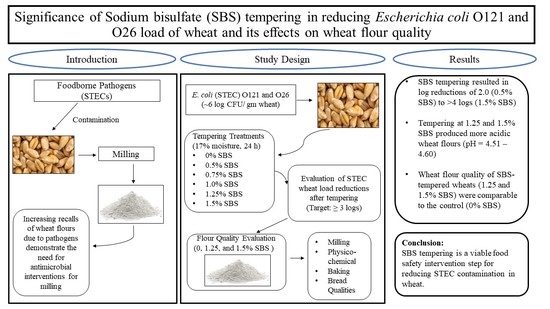
Research – Significance of Sodium Bisulfate (SBS) Tempering in Reducing the Escherichia coli O121 and O26 Load of Wheat and Its Effects on Wheat Flour Quality

MDPI

The occurrence of recalls involving pathogenic Escherichia coli-contaminated wheat flours show the need for incorporating antimicrobial interventions in wheat milling. The objectives of this study were to assess the efficacy of sodium bisulfate (SBS) tempering in reducing E. coli O121 (ATCC 2219) and O26 (ATCC 2196) wheat load and to evaluate the impact of effective (≥3.0 log reductions) SBS treatments on wheat flour quality. Wheat grains were inoculated with E. coli (~6 log CFU/g) and tempered (17% moisture, 24 h) using the following SBS concentrations (%wheat basis): 0, 0.5, 0.75, 1.0, 1.25, and 1.5% SBS. Reductions in E. coli O121 and O26 wheat load at different time intervals (0.5, 2, 6, 12, 18, and 24 h) during tempering were evaluated. The addition of SBS during tempering resulted in E. coli (O121 and O26) log reductions of 2.0 (0.5% SBS) to >4.0 logs (1.5% SBS) (p ≤ 0.05). SBS tempering (1.25 and 1.5% SBS) produced acidic wheat flours (pH = 4.51–4.60) but had comparable wheat flour properties in terms of composition, dough, and bread-making properties relative to the control (0% SBS). SBS tempering reduced the E. coli O121 and O26 load of wheat after tempering with minimal effects on wheat flour quality. View Full-Text

France – Product recall: LA FROMAGERIE DU QUERCY Rocamadour AOP – STEC E.coli O26

Oulah

ENCOUNTERED PROBLEM

Presence of Escherichia coli STEC O26: H11

PROPOSED SOLUTION

People who hold the product in question are asked not to consume them – and more particularly young children, pregnant women, immunocompromised people and the elderly – and to return them to the point of sale where they were purchased.

People who have consumed it and who present symptoms such as diarrhea, abdominal pain or vomiting should consult their doctor as soon as possible, mentioning this consumption and the possible link with the bacterium Escherichia coli.

In the absence of symptoms within 10 days after consuming the affected products, there is no need to worry and consult a doctor.

The E. coli bacterium is naturally present in the digestive microflora of humans and warm-blooded animals. Some strains of E. coli are pathogenic, and can be responsible in humans for various disorders ranging from mild diarrhea to more serious forms such as hemorrhagic diarrhea or severe kidney damage such as HUS, mainly in young children.

FURTHER INFORMATION

▸ Names of models or references
Rocamadour AOP brand LA FROMAGERIE DU QUERCY (3x 35g)


▸ Barcode
3443520068063


▸ Lot
131-1


▸ DLC – DDM
06/24/202


▸ Packaging
3x 35g
Sold to self-service shelves


▸ Start / end date of marketing
from 05/25/2021 to 06/23/2021


▸ Health mark
FR 46.204.002 CE


▸ Consumer service contact
The Consumer Service is at your disposal to answer any questions
Toll Free: 0800 35 29 19 from France / From abroad: +33 (0) 2 48 66 23 78
Hours: 9h00 – 17h00


▸ Source
https://www.intermarche.com/