Category Archives: E.coli O157:H7

USA – FSIS tells us that Greater Omaha Packing Co (GOPAC) shipped E. coli tainted hamburger

Food Poison Journal

The U.S. Department of Agriculture’s Food Safety and Inspection Service (FSIS) is issuing a public health alert because raw beef product produced by Greater Omaha Packing Co. Inc., an Omaha, Neb. establishment, may be contaminated with E. coli. O157:H7. A recall was not requested because the affected product is no longer available for purchase.

FSIS is concerned that some ground beef products may be in consumers’ refrigerators or freezers. Consumers who have purchased these products should not consume them. These products should be thrown away or returned to the place of purchase.

The raw beef item was produced by Greater Omaha Packing Co. Inc. on January 14, 2021, further processed into ground beef and sold by Art’s Food Market located in Sandwich, Illinois. The following product is subject to the public health alert:

2-lb (approximately) trays containing raw ground beef labeled with a retail label with “PACKED” dates ranging from JAN 28 2021 through JAN 31 2021.
This item was sold by the single retail location in Sandwich, Illinois.

USA – FDA CORE Response Team Update

FDA

core

USA – Outbreak Investigation of E. coli – Leafy Greens (December 2020)

FDA

Total Illnesses: 40
Hospitalizations: 20 (4 Cases HUS)
Deaths: 0

The FDA, along with CDC and state and local partners, investigated a multistate outbreak of E. coli O157:H7 infections in the fall of 2020. The epidemiology and traceback investigation have determined that the outbreak was linked to leafy greens. The epidemiological and traceback investigations were not able to determine a specific type of leafy green linked to illnesses. On 12/22/2020, the CDC announced that this outbreak appears to be over. This outbreak, announced by FDA and CDC on October 28, 2020, was caused by a strain of E. coli that is genetically related to a strain linked to the fall 2019 romaine outbreak.

The FDA completed a traceback investigation of multiple types of leafy greens identified in patient interviews. Although no single ranch was identified as a common source of the leafy greens, FDA and state partners also conducted on-site investigations on farms of interest.

Teams were deployed to dozens of ranches in the region to conduct large scale environmental sampling. Additionally, no Shiga toxin-producing E. coli were found on leafy greens. As part of the field investigation, teams conducted environmental sampling on and around ranches of interest to identify any factors that could have led to contamination. Samples of soil, scat or animal droppings, compost, water, and other environmental sources were collected and analyzed.

Laboratory analysis of samples is now complete. The analysis has confirmed a positive match to the outbreak strain in a sample of cattle feces, which was collected during follow-up investigations on a roadside, uphill from where leafy greens or other food identified in the traceback investigation were grown. While the finding does not provide definitive information on how E. coli may have contaminated product during the growing and harvesting season, it does confirm the presence of a strain of E. coli O157:H7 that causes recurring outbreaks in a more narrowly defined growing region and a potential, continued source of contamination.

At this time, FDA’s investigational activities have concluded. The FDA continues to review the findings from this outbreak and a detailed report will be released in the near future. This report will include recommendations shaped by the investigation findings.

In the meantime, as recommended in our Leafy Greens Action Plan, the FDA continues to recommend growers assess and mitigate risk associated with adjacent and nearby land use practices, particularly as it relates to the presence of livestock, which are a persistent reservoir of E. coli O157:H7 and other STEC.

Recommendation

CDC has declared this outbreak to be over. There is no recommendation for consumers, retailers, or suppliers.

Research – Evaluation of foodborne pathogen die-off in back-sweetened wine and apple cider models

Journal of Food Protection

Wine and alcoholic apple cider are commonly back-sweetened with unpasteurized juice to produce fresh, natural, and palatable sweetened alcoholic beverages. Foodborne pathogens may be introduced from unpasteurized juice into alcoholic beverages through this back-sweetening process. Although pathogens generally do not survive under low pH conditions or high alcohol environment, the die-off of these pathogens has not been established to ensure the safety of the products. To determine the safety of these back-sweetened beverages, we evaluated the survival of three common foodborne pathogens, E. coli O157:H7, Salmonella enterica , and Listeria monocytogenes in modified white grape juice and apple juice models. White grape juice and apple juice were modified with hydrochloric acid/sodium hydroxide and ethanol to achieve conditions that are similar to the back-sweetened white wine and alcoholic apple cider. Pathogen cocktails were inoculated separately into modified juice models and their survival in the juice models were recorded over a 96-hour period. Our results show that a combination of low pH and high ethanol content resulted in a faster pathogen die-off compared to higher pH and lower ethanol conditions. The holding times required for different combinations of pH and ethanol concentration for each juice model to achieve 5-log reduction were reported. This research provides data to validate pathogen die-off to comply with Juice HACCP 5-log pathogen inactivation requirements for back-sweetened wine and alcoholic apple cider.

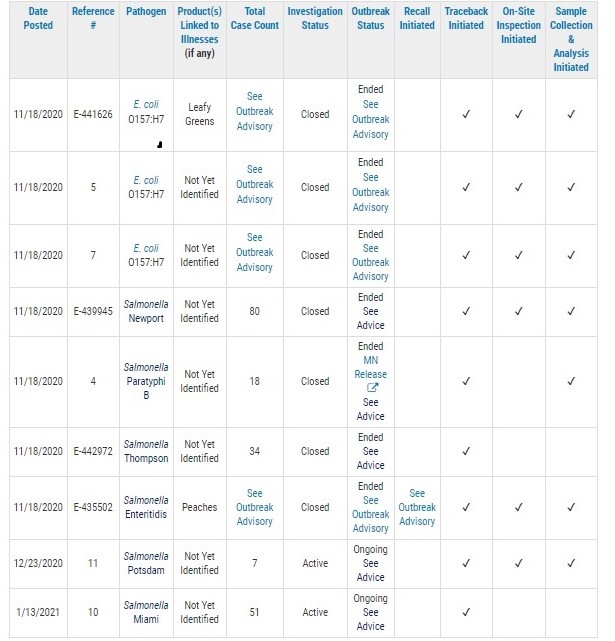
USA – Investigations of Foodborne Illness Outbreaks

FDA

The following is a list of outbreak investigations being managed by FDA’s CORE Response Teams. The investigations are in a variety of stages, meaning that some outbreaks have limited information, and others may be near completion.

qqqq


USA – Sources of Foodborne Illness Report Released – IFSAC

Click to access P19-2018-report-TriAgency-508.pdf

Research – Photocatalytically Enhanced Inactivation of Internalized Pathogenic Bacteria in Fresh Produce using Ultraviolet Irradiation with Nano-titanium Dioxide

Journal of Food Protection

Once pathogens are internalized in fresh produce, they pose a challenging food safety issue since they are not effectively inactivated by conventional rinsing or sanitization. To protect food safety and public health, the objectives were to examine internalized levels of foodborne pathogens in different types of fresh produce and to investigate the effectiveness of photocatalytically enhanced inactivation of internalized pathogens in fresh produce using UV irradiation with titanium dioxide (TiO 2 ). For this, green fluorescent protein-labeled S. Typhimurium and E. coli O157:H7 were inoculated on the leaf surface of four types of fresh produce (~10 8 CFU (colony-forming unit)/leaf) and varying concentrations of TiO 2 suspension (0.50, 0.75, 1.00, 1.25, and 1.50 µg/ml)) were applied to the surface of contaminated leaves. Depending on the nature of each vegetable, the internalized bacterial level differed (log 2 – 5 CFU/g of leaf). When UV irradiation (6,000 J/m 2 ) was applied, the internalized S. Typhimurium and E. coli levels were reduced by 0.8 – 2.4 log CFU/leaf and was with TiO 2 , the reduction was 1.1 – 3.7 log CFU/leaf. The inactivation efficiency increased as the TiO 2 concentration (up to 1.50 μg/leaf). These results indicate that the TiO 2 application enhanced the photocatalytic inactivation of internalized foodborne pathogens. The application of TiO2 would be most practical before UV irradiation and before distributing the produce. This study established a platform for future research on the inactivation of various internalized pathogens for protecting public health and scaling up fresh produce treatments by the food industry.

USA – Outbreak Investigation of E. coli – Leafy Greens (December 2020) – CDC declares outbreak over, FDA investigation ongoing

FDA

The FDA, along with CDC and state and local partners, investigated a multistate outbreak of E. coli O157:H7 infections in the fall of 2020. The epidemiology and traceback investigation have determined that the outbreak was linked to leafy greens. The epidemiological and traceback investigations were not able to determine a specific type of leafy green linked to illnesses. On 12/22/2020, the CDC announced that this outbreak appears to be over. This outbreak, announced by FDA and CDC on October 28, 2020, was caused by a strain of E. coli that is genetically related to a strain linked to the fall 2019 romaine outbreak.

The FDA completed a traceback investigation of multiple types of leafy greens identified in patient interviews. Although no single ranch was identified as a common source of the leafy greens, FDA and state partners also conducted on-site investigations on farms of interest. 

Teams were deployed to dozens of ranches in the region to conduct large scale environmental sampling. Additionally, no Shiga toxin-producing E. coli were found on leafy greens. 

At this time, FDA’s investigational activities, including sample analysis are ongoing. A detailed report of FDA’s findings in the investigation will be released in early 2021, following the conclusion of investigational activities.

Recommendation

CDC has declared this outbreak to be over. There is no recommendation for consumers, retailers, or suppliers.


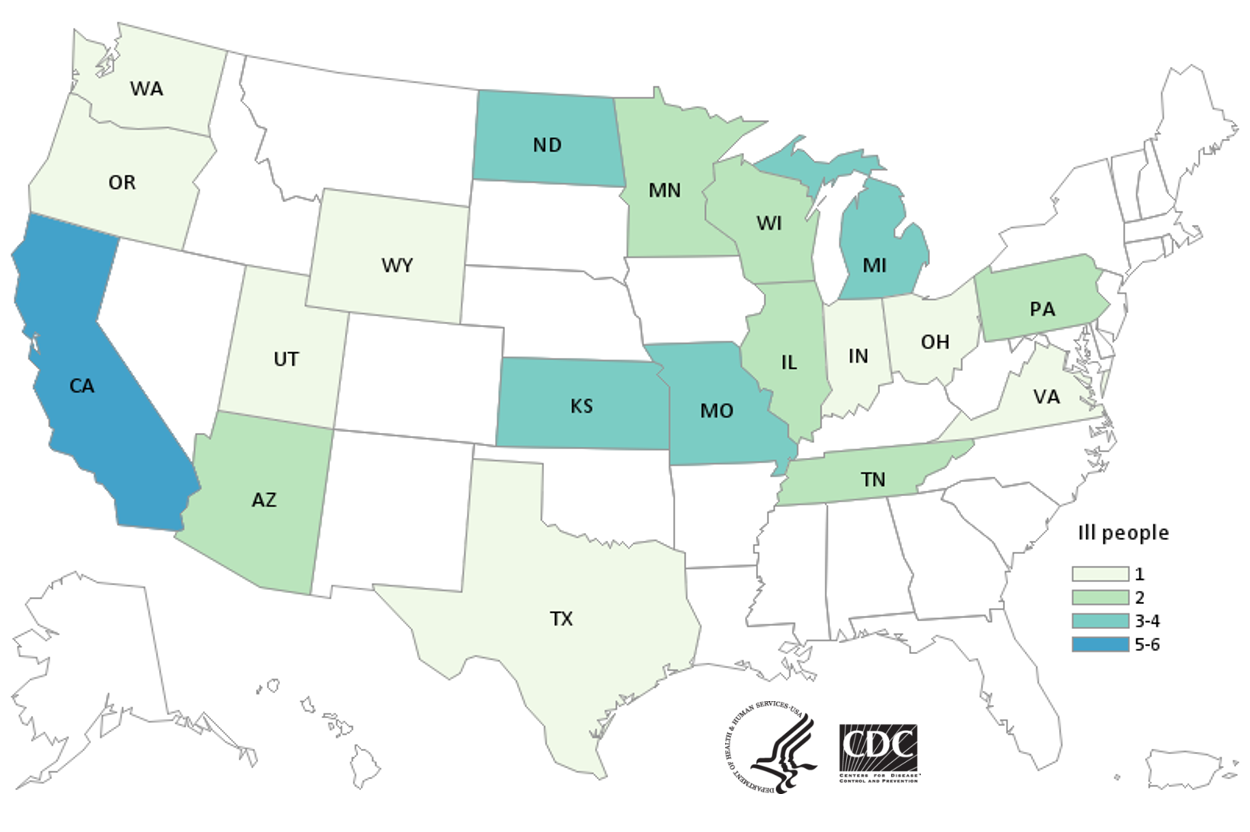
Case Count Map Provided by CDC

Outbreak Investigation of of E. coli in Leafy Greens (December 2020) - Case Count Map from CDC 12/22/2020

Case Counts

Total Illnesses: 40
Hospitalizations: 20 (4 Cases HUS)
Deaths: 0
Last Illness Onset Date: October 31, 2020
States with Cases: AZ (2), CA (6), IL (2), IN (1), KS (4), MI (3), MN (2), MO (3), ND (4), OH (1), OR (1), PA (2), TN (2), TX (1), UT (1), VA (1), WA (1), WI (2), WY (1)
*States with confirmed distribution; product could have been distributed further

Useful Links

USA – Outbreak Investigation of E. coli O157:H7: Unknown Food (Fall 2020)

FDA

The FDA and CDC, in collaboration with state and local partners, have completed the investigation on two of three multistate outbreak of E. coli O157:H7 infections in the U.S. this fall.

One of these investigations, Outbreak Unknown Source 3, identified 18 reported illnesses in nine states: California, Colorado, Illinois, Michigan, New York, Ohio, Pennsylvania, Virginia, Washington.

FDA completed a traceback investigation of several potential food vehicles identified in patient interviews and although no single farm was identified as a common source of the outbreak, FDA and state partners also conducted on-site investigations on farms of interest. However, information and samples collected in these inspections did not link these farms to the outbreak. The investigation of a farm does not mean that the farm is linked to an outbreak. The results of an investigation into a farm may well lead to that firm being ruled out of the investigation. On 12/18/2020, the CDC announced that this outbreak had ended.

The other completed outbreak investigation, Outbreak Unknown Source 1, identified 32 reported illnesses in 12 states: California, Illinois, Louisiana, Maryland, Michigan, Montana, New Jersey, Ohio, Utah, Virginia, Washington, Wisconsin. This strain of E. coli is genetically similar to a strain linked to a romaine outbreak that occurred in the spring of 2018, though a food was not linked to the current outbreak. FDA completed a traceback investigation and was unable to determine a common source of the outbreak. FDA and state partners also conducted on-site inspections on farms of interest, though information collected in these inspections did not link these farms to the outbreak. On 12/18/2020, the CDC announced that this outbreak had ended.

Investigations of a third E. coli outbreak of Unknown Source 2 continue.

Recommendation

Consumers, restaurants, and retailers, were advised not to eat, sell, or serve recalled Tanimura & Antle, Inc. brand packaged single head romaine lettuce with a pack date of 10/15/2020 or 10/16/2020.

The recalled products are now well beyond expiration and likely no longer on the market or in consumers’ homes.

USA – Cannibal Sandwiches: Wisconsin officials advise against this holiday tradition.

Outbreak News Today

The Wisconsin Department of Health Services (DHS) reminded the public to abstain from the state holiday tradition– eating raw meat sandwiches, sometimes called Tiger Meat or Cannibal Sandwiches.

What is a cannibal sandwich?

A cannibal sandwich or Tiger meat sandwich is by definition, raw ground beef typically served on rye bread or crackers with onions. Occasionally, a raw egg will be mixed with the meat. It is a traditional winter holiday specialty in certain regions of the upper Midwest.

Health officials say there are foodborne illness risks with eating raw meat like ground beef like SalmonellaE. coli O157:H7, Campylobacter and Listeria and it doesn’t matter where you buy the meat.

Since 1986, eight outbreaks have been reported in Wisconsin linked to eating a raw ground beef dish, including a large Salmonella outbreak involving more than 150 people during December 1994. Ground beef should ALWAYS be cooked to an internal temperature of 160° F.