Category Archives: E.coli O121

Research – Evaluation of the use of ampicillin- and streptomycin-resistant Shiga toxin-producing Escherichia coli to reduce the burden of background microbiota during food safety studies

Wiley Online

Tracking artificially seeded foodborne pathogens in foods with high background microbiota is challenging. Wheat flour and its subsidiary products are known to carry a high native microbial load, which could interfere with tracking and enumeration of target organisms in such matrices. Shiga toxin-producing Escherichia coli (STEC) serogroups O26, O121, and O157:H7 were transformed with the pGFPuv plasmid encoding ampicillin resistance (+Amp) and green fluorescent protein and were additionally conferred resistance to streptomycin (+Amp + Strep) through exposure to incremental concentrations of the antibiotic. Growth characteristics of these antibiotic-resistant strains were compared to those of the nonresistant native strains (NR). The supplementation of ampicillin and ampicillin + streptomycin in growth media was evaluated for its ability to suppress growth of the native microbial load of three different commercial cake mixes. Antibiotic supplementation in growth media was successful in suppressing the native microbiota of the cake mixes, while the growth characteristics of the +Amp + Strep variants of the three STEC strains did not differ significantly from the NR strains (p > .05). These results indicate that STEC strains with ampicillin and streptomycin resistance markers have improved trackability over their wild-type counterparts when isolated from food matrices with high background microbiota. These strains would be advantageous for use in laboratory experiments on STEC survival in wheat and wheat derived products as their detection and enumeration can occur without interference from native microbial load.

USA- FDA Core Investigation Table Updates

FDA

Cyclospora Increase

Research – Fate of Salmonella and Enterohemorrhagic Escherichia coli on Wheat Grain

Journal of Food Protection

Wheat flour has been connected to outbreaks of foodborne illnesses with increased frequency in recent years, specifically, outbreaks involving Salmonella enterica and enterohemorrhagic Escherichia coli (EHEC). However, there is little information regarding the survival of these pathogens on wheat grain during long-term storage in a low-moisture environment. This study aims to evaluate the long-term survival of these enteric pathogens on wheat grain over the course of a year. Hard red spring wheat was inoculated with strains of four serovars of Salmonella enterica (Enteritidis , Agona, Tennessee, and Montevideo) and six serotypes of EHEC (O157:H7, O26:H11, O121:H19, O45:NM, O111:H8, and O103:H2) in triplicate, sealed in Mylar bags to maintain the water activity, and stored at room temperature (22 ± 1°C). The survival of each pathogen was evaluated by plating onto differential media . Viable counts of strains from all four serovars of Salmonella (Enteritidis , Agona, Tennessee, and Montevideo) were detected on wheat grain stored at room temperature (22 ± 1°C) for the duration of the study (52 weeks). Viable counts of strains from EHEC serotypes O45:NM, O111:H8, and O26:H11 were only detected for 44 weeks and strains from serotypes O157:H7, O121:H19, and O103:H2 were only detected for 40 weeks until they passed below the limit of detection (2.0 log CFU/g). D -values were found to be significantly different between Salmonella and EHEC (adj. p ≤ 0.05) with Salmonella D -values ranging from 22.9 ± 2.2 to 25.2 ± 1.0 weeks and EHEC D -values ranging from 11.4 ± 0.6 to 13.1 ± 1.8 weeks. There were no significant differences amongst the four Salmonella strains or amongst the six EHEC strains (adj. p > 0.05). These observations highlight the wide range of survival capabilities of enteric pathogens in a low-moisture environment and confirm these pathogens are a food safety concern when considering the long shelf life of wheat grain and its products.

USA – Core Table Update

FDA

USA – Core Outbreak Table – Three New Investigations

FDA

There are three new foodborne disease outbreak investigations involving Cyclospora (32 cases), E. coli O121 (15 cases) and Salmonella Typhimurium (8 cases). There are no further details that  have been released, and CDC has not yet posted any information on its website.


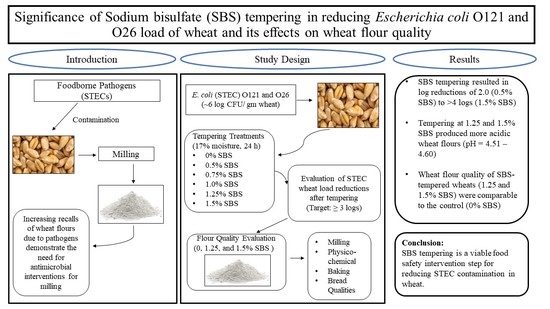
Research – Significance of Sodium Bisulfate (SBS) Tempering in Reducing the Escherichia coli O121 and O26 Load of Wheat and Its Effects on Wheat Flour Quality

MDPI

The occurrence of recalls involving pathogenic Escherichia coli-contaminated wheat flours show the need for incorporating antimicrobial interventions in wheat milling. The objectives of this study were to assess the efficacy of sodium bisulfate (SBS) tempering in reducing E. coli O121 (ATCC 2219) and O26 (ATCC 2196) wheat load and to evaluate the impact of effective (≥3.0 log reductions) SBS treatments on wheat flour quality. Wheat grains were inoculated with E. coli (~6 log CFU/g) and tempered (17% moisture, 24 h) using the following SBS concentrations (%wheat basis): 0, 0.5, 0.75, 1.0, 1.25, and 1.5% SBS. Reductions in E. coli O121 and O26 wheat load at different time intervals (0.5, 2, 6, 12, 18, and 24 h) during tempering were evaluated. The addition of SBS during tempering resulted in E. coli (O121 and O26) log reductions of 2.0 (0.5% SBS) to >4.0 logs (1.5% SBS) (p ≤ 0.05). SBS tempering (1.25 and 1.5% SBS) produced acidic wheat flours (pH = 4.51–4.60) but had comparable wheat flour properties in terms of composition, dough, and bread-making properties relative to the control (0% SBS). SBS tempering reduced the E. coli O121 and O26 load of wheat after tempering with minimal effects on wheat flour quality. View Full-Text

Research – Investigation of On-Farm Transmission Routes for Contamination of Dairy Cows with Top 7 Escherichia coli O-Serogroups

Springer

Shiga toxin-producing Escherichia coli (STEC) are foodborne bacterial pathogens, with cattle a significant reservoir for human infection. This study evaluated environmental reservoirs, intermediate hosts and key pathways that could drive the presence of Top 7 STEC (O157:H7, O26, O45, O103, O111, O121 and O145) on pasture-based dairy herds, using molecular and culture-based methods. A total of 235 composite environmental samples (including soil, bedding, pasture, stock drinking water, bird droppings and flies and faecal samples of dairy animals) were collected from two dairy farms, with four sampling events on each farm. Molecular detection revealed O26, O45, O103 and O121 as the most common O-serogroups, with the greatest occurrence in dairy animal faeces (> 91%), environments freshly contaminated with faeces (> 73%) and birds and flies (> 71%). STEC (79 isolates) were a minor population within the target O-serogroups in all sample types but were widespread in the farm environment in the summer samplings. Phylogenetic analysis of whole genome sequence data targeting single nucleotide polymorphisms revealed the presence of several clonal strains on a farm; a single STEC clonal strain could be found in several sample types concurrently, indicating the existence of more than one possible route for transmission to dairy animals and a high rate of transmission of STEC between dairy animals and wildlife. Overall, the findings improved the understanding of the ecology of the Top 7 STEC in open farm environments, which is required to develop on-farm intervention strategies controlling these zoonoses.

Research – Escherichia coli in flour – sources, risks and prevention

Click to access escherichia-coli-in-flour-sources-risks-and-prevention.pdf

Investigation – Foodborne outbreak in British Columbia related to raw milk Gouda-like products, 2018

Gov

Abstract

Background: In 2018, a Shiga toxin-producing Escherichia coli O121 outbreak that affected seven individuals was associated with raw milk Gouda-like cheese produced in British Columbia, Canada.

Objectives: To describe the Ecoli O121 outbreak investigation and recommend greater control measures for raw milk Gouda-like cheese.

Methods: Cases of Ecoli O121 were identified through laboratory testing results and epidemiologic surveillance data. The cases were interviewed on exposures of interest, which were analyzed against Foodbook Report values for British Columbia. Environmental inspection of the dairy plant and the cheese products was conducted to ascertain a source of contamination. Whole genome multi-locus sequence typing (wgMLST) was performed on all positive Ecoli O121 clinical and food isolates at the provincial laboratory.

Results: Four out of the seven cases consumed the same raw milk Gouda-like cheese between August and October 2018. The implicated cheese was aged longer than the required minimum of 60 days, and no production deficiencies were noted. One sample of the implicated cheese tested positive for Ecoli O121. The seven clinical isolates and one cheese isolate matched by wgMLST within 6.5 alleles.

Conclusion: Raw milk Gouda and Gouda-like cheese has been implicated in three previous Shiga toxin-producing E. coli outbreaks in North America. It was recommended product labelling to increase consumer awareness and thermization of milk to decrease the risk of illness associated with raw milk Gouda and Gouda-like cheese.

Introduction

Shiga toxin-producing Escherichia coli (STEC) is a major cause of foodborne illness in North America. STEC infections cause diarrheal illness and may lead to severe complications, such as hemolytic uremic syndrome, and death. The incidence rate of O157 STEC illness has been decreasing, whereas the rate of non-O157 STEC, including O121, has been increasing in many countries, likely due to changes in laboratory methods of detection. Outbreaks of STECO121 have been associated with raw flour, fresh or frozen produce, dairy and beef products 

The risk of STEC due to unpasteurized dairy products has been previously described . Between 2002 and 2013, three Ecoli O157 outbreaks associated with raw milk Gouda cheeses aged for at least 60 days were reported in North America, including one associated with a British Columbia (BC) dairy plant. Following each outbreak, public health professionals recommended strengthening control measures to decrease the risk associated with raw milk Gouda cheeses . None of these changes had been implemented in Canada by 2018.

In November 2018, another STEC outbreak associated with a raw milk Gouda-like cheese occurred in BC (population: 5.1 million).

The objective of this article is to describe the outbreak investigation and findings and reiterate the need for greater control measures related to raw milk Gouda-like cheese.

Research – Microbiological Survey of Wheat Flour Sold at Retail in Canada, 2018-2019

Journal of Food Protection

Following two O121 STEC outbreaks linked to wheat flour, this study was conducted to gain baseline information on the occurrence of bacterial pathogens and levels of indicator organisms in wheat flour in Canada. A total of 347 pre-packaged wheat flour samples were analyzed for Salmonella spp., Shiga Toxin-Producing Escherichia coli (STEC), Listeria monocytogenes ( L. monocytogenes ) , aerobic colony count (ACC), total coliforms, and generic Escherichia coli ( E. coli ) . Salmonella spp. and O157 STEC were not detected in any of the samples. L. monocytogenes was identified in two samples (0.6%) at levels below the limit of detection (<0.7 log CFU/g). Non-O157 STEC were isolated from six samples (1.7%) and were characterized for the presence of STEC virulence genes: stx 1, stx 2 and subtypes, eae , hlyA, and aggR . One O103:H25 STEC isolate carried virulence genes ( stx 1 a + eae ) that are known to be capable of causing diarrhea and/or bloody diarrhea in humans. Of the five remaining non-O157 STEC isolates, four carried single stx 2a or stx 2c genes and were considered to have the potential of causing diarrhea. The remaining non-O157 STEC isolate ( stx 2 ), while not a priority non-O157 STEC was not available for sequencing and thus its potential to cause illness is unknown. ACC, total coliforms, and generic E. coli were detected   in 98.8%, 72.6% and 0.6% of the flour samples. The mean counts of ACC were greater in whole-wheat flour as compared to the other flour types tested ( p <0.001). The results of this study suggest that the occurrence of O157 STEC and Salmonella  is low, but the occurrence of non-O157 STEC in wheat flour with the potential to cause human illness of diarrhea is relatively common. Therefore, the consumption of raw flour could increase the likelihood of STEC infections. Further research is merited for potential risk mitigation strategies within the food production system and with consumers.