Category Archives: Campylobacter

Research – Campylobacter jejuni in Poultry: Pathogenesis and Control Strategies

MDPI

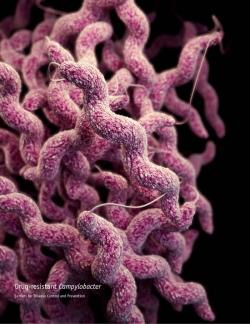
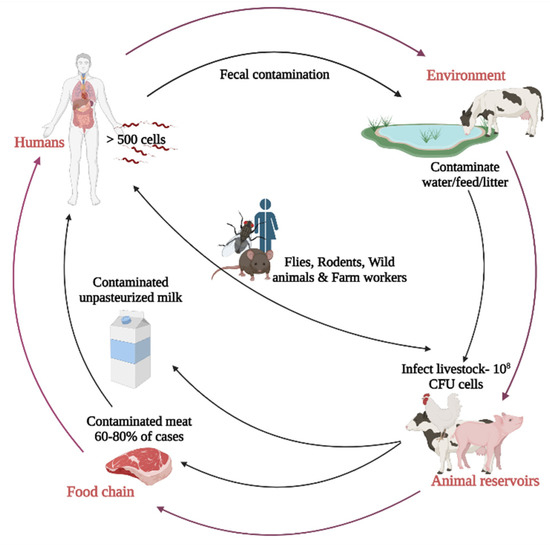
C. jejuni is the leading cause of human foodborne illness associated with poultry, beef, and pork consumption. C. jejuni is highly prevalent in commercial poultry farms, where horizontal transmission from the environment is considered to be the primary source of C. jejuni. As an enteric pathogen, C. jejuni expresses virulence factors regulated by a two-component system that mediates C. jejuni’s ability to survive in the host. C. jejuni survives and reproduces in the avian intestinal mucus. The avian intestinal mucus is highly sulfated and sialylated compared with the human mucus modulating C. jejuni pathogenicity into a near commensal bacteria in poultry. Birds are usually infected from two to four weeks of age and remain colonized until they reach market age. A small dose of C. jejuni (around 35 CFU/mL) is sufficient for successful bird colonization. In the U.S., where chickens are raised under antibiotic-free environments, additional strategies are required to reduce C. jejuni prevalence on broilers farms. Strict biosecurity measures can decrease C. jejuni prevalence by more than 50% in broilers at market age. Vaccination and probiotics, prebiotics, synbiotics, organic acids, bacteriophages, bacteriocins, and quorum sensing inhibitors supplementation can improve gut health and competitively exclude C. jejuni load in broilers. Most of the mentioned strategies showed promising results; however, they are not fully implemented in poultry production. Current knowledge on C. jejuni’s morphology, source of transmission, pathogenesis in poultry, and available preharvest strategies to decrease C. jejuni colonization in broilers are addressed in this review

USA – Health Department Probing Possible Foodborne Illness Outbreak In Brooklyn

Patch

Campylobacter kswfoodworld

City health officials are investigating a potential outbreak of campylobacter, a bacterial infection that causes flu-like stomach symptoms.

City health officials are investigating a potential outbreak in Brooklyn of campylobacter, a bacterial infection that causes flu-like stomach symptoms.

Campylobacter is a gastrointestinal bug that can come from eating raw or undercooked poultry or something that comes in contact with it, according to the Centers for Disease Control and Prevention. People can also get it from contact with animals that carry the bacteria and by drinking contaminated water.

In Brooklyn, health officials said approximately 50 cases have been reported in the borough since the start of the month. A spokesperson for the city’s Department of Health and Mental Hygiene (DOHMH) declined to detail which neighborhoods have seen the spike.

USA – CDFA ANNOUNCES RECALL OF RAW GOAT MILK PRODUCED AT VALLEY MILK SIMPLY BOTTLED OF STANISLAUS COUNTY

CDFA

SACRAMENTO, October 21, 2022 – Raw goat milk produced and packaged by Valley Milk Simply Bottled of Stanislaus County is the subject of a statewide recall and quarantine order announced by California State Veterinarian Dr. Annette Jones.  The quarantine order came following the confirmed detection of the bacteria Campylobacter jejuni in the farm’s packaged raw whole goat milk sampled and tested by the California Department of Food and Agriculture.

The order applies to “Valley Milk Simply Bottled Raw Goat Milk” and “DESI MILK Raw Goat Milk” distributed in half-gallon (64 oz) plastic jugs with a code date marked on the container of OCT 21 2022 through OCT 31 2022.

Consumers are strongly urged to dispose of any product remaining in their refrigerators, and retailers are to pull the product immediately from their shelves. The current order does not include the farm’s raw cow milk.

CDFA found the campylobacter bacteria in a routine sample collected at the Valley Milk Simply Bottled production and packaging facility.  No illnesses have been reported.

Symptoms of campylobacteriosis include diarrhea, abdominal cramps, and fever.  Most people with camplylobacteriosis recover completely.  Illness usually occurs 2 to 5 days after exposure to campylobacter and lasts about a week.  The illness is usually mild and some people with campylobacteriosis have no symptoms at all.  However, in some persons with compromised immune systems, it can cause a serious, life-threatening infection.  A small percentage of people may have joint pain and swelling after infection.  In addition, a rare disease called Guillian-Barre syndrome that causes weakness and paralysis can occur several weeks after the initial illness.

Research – Quantitative Determination Of Campylobacter On Broilers Along 22 UK Processing Lines, To Identify Potential Process Control Points and Cross-contamination From Colonized To Uncolonized Flocks

Journal of Food Protection

As part of a program to reduce numbers of the human pathogen Campylobacter on retail chickens twenty-two broiler processing lines, representing over 90% of United Kingdom (UK) production, were characterized by enumerating Campylobacter on pooled neck skins after the exsanguination, scalding, defeathering, evisceration, crop removal, inside-outside washing, and air-chilling stages of processing.  Sixteen of the processing lines investigated showed significant (p<0.05) reductions in Campylobacter numbers because of carcass scalding.  However, in all these lines, the following defeathering stage caused a significant increase in Campylobacter contamination that effectively negated the reductions caused by scalding.  On four processing lines, primary chilling also caused a significant reduction in numbers of Campylobacter.  On three lines, there was a significant microbiological benefit from inside-outside (I/O) washing.  The stages where Campylobacter numbers were reduced require further investigations to determine the specific mechanisms responsible so that the observed pathogen reductions can be optimized, and more widely implemented. The transfer of up to 4 log cfu Campylobacter per gram of neck skin from a colonized flock to a following uncolonized flock was observed.  The cross contamination was substantial and still detectable after 5,000 carcasses from an uncolonized flock had been processed.  The numbers of Campylobacter recovered from the uncolonized flocks were highest on the first of the uncolonized birds to pass along the line and, in general, numbers fell as more uncolonized birds were processed.  Air sampling recovered low numbers at the processing stages monitored, indicating that airborne transmission was unlikely to be the primary transfer mechanism operating for cross-contamination between flocks.

Research -The annual cost of foodborne illness in Australia

FSANZ

Executive summary
Foodborne illness causes a significant health burden in Australia. Estimates of both the extent of foodborne illness and the costs arising from illness are essential for measuring the impact on the population.
In 2010 it was estimated that Australians experience almost 16million episodes of gastroenteritis each year, with about one quarter of these due to contaminated food. This report updates these numbers to circa 2019 and estimates the associated costs to individuals and the health system. As foodborne disease interventions are often targeted at specific causes of illness, costs are also provided for ten high-priority pathogens.
We estimate that foodborne illness and its sequelae costs Australia AUD 2.44billion each year. The largest component of this cost is lost productivity due to non-fatal illness, followed by premature mortality and direct costs (including hospitalisations and other health care use).
While costs due to lost productivity are lower under the more conservative friction cost model, it remains the largest component cost for foodborne illness due to all causes. The pathogen with the highest individual cost is Campylobacter (AUD 365millionper year), while norovirus, other pathogenic E. coli, and Salmonella are all estimated to cost Australians over AUD 100 million each year. Lost productivity is the largest component cost for most pathogens, although premature mortality is the largest cost for pathogens that typically cause more severe illness, such as Listeria monocytogenes, Shiga toxin-producing Escherichia Coli, and Salmonella.
Significant advances in this report include the incorporation of estimated willingness to pay to avoid pain and suffering based on a discrete choice experiment from another FSANZ commissioned study, and the use of a simulation approach to estimating costs which provides uncertainty intervals on all estimates. A costing tool is provided with this report to allow estimates to be updated in the future.
Costs associated with surveillance for foodborne pathogens and related to outbreak investigations are considered separately to the model. Likewise, industry costs due to outbreaks such as lost sales, disposal of products, recall costs, enforcement related costs and potential business costs are not included in the costing model. Key limitations in this work include the lack of data on the long-term burden and health care usage associated with sequelae or ongoing illness due to toxoplasmosis and listeriosis. These costs are not included in this report due to unavailability of data. Costs of pain and suffering, which we approximate using willingness to pay to avoid pain and suffering, are relatively low compared to those estimated for other countries, which may represent differences in underlying preferences across countries and could suggest that greater international standardisation of methods and data collection may be required.

This report demonstrates that foodborne illness results in a substantial cost to Australia and that interventions to improve food safety across industry, retail, and consumers are needed to improve public health. Pathogen-specific costing estimates allow policy makers to target such interventions at individual pathogens, with the end goal of reducing the burden due to foodborne illness.

USA – CDFA ANNOUNCES RECALL OF RAW SHEEP MILK PRODUCED AT VALLEY MILK SIMPLY BOTTLED OF STANISLAUS COUNTY- Campylobacter

CDFA

campy2

SACRAMENTO, September 27, 2022 – Raw sheep milk produced and packaged by Valley Milk Simply Bottled of Stanislaus County is the subject of a statewide recall and quarantine order announced by California State Veterinarian Dr. Annette Jones.  The quarantine order came following the confirmed detection of the bacteria Campylobacter jejuni in the farm’s packaged raw whole sheep milk sampled and tested by the California Department of Food and Agriculture.

The raw sheep milk is distributed in half-gallon (64 oz) plastic jugs and labeled as “Valley Milk Simply Bottled Raw Sheep Milk”. The recall order applies to products marked on the container with expiration code dates of SEP 28 2022 through OCT 01 2022.

Consumers are strongly urged to dispose of any product remaining in their refrigerators.  The current order does not include the farm’s raw cow milk or raw goat milk.

CDFA found the campylobacter bacteria in a routine sample collected at the Valley Milk Simply Bottled production and packaging facility.  No illnesses have been reported.

UK – AMR in Campylobacter in UK chicken over the last 20 years

FSA

Campylobacter kswfoodworld

The Food Standards Agency (FSA) has published a report analysing 20 years of data on antimicrobial resistance (AMR) in Campylobacter from retail chicken in the UK.

The study aimed to assess any trends during this 20-year period and provides a baseline against which to evaluate future, hoped-for reductions in AMR.

AMR is when bacteria adapt to become resistant to the killing effects of antimicrobials, such as antibiotics. This resistance subsequently makes such infections in humans more difficult to treat using drugs.  AMR can develop in any bacteria, including Campylobacter. Campylobacter is the main cause of bacterial food poisoning in the developed world and it is estimated that there are in excess of half a million cases annually in the UK.

The FSA’s Science lead in Microbiological Risk Assessment, Dr Paul Cook, said:

“While the data shows a marked increase in AMR in Campylobacter to certain antimicrobials, it is encouraging that there has been no significant increase in resistance since 2014.

“Any increase of AMR in Campylobacter is a concern and continued surveillance is essential. We will continue to carry out AMR surveillance in chicken and other meats and to monitor any long-term trends in resistance, while promoting good food hygiene practice to reduce exposure to AMR bacteria and protect consumer safety.”

Since its formation in 2000, the FSA has commissioned several UK-wide retail surveys and sampling studies that involved testing for Campylobacter in chicken. A significant proportion of the Campylobacter isolates detected were further tested to assess resistance to a range of antimicrobials.

Key findings from this report vary between the five main types of antimicrobial drugs included in the study. Resistance to quinolones (ciprofloxacin and nalidixic acid) and tetracycline was common in the most prevalent types of Campylobacter from chicken (Campylobacter jejuni and Campylobacter coli). In comparison, resistance to erythromycin and streptomycin was much rarer in the Campylobacter isolates examined.  Gentamicin resistance was very rare.

There are effective ways for consumers to reduce exposure to AMR bacteria. This includes cleaning surfaces properly, cooking food thoroughly, chilling food at the correct temperature and handling food hygienically so it doesn’t cross contaminate other foods or surfaces. For any fruit or vegetables consumed raw, make sure they are washed thoroughly or peeled as this will help to remove any visible dirt or bacterial contamination.

For more information on AMR, including an ‘FSA Explains’ video, visit our dedicated AMR webpage. The research report is available on our research pages.

What Are Common Food Poisoning Pathogen Incubation Periods?

Food Safety Gov

Check out the fact sheets at the link above.

Bacteria and Viruses

Bacteria and viruses are the most common cause of food poisoning. The symptoms and severity of food poisoning vary, depending on which bacteria or virus has contaminated the food.

To prevent illness, always follow the food safety steps: cleanseparatecook, and chill. Other prevention tips for specific bacteria and viruses are included below.

The bacteria and viruses that cause the most illnesses, hospitalizations, or deaths in the United States are described below and include:

Other important bacteria and viruses that cause foodborne illness include:

Research – Pulsed Light Application for Campylobacter Control on Poultry Meat and Its Effect on Colour and Volatile Profile

MDPI

Campylobacter on poultry meat needs to be controlled to reduce the risk of infection caused by the consumption of chicken meat. Pulsed light (PL) application on poultry meat was studied to control Campylobacter spp. The effect of this technology was evaluated regarding poultry meat colour and volatile compound changes. Two breast sample groups were prepared: inoculated with Campylobacter (107 bacteria of Campylobacter jejuni strains) and not inoculated. Samples were submitted to PL, five pulses/s of 300 ms, 1 Hz, and 1 J/cm2 in the apparatus, PL Tecum unit (Claranor). A response surface experimental design was applied regarding the factors of voltage (1828 to 3000 W) and distance to the source UV lamp (2.6 to 5.4 cm). The binomial factorial treatment (voltage and distance) with PL induced different energy doses (fluence J/cm2) received by samples, 2.82 to 9.67 J/cm2. Poultry meat pulsed light treated had a significant decrease of Enterobacteriaceae counts. The treatments applied were unable to reduce 1 log Campylobacter cfu/g of poultry meat. The poultry meat PL treated became slightly light, redder, and yellower than those not treated. PL can decrease the proportion of aldehydes on total volatiles in meat, particularly on those associated with chicken-like, chicken skin-like, and sweet odour notes in fresh poultry meat. Further studies of PL with higher energy doses will be necessary to confirm if there are Campylobacter reductions and about poultry meat treated under storage to evaluate if volatile compounds can affect the flavour of PL-treated meat samples. View Full-Text

RASFF Alert – Campylobacter – Chicken

RASFF

Campylobacter in chicken from Hungary in Austria