
Monthly Archives: May 2021

RASFF Alert- Listeria monocytogenes – Raw Milk Goats Cheese

RASFF

Listeria monocytogenes in raw milk goat cheese from France in Belgium


list

RASFF Alerts – Foodborne outbreak -Salmonella Dublin in chilled raw milk cheese

RASFF

Foodborne outbreak suspected to be caused by Salmonella Dublin in chilled raw milk cheese from France

RASFF Alerts – Salmonella – Polish Chicken and Turkey – Sesame Seeds – BBQ Pork Ribs – Shatavari Powder – Frozen Blanched Shrimps

RASFF

Salmonella spp. in chilled chicken meat from Poland in Germany and the UK

RASFF

Salmonella enterica ser. Enteritidis in frozen chicken elements from Poland in Belgium, France, Hungary, Latvia, Lithuania, UK, Netherlands, Slovakia and Poland

RASFF

Salmonella spp. in sesame from Nigeria in Germany

RASFF

Salmonella spp. in chilled chicken meat from Poland in Poland, Germany , Netherlands and UK

RASFF

Salmonella Enteritidis in chicken in Germany and Poland

RASFF

Salmonella spp. in fresh chicken broiler meat thighs meat, boneless, skinless from Poland in Lithuania

RASFF

Salmonella spp. in fresh chicken broiler drumsticks from Poland in Lithuania

RASFF

Salmonella spp. in chilled marinated in BBQ sauce pork ribs from Poland in Lithuania

RASFF

Salmonella in frozen chicken meat preparations from Belgium in the Netherlands

RASFF

Salmonella O:4 (B) in turkey meat from Poland in the UK

RASFF

Salmonella Enteritidis detected in chicken neck skins, chickens originating from Hungary, slaughtered in Poland” in Poland

RASFF

Carcasses and poultry cuts salmonella enteritidis from Poland in the UK, Ireland and Netherlands

RASFF

Salmonella spp. in organic shatavari powder from India in Austria, Finland, Germany, Italy , Netherlands, Poland, Portugal. Slovenia, Spain, Switzerland and the UK

RASFF

Salmonella Enteritidis in chicken neck skins from Poland in Lithuania

RASFF

Salmonella in gambero indopacifico/salmonella in frozen blanched shrimps (Parapenaeopsis stylifera) from India in Italy

RASFF

Salmonella Enteritidis in chilled chicken elements from Poland in Romania, Ukraine and the UK

RASFF

Presence of Salmonella in hulled sesame seeds from Nigeria in Greece

RASFF

Presence of Salmonella in sesame seeds from Nigeria in Greece


RASFF Alerts – Animal Feed – Moulds -Sunflower Meal

RASFF

Mould in sunflower meal from Ukraine in Poland

RASFF

Mould in sunflower meal from Ukraine in Poland

RASFF Alerts – Animal Feed -Aflatoxin – Millet

RASFF

Aflatoxin B1 in panicum millet from India in Spain

RASFF

Aflatoxin B1 in millet from India in Spain, Cyprus and Malta

RASFF Alerts – Animal Feed – Salmonella – Feed Material – Rapeseed Cake

RASFF

Salmonella O:7 in feed material from the Ukraine in Poland

RASFF

Salmonella enterica ser. Agona (present /25g) in rapeseed cake from Belgium in France

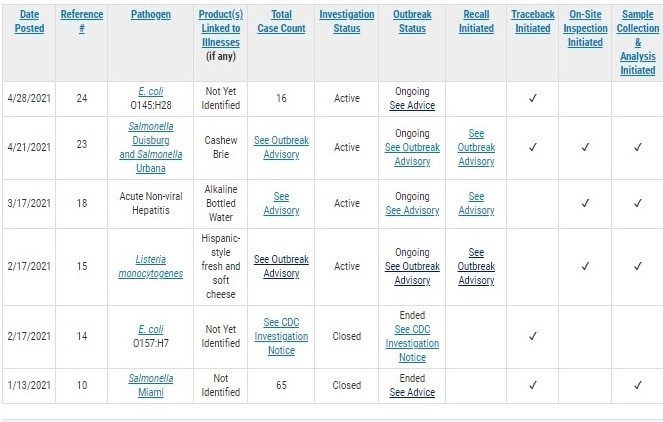
USA – FDA Core Investigation Table Update

FDA

0a

Research – Hepatitis A outbreak associated with consumption of dates, England and Wales, January 2021 to April 2021

Eurosurveillance

An outbreak of genetically related hepatitis A virus (HAV) infections among people with no travel history was identified by the Public Health England (PHE) Virus Reference Department (VRD) in conjunction with local teams noting that the cases had eaten dates.

We describe investigations including case characteristics, phylogenetics, analytical studies, and control measures. We aim to flag the possible risk of hepatitis A to populations in other countries through the consumption of contaminated dates, particularly as Ramadan, which is associated with an increase in consumption of dates, began on 12 April 2021, and hepatitis A has a long incubation period of 15 to 50 days.

A confirmed case was defined as a laboratory-confirmed HAV infection with one of three clustered sequences (sequences VRD21_HAV005, VRD21_HAV009 and VRD21_HAV020) and onset date from 1 January 2021 in England or Wales, no travel history or contact with a suspected or confirmed HAV case in the 60 days before onset. A probable case was a laboratory-confirmed HAV infection, with no or pending sequencing result, and with an epidemiological link to a confirmed HAV case with one of the three clustered sequences.

Samples from all locally diagnosed HAV infections in England and Wales are routinely sent to the VRD for characterisation. The outbreak cases had HAV from three closely related Middle Eastern genotype IB sequences (≤ 2 bp different in a 505 bp segment) which clustered most closely with those found in travellers returning from Syria and Lebanon. The sequences have been submitted to the European Nucleotide Archive (ENA), accession numbers OD998295–OD998297.

New Zealand – Food Safety has taken precautionary action following the detection of Salmonella Enteritidis at an Auckland poultry farm.

MPI

kswfoodworld Salmonella

New Zealand Food Safety has taken precautionary action following the detection of Salmonella Enteritidis at an Auckland poultry farm.

This is a timely reminder to take the usual precautions around food safety at home, says director of food regulation Paul Dansted.

“There has been an increase in human cases caused by the same strain of salmonella found in our investigation, which we are tracking alongside the Ministry of Health.

“The cause of the human cases is still being investigated. However, to reduce the possibility of getting ill through food, we’d like to remind people to follow the 3Cs of food safety at home.

“In other words, clean food preparation surfaces, cook raw chicken meat to an internal temperature of 75°C, and chill cooked chicken meat in the fridge.

“Symptoms of Salmonella illness include abdominal cramps, diarrhoea, fever, headache, nausea and vomiting. It can be serious in people with reduced immunity, older people, children, and pregnant women.”

A New Zealand Food Safety audit and follow-up testing has found the bacterium at an Auckland supplier of hatching eggs and day-old chicks to industry.

“That facility has taken a number of steps to prevent further infection, including sanitising affected sheds, culling potentially affected chickens, and increased testing.

“These actions, as well as our tracing work, and wider industry testing, have prevented any contaminated eggs from reaching consumers.

“People’s safety is our number one priority here. Our testing and tracing work over the past few months has been focussed on ensuring the risk remains low, and to assist industry to eradicate the bacterium from commercial chicken flocks.”

Actions to date include:

  • Tracing product from the facility to 64 farms, which have all been tested. Two of these farms tested positive and have been required to hold product before it goes to market. The farms must take a number of actions before being allowed to continue trading. Results from a further 2 facilities are due in the next few days, and the remaining 60 farms returned negative tests.
  • Four facilities which earlier tested positive for the bacterium have already been sanitised and the affected flocks have been culled.
  • Significantly increased industry testing for Salmonella, above and beyond normal requirements, across the supply chain.

“For context, the Salmonella Enteritidis bacterium is present in the poultry industries of many countries and is managed by a variety of regulatory controls. However, it does occasionally cause outbreaks of food poisoning, and can be serious.

“We continue to monitor the situation with the Ministry of Health and are working closely with the poultry sector to ensure any risk is identified and dealt with.”

Salmonellosis can spread in a variety of ways outside of food, including contact with infected animals, material, or surfaces.

France – Product recall: Kerméné brand VPF barded pork muzzle – Listeria monocytogenes

Oulah

Product recall: Kerméné brand VPF barded pork muzzle

ENCOUNTERED PROBLEM

Presence of Listeria monocytogenes

PROPOSED SOLUTION

People who may have this product are asked not to consume it and to return it to the point of sale where it was purchased.

People who have consumed this product and who have a fever, isolated or accompanied by headaches, are invited to consult their doctor, notifying him of this consumption.
Pregnant women should pay special attention to these symptoms, as well as immunocompromised people and the elderly. These symptoms may suggest listeriosis, a disease that can be serious and can take up to eight weeks to incubate.

FURTHER INFORMATION


▸ Lot
11652420


▸ DLC – DDM
05/21/2021


▸ Start / end date of marketing
From 05/08/2021 to 05/12/2021


▸ Health mark
FR 22.364.008 CE


Lannion geographic sales area


▸ Distributors
Center E.LECLERC Perlandis


▸ Consumer service contact
0296480094


▸ Source
PERLANDIS Center Leclerc