Research – BSI – What is PAS 320 Developing and sustaining a mature food safety culture – Guide about?

BSI

When it comes to food safety, the common factor in many incidents and recalls is people. In response PAS 320:2023 gives organizations clear guidance on what a good food safety culture looks like.

Who is PAS 320 Developing and sustaining a mature food safety culture – Guide for?

Any organization of any size or purpose across the food chain, from primary production to final delivery to consumers. PAS 320:2023 might also be of use to:

  • Educational institutions
  • Trade associations
  • Coalitions of action
  • Professional bodies
  • Certification and accreditation bodies
  • Certification programme owners (CPOs) and regulatory bodies

What does PAS 320 Developing and sustaining a mature food safety culture – Guide cover?

PAS 320:2023 gives guidance on recognizing and maintaining a positive culture of food safety in any food organization, regardless of its size or focus.

It includes guidance on using a food safety culture maturity model against which organizations can assess their level of maturity to help foster cultural change that impacts on all functions and levels in a food organization. It covers the defined pre-requisites and taxonomy of organizational culture, with a food safety culture focus. Why should you use PAS 320 Developing and sustaining a mature food safety culture – Guide?

  • It provides practical guidance on recognizing and maintaining a positive safety culture in any food organization
  • It will drive best practices throughout the industry that can proactively mitigate food safety risks by embedding a safety culture in food organizations, top down and bottom up

It can help increase confidence in food organizations and strengthen their risk management.

PAS 320:2023 contributes to UN Sustainable Development Goal 2 on ending hunger, and achieving food security and sustainable agriculture, and Goal 3 on good health and well-being.


Ireland – Recall of a batch of Guastalla Green and Black Pitted Olives due to the presence of Listeria monocytogenes

FSAI

Thursday, 13 April 2023

Summary
Category 1: For Action
Alert Notification: 2023.08
Product: Guastalla Green and Black Pitted Olives; pack size: 100g; approval number: IE 4071 EC
Batch Code: Use by date: 25.04.2023
Country Of Origin: Ireland

Message:

Italicatessen is recalling the above batch of Guastalla Green and Black Pitted Olives due to the presence of Listeria monocytogenes.

Recall notices will be displayed at point-of-sale.

Nature Of Danger:

Symptoms of Listeria monocytogenes infection can include mild flu-like symptoms, or gastrointestinal symptoms such as nausea, vomiting and diarrhoea. In rare cases, the infection can be more severe, causing serious complications. Some people are more vulnerable to Listeria monocytogenes infections, including pregnant women, babies, and people with weakened immune systems, including the elderly. The incubation period (time between initial infection and first symptoms appearing) is on average 3 weeks but can range between 3 and 70 days.

Action Required:

Manufacturers, wholesalers, distributors, caterers & retailers:

Retailers are requested to remove the implicated batch from sale and display recall notices at point- of-sale.

Consumers:

Consumers are advised not to eat the implicated batch.

Guastalla Green and Black Pitted Olives

RASFF Alerts – Aflatoxin – Pistachios and Hazelnuts

RASFF

Aflatoxin in Pistachio from Turkey in Italy

RASFF

Aflatoxins in hazelnuts from Georgia in Germany and Bulgaria

RASFF Alert- Norovirus – French Oysters

RASFF

Norovirus in oysters from France in Belgium

RASFF Alert -STEC E.coli – Minced Meat

RASFF

STEC (stx+;eae+) in minced meat from Belgium in France and the Netherlands

RASFF Alert – Listeria monocytogenes – Cheese – Chorizo – Dairy Products

RASFF

Detection of Listeria monocytogenes on cheese from France in Belgium and Luxembourg

RASFF

Detection of listeria monocytogenes in chorizo from Spain in France

RASFF

Presence of listeria monocytogenes in dairy products from Italy in Malta, Slovenia, France

RASFF Alerts – Salmonella – Sesame Seeds – Polish Chicken – Chicken Sausages – Chicken Breast – Turkey Meat –

RASFF

Salmonella Enteritidis in cream cake from Slovenia in Austria

RASFF

Salmonella in chicken sausages from Belgium in the Netherlands

RASFF

Detection of Salmonella enteritidis on chicken legs from Poland in France

RASFF

Salmonella in frozen roasted chicken breast from Ukraine in France, Germany and Netherlands

RASFF

Salmonella Typhimurium in turkey meat from Poland  in  Belgium, Czech Republic, Denmark, Germany, Hungary, Romania, Slovakia, Sweden.

RASFF

Salmonella spp in sesame seeds from Nigeria in Greece and Switzerland

RASFF

Salmonella spp in sesame seeds from Nigeria in Greece and Switzerland

RASFF

Salmonella spp in sesame seeds from Nigeria in Greece and Switzerland

RASFF

Salmonella spp in sesame seeds from Nigeria in Greece

RASFF

Salmonella spp. in sesame seeds from Nigeria in Greece

RASFF Alerts – Animal Feed – Salmonella – Pet Food – Organic Sunflower Press Cake

RASFF

Salmonella in pet food from Netherlands in Belgium

RASFF

Salmonella spp. in organic sunflower press cake from Bulgaria in Germany

Research – Sanitizers to reduce Salmonella on and in turkey eggs evaluated

Feedstuffs

hazegg.jpg

USPOULTRY and the USPOULTRY Foundation have announced the completion of a funded research project at Cargill Inc., in which researchers evaluated egg wash sanitizers to reduce Salmonella contamination on and in turkey eggs. The research was made possible in part by an endowing Foundation gift from Cargill and proceeds from the International Poultry Expo, part of the International Production & Processing Expo (IPPE).

According to the research summary, Salmonella remains the number one cause of foodborne illness in the U.S., which causes an economic burden for the poultry industry as well as public concern for the consumers. As such, the poultry industry must be diligent during processing to reduce Salmonella risk, including interventions for hatch eggs.

Dr. Ted Brown and colleagues at Cargill, Inc. recently completed a research project that evaluated sanitizers with thymol, peracetic acid (PAA), bromine, peroxide, chlorine and quaternary ammonium. The peroxide product proved to be the most effective egg sanitizer at reducing Salmonella prevalence on the egg surface by more than 73%. None of the sanitizers tested in the trial caused damage to the cuticle, and Salmonella did not penetrate the egg.

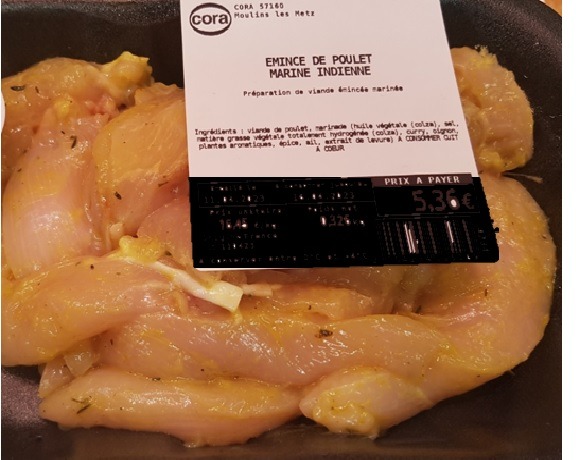
France – Indian marinated chicken mince – Salmonella

Gov france

Identification information of the recalled product

  • Product category Feed
  • Product subcategory Meats
  • Product brand name prepared by the store
  • Model names or references Indian marinated chicken mince
  • Identification of products
    GTIN Batch Date
    2054234000000 packed on 03/31/2023 Use-by date 05/04/2023
  • Packaging variable weight tray
  • Marketing start/end date From 31/03/2023 to 05/04/2023
  • Storage temperature Product to be stored in the refrigerator
  • Health mark/
  • Geographic area of ​​sale cora Moulins les Metz (57)
  • Distributor scora store Moulins les Metz

Practical information regarding the recall

  • Reason for recall presence of salmonella
  • Risks incurred by the consumer Salmonella spp (causative agent of salmonellosis)