RASFF Alerts – Salmonella – Polish Chicken Products – Black Pepper – Sesame Seeds – Deer Chunks – Pork Collar – Seasoned Poultry Meat- Chocolate Products

RASFF

Detection of Salmonella Infantis on chicken meat preparations from Spain in France

RASFF

Salmonella typhimurium in pork collar from Poland in Estonia

RASFF

Salmonella in chicken kebab meat from Poland in Austria

RASFF

Salmonella Infantis in chilled chicken breast fillets from Poland in the Czech Republic

RASFF

Salmonella spp in sesame seeds from Nigeria in Spain

RASFF

Salmonella spp. in sesame seeds from Nigeria in Spain

RASFF

Salmonella Mbandaka in chilled chicken legs from Poland in Bulgaria

RASFF

Salmonella spp. in black pepper from Brazil in Germany

RASFF

Salmonella spp. in black pepper from Brazil in Germany

RASFF

Salmonella spp. in seasoned poultry meat (raw material for chicken skewers kebab style seasoned with liquid seasoning) produced in Germany from Poland

RASFF

Salmonella in frozen deer chunks from Slovenia in Italy

RASFF

Salmonella spp. in black pepper from Brazil in Germany

RASFF

Salmonella spp. in black pepper from Brazil in Germany and the Netherlands

RASFF

Salmonella spp. in black pepper from Brazil in Germny

RASFF

Salmonella enteritidis in Chicken thigh boneless, skinless from Poland in Estonia

RASFF

Salmonella in chocolate products from Israel in Austria, France, Germany, Hungary, Italy, Netherlands, Poland, Romania, Spain, UK and USA

RASFF Alerts – Animal Feed – Rapeseed Meal – Dried Porcine Haemoglobin – Rice Husk – Rosemary Powder

RASFF

Salmonella Mbandaka in rapeseed meal from Poland in Lithuania

RASFF

Salmonella in dried porcine haemoglobin from the UK in Netherlands and Spain

RASFF

Salmonella Typhimurium in rice husk from Italy used as feed material in Spain

RASFF

Salmonella in Rosemary powder as feed additive from Tunisia in France and Norway

Canada – More organic poppy seeds recalled due to Salmonella

CFIA

Product
Certain organic poppy seeds
Issue
Food – Microbial Contamination – Salmonella
What to do
Do not consume the recalled product

Issue

Bulk Basket is recalling certain organic poppy seeds from the marketplace due to possible Salmonella contamination.

The recalled product has been sold at Bulk Basket, 401, 20th St. W., Saskatoon, Saskatchewan.

What you should do

  • If you think you became sick from consuming a recalled product, call your doctor
  • Check to see if you have the recalled product in your home
  • Do not consume the recalled product
  • Recalled products should be thrown out or returned to the location where they were purchased

Food contaminated with Salmonella may not look or smell spoiled but can still make you sick. Young children, pregnant women, the elderly and people with weakened immune systems may contract serious and sometimes deadly infections. Healthy people may experience short-term symptoms such as fever, headache, vomiting, nausea, abdominal cramps and diarrhea. Long-term complications may include severe arthritis.

France – RECALL / WITHDRAWAL Elite /Strauss Products – Salmonella

Gov france

Identification information of the recalled product

  • Product category Food
  • Product subcategory Sweet products
  • Product brand name ELITE / STRAUSS
  • Model names or references Log of milk chocolate 25g
  • Identification of products
    GTIN Batch
    0077245101755 All lots
  • Products ListCopy_of_Copy_of_elite_recall_product_list_280422.pdfEnclosed
  • Packaging25g bar
  • Marketing start/end date From 01/01/2022 to 04/29/2022
  • Storage temperature Product to be stored at room temperature
  • Further information Elite Chocolate
  • Geographic area of ​​sale Whole France
  • Distributors INTERMARCHE SUPERK AU GOOD TASTE FRANPRIX G20 EDEN CASH CARREFOUR KLOTCH BUTCHER YAGUEL ANDRE KACHER AUCHAN LEADER CASH
  • List of points of saleCopy_of_CLIENTS_VENTES_PRODUIT_FOUNISSEURS_ELITE_4_MOIS_2022__RAPPEL_280422.pdf

Practical information regarding the recall

  • Reason for recall suspected  salmonella
  • Risks incurred by the consumer Salmonella spp (causative agent of salmonellosis)

Research – Invasive listeriosis outbreaks and salmon products: a genomic, epidemiological study

Tandfonline

Invasive listeriosis, caused by Listeria (L.) monocytogenes, is a severe foodborne infection, especially for immunocompromised individuals. The aim of our investigation was the identification and analysis of listeriosis outbreaks in Germany with smoked and graved salmon products as the most likely source of infection using whole-genome sequencing (WGS) and patient interviews.

In a national surveillance program, WGS was used for subtyping and core genome multi locus sequence typing (cgMLST) for cluster detection of L. monocytogenes isolates from listeriosis cases as well as food and environmental samples in Germany. Patient interviews were conducted to complement the molecular typing.

We identified 22 independent listeriosis outbreaks occurring between 2010 and 2021 that were most likely associated with the consumption of smoked and graved salmon products. In Germany, 228 cases were identified, of 50 deaths reported (22%) 17 were confirmed to have died from listeriosis. Many of these 22 outbreaks were cross-border outbreaks with further cases in other countries.

This report shows that smoked and graved salmon products contaminated with L. monocytogenes pose a serious risk for listeriosis infection in Germany. Interdisciplinary efforts including WGS and epidemiological investigations were essential to identifying the source of infection. Uncooked salmon products are high risk foods frequently contaminated with L. monocytogenes. In order to minimise the risk of infection for consumers, food producers need to improve hygiene measures and reduce the entry of pathogens into food processing. Furthermore, susceptible individuals should be better informed of the risk of acquiring listeriosis from consuming smoked and graved salmon products’.

Research – Will climate change increase the risk of aflatoxin in U.S. corn?

Science Daily

As climate change continues to alter weather patterns around the planet including the Midwest, researchers at Michigan State University are modeling the impact on crops such as corn.

“The United States is the largest exporter and donor of field corn around the world,” said Felicia Wu, a John A. Hannah Distinguished Professor and an international expert on food safety in the Department of Food Science and Human Nutrition and the Department of Agricultural, Food, and Resource Economics in the College of Agriculture and Natural Resources at MSU. “Here in the U.S., we consume field corn in the form of corn chips, corn flakes, corn grits and corn tortillas; as opposed to sweet corn, which is frozen, canned and eaten off the cob. Field corn is also used for animal feed and for ethanol production.”

The fungi Aspergillus flavus and Aspergillus parasiticus produce aflatoxin which can infect peanuts, tree nuts and corn. Aflatoxin not only degrades corn quality but can also cause health problems for humans and animals depending on the amount and length of time it is ingested. While aflatoxin contamination occurs annually in the southern United States because of the hot and dry climate, it has rarely been a serious problem in the Corn Belt region of the U.S.

“When we ran our near-term climate model scenarios, we found that between 2031-2040, aflatoxin is going to become more of a problem in the U.S. Corn Belt in the Midwest,” Wu said. “The last time there was a serious problem was in 2012 when we had an unusually hot and dry summer throughout the Midwest; particularly Iowa, Illinois and Indiana.”

Wu’s research was published April 5, 2022 in the journal Environmental Research Letters. Co-authors on the paper include her former doctoral student Jina Yu (Hong Kong Baptist University), David Hennessy (Iowa State University) and Jesse Tack (Kansas State University).

Hot and dry conditions encourage fungi spores to be airborne which increases their chances of contaminating crops. Water helps plants withstand stress that makes them vulnerable to harmful fungi. Steps growers, grain elevators and processors can take to reduce the risk of aflatoxin contamination include storing corn harvests in cool, dry conditions and keeping crops irrigated to the extent possible given declining water tables.

Researchers are already using both biotechnological and conventional breeding techniques to develop hybrid crops that can withstand drought, insect damage and fungal infections. In many parts of the world, corn growers are using biocontrol to reduce aflatoxin. Biocontrol infects plants with Aspergillus fungi which is unable to produce aflatoxin because this these fungi competitively exclude the fungi that produce aflatoxin.

Another possibility shifts crop production further north or further south geographically where the climate is cooler or wetter to reduce aflatoxin risk. That, however, impacts farms that have been passed down for generations.

For consumers concerned about eating field corn and their aflatoxin risk, Wu suggests eating your greens and garlic. “Green leafy vegetables are good for your overall health,” Wu said. “Chlorophyll has a sandwich molecular structure that traps aflatoxin molecules so that humans excrete them before the toxin can enter our bloodstream.”

Also, cruciferous vegetables like broccoli, cauliflower, kale and allium vegetables like garlic, onions and leeks can help detoxify carcinogens in our bodies.

“We predict seeing an increase in aflatoxin problems over the next 10-20 years,” Wu said. “So, we need to rely on technologies and a whole suite of interventions that can reduce the problem.”


Story Source:

Materials provided by Michigan State University. Original written by Emilie Lorditch. Note: Content may be edited for style and length.

USA – FDA Core Investigation Table Update

FDA

Date
Posted
Ref Pathogen or
Cause of Illness

Product(s)
Linked to
Illnesses

(if any)
Total
Case Count

Status
4/20/

2022

1064 Not Yet
Identified
Dry Cereal 529 adverse
event reports
Active
4/13/

2022

1057 Listeria
monocytogenes
Not Yet
Identified
18 Active
4/6/

2022

NA Norovirus* Raw Oysters See
CDC Alert
Active
3/30/

2022

1060 Not Yet
Identified
Meal

Replacement
Drink

6 adverse
event reports
Active
3/16/

2022

1055 Salmonella
Saintpaul
Not Identified 60 Closed
2/17/

2022

1056 Cronobacter
sakazakii
Powdered
Infant
Formula
See
Advisory
Active
2/9/

2022

1040 Listeria
monocytogenes
Not Yet
Identified
19 Active
2/2/

2022

1054 Enteroinvasive
E. coli
O143:H26
Not
Identified
16 Closed
1/10/

2022

1050 E. coli
O121:H19
Romaine 4 Closed
12/29/

2021

1052 E. coli
O157:H7
Packaged
Salad
See Outbreak
Advisory
Closed
12/20/

2021

1039 Listeria
monocytogenes
Packaged
Salad
See Outbreak
Advisory
Closed
12/15/

2021

1048 Listeria
monocytogenes
Packaged
Salad
See Outbreak
Advisory
Closed

France – Alfalfa organic sprouted seeds – Salmonella

Gov france

Identification information of the recalled product

  • Product category Food
  • Product subcategory Nuts and seeds
  • Product brand name GERMLINE
  • Model names or references In 60g In 100g
  • Identification of products
    GTIN Batch Date
    3465511911608 220427 Use-by date 05/11/2022
    3465511911608 220428 Use-by date 05/12/2022
    3465511912001 220427 Use-by date 05/11/2022
    3465511912001 220428 Use-by date 05/12/2022
  • Packaging60g tray with lid 100g tray with lid
  • Marketing start/end date From 04/28/2022 to 05/12/2022
  • Storage temperature Product to be stored in the refrigerator
  • Geographic area of ​​sale Whole France
  • Distributors BIOCOOP THE NEW ROBINSON MARCEL-ANNEMASSE RELAIS VERT VITAFRAIS NATURALIA CAFRUTA NATURDIS METRO

Practical information regarding the recall

  • Reason for recall Salmonella detection
  • Risks incurred by the consumer Salmonella spp (causative agent of salmonellosis)

France – SUBTIL’MIX organic sprouted seeds 50g – Salmonella

Gov france

Identification information of the recalled product

  • Product category Food
  • Product subcategory Nuts and seeds
  • Product brand name GERMLINE
  • Model names or references SUBTIL’MIX organic sprouted seeds 50g
  • Identification of products
    Batch Date
    220428 Use-by date 05/10/2022
  • Packaging filmed plastic tray
  • Marketing start/end date From 04/29/2022 to 05/10/2022
  • Storage temperature Product to be stored in the refrigerator
  • Geographic area of ​​sale Whole France
  • Distributors Biocoop The new Robinson Green Relays

Practical information regarding the recall

  • Reason for recall Salmonella detection
  • Risks incurred by the consumer Salmonella spp (causative agent of salmonellosis)

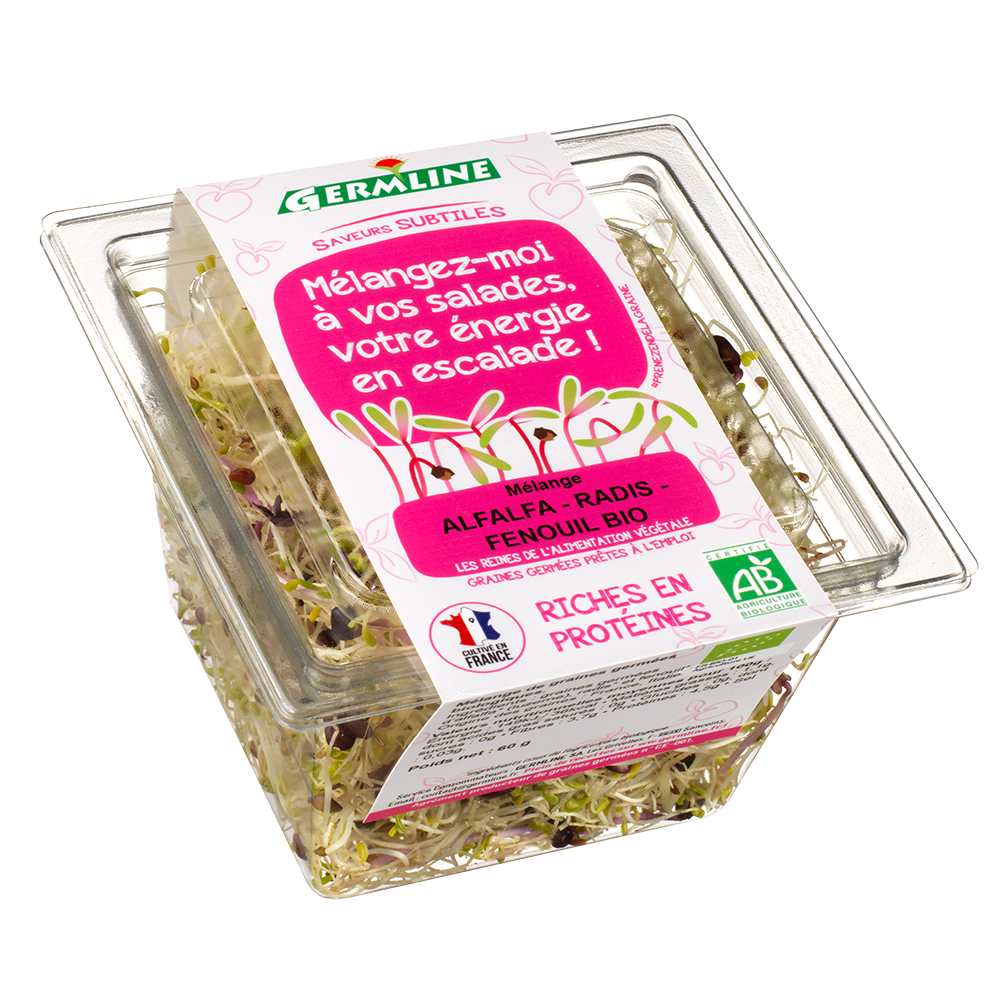
France – Alfalfa-radish-fennel organic sprouted seeds – Salmonella

Gov france

Identification information of the recalled product

  • Product category Food
  • Product subcategory Nuts and seeds
  • Product brand name GERMLINE
  • Model names or references Alfalfa-radish-fennel organic sprouted seeds
  • Identification of products
    GTIN Batch Date
    3465511822003 220428 Use-by date 05/12/2022
    3465511821600 220428 Use-by date 05/12/2022
  • Packaging In tray with lid in 60g and 100g
  • Marketing start/end date From 04/29/2022 to 05/12/2022
  • Storage temperature Product to be stored in the refrigerator
  • Geographic area of ​​sale Whole France
  • Distributors BIOCOOP THE NEW ROBINSON RELAIS GREEN VITAFRAIS NATURALIA METRO

Practical information regarding the recall

  • Reason for recall Salmonella detection
  • Risks incurred by the consumer Salmonella spp (causative agent of salmonellosis)