Category Archives: Vibrio

RASFF Alert – Vibrio cholerae – Shrimps

RASFF

Vibrio cholerae (NON 014/NON 0139) was detected in frozen shrimps from Venezuela in Spain

RASFF Alert – Vibrio cholerae – Frozen Octopus

RASFF

Vibrio cholerae in frozen octopus from Senegal in Spain

Research – Raw Aquatic Food Products – A Source of Pathogens and Parasites

CFS

The harmful microorganisms of concern include both bacteria (e.g. Vibrio parahaemolyticus (VP) and Vibrio cholerae (VC)) and viruses (e.g. norovirus). VP occurs naturally in seawater (estuaries and coastal areas). Hence, some seafood is inevitably contaminated with VP. On the other hand, VC can live in both saltwater and freshwater such as rivers. In Hong Kong, norovirus is a prevalent foodborne virus that is commonly found in polluted seawater and shellfish living in polluted areas is easily contaminated.

Research – Advances in science and risk assessment tools for Vibrio parahaemolyticus and V. vulnificus associated with seafood: meeting report

WHO

Globally, the Vibrio parahaemolyticus and Vibrio vulnificus represent important human pathogens associated with the consumption of seafood. In response to the requests for scientific advice from Codex Committee on Food Hygiene (CCFH), risk assessments for the pathogens V. vulnificus, V. cholerae, V. parahaemolyticus and guidance on methods for the detection of Vibrio spp. with seafood have been conducted and published previously by JEMRA. In order to provide an update on the state-of-the-art advice regarding risk assessment for V. parahaemolyticus and V. vulnificus in seafood, an expert meeting was convened.

Several critical developments in the last decade were subsequently noted by the expert working group: 1) The emergence of highly pathogenic strains; 2) In response to climate change, there has been a significant geographical spread regarding when and where these seafood-associated Vibrio infections; 3) Demographic considerations are very important; 4) A range of new approaches for best practice; and 5) A range of new methods, such as those utilising genomics and satellite imagery. This report describes the output of that expert meeting.

RASFF Alert – Vibrio parahaemolyticus – Mussels

RASFF

Vibrio parahaemolyticus in mussels (mytilus galloprovincialis) produced in Italy and reared in Spain in Italy

RASFF Alert- Vibrio cholerae – Shrimps

RASFF

Vibrio cholerae in shrimps from Ecuador in Spain

Research – Vibrio vulnificus and Vibrio parahaemolyticus in Oysters under Low Tidal Range Conditions: Is Seawater Analysis Useful for Risk Assessment?

MDPI

Food Illness

Abstract

Human-pathogenic Vibrio bacteria are acquired by oysters through filtering seawater, however, the relationships between levels of these bacteria in measured in oysters and overlying waters are inconsistent across regions. The reasons for these discrepancies are unclear hindering our ability to assess if -or when- seawater samples can be used as a proxy for oysters to assess risk. We investigated whether concentrations of total and human pathogenic Vibrio vulnificus (vvhA and pilF genes) and Vibrio parahaemolyticus (tlhtdh and trh genes) measured in seawater reflect concentrations of these bacteria in oysters (Crassostrea virginica) cultured within the US lower Chesapeake Bay region. We measured Vibrio spp. concentrations using an MPN-qPCR approach and analyzed the data using structural equation modeling (SEM). We found seawater concentrations of these bacteria to predictably respond to temperature and salinity over chlorophyll a, pheophytin or turbidity. We also inferred from the SEM results that Vibrio concentrations in seawater strongly predict their respective concentrations in oysters. We hypothesize that such seawater-oyster coupling can be observed in regions of low tidal range. Due to the ease of sampling and processing of seawater samples compared to oyster samples, we suggest that under low tidal range conditions, seawater samples can foster increased spatial and temporal coverage and complement data associated with oyster samples.

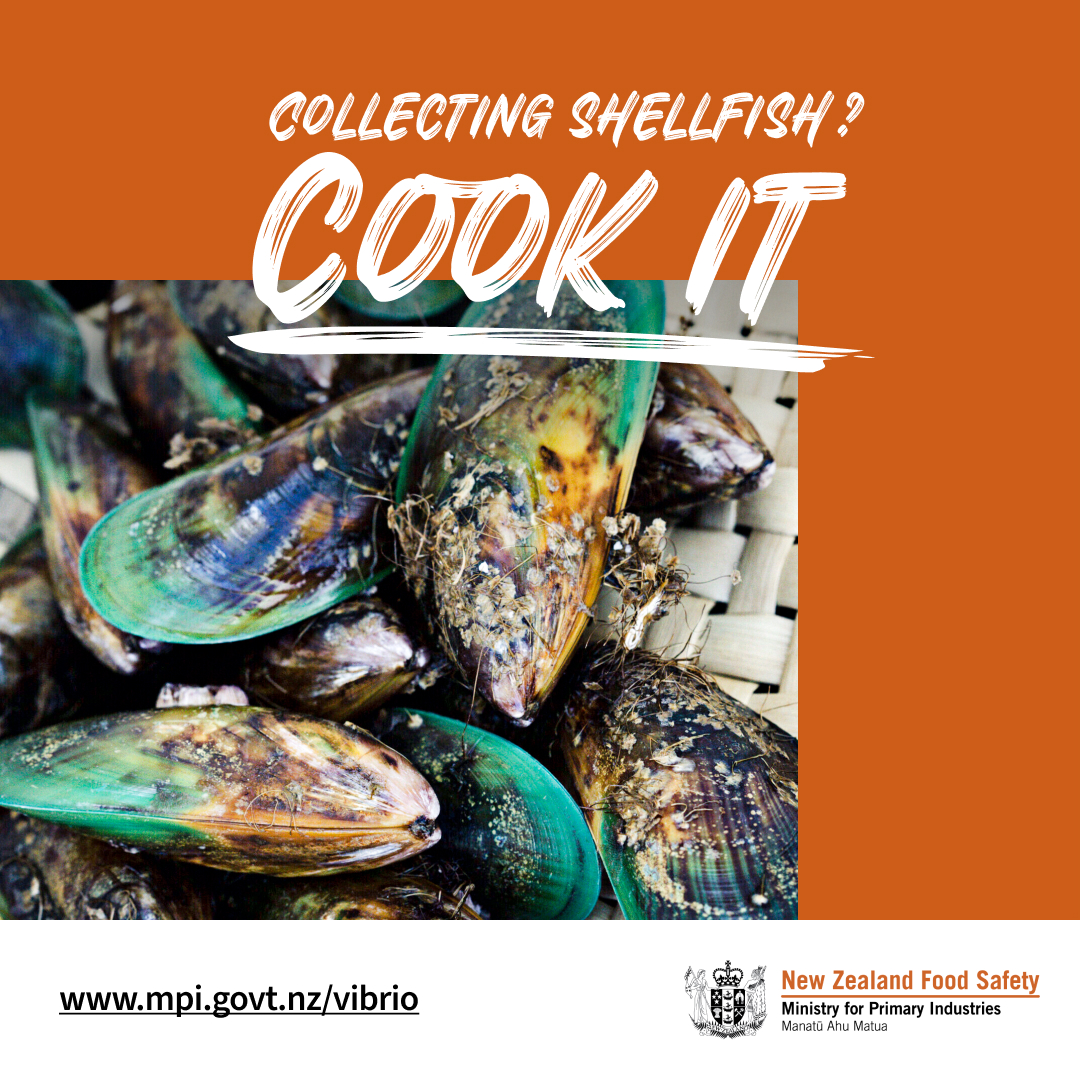
New Zealand – Collecting shellfish this summer? Cook it to keep your whānau safe from Vibrio

MPI

New Zealand Food Safety is calling on Kiwis to thoroughly cook the shellfish they collect this summer following an increase in cases of Vibrio parahaemolyticus illness in previous summer months.

Vibrio is a type of bacteria naturally living in the sea, and some strains can make people sick with gastroenteritis when consumed in raw or undercooked shellfish.

“Our message to those who want to eat raw or lightly cooked shellfish – like mussels, kina and pipi – is to be aware there are increased risks of illness and the simple precautions you can take to protect yourselves and your families,” says New Zealand Food Safety deputy director-general Vincent Arbuckle.

“We are starting to see more cases of illness from Vibrio parahaemolyticus. While we can’t definitively identify the cause, it is possibly because of rising sea temperatures, making it easier for bacteria to spread.

“So, as we gear up for summer, and enjoy time with family and friends over the holidays, we need to make sure to take extra care when collecting and preparing shellfish.

“In the most recent outbreak, there were 60 reported cases of Vibrio parahaemolyticus, between November 2021 and May 2022. Of particularly of concern is the high hospitalisation rate of almost 42%.

“It’s a notable increase in reported cases from previous years, with 24 cases reported earlier in 2021, 16 cases in 2020 and 23 cases in 2019. The reason for the increase is unclear at this stage – it could be caused by environmental change, increased testing and reporting, or a combination of these and other factors – but it is clear, that cooking your shellfish kills the bacteria that makes you sick.

Vibrio bacteria can cause illnesses like gastroenteritis – with symptoms including diarrhoea, abdominal cramps, nausea, vomiting and fever – blood poisoning and wound infections.

“It’s especially important for those with underlying health conditions, pregnant and older people, and younger children to avoid eating raw shellfish,” Mr Arbuckle said.

“The more people know how to collect, store, prepare and cook shellfish safely, the more they can look out for both themselves and others in our communities who may be more vulnerable.

“We want people to know there are easy, tasty ways to make the kai moana you collect safe for eating, so we’ve released a series of simple recipes, created by a community chef. These are available on the website to download and enjoy.

“On our own, we can’t control the changing environmental factors, but we can all help look after our whānau and reduce the risk of them falling sick from Vibrio by taking some simple precautions – and by spreading the word on safe ways to cook shellfish.”

What you can do to help keep your whānau safe:

  • Don’t eat shellfish raw or undercooked. Cook shellfish thoroughly (until they open and are firm to the touch) or so they get to at least 65°C for 1 minute. 
  • Avoid gathering shellfish after heavy rainfall or if the water is unusually dirty.
  • Keep shellfish alive and cool.
  • Refrigerate your shellfish as soon as possible and, ideally, eat it on the day of collection or within 2 days.
  • To avoid cross-contamination, keep hands and utensils clean to prepare raw shellfish, and keep raw shellfish separated from cooked or ready-to-eat products.

What to do if someone falls sick after eating shellfish:

  • phone healthline on 0800 61 11 16, or
  • seek medical attention immediately.

If possible, store and refrigerate any leftover shellfish for testing.

More information on Vibrio and shellfish food safety tips

Research – The European Scientific Conference on Applied Infectious Disease Epidemiology (ESCAIDE)

Escaide

Abstracts

Page 71 – An Easter Surprise: Salmonella Typhimurium outbreak linked to chocolate products in the United Kingdom, 2022; a case control study

Page 72  – International outbreak of Salmonella Typhimurium linked to a chocolate factory in 2022: Belgian findings

Page 73 – Whole Genome Sequencing identified a prolonged Salmonella Poona nursery outbreak (2016-2021) in North West England, UK

Page 74 – Climate Warming and increasing Vibrio vulnificus infections in North America

Page 106 – Timely and reliable outbreak investigation using a non-probabilistic online panel as a source of controls – two parallel case-control studies investigating a Salmonella Braenderup outbreak in Germany

Page 107 – An outbreak of Escherichia coli-associated haemolytic uremic syndrome linked to consumption of an unexpected food vehicle, France 2022

Page 108 – Outbreak investigation of cholera in a peri-urban village of Panchkula district, Haryana, India, 2021

Page 109 – Cholera Outbreak Investigation, Ballo Adda Mohalla, Lucknow District, Uttar Pradesh 2021

Page 110 – Norovirus GII.3[P12] outbreak associated with the drinking-water supply in a rural area in Galicia, Spain, 2021

Page 111 – Impact of COVID-19 restrictions on the epidemiology of Cryptosporidium spp. in England and Wales

Page 149 – Monophasic Salmonella Typhimurium outbreak linked to chocolate products, Ireland, 2022

Page 151 – Successful containment of a Listeria monocytogenes outbreak caused by shredded vegetables, Hesse/Germany, 2021-2022

Page 152 – Outbreak of monophasic Salmonella Typhimurium linked to fresh small tomatoes, Sweden, 2021

Page 194 – Cholera Outbreak Investigation, Kamarhati-Municipality, North-24-Parganas District, West Bengal, India 2021

Page 195 – Botulism outbreak and response in Dangara District Tajikistan, October 2020

Page 196 – Outbreak of suspected Clostridium perfringens associated with consumption of roast beef in a restaurant, January 2022 South West England

Page 198 – Doughnuts for weight loss? A norovirus outbreak in the Australian Capital Territory, November 2021

Page 212 – Outbreak of Legionnaires’ disease linked to unregistered cooling towers, West Midlands, England, July-September 2020


RASFF Alerts – Vibrio vulnificus – Shrimp

RASFF

Frozen Raw Shrimp – Vibrio vulnificus from Venezuela in France