Category Archives: Staphylococcus aureus

Research – Cold-sensitive staphylococci reveal a weakness

Science Daily

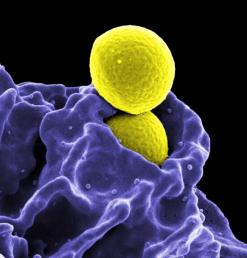
MRSA Staphylococcus KSW Food World

Image CDC

Staphylococcus aureus” — also known as “golden staph” — has the ability to develop in highly variable environmental conditions (on the skin, in the nose, on sterile surfaces, and so forth). Its great adaptability depends especially on a protein (an RNA helicase) involved in the degradation of RNA messengers that have become useless. In their attempts to have a better understanding of how this helicase works, scientists from the University of Geneva (UNIGE) discovered that it contributes to another physiological process, without any apparent link to the first: the synthesis of the fatty acids that are the essential constituents of the bacterial membrane. This advance, to be published in the journal PLoS Genetics, offers an interesting insight since fatty acid synthesis is precisely one of the targets favoured by numerous laboratories to fight this pathogen that is difficult to treat due to its resistance to antibiotics.

Golden staph (Staphylococcus aureus) is an opportunistic pathogenic bacterium that is capable of adapting to highly variable environments. It can be found in the nostrils of 25 to 30% of the population, although this is generally not a problem. However, the bacterium can take advantage of a drop in immunity or a surgical operation to trigger a real infection. And the problem with golden staph is its ability to develop resistance to antibiotic drugs, which often makes it difficult — sometimes impossible — to treat.

“My laboratory studies a protein, RNA helicase, which plays an important role in golden staph’s ability to adapt to very different environments,” begins Patrick Linder, a professor in the Department of Microbiology and Molecular Medicine in UNIGE’s Faculty of Medicine. “When the environment changes, the bacterium has to be able to synthesise new proteins that are more suitable and stop the production of others that are no longer useful. The helicase we’re interested in — called CshA — is involved in the degradation of the RNA, those molecules derived from the DNA and used in protein synthesis.”

Cold-sensitive bacteria

Oddly enough, when the helicase is absent (due, for example, to a genetic mutation), the researchers found that the cultured bacteria could no longer form colonies if the temperature dropped below a certain threshold (around 25°C).

The Geneva-based biologists undertook a series of experiments designed to improve our understanding of the link between golden staph’s sensitivity to cold, the degradation of the RNA and the adaptation capacity. They discovered that the same helicase is probably also required in another physiological process, namely the synthesis of fatty acids, which are the constituents of bacterial membranes.

“Using cultured golden staph stripped of helicases, we succeeded in isolating 82 gene mutations (appearing spontaneously in many different bacteria), which meant that their holders regained the ability to form colonies at 25°C,” continues Vanessa Khemici, a researcher in Patrick Linder’s laboratory and the article’s first author. “We identified almost all the affected genes, and no less than two thirds of them are involved in the fatty acid synthesis.”

The findings also helped the researchers understand that the lack of the helicase has the effect of deregulating the fatty acid synthesis and decreasing the flexibility of the membrane when the temperature drops. This prevents the membrane from fulfilling its functions properly and the bacterium from growing. In a second step, each of the 82 mutations succeeded in its own way in restoring the initial balance by acting on the different genetic levers involved in fatty acid synthesis.

Scientific controversy

“A section of the scientific community supports the idea that a future treatment against staphylococcus will involve a drug capable of inhibiting fatty acid synthesis,” notes Professor Linder, “but there is a controversy about it because some studies contradict this point of view.”

The results of the Geneva scientists do not provide a clear-cut answer or make it possible to directly develop a drug against these bacteria. Nevertheless, they fit into this context and provide a better understanding of golden staph’s fundamental mechanisms. The discovery of this unprecedented link between the fluidity of the membrane and adaptation to environmental change represents an important step in the fight against the bacterium. It is undoubtedly for these reasons that the journal decided to publish an overview in parallel with the article.


Story Source:

Materials provided by Université de GenèveNote: Content may be edited for style and length.


Journal Reference:

  1. Vanessa Khemici, Julien Prados, Bianca Petrignani, Benjamin Di Nolfi, Elodie Bergé, Caroline Manzano, Caroline Giraud, Patrick Linder. The DEAD-box RNA helicase CshA is required for fatty acid homeostasis in Staphylococcus aureusPLOS Genetics, 2020; 16 (7): e1008779 DOI: 10.1371/journal.pgen.1008779

Research – Biofilm-forming ability of pathogenic strains isolated from retail food in Poland

Journal of Food Protection

Biofilms have a significant impact on food safety in the food industry. Many foodborne outbreaks have been associated with pathogenic strains that can form a biofilm. The present study aimed to examine the ability to form biofilms by pathogenic strains collected from retail food samples under the Official Control and Monitoring Program in Poland. Biofilm formation was assessed by the qualitative detection of EPS production on Congo Red Agar, tube method, crystal violet biofilm assay, and MTT assay. A total of 40 isolates from food samples (10 strains for each of the species Listeria monocytogenes, Staphylococcus aureus, Escherichia coli, and Bacillus cereus ) were examined. . . The study classifies strains as adherent strain, slightly adherent, nonadherent (A, SA and N); as weak, moderate, and strong biofilm formation (WBF, MBF and SBF); and weak, moderate, and high metabolic activity (WMA, MMA and HMA). Incubation conditions and time influenced the biofilm levels formed. Moreover, growth medium had a significant impact on biofilm formation. Results showed that 22.5% strains demonstrated A type in LBB and 77.5% SA type in LBB in the test tube while the stronger adhesion was obtained in BHI with 2% sucrose. Among the isolates incubated in the BHI medium with 2% sucrose, A type was observed in 60% of isolates (60%).. CV assay result show that the after 24 h incubation in LBB, SBP was 7,5% while after 48 h – 37.5% tested strains. For BHI medium supplemented with 2% sucrose after 24 h incubation strains 42.5% was classified as SBP and 37.6% after 48h.MTT assay result indicate that 15% strains incubate in LBB (24h) was HMA, and after 48h incubation time HMA show 25%. For BHI medium supplemented with 2% sucrose after 24 h or 48 h incubation strains 70% and 85 % was classified as HMA.

Research – Attributing human foodborne diseases to food sources and water in Japan using analysis of outbreak surveillance data

JFP

In Japan, strategies for ensuring food safety have been developed without reliable scientific evidence on the relation between foodborne infections and foods. The aim of this research was to provide information on the proportions of foodborne diseases caused by seven major causative pathogens ( Campylobacte r spp., Salmonella spp., EHEC, V. parahaemolyticus , Clostridium perfringens , Staphylococcus aureus , and Norovirus) attributable to foods using analysis of outbreak surveillance data. For the calculation of the number of outbreaks attributed to each source, simple-food outbreaks were attributed to the single-food category in question, and complex-food outbreaks were classified under each category proportionally to the estimated probability. Between 2007 and 2018, 8.730 outbreaks of foodborne diseases caused by seven pathogens were reported and another 6,690 (76.6%) were of “unknown source”. We observed fluctuations in the sources of foodborne diseases caused by the seven pathogens from 2013 to 2018 as follows: chicken products (92.9%, CI 92.6–92.9) for Campylobacter spp., beef products (40.1%, CI 38.2–41.2) and vegetables (39.3%, CI 38.2–41.2) for EHEC, eggs (22.8%, CI 14.9–31.9), chicken products (13,3%, CI 6.4–21.3) for Salmonella spp., finfish (86.3%, CI 62.5–95.8) and shellfish (13.7%, CI 4.2–37.5) for V. parahaemolyticus, grains and beans (47.2%, CI 31.2–62.5) for S. aureus, vegetables (69.3%, CI 50.8–79.7) and beef products (13.1%, CI 10.2–15.3) and chicken products (10.0%, CI 1.7–27.1) for C. perfringens , and shellfish (74.7%, CI 73.1–75.9) for Norovirus. In this study, we provide the best currently available basis to evaluate the link between foodborne diseases and foods. Additionally, our results reflected the effect of strict health regulations for raw beef during a given time period, and demonstrate the importance of controlling the contamination rate of Campylobacter spp. in chicken products at each step of the food supply chain.

Research – Microbiological Quality of Cooked Chicken: Results of Monitoring in England (2013-17)

JFP

Results from monitoring of the microbiological quality of 2,721 samples of ready-to-eat cooked chicken collected between 2013 to 2017 in England were reviewed: 70% of samples were from retail, catering or manufacture and 30% were imported and collected at English ports. Samples were tested for a range of bacterial pathogens and indicator organisms. Six samples (<1%) had unsatisfactory levels of pathogens which were potentially injurious to health. Neither Salmonella nor Campylobacter were recovered from any sample. Two samples from catering settings contained either an unsatisfactory level of Bacillus cereus (5 x 10 6 CFU/g) or an unsatisfactory level of coagulase positive staphylococci (1.6 x 10 4 CFU/g). Listeria monocytogenes was recovered from 36 samples (one at manufacture, 26 at catering and nine at retail) and in four instances, unsatisfactory levels (≥10 2 CFU/g) were detected (three samples collected at catering and one at retail). For L. monocytogenes there were no significant differences between the rates of contamination with between the samples collected from ports, manufacture, retail supermarkets and other retailers (p = 0.288). There were no differences between the rates of contamination for other potential pathogens detected between samples from different settings. The prevalence of hygiene indicators ( Escherichia coli , Enterobacteriaceae and Aerobic Colony Counts) at import was significantly lower than in samples collected from manufacturers, retail or catering (p < 0.01). Samples collected from catering gave poorer results than all other settings. Regardless of the stage in the food chain, samples from Thailand and from other non-EU countries were of significantly better microbiological quality with respect to indicator organisms than those from the UK or from other EU countries (p = <0.001).

France – Auchan Iraty Fermier PDO raw milk cheese from Auchan brand – Responsible sector – Staphylococcal Enterotoxins.

Oulah

ENCOUNTERED PROBLEM

Presence of Staphylococcal Enterotoxins.

PROPOSED SOLUTION

It is recommended that people who hold products belonging to the batch described below not consume and destroy them, or bring them to the point of sale where they were purchased.
Foodborne illness caused by Staphylococcal Enterotoxins results in gastrointestinal disturbances (mainly vomiting) appearing within hours of ingestion and generally disappearing quickly.
People who have consumed the “Ossau Iraty Fermier AOP” cheese mentioned below and who show persistence of these symptoms are invited to consult their doctor, reporting this consumption, as well as the place and date of purchase.

FURTHER INFORMATION

▸ Sale
The product “Ossau Iraty Fermier AOP” was sold to the “traditional” department of your Auchan store between 20/05/2020 and 10/06/2020.

▸ Health
stamp FR 64.006.100 CE

▸ Contact
customer service SCA LES FERMIERS BASCO BEARNAIS is at the disposal of consumers to answer their questions at the following telephone number: 05-59-34-76-06.

▸ Source
https://www.auchan.fr/

Research – Essential Oils: Their Antibacterial Properties and Potential Applications in Foods–A Review

Pub Med

Abstract

In vitro studies have demonstrated antibacterial activity of essential oils (EOs) against Listeria monocytogenes, Salmonella typhimurium, Escherichia coli O157:H7, Shigella dysenteria, Bacillus cereus and Staphylococcus aureus at levels between 0.2 and 10 microl ml(-1). Gram-negative organisms are slightly less susceptible than gram-positive bacteria. A number of EO components has been identified as effective antibacterials, e.g. carvacrol, thymol, eugenol, perillaldehyde, cinnamaldehyde and cinnamic acid, having minimum inhibitory concentrations (MICs) of 0.05-5 microl ml(-1) in vitro. A higher concentration is needed to achieve the same effect in foods. Studies with fresh meat, meat products, fish, milk, dairy products, vegetables, fruit and cooked rice have shown that the concentration needed to achieve a significant antibacterial effect is around 0.5-20 microl g(-1) in foods and about 0.1-10 microl ml(-1) in solutions for washing fruit and vegetables. EOs comprise a large number of components and it is likely that their mode of action involves several targets in the bacterial cell. The hydrophobicity of EOs enables them to partition in the lipids of the cell membrane and mitochondria, rendering them permeable and leading to leakage of cell contents. Physical conditions that improve the action of EOs are low pH, low temperature and low oxygen levels. Synergism has been observed between carvacrol and its precursor p-cymene and between cinnamaldehyde and eugenol. Synergy between EO components and mild preservation methods has also been observed. Some EO components are legally registered flavourings in the EU and the USA. Undesirable organoleptic effects can be limited by careful selection of EOs according to the type of food.

Research – Protective shield: How pathogens withstand acidic environments in the body

Science Daily

Certain bacteria, including the dangerous nosocomial pathogen MRSA, can protect themselves from acidic conditions in our body and thus ensure their survival. Researchers at the Biozentrum of the University of Basel have now elucidated an important mechanism in this process. A transport protein involved in cell wall biosynthesis plays a key role, they report in the journal Nature Structural & Molecular Biology.

Each year, thousands of patients in Swiss hospitals become infected with dangerous pathogens that can hardly be controlled with antibiotics. The methicillin-resistant bacterium Staphylococcus aureus, MRSA for short, is particularly feared among the multi-resistant nosocomial germs. It can cause severe wound, respiratory and urinary tract infections and life-threatening sepsis. This is aggravated by the fact that MRSA causes chronic infections.

Research – In vitro antimicrobial effects of Myristica fragrans essential oil on foodborne pathogens and its influence on beef quality during refrigerated storage

Wiley Online

Nutmeg (Myristica fragrans) seed was subjected to the hydro‐distillation method to extract its essential oil (NEO). Its main constituents were α‐pinene (20.16%), sabinene (14.45%), and β‐pinene (13.26%) with great antimicrobial and antioxidant actions. A novel edible coating was then fabricated based on the sage seed mucilage (SSM) and NEO, to ameliorate the quality and shelf‐life of beef slices. The NEO‐loaded SSM coating was able to significantly decrease the population of total viable count, Escherichia coliStaphylococcus aureus, psychrotrophic bacteria, and fungi. Moreover, lipid oxidation of beef slices was remarkably suppressed upon the application of bioactive NEO‐loaded SSM edible coating, as compared with the control by Day 6. The coated beef sample, especially NEO‐rich SSM coated ones perceived a higher consumer acceptance and firmness than the SSM coated and noncoated samples. The SSM edible coating containing NEO could therefore have the potential to control the growth of pathogenic microorganisms and lipid oxidation, and to improve the color stability and sensory properties of meat and meat products.

Research – Bacteria killed by new light-activated coating

Science Daily

To stop the spread of disease, it could be used to coat phone screens and keyboards, as well as the inside of catheters and breathing tubes, which are a major source of healthcare-associated infections (HCAIs).

The most well known HCAIs are caused by Clostridioides difficile (C. difficile), methicillin-resistant Staphylococcus aureus (MRSA) and Escherichia coli (E. coli). They commonly occur during in-patient medical or surgical treatment, or from visiting a healthcare setting and pose a serious health threat, making them a key priority for the NHS to address*.

The research, published today in Nature Communications, is the first to show a light activated antimicrobial coating successfully killing bacteria in low intensity, ambient light (300 Lux), such as that found in wards and waiting rooms. Previously, similar coatings needed intense light (3,000 Lux), like that found in operating theatres, to activate their killing properties.

The new bactericidal coating is made of tiny clusters of chemically modified gold embedded in a polymer with crystal violet — a dye with antibacterial and antifungal properties.


Research -Persistent contamination of Salmonella, Campylobacter, Escherichia coli, and Staphylococcus aureus at a broiler farm in New Zealand

Canadian Journal of Microbiology

Intensive poultry production due to public demand raises the risk of contamination, creating potential foodborne hazards to consumers. The prevalence and microbial load of the pathogens CampylobacterSalmonellaStaphylococcus aureus, and Escherichia coli was determined by standard methods at the farm level. After disinfection, swab samples collected from wall crevices, drinkers, and vents were heavily contaminated, as accumulated organic matter and dust likely protected the pathogens from the disinfectants used. The annex floor also showed high microbial concentrations, suggesting the introduction of pathogens from external environments, highlighting the importance of erecting hygiene barriers at the entrance of the main shed. Therefore, pathogen control measures and proper application of disinfectants are recommended as intervention strategies. Additionally, quantitative polymerase chain reaction (qPCR) was evaluated as a quantification tool. qPCR showed limitations with samples containing low microbial counts because of the low detection limit of the method. Thus, bacterial pre-enrichment of test samples may be necessary to improve the detection of pathogens by qPCR.