Category Archives: Salmonella

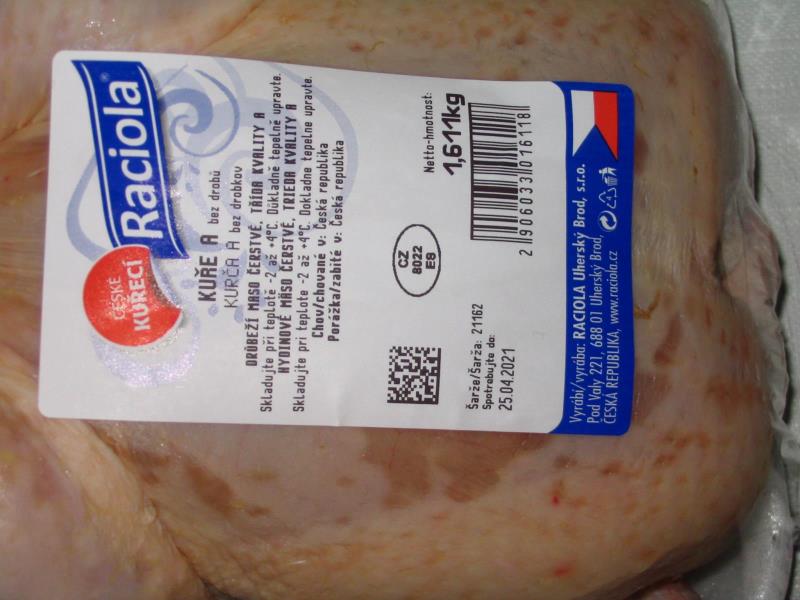
Czech Republic- Chilled chicken without offal B – Salmonella

Potravinynapranyri

Food group: Meat and meat products Packaged meat

Chilled chicken without offal B
Category: Dangerous food
Unsatisfactory parameter:

Salmonella enterica serum. Enteritidis

The pathogenic bacterium Salmonella enterica serum was detected in chilled chickens without offal Enteritidis , which can cause a condition called salmonellosis.

Expiration date: 4/25/2021
Packaging: Plastic foil
Producer: RACIOLA Uhersky Brod, sro
Country of origin:  Czechia
Date of sampling: 20. 4. 2021
Reference number: 21-000018-SVS-CZ
The sample was found by official inspection of the State Veterinary Administration.

Germany – Basak curry 100g – Salmonella

AGES

AGES informs about a recall of the company Macro Group Handels GmbH. The company initiated a recall of the product Basak Curry 100g on June 11th, 2021:

Food recall

Basak curry 100g
Recall reason Salmonella
Marketed by Macro Group Handels GmbH
Manufacturer Basak
Expiry Date 04.2023

Product recall: Basak Curry 100g

Vienna (OTS) – The article Basak Curry 100g contains salmonella and is therefore criticized as HARMFUL. We therefore ask you not to consume and return goods that have already been purchased.

The following best before dates are affected: Best before: 03.2023

The article Basak Curry 100g could contain foreign bodies and will therefore be rejected as HARMFUL. We therefore ask you not to consume and return goods that have already been purchased.

The following
best before dates are affected : Best before: 12.2022, 03.2023 and 04.2023 Inquiries

& contact:

Mücahit Bülük: TEL .: + 43 2162 65 708 21

Original broadcast

USA- Recalled: A Single Lot of Freshpet Select Small Dog – Salmonella

Petful

Maker: Freshpet, Inc.
Cause: Potential for salmonella
Announcement: FDA alert dated June 13, 2021 (archived here)
What was recalled: Freshpet Select Small Dog Bite Size Beef & Egg Recipe Dog Food, 1 lb., UPC # 627975012939, with sell by date of Oct. 30, 2021 and Lot Code 1421FBP0101

Only the dog food listed above — with the exact UPC, sell by date and lot code — is part of this recall, and no other Freshpet products are affected.

Research- Monte Carlo Simulation Model for Predicting Salmonella Contamination of Chicken Liver as a Function of Serving Size for Use in Quantitative Microbial Risk Assessment

Journal of Food Protection

Salmonella kswfoodworld

The first step in quantitative microbial risk assessment (QMRA) is to determine distribution of pathogen contamination among servings of the food at some point in the farm-to-table chain. In the present study, distribution of Salmonella contamination among servings of chicken liver for use in QMRA was determined at meal preparation. A combination of five methods: 1) whole sample enrichment; 2) quantitative polymerase chain reaction; 3) cultural isolation; 4) serotyping; and 5) Monte Carlo simulation were used to determine Salmonella prevalence (P), number (N), and serotype for different serving sizes. In addition, epidemiological data were used to convert serotype data to virulence (V) values for use in QMRA. A Monte Carlo simulation model based in Excel and simulated with @Risk predicted Salmonella P, N, serotype, and V as a function of serving size from one (58 g) to eight (464 g) chicken livers. Salmonella P of chicken livers was 72.5% (58/80) per 58 g. Four serotypes were isolated from chicken livers: 1) Infantis (P = 28%, V = 4.5); 2) Enteritidis (P = 15%, V = 5); 3) Typhimirium (P = 15%, V = 4.8); and 4) Kentucky (P = 15%, V = 0.8). Median Salmonella N was 1.76 log per 58 g (range: 0 to 4.67 log/58 g) and was not affected ( P > 0.05) by serotype. The model predicted a non-linear increase ( P ≤ 0.05) of Salmonella P from 72.5% per 58 g to 100% per 464 g, minimum N from 0 log per 58 g to 1.28 log per 464 g, and median N from 1.76 log per 58 g to 3.22 log per 464 g. Regardless of serving size, predicted maximum N was 4.74 log, mean V was 3.9, and total N was 6.65 log per lot (10,000 chicken livers). The data acquired and model developed in this study fill an important data and modeling gap in QMRA for Salmonella and chicken liver.

Research – Application of peroxyacetic acid for decontamination of raw poultry products and comparison to other commonly used chemical antimicrobial interventions – A Review

Journal of Food Protection

Poultry remains one of the top food commodities responsible for foodborne illness in the U.S., despite poultry industry efforts since the inception of HACCP to reduce the burden of foodborne illness implicating poultry products. The appropriate use of antimicrobial compounds during processing of raw poultry can help minimize this risk. Currently, peroxyacetic acid (PAA) is the most popular antimicrobial in the poultry industry, displacing chlorine compounds and others. The aim of this review was to compare the effectiveness of PAA to that of other antimicrobials for the decontamination of raw poultry carcasses and parts. Twenty-six articles were found that compared PAA to over 20 different antimicrobials, applied as spray or immersion treatments for different exposure times and concentrations. The most common comparisons were to chlorine compounds (17 articles), to lactic acid (LA) compounds (5 articles) and to cetylpyridinium chloride (CPC, 6 articles). Studies measured effectiveness by reductions in native flora or inoculated bacteria, usually Salmonella or Campylobacter . PAA was found to be more effective than chlorine under most conditions studied. Effectiveness of PAA was higher or comparable to that of LA and CPC depending on product and treatment conditions. Overall, the results of primary literature studies support the popularity of PAA as an effective intervention against pathogenic bacteria during poultry processing.

USA- Salmonella Outbreaks Linked to Backyard Poultry

CDC

Fast Facts
  • Illnesses: 163
  • Hospitalizations: 34
  • Deaths: 0
  • States: 43
  • Recall: No
  • Investigation status: Active
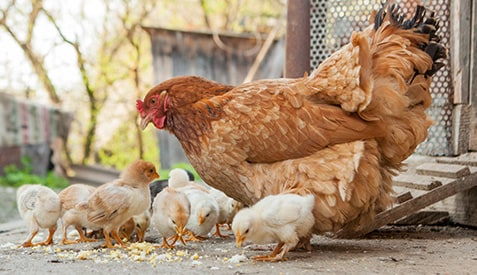
Backyard poultry with chickens eating
Backyard Poultry and Salmonella

Backyard poultry, like chicken and ducks, can carry Salmonella germs even if they look healthy and clean. These germs can easily spread to anything in the areas where they live and roam.

You can get sick from touching your backyard poultry or anything in their environment and then touching your mouth or food, and swallowing Salmonella germs.

France – Pork rillettes – Salmonella

Gov france

  • Food
  • Product sub-categoryMeats
  • Product brand nameBiocoop
  • Names of models or referencesPork rillettes refill approx. 800g (rear service)
  • Product identificationGTINLotDated346280116454221146Use-by date 06/16/2021
  • Products ListStore_Display_FYT1 _-_ YT0329.pdfAttachment
  • PackagingSold in rear service
  • Start date / End of marketingUntil 06/08/2021
  • Storage temperatureProduct to be stored in the refrigerator
  • Health markFR.35.162.009.CE
  • Further informationProduct sold in the traditional section by the cut.
  • Geographical sales areaWhole France
  • DistributorsBiocoop
  • List of points of saleRecall_rillettes_Biocoop _-_ shopping_list.pdf

RASFF Alerts – Salmonella – Polish Chicken – Polish Turkey – Chicken Meat – Mussels –

RASFF

Salmonella group B (O:4) in chilled turkey meat from Poland in Belgium, Germany and Netherlands

RASFF

Salmonella enterica ser. Enteritidis in chilled chicken meat from the Netherlands in the Netherlands and Belgium

RASFF

Fishing mussels – salmonella spp from Denmark in France

RASFF

Frozen chicken legs – Salmonella Enteritidis from Poland in France

RASFF

Salmonella in chicken meat preparations from Poland in the Netherlands, Luxembourg and Belgium

RASFF

Salmonella Enteritidis in official samples of chicken neck skins from Poland in the UK, Lithuania, Belgium, 

RASFF

Salmonella Typhimurium in turkey meat from Poland in Belgium, Czech Republic, Germany, Ireland and Latvia

RASFF

Salmonella infantis in chicken meat from Spain in France

RASFF

Salmonella infantis in chicken breast from Poland in the Czech Republic


Research – Effect of UVC light-emitting diodes on pathogenic bacteria and quality attributes of chicken breast

Journal of Food Protection

This study aimed to investigate the inactivation of foodborne pathogens and the quality characteristics of fresh chicken breasts after Ultraviolet-C light-emitting diode (UVC-LED) treatment. Fresh chicken breasts were separately inoculated with Salmonella Typhimurium, Escherichia coli O157:H7, and Listeria monocytogenes at an initia population of 6.01, 5.80, and 6.22 log 10 CFU/cm 2 , respectively, then were treated by UVC-LED at 1000 to 4000 mJ/cm 2 . UVC-LED irradiation could inactivate the tested bacteria in a dose-dependent manner. After UVC-LED treatment at 4000 mJ/cm 2 , the populations of S . Typhimurium, E . coli O157:H7, and L . monocytogenes on chicken breasts were decreased by 1.90, 2.25, and 2.18 log 10 CFU/cm 2 , respectively. No significant ( P > 0.05) changes were found in the color, pH value, texture properties, and thiobarbituric acid reactive substances (TBARS) values of chicken breasts following the UVC-LED radiation at doses up to 4000 mJ/cm 2 . Overall, this study indicates that UVC-LED is a promising technology to reduce the number of microorganisms while maintaining the physico-chemical characteristics of poultry meat.

Research- Prevalence of Toxoplasma gondii, Hepatitis E Virus and Salmonella antibodies in meat juice samples from pigs at slaughter in Switzerland

Journal of Food Protection

Toxoplasma

Toxoplasma gondii , hepatitis E virus (HEV) and Salmonella are zoonotic foodborne pathogens that may be transmitted to humans through the consumption of raw or undercooked pork.  The aim of this study was to determine the seroprevalence of anti- Toxoplasma gondii , anti-HEV and anti- Salmonella antibodies from healthy pigs at slaughter in Switzerland. In the period of August to September 2020 diaphragm muscle of Swiss fattening pigs was collected in three Swiss abattoirs from a total of 188 farms. Two randomly chosen pig carcasses per farm were selected. On the basis of the slaughter data, the production system and the canton of origin were noted, comparing indoor (n=120) and free-range farming (n=68), and regional allocation. The meat juice of these samples was analyzed for pathogen-specific antibodies using commercial enzyme-linked immunosorbent assay (ELISA) kits. The seroprevalences were 1.3% for T. gondii , 71.8% for the HEV and 5.3% for Salmonella , respectively. Comparing the origins, the results of many cantons weren’t meaningful due to the low number of samples. No regional accumulations were found for T. gondii and the HEV. The results showed that 2.1% of the farms had least one T. gondii seropositive animal, 80.3% had at least one HEV seropositive animal, and 8.5% had at least one Salmonella seropositive animal, respectively. The seropositivity of T. gondi i was higher in free-range pigs than in indoor pigs, whereas anti- Salmonella antibodies were more common in pigs from indoor farming than in outdoor pigs. The seroprevalence of anti HEV-Abs was similar in free-range and indoor farming pigs. Compared to studies from 2012 the seroprevalence of T. gondii has decreased whereas the seroprevalence of the HEV has increased and is highly prevalent among fattening pigs in Switzerland. The low seroprevalence of Salmonella has remained stable in recent years.