Category Archives: Research

Research – Prevalence and identification of Aspergillus and Penicillium species isolated from peanut kernels in central Myanmar

Wiley Online

Abstract

The objective of the present study was to conduct a survey to evaluate the postharvest handling of peanuts at farm level and to screen and identify the strains of Aspergillus and Penicillium species from peanut kernels in central Myanmar. A total of 640 samples from the stores of farmers, collectors, and wholesalers were collected and seeded for growth, isolation, and characterization of fungi. Out of 85 isolates, Aspergillus flavus (38), A. niger (20), A. terreus (15), and Penicillium citrinum (12) were identified and confirmed by molecular techniques including DNA sequencing using internal transcribed spacer (ITS5/4) and beta‐tubulin (Bt2a/2b) primer sets. The study indicates different factors associated with fungal contamination at farm level peanut storage and warrants an immediate attention of food safety regulatory authorities to design and implement strategies for postharvest handling and storage practice in developing countries to minimize fungal contamination.

Practical applications

In developing countries like Myanmar, there are lack of food safety practices and policies regarding the food storage, handling, and farmer education. The current study indicates the different storage methods for peanut kernels at farm level and their influence on prevalence of fungi. The study will give a deep insight to the policy makers to design food safety practices at farm level and educate the farmers to adopt the better practices to assure the consumer health and satisfaction in developing countries.

Research -The probiotic, Leuconostoc mesenteroides, inhibits Listeria monocytogenes biofilm formation

Wiley Online listeria

Listeria monocytogenes biofilm formation renders these cells highly resistant to current sanitation methods, and probiotics may be a promising approach to the efficient inhibition of Listeria biofilms. In the present study, three Leuconostoc mesenteroides strains of lactic acid bacteria isolated from kimchi were shown to be effective probiotics for inhibiting Listeria biofilm formation. Biofilms of two L. monocytogenes serotypes, 1/2a (ATCC15313) and 4b (ATCC19115), in dual‐species culture with each probiotic strain were decreased by more than 40‐fold as compared with single‐species Listeria biofilms; for instance, a reduction from 5.4 × 106 colony forming units (CFU)/cm2 L. monocytogenes ATCC19115 in single‐species biofilms to 1.1 × 105 CFU/cm2 in dual‐species biofilms. Most likely, one of the Leuconostoc strains, L. mesenteroides W51, led to the highest Listeria biofilm inhibition without affecting the growth of L. monocytogenes. The cell‐free supernatant from the L. mesenteroides W51 culture containing large protein molecules (>30 kDa) also inhibited Listeria biofilms. These data indicate that Leuconostoc probiotics can be used to repress L. monocytogenes biofilm contamination on surfaces at food processing facilities.


Research – Inactivating foodborne pathogens in apple juice by combined treatment with fumaric acid and ultraviolet-A light, and mechanisms of their synergistic bactericidal action

Science Direct

We evaluated the bactericidal efficacy of the simultaneous application of ultraviolet-A (UV-A) irradiation and fumaric acid (FA) against Escherichia coli O157:H7, Salmonella enterica serovar Typhimurium, and Listeria monocytogenes in apple juice and as well as investigated the effects of this treatment on product quality. Further, we elucidated the mechanisms underlying their synergistic bactericidal action. Simultaneous UV-A light irradiation and 0.1% FA treatment for 30 min resulted in 6.65-, 6.27-, and 6.49-log CFU/ml reductions in E. coli O157:H7, S. Typhimurium, and L. monocytogenes, respectively, which involved 3.15, 2.21, and 3.43 log CFU reductions, respectively, and these were attributed to the synergistic action of the combined treatments. Mechanistic investigations suggested that the combined UVA-FA treatment resulted in significantly greater bacterial cell membrane damage and intracellular reactive oxygen species (ROS) generation. UVA-FA treatment for 30 min did not cause significant changes to the color, nonenzymatic browning index, pH, and total phenolic content of apple juice. These results suggest that combined UVA-FA treatment can be effectively used to control foodborne pathogens in apple juice without affecting its quality.

Information – Food Net Fast – CDC Tool

FoodNet Fast

FoodNet Fast Logo


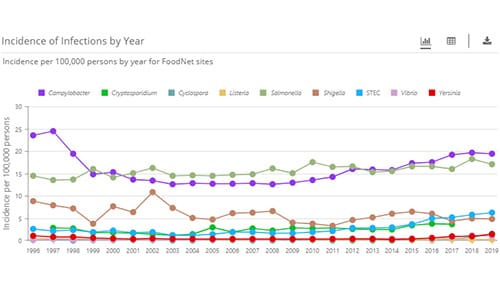
FoodNet Fast provides online access to information reported to the Foodborne Diseases Active Surveillance Network (FoodNet). FoodNet’s surveillance area includes about 15% of the U.S. population.

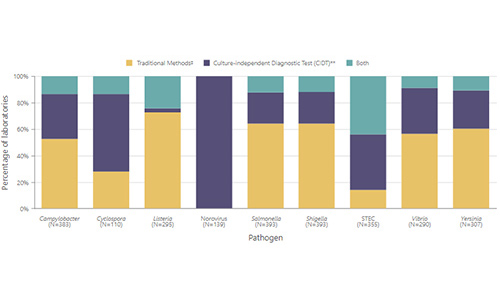
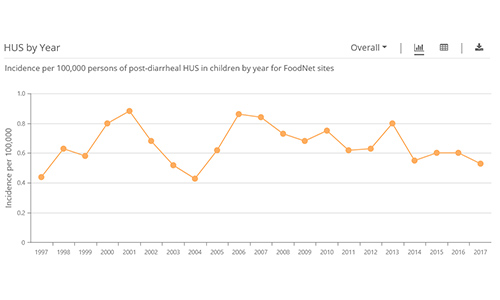
You can use FoodNet Fast tools to search data and see results displayed on interactive graphs and charts.

  • Pathogen Surveillance Tool: See how rates of illness have changed in FoodNet’s surveillance area since 1996 for nine pathogens transmitted commonly through food: CampylobacterCryptosporidium *Cyclospora, Listeria, Salmonella, Shiga toxin-producing Escherichia coli (STEC), Shigella, Vibrio, and Yersinia.
  • Diagnostic Laboratory Practices Tool: Find out how diagnostic testing practices in FoodNet’s surveillance area have changed over time for 10 pathogens: CampylobacterCryptosporidium *CyclosporaListerianorovirusSalmonella, STEC, ShigellaVibrio, and Yersinia.
  • Hemolytic Uremic Syndrome (HUS) Surveillance Tool: HUS is a life-threatening condition, most often triggered by STEC infection. See how rates of pediatric HUS and STEC infection have changed in FoodNet’s surveillance area since 1997.

As of January 1, 2018, FoodNet no longer conducts active surveillance for Cryptosporidium.

Background Information

Start exploring FoodNet Fast now – or click the boxes below for more information.

Pathogen Surveillance Tool FAQ

Graphic chart of Pathogen Surveillance Tool FAQ

Laboratory Practices Tool FAQ

Graphic chart of Laboratory Practices Tool FAQ

HUS Surveillance Tool FAQ

Graphic chart of Laboratory Practices Tool FAQ

Research – Eugenol as an antimicrobial wash treatment reduces Campylobacter jejuni in postharvest poultry

Wiley Online

Abstract

The efficacy of the natural plant‐derived compound, eugenol (EG), as an antimicrobial wash treatment to reduce Campylobacter jejuni in postharvest poultry was investigated. The antimicrobial efficacy of EG was studied as a suspension, emulsion, or nanoemulsion treatment (two trials each). In each trial, chicken skin samples were inoculated with C. jejuni (∼7.2 Log CFU/sample), washed with treatments (0, 0.125, 0.25, 0.5, 1, or 2% EG corresponds to 0, 7.61, 15.22, 30.45, 60.90, or 121.8 mM, respectively) for 1 min, drip dried for 2 min, and then processed at 0, 8, and 24 hr of refrigerated storage (n = 5 samples/treatment/time point). All doses of the EG suspension consistently reduced C. jejuni counts with the greatest reduction (>2.0 Log CFU/sample) for the 2% dose when compared with controls (p < .05). EG emulsions or nanoemulsions did not provide any additional reduction in C. jejuni when compared to EG suspension. Our results suggest that EG could be an effective postharvest intervention strategy for reducing C. jejuni contamination on poultry products.

Practical Applications

Campylobacter jejuni, a leading cause of foodborne illness in humans, is strongly associated with the consumption of contaminated poultry products. Interventions reducing C. jejuni contamination in poultry would reduce the risk of subsequent human infections. In this study, the antimicrobial efficacy of eugenol was studied in three different delivery systems; suspension, emulsion, or nanoemulsion. Our results demonstrated that eugenol was effective in reducing C. jejuni counts on chicken skin and can be used as a potential strategy to reduce Campylobacter on poultry products.

Research – Antibacterial mechanism of Tetrapleura tetraptera extract against Escherichia coli and Staphylococcus aureus and its application in pork

Wiley Online

Abstract

The antibacterial activity and the mechanism of Tetrapleura tetraptera root extract against Escherichia coli and Staphylococcus aureus were investigated. The mechanism of action of T. tetraptera on tested bacterial species was predominantly characterized by the study of transmission electron microscopy, which revealed severe damage on the primary target which affected the cell integrity and cell membrane permeability. The loss of soluble proteins studied by bacterial protein sodium dodecyl sulfate–polyacrylamide gel electrophoresis analysis and the decreased adenosine triphosphate and DNA contents confirmed the leakage of cell wall. In addition, the studies revealed that the root extract of T. tetraptera could also disrupt the respiratory metabolism by inhibiting the bacteria through the Embden–Meyerhof–Parnas and the hexose monophosphate pathways. T. tetraptera extract possessed a high level of antimicrobial activity in pork, which significantly reduced total viable bacterial population. This study clearly indicates that the T. tetraptera could be a potential source of new antimicrobial agent which has proven effective activity against antibiotic‐resistant strains of pathogens.

Practical Applications

Tetrapleura tetraptera is a flowering plant native to Africa with a wide range of applicability in local cuisines and traditional medicine. The T. tetraptera root extract possesses high antimicrobial activity against both gram‐positive and gram‐negative bacteria. This study could contribute to the better understanding of antibacterial mechanism of T. tetraptera. As a natural food preservative, it has broad prospect to be utilized in the meat industry.

Information – Handling Flour Safely: What You Need to Know

FDA

Flour is a raw food. It may not look like a raw food, but it usually is, just like fresh tomatoes or carrots. The grains from which flour is ground are grown in fields and, like all foods grown outdoors, they may be exposed to a variety of harmful bacteria like Salmonella and pathogenic Escherichia coli (E. coli).

5 Important Things to Know About Flour

  1. Flours most commonly used in home baking and cooking are made directly from raw grains.
  2. Processing raw grains into flour does not kill harmful bacteria.
  3. Many foods made with flour also contain raw eggs, which may contain harmful bacteria.
  4. Cooking is the only way to be sure that foods made with flour and raw eggs are safe.
  5. Never eat or taste raw flour, dough, or batter.

OUTBREAK

Since 2009 there have been several outbreaks of foodborne illness involving raw flour or raw flour-containing products like cake mixes and cookie dough. These have resulted in 168 known illnesses and 20 hospitalizations.

Dos and Don’ts of Handling Flour

Check out this list of DO’s and DON’Ts to help keep you and your family safe when handling raw flour.

  • DO follow package directions on baking mixes and other flour containing products for correct cooking temperatures and specified times.
  • DO keep all raw foods, like flour and eggs, separate from ready-to eat foods. Remember, flour is a powder and spreads easily.
  • DO refrigerate cookie and pastry dough according to package directions. Use a refrigerator thermometer to be sure your refrigerator is at a safe 40°F.
  • DO clean up carefully after working with flour or raw dough and eggs:
    • Wash hands thoroughly with soap and running water, and,
    • Wash utensils, bowls, baking pans and cutting boards, and countertops with warm, soapy water.
  • DO NOT eat or allow children to eat or play with raw dough products made with any brand of flour or baking mix before cooking.
  • DO NOT keep recalled flour. Throw it away.
  • DO NOT let children use raw dough for crafts or play clay.
  • DO NOT use products that contain raw flour, like cake mix to make milkshakes.
  • DO NOT use raw cookie dough in ice cream (the cookie dough in ice cream sold in stores has been treated to kill harmful bacteria).

Research – Chemical composition and antimicrobial activity against food‐related microorganisms of different essential oils from Lebanon

Wiley Online

Abstract

Essential oils (EOs) have long been recognized for their medicinal properties. Application of EOs in food preservation has gained recent interest as natural alternatives to conventional chemicals. Even though the properties of EOs are extensively documented, their effect on several food‐related microorganisms is yet to be explored. In this study, six EOs were extracted by hydrodistillation and analyzed using GC/MS techniques, and then antimicrobial activity was tested against microorganisms of food interests through minimal inhibitory concentration (MIC) techniques. Both Coridothymus capitatus and Origanum syriacum EOs showed an antifungal activity (MIC ≤ 0.625 μL/mL). Interestingly all foodborne pathogens tested were sensitive to Ccapitatus EO and two of them, Staphylococcus aureus and Listeria monocytogenes, to Osyriacum EO (MIC ≤ 1.25 μL/mL) while the beneficial food‐related bacteria (Lactobacillus sp.) were not affected (MIC ± 10 μL/mL). Finally, Cinnamomum zeylanicum EO showed a broader antimicrobial activity on all microorganisms analyzed.

Practical Applications

Essential oils from Lebanese plants could be used to selectively control foodborne pathogens, including fungi and bacteria. These essential oils could represents an alternative to conventional anti microbials as they did not affect benefiacial food‐related bacteria.

Research – Shiga toxin-producing Escherichia coli (STEC) and food: attribution, characterization, and monitoring

WHO

Strains of pathogenic Escherichia coli that are characterized by their ability to
produce Shiga toxins are referred to as Shiga toxin-producing E. coli (STEC). STEC
are an important cause of foodborne disease and infections have been associated with a wide range of human clinical illnesses ranging from mild non-bloody
diarrhoea to bloody diarrhoea (BD) and haemolytic uraemic syndrome (HUS)
which often includes kidney failure. A high proportion of patients are hospitalized,
some develop end-stage renal disease (ESRD) and some die.
The Codex Committee on Food Hygiene (CCFH) has discussed the issue of STEC
in foods since its 45th Session, and at the 47th Session, in November 2015, it was
agreed that it was an important issue to be addressed (REP 16/FH, 2015)2
. To
commence this work, the CCFH requested the Food and Agriculture Organization
(FAO) and the World Health Organization (WHO) to develop a report compiling
and synthesizing available relevant information, using existing reviews where
possible, on STEC. The CCFH noted that further work on STEC in food, including
the commodities to be focused on, would be determined based on the outputs of
the FAO/WHO consultation.
The information requested by CCFH is divided into three main areas: the global
burden of disease and source attribution; hazard identification and characterization; and monitoring, including the status of the currently available analytical
methods. This report provides an overview of the work undertaken in response to
the request from the CCFH and provides the conclusions and advice of the Expert
Group based on the currently available information.

Research – Assessing the microbiological quality of raw goats’ and ewes’ tank milk samples in Switzerland

Science Direct

In recent years, popularity of raw milk has increased in many industrialised countries.

This study (i) enumerated total viable counts (TVC) and Escherichia coli counts, (ii) assessed prevalence of Staphylococcus (S.aureusSalmonella spp. and STEC, (iii) screened for methicillin resistant S. aureus (MRSA) and extended-spectrum β-lactamases (ESBL)-producing Enterobacteriaceae in sheep and goat tank milk samples collected throughout Switzerland and (iv) provided further strain characteristics on isolated pathogens and MRSA. One hundred and twenty-three tank milk samples from 116 farms were analysed. The median TVC was 3.8 log cfu mL-1E. coli was detected in 16 (13.0%) and S. aureus in 18 (14.6%) samples. Polymerase chain reaction for stx genes was positive in 14 (11.4%) samples. MRSA were isolated from 4 (3.3%) samples. Salmonella spp. and ESBL-producing Enterobacteriaceae were not isolated.