Category Archives: Microbiology

USA – FDA Is Focusing on Safety of Frozen Berries

Food Safety Tech

From 1983 to 2018, there were 50 outbreaks globally that were attributed to frozen berries: 36 caused by Norovirus and 14 by Hepatitis A.

On July 22, the FDA announced that it is developing a food safety prevention strategy to enhance the safety of fresh and frozen berries. The move comes in response to multiple hepatitis A (HAV) and norovirus (NoV) outbreaks linked to the consumption of both fresh and frozen berries.

The FDA reports that there have been four HAV outbreaks and three NoV outbreaks linked to frozen berries from 1990 to 2016 in the U.S., and since 2011, there have been three HAV outbreaks linked to fresh berries, including a current outbreak linked to fresh organic strawberries.

In addition, from 1983 to 2018, there were 50 outbreaks globally that were attributed to frozen berries: 36 caused by NoV and 14 by HAV. The FDA noted that although freezing preserves berries it generally does not inactivate viruses that may be introduced at various points in the supply chain, such as by infected workers, contaminated water or contaminated food contact surfaces. In addition, fresh berries are generally eaten raw without a kill-step that could eliminate pathogens.

In August, the FDA plans to resume an assignment to collect and test frozen berries that it paused at the start of the COVID-19 pandemic. The assignment seeks to estimate the prevalence of HAV and NoV in frozen strawberries, raspberries and blackberries and help the FDA identify sites where practices or conditions may exist that constitute safety vulnerabilities.

The FDA also plans to work collaboratively with industry, academia and regulatory partners in the development of a food safety prevention strategy to identify measures that can be taken to limit or prevent contamination from occurring throughout the berry supply chain, approaches to re-enforce control measures and their application as well as areas where additional research is needed.
France – French E. coli outbreak linked to dairy

Food Safety News

At least a dozen children have been sickened in France with officials linking illnesses to a dairy company.

Since early June, 12 cases of haemolytic uremic syndrome (HUS) have been reported in the Provence-Alpes-Côte d’Azur and Occitanie regions. HUS is a severe complication associated with E. coli infection that causes kidney failure and sometimes death.

Seven boys and five girls aged 11 months to 9 years old are sick. They fell ill from June 4 to July 18.

In France, Shiga toxin-producing E. coli (STEC) surveillance is only based on HUS in children younger than 15, so it only catches the most severe cases.

Santé publique France, the Directorate General for Food (DGAL) and Directorate General for Health (DGS) are part of the investigation.

USA – FDA Shares Updates on Cyclospora Action Plan

Food Safety Magazine

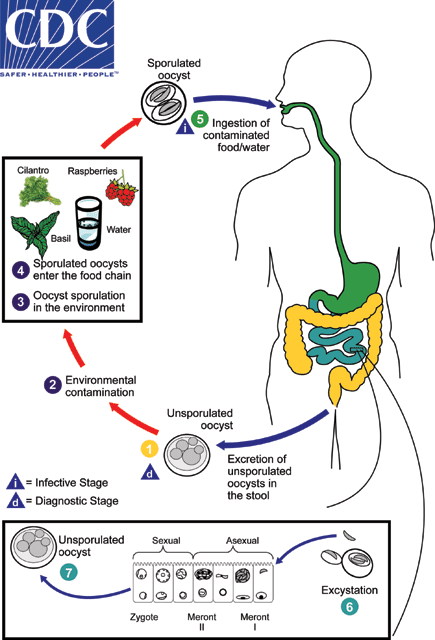
The U.S. Food and Drug Administration (FDA) recently updated its constituents about the agency’s ongoing Cyclospora cayetanensis prevention and research efforts. In 2021, FDA released its “Cyclospora Prevention, Response and Research Action Plan.” The action plan was developed by the agency’s Cyclospora Task Force and details FDA’s strategy for reducing the public health burden of foodborne cyclosporiasis in the U.S. It also defines the agency’s priorities for Cyclospora food safety research and supports ongoing efforts to combat foodborne illness in alignment with FDA’s New Era of Smarter Food Safety initiative.

Since releasing the Cyclospora action plan, FDA has made progress on several goals. The agency’s activities related to the Cyclospora action plan include:

  • Collaboration with the National Advisory Committee on Microbiological Criteria for Foods to develop a charge document that will inform FDA’s prioritization of Cyclospora research and propose novel food safety research projects in collaboration with stakeholders
  • Implementation of a genotyping approach for Cyclospora in environmental and food samples based on the same method published by the U.S. Centers for Disease Control and Prevention (CDC)
  • Implementation of a distance learning plan and a series of Cyclospora methodology training webinars on the “Bacteriological Analytical Manual (BAM) Chapter 19b – Detection of C. cayetanensis in Fresh Produce” using a real-time PCR-analytical method in Spanish for regulatory lab personnel at food safety authorities in Mexico through the FDA-SENASICA-Cofepris Food Safety Partnership
  • Collaborated with the U.S. Centers for Disease Control and Prevention (CDC) to publish an article in Food Safety Magazine summarizing the data on all cyclosporiasis outbreaks from 2013 to 2020
  • Delivered eight webinars directed to the fresh produce industry, regulators, and other stakeholders for Cyclospora outreach and educational purposes
  • Completed a microbial survey of fresh herbs that included over 800 samples tested for C. cayetanensis.

Canada – Magnesium Citrate Oral Solution; Microbial contamination

Gov Canada

Summary

Product
Magnesium Citrate Oral Solution
Issue
Health products – Product quality
What to do
  • Stop using the products listed. Consult your health care professional if you have used these products and have health concerns, and for advice on which health products are best for you and your family.
  • Report any health product adverse events or complaints to Health Canada.

Affected products

Issue

Presence of Gluconacetobacter liquefaciens in affected lots.

What you should do

  • Stop using the products listed. Consult your health care professional if you have used these products and have health concerns, and for advice on which health products are best for you and your family.
  • Report any health product adverse events or complaints to Health Canada.

Research – Incidents remain stable for international food safety network

Food Safety News

The number of food safety incidents involving an international network has stayed almost the same in the second quarter of 2022.

The International Food Safety Authorities Network (INFOSAN) was part of 46 alerts from April through June this year compared to 47 in the first quarter of 2022.

A total of 22 incidents involved a biological hazard with Listeria monocytogenes behind eight and Salmonella causing seven. Norovirus was responsible for three and hepatitis A for one. The hazard has not yet been identified in two cases.

Seventeen alerts were because of an undeclared allergen or ingredient such as milk, shellfish, peanuts, almonds, egg, gluten, hazelnuts, mustard, sesame or soy.

Five were because of a chemical hazard such as aflatoxin, chlorpyriphos, histamine and alkaloids and two involved a physical hazard; one for metal and one for plastic.

India – Karnataka: 40 students fall sick after eating midday meal

India Express

Forty students of Government Higher Primary School in Gollarahatti, in Chitradurga district, fell sick and 26 of them had to be hospitalised after eating the midday meal served at the school on Thursday afternoon.

Doddappa MC, headmaster of the school, said, “On Thursday afternoon I received calls from villagers and teachers who complained that students are falling unconscious and are vomiting. By the time I reached the school, some students had been admitted to the hospital. However, all students are okay.”

He added that food samples have been sent to the laboratory to ascertain if it was a case of food poisoning.

News! – Man who ‘hasn’t stopped farting for five years’ sues food stall for €235k over ham roll -Salmonella

Irish Mirror

A dad who claims he hasn’t stopped farting since eating a ham sandwich five years ago is suing a food stall for €235,000.

He claims to have been bedridden for five weeks with salmonella as a result of eating the item.

The lawyers added that Mr Prades has had regular and uncontrollable flatulence ever since, embarrassing him in public and waking him up at night.

Research – From chicken to salad: Cooking salt as a potential vehicle of Salmonella spp. and Listeria monocytogenes cross-contamination

PubMed

Epidemiological studies show that improper food handling practices at home account for a significant portion of foodborne illness cases. Mishandling of raw meat during meal preparation is one of the most frequent hazardous behaviours reported in observational research studies that potentially contributes to illness occurrence, particularly through the transfer of microbial pathogens from the raw meat to ready-to-eat (RTE) foods. This study evaluated the transfer of two major foodborne pathogens, Salmonella enterica and Listeria monocytogenes, from artificially contaminated chicken meat to lettuce via cooking salt (used for seasoning) during simulated domestic handling practices. Pieces of chicken breast fillets were spiked with five different loads (from ca. 1 to 5 Log CFU/g) of a multi-strain cocktail of either S. enterica or L. monocytogenes. Hands of volunteers (gloved) contaminated by handling the chicken, stirred the cooking salt that was further used to season lettuce leaves. A total of 15 events of cross-contamination (three volunteers and five bacterial loads) were tested for each pathogen. Immediately after the events, S. enterica was isolated from all the cooking salt samples (n = 15) and from 12 samples of seasoned lettuce; whereas L. monocytogenes was isolated from 13 salt samples and from all the seasoned lettuce samples (n = 15). In addition, S. enterica and L. monocytogenes were able to survive in artificially contaminated salt (with a water activity of 0.49) for, at least, 146 days and 126 days, respectively. The ability of these foodborne pathogens to survive for a long time in cooking salt, make it a good vehicle for transmission and cross-contamination if consumers do not adopt good hygiene practices when preparing meals.

Research – Public Health Risk of Foodborne Pathogens in Edible African Land Snails, Cameroon

CDC

In tropical countries, land snails are an important food source; however, foodborne disease risks are poorly quantified. We detected Campylobacter spp., Yersinia spp., Listeria spp., Salmonella spp., or Shiga-toxigenic Escherichia coli in 57%–86% of snails in Cameroon. Snail meat is a likely vector for enteric diseases in sub-Saharan Africa countries.

Research – A 3-year multi-food study of the presence and persistence of Listeria monocytogenes in 54 small food businesses in Ireland

Academia Edu

The problem of assessing the occurrence of the food-borne pathogen Listeria monocytogenes in the food chain, and therefore the risk of exposure of the human population, is often challenging because of the limited scope of some studies.

In this study the occurrence of L. monocytogenes in food from four major food groups, dairy products,
meats, seafood and vegetables, and associated food processing environments in Ireland was studied over a three-year period. Fifty-four small food businesses participated in the study and sent both food and environmental samples every 2 months between 2013 and 2015. L.monocytogenes was isolated using the ISO11290 standard method.

Confirmation of L. monocytogenes and identification of serogroups were achieved using a multiplex PCR
assay, and for some isolates serotype was determined using commercial antisera. Pulsed- field gel electrophoresis (PFGE) analysis was performed on all isolates allowing the relatedness of isolates from different food businesses
to be compared nationwide. In total, 86 distinct pulsotypes were identified. The overall occurrence of L.
monocytogenes in food samples was 4.2%, while in environmental samples it was 3.8%. In general, the occurrence of L. monocytogenes in food businesses decreased over the course of the study, presumably reflecting increased awareness and vigilance.

The majority of the pulsotypes detected were unique to a particular food group (63/
86), while only three pulsotypes were found in all four food groups investigated. The highest occurrence in food was found in the meat category (7.5%) while seafood had the lowest rate of occurrence (1.8%). Seventeen of the pulsotypes detected in the study were persistent, where persistence was defined as repeated isolation from a single facility with a minimum time interval of 6 months. Using PFGE, 11 of the pulsotypes identified in this study were indistinguishable from those of 11 clinical isolates obtained from patients in Ireland over the last 4 years, highlighting the fact that these pulsotypes are capable of causing disease.

Overall, the study shows the diversity of L. monocytogenes strains in the Irish food chain and highlights the ability of many of these strains to persist in food processing environments. The finding that a significant proportion of these pulsotypes are also found in clinical settings highlights the need for continued vigilance by food producers, including frequent sampling and typing of isolates detected.