Salmonella in chicken meal from The Netherland in Italy.
Salmonella in poultry meal from the UK in Belgium and the Netherlands
Salmonella Newport in dog chews from Poland in Germany

Salmonella in chicken meal from The Netherland in Italy.
Salmonella in poultry meal from the UK in Belgium and the Netherlands
Salmonella Newport in dog chews from Poland in Germany
Posted in Animal Feed, Animal Feed Salmonella, Animal Feed Testing, Food Micro Blog, Food Microbiology, Food Microbiology Blog, Food Microbiology Testing, microbial contamination, Microbiological Risk Assessment, Microbiology, Microbiology Investigations, Pet Food, Pet Food Testing, RASFF, Salmonella, Salmonella Dog Food, Uncategorized

Consuming raw or undercooked eggs potentially causes Salmonella infection, which can pose severe, sometimes life-threatening, health risks, especially to susceptible populations. During August 2017 to August 2020, the Centre for Food Safety has received referrals of more than 300 food poisoning outbreaks related to food premises, involving nearly 1000 victims, caused by Salmonella species.
Both the outside and the inside of eggs can be contaminated with Salmonella. Egg shells can be contaminated with faecal matter and germs may enter through pores or cracks on the shell of eggs. Moreover, Salmonella can be introduced to the egg from infected reproductive tissues of poultry prior to shell formation. Eggs contaminated with Salmonella may look normal.
To assist the food trade in preventing food poisoning due to Salmonella in eggs and egg products, the Centre for Food Safety gives out practical food safety advice about using eggs in food preparation:
Purchase eggs from reliable sources and only accept eggs that are clean without cracks or leakage.
For dishes that often use lightly cooked or uncooked eggs, choose pasteurised eggs, egg products or dried egg powder. Pasteurisation is the process of applying low heat to kill pathogens and inactivate spoilage enzymes.
The above advice is applicable not only in food businesses but also in domestic settings to reduce risks of food poisoning.

MethodsData from 22 of 31 provincial-level administrative divisions (PLADs) of the National Foodborne Disease Outbreaks Surveillance System during 2004−2020 and Embase, China National Knowledge Infrastructure (CNKI), Wanfang Data, and Chinese Science and Technique Journals (CQVIP) from January 2004 to December 2020 to identify indexed publications in the Chinese literature using the following search terms “botulism,” or “botulinum toxin,” or “Clostridium botulinum.” The number and proportion of outbreaks, illnesses, and deaths by PLAD, food types, and contributing factors were calculated.
ResultsDuring 2004−2020, a total of 80 foodborne botulism outbreaks occurred in China, involving 386 illnesses and 55 deaths; most outbreaks were reported between June and August, with a sharp peak in January; 22 out of 31 PLADs reported foodborne botulism outbreaks, Xinjiang reported the largest number of outbreaks (20), followed by Qinghai (13); the most commonly implicated food was home-prepared traditional processed stinky tofu and dried beef, accounting for 51.25% events. Improper processing and improper storage in contributing factors accounted for 77.50% outbreaks. Initial misdiagnosis occurred in 27.50% of cases.
ConclusionsOutbreaks of foodborne botulism had a high case-fatality rate. Targeted food safety and popularization education to farmers and herdsmen in Xinjiang and Qinghai related to botulism prevention should be carried out, and timely outbreak investigation and hospital surge capacity should be improved.
Belgian scholars in consumers of sausages first described botulism in 1896 (1). It was confirmed that the growth and germination of toxins occurred only under particular conditions in an anaerobic low salt, low-acid environment. People who ingest food contaminated with botulinum neurotoxin (BoNT) produced by botulinum toxin can have a potentially fatal outcome (2). Outbreaks have been reported worldwide. In Canada, the first Clostridium botulinum type E outbreak in 1944 in Nanaimo, British Columbia was reported in 1947 (3); In China, Wu et al. first reported botulism in Xinjiang in 1958 due to edible semi-finished noodle sauce (4). A better understanding of the epidemiology of botulism outbreaks can help tailor local prevention and public health response strategies. Here, we reviewed surveillance data on outbreaks, illnesses, and deaths of botulism in China from 2004 to 2020.
Posted in Clostridium, Clostridium botulinum, Decontamination Microbial, food bourne outbreak, Food Illness, Food Micro Blog, Food Microbiology, Food Microbiology Blog, Food Microbiology Research, Food Microbiology Testing, Food Poisoning, Food Poisoning Death, Foodborne Illness, Foodborne Illness Death, foodborne outbreak, foodbourne outbreak, Illness, microbial contamination, Microbiological Risk Assessment, Microbiology, Microbiology Investigations, outbreak, Research
| Date Posted |
Ref # |
Pathogen or Cause of Illness |
Product(s) Linked to Illnesses (if any) |
Total Case Count |
Status |
| 6/15/
2022 |
1070 | Listeria monocytogenes |
Not Yet Identified | 12 | Active |
| 6/8/
2022 |
1068 | E. coli O157:H7 |
Not Yet Identified | 10 | Active |
| 6/1/
2022 |
1066 | Hepatitis A Virus | Strawberries | See Outbreak Advisory |
Active |
| 5/25/
2022 |
1067 | Salmonella Senftenberg |
Peanut Butter | See Outbreak Advisory | Active |
| 4/20/
2022 |
1064 | Not Yet Identified |
Dry Cereal | 558 adverse event reports |
Active |
| 4/13/
2022 |
1057 | Listeria monocytogenes |
Not Yet Identified |
21 | Active |
| 3/30/
2022 |
1060 | Not Yet Identified |
Meal Replacement Drink |
6 adverse event reports |
Closed |
| 3/16/
2022 |
1055 | Salmonella Saintpaul |
Not Identified | 60 | Closed |
| 2/17/
2022 |
1056 | Cronobacter sakazakii |
Powdered Infant Formula |
See Advisory |
Active (IMG) |
| 2/9/
2022 |
1040 | Listeria monocytogenes |
Not Identified | 20 | Closed |
| 2/2/
2022 |
1054 | Enteroinvasive E. coli O143:H26 |
Not Identified |
16 | Closed |
| 1/10/
2022 |
1050 | E. coli O121:H19 |
Romaine | 4 | Closed |
Posted in Cronobacter sakazakii, E.coli O121, E.coli O157, E.coli O157:H7, FDA, Food Micro Blog, Food Microbiology, Food Microbiology Blog, Food Microbiology Research, Food Microbiology Testing, Hepatitis A, Listeria monocytogenes, microbial contamination, Microbiological Risk Assessment, Microbiology, Microbiology Investigations, O143:H26, Salmonella
USDA’s Food Safety and Inspection Service (FSIS) has issued a notice informing inspection program personnel (IPP) that FSIS will stop sampling for Salmonella sampling in raw fish in both domestic and imported products.
The final rule “Mandatory Inspection of Fish of the Order Siluriformes and Products Derived from Such Fish” (80 FR 75590; December 2, 2015) amended the Agency’s regulations to establish a mandatory inspection program for these fish and products derived from these fish. FSIS conducted exploratory sampling for Salmonella in raw fish to monitor its presence.
FSIS inspection program personnel are informed that the agency is stopping Salmonella sampling for raw fish in domestic and imported products. After July 13, 2022, IPP will no longer receive sampling tasks for the project codes:
If any sampling tasks remain after July 13, 2022, IPP should cancel the remaining sampling tasks and select “Not collected for miscellaneous reasons” as the reason for the cancellation.
Listeria monocytogenes is a serious public health hazard responsible for the foodborne illness listeriosis. L. monocytogenes is ubiquitous in nature and can become established in food production facilities, resulting in the contamination of a variety of food products, especially ready-to-eat foods. Effective and risk-based environmental monitoring programs and control strategies are essential to eliminate L. monocytogenes in food production environments. Key elements of the environmental monitoring program include (i) identifying the sources and prevalence of L. monocytogenes in the production environment, (ii) verifying the effectiveness of control measures to eliminate L. monocytogenes, and (iii) identifying the areas and activities to improve control. The design and implementation of the environmental monitoring program are complex, and several different approaches have emerged for sampling and detecting Listeria monocytogenes in food facilities. Traditional detection methods involve culture methods, followed by confirmation methods based on phenotypic, biochemical, and immunological characterization. These methods are laborious and time-consuming as they require at least 2 to 3 days to obtain results. Consequently, several novel detection approaches are gaining importance due to their rapidness, sensitivity, specificity, and high throughput. This paper comprehensively reviews environmental monitoring programs and novel approaches for detection based on molecular methods, immunological methods, biosensors, spectroscopic methods, microfluidic systems, and phage-based methods. Consumers have now become more interested in buying food products that are minimally processed, free of additives, shelf-stable, and have a better nutritional and sensory value. As a result, several novel control strategies have received much attention for their less adverse impact on the organoleptic properties of food and improved consumer acceptability. This paper reviews recent developments in control strategies by categorizing them into thermal, non-thermal, biocontrol, natural, and chemical methods, emphasizing the hurdle concept that involves a combination of different strategies to show synergistic impact to control L. monocytogenes in food production environments.
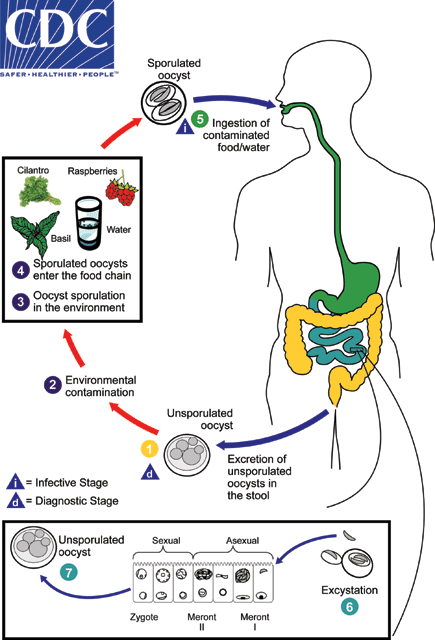
Will there be a cyclospora outbreak in the United States this summer? There have been multiple cyclospora outbreaks in the past nine years, including in 2013, 2014, 2015, 2016, 2017, 2018, 2019, 2020, and 2021. This year may be no exception.
In the past, Cyclospora outbreaks have been linked to fresh produce, including cilantro, raspberries, basil, mesclun, vegetable trays, bagged salad mixes, and snow peas. The cyclospora parasite is transmitted through human feces. The oocyst must mature, or sporulate, outside of the body before it becomes infectious. This infection is not passed person-to-person.
It is very difficult to protect yourself against this parasite, since it can cling to produce, especially produce such as leafy greens and herbs, and is not easily washed or rinsed off. And since most of the foods it contaminates are eaten without being heated, there is no kill step to destroy the parasite.
Posted in Cyclospora, Cyclosporiasis, food bourne outbreak, Food Illness, Food Micro Blog, Food Microbiology, Food Microbiology Blog, Food Microbiology Research, Food Microbiology Testing, Foodborne Illness, Foodborne Illness Death, foodborne outbreak, foodbourne outbreak, Illness, microbial contamination, Microbiological Risk Assessment, Microbiology, Microbiology Investigations, outbreak, Parasite, Protozoan, Research
The Alliance to Stop Foodborne Illness created what it said is an evolving food safety culture toolkit tailored for small and medium-sized food businesses to help companies mature their food safety cultures.
Food safety culture is one of the biggest drivers of change across the food industry. By definition, a mature and positive food safety culture consists of shared values, norms and beliefs that affect mindsets and behaviors toward food safety in, across and throughout the company. Leaders in mature and positive cultures demonstrate ownership and recognize food safety is integral to the consumer and the success of their company.
Every company has a food safety culture — good, bad or okay — but how do you work to improve when you might not know how to start?
The Alliance to Stop Foodborne Illness created an evolving food safety culture toolkit tailored for small and medium-sized food businesses to help companies mature their food safety cultures.
Because one more person impacted by foodborne illness is too many, the toolkit is offered for free to strengthen food safety behaviors that help prevent our friends, loved ones, and neighbors from getting sick.
This is a initiative between Stop Foodborne Illness (STOP) and members of the Alliance — which consists of industry-leading food safety practitioners from Fortune 500 companies and guided by Dr. Lone Jespersen, STOP board member.
The Alliance working group spent the last year creating this initial guide drawing on science, personal food safety culture experiences, and working with STOP constituent advocates negatively impacted by a foodborne illness.
The toolkit helps businesses create a strategy to improve their food safety culture. “This toolkit helps food companies shift from doing the bare minimum to avoid recalls to making good, holistic choices to protect overall public health,” said Dr. Vanessa Coffman, Director of Alliance to Stop Foodborne Illness. “By sharing our Alliance members’ best practices, smaller companies can now build a path toward improving their own food safety culture. This toolkit is not a checklist. It is a process of continual learning, a helpful guide in choosing tools most effective for your workforce.”
Much like a food safety culture journey, the toolkit will evolve with additional resources, guides and how-to strategies. “We will continue to enhance this toolkit for as long as organizations continue to want to keep products and families safe from foodborne illness,” said Coffman.
On Sunday, June 12th, around two in the afternoon many people began to go to a private clinic located near the outskirts of the municipality of Seyé, presenting the same symptoms.
Nausea, high or low blood pressure, vomiting, and diarrhea were just some of the symptoms suffered by men, women, and children, due to the food poisoning cases that forced the municipal authorities to report the events to the Ministry of Health.
The Secretary of Public Security (SSP) transferred some people to other places for their attention, and staff from the Ministry of Health arrived in Seyé to carry out the corresponding investigations.
Posted in food bourne outbreak, Food Illness, Food Micro Blog, Food Microbiology, Food Microbiology Blog, Food Microbiology Testing, Food Poisoning, Foodborne Illness, foodborne outbreak, foodbourne outbreak, Illness, microbial contamination, Microbiological Risk Assessment, Microbiology, Microbiology Investigations, outbreak, Poisoning
Three people have died in an ongoing Listeria outbreak linked to fish in the United Kingdom.
The UK Health Security Agency, Food Standards Agency (FSA), Public Health Scotland and Food Standards Scotland (FSS) are investigating the Listeria monocytogenes outbreak that was first made public in April.
Twelve patients across the UK have been identified, including three in Scotland, with onset dates of illness between October 2020 to March 2022.
Ten sick people are over the age of 65, and one is a pregnant woman. Three of those affected who are older than 65 have died.
Six people have fallen ill since January 2022. The majority of patients reported eating smoked fish.
The FSA and FSS are doing food chain and microbiological investigations including whole genome sequencing (WGS) but the cause is yet to be confirmed.
Posted in food bourne outbreak, food death, Food Illness, Food Micro Blog, Food Microbiology, Food Microbiology Blog, Food Microbiology Research, Food Microbiology Testing, Foodborne Illness, Foodborne Illness Death, foodborne outbreak, foodbourne outbreak, Illness, Listeria, Listeria monocytogenes, microbial contamination, Microbiological Risk Assessment, Microbiology, Microbiology Investigations, outbreak, Research, UKHSA

 FoodWorld