Category Archives: microbial contamination

USA -Quest Beef Cat Food Recalled For Possible Salmonella

Food Poisoning Bulletin

Go Raw, LLC is recalling its 2 pound frozen bags of Quest Beef Cat Food for possible Salmonella contamination. No illnesses have been reported to date in connection with this issue.

The Quest Beef Cat Food is sold in 2 pound bags, and has the UPC number UPC 6-91730-17101-8 with lot number N128. The Minnesota Department of Agriculture took a sample of the product and tested it for Salmonella; it tested positive.

The firm conducted its own test and it was negative. But, Salmonella may not be evenly distributed throughout the cat food, which is typical, which explains the discrepancy.

Sweden -Sweden reports increase in Cryptosporidium, most in Stockholm

Outbreak News Today crypto

Swedish health officials, aka Folkhalsomyndigheten have reported an increase in the parasitic infection, cryptosporidiosis in recent weeks, particularly in November.

About half of the country’s regions have reported cases in all ages, but primarily in adults. Most cases are seen in the Stockholm region.

The Public Health Agency and the National Food Agency have started an outbreak investigation to identify if there are one or more common sources of infection that are unknown so far. As part of the investigation, cases are interviewed about what they ate and drank before they became ill.

USA -Outbreak of Listeria Infections Linked to Deli-Sliced Meats and Cheeses

CDC

This investigation is over. This outbreak is a reminder that deli products, such as sliced meats and cheeses, can have Listeria bacteria. People who are at higher risk for Listeria infection should avoid eating hot dogs, lunch meats, cold cuts, and other deli meats, unless they are heated to an internal temperature of 165°F or until steaming hot just before serving.

CDC and several states, along with the U.S. Department of Agriculture’s Food Safety and Inspection Service and the U.S. Food and Drug Administration, investigated a multistate outbreak of Listeria infections linked to deli-sliced meats and cheeses. A single, common supplier of deli products was not identified.

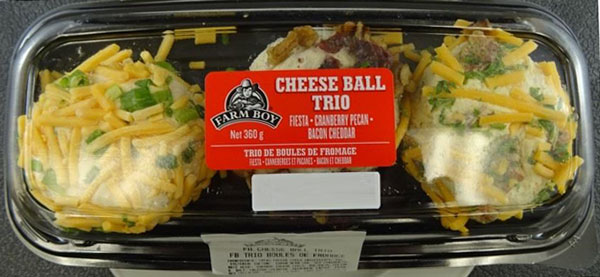
Canada – Food Recall Warning – Farm Boy brand cheese balls recalled due to Listeria monocytogenes

CFIA

Ottawa, November 17, 2019 – Farm Boy is recalling Farm Boy brand cheese balls from the marketplace due to possible Listeria monocytogenes contamination. Consumers should not consume the recalled products described below.

Recalled product

Brand Product Size UPC Codes
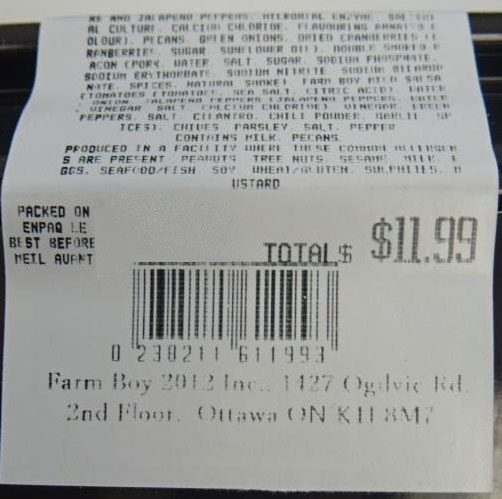
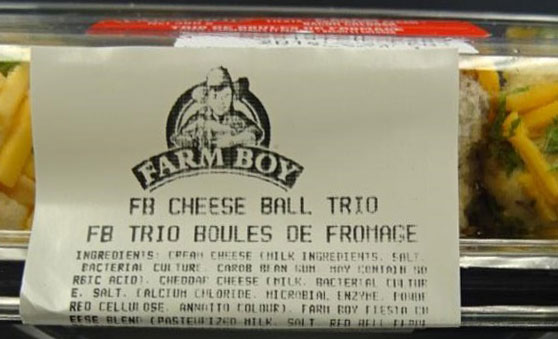
Farm Boy Cheese Ball Trio – Fiesta, Cranberry Pecan, Bacon Cheddar and/or “FB Cheese Ball Trio” 360 g Starting with 0 238211 All units sold up to and including November 17, 2019
Farm Boy “FB Blue Cheese & Walnut Ball” 180 g Starting with 0 238274 All units sold up to and including November 17, 2019
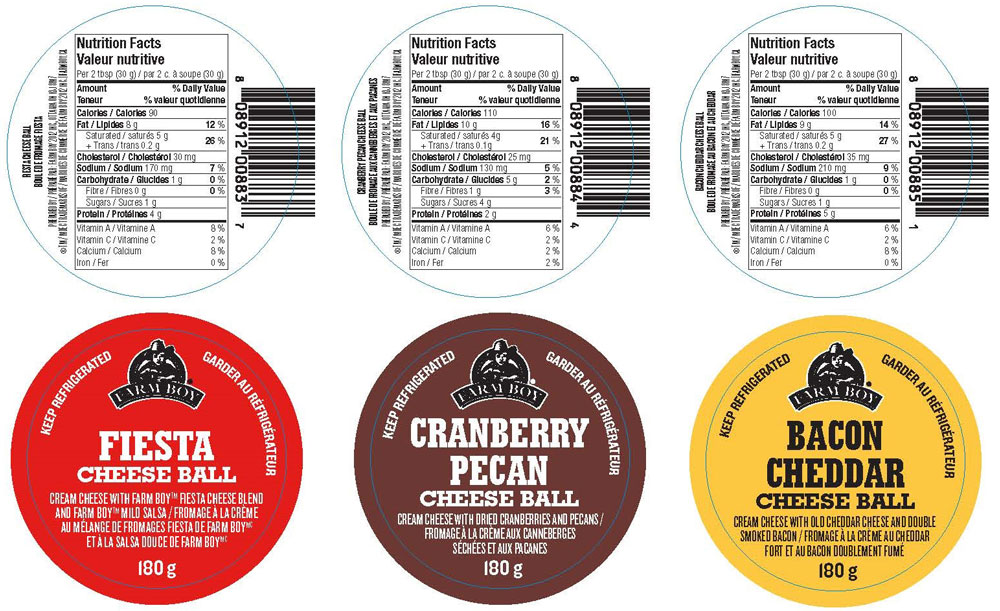
Farm Boy Cranberry Pecan Cheese Ball and/or “FB Cran Pecan Cheese Ball” 180 g 8 08912 00884 4 or Starting with 0 232337 All units sold up to and including November 17, 2019
Farm Boy Fiesta Cheese Ball and/or Farm Boy Fiesta Cheese Ball 180 g 8 08912 00883 7 or Starting with 0 238283 All units sold up to and including November 17, 2019
Farm Boy “FB Wht Choc Pecan Cran Ball” 180 g Starting with 0 238275 All units sold up to and including November 17, 2019
Farm Boy Bacon Cheddar Cheese Ball and/or “FB Bacon Chedd. Cheese Ball” 180 g 8 08912 00885 1 or Starting with 0 238284 All units sold up to and including November 17, 2019

Illnesses

There have been no reported illnesses associated with the consumption of these products.

Product photos

Printer ready version of photos

  • Farm Boy Cheese Ball Trio – 360 grams (side)
  • Farm Boy Cheese Ball Trio – 360 grams (outer label)
  • Farm Boy Cheese Ball Trio – 360 grams (UPC)
  • Farm Boy Cheese Ball – 180 grams (pre-printed labels)
  • Farm Boy Cheese Ball – 180 grams (store-printed labels)

Research – Decontamination of Bacillus cereus in cardamom (Elettaria cardamomum) seeds by infrared radiation and modeling of microbial inactivation through experimental models

Wiley Online 

In this work, infrared (IR) irradiation was used for inactivation of Bacillus cereus in cardamom seeds. The effect of IR power (100, 200, and 300 W), sample distance from radiation source (5, 10, and 15 cm) and holding times (0–11 min) was investigated on B. cereus count, as well as cardamom seeds color and temperature profiles. Inactivation of B. cereus on cardamom seeds during IR processing was demonstrated by experimental models. The highest reduction of B. cereus count (5.11 Log CFU/g) was achieved after 8 min IR irradiation at 300 W power and 15 cm distance. Measurement of temperature profiles revealed that there was a significant difference (p < .05) between surface and center temperatures of the cardamom seeds. The green color (a* value) of cardamom seeds was slightly affected and the highest color change was observed at 200 W IR, 10 cm distance and 10 min irradiation that resulted in an increase of a* from −3.05 ± 0.96 to −0.05 ± 0.44. In conclusion, IR irradiation could be successful for decontamination of cardamom seeds without severe alteration of its quality. Among the experimental models for microbial inactivation during IR processing, the Double Weibull model had the highest coefficient value of determination (R2 = 0.9966).

Research -Occurrence of Campylobacter spp., Salmonella spp. and shiga toxin‐producing Escherichia coli in inline milk filters from Swedish dairy farms

Wiley Online

Abstract

This study investigated the occurrence of shiga toxin‐producing Escherichia coli (STEC), thermotolerant Campylobacter spp. and Salmonella spp. in Swedish dairy milk. A total of 302 inline milk filters were analyzed. Salmonella was not isolated from any filters. Polymerase chain reaction screening detected thermotolerant Campylobacter in 30.5% of the milk filters analyzed and it was isolated from 12.6% of filters. The stx genes (stx 1, stx 2, or both) were screened from 71% of the filters and STEC was isolated from 14% of these. Of the STEC isolates, 21 contained the stx 1 gene, 19 the stx 2 gene, and five a combination of both stx 1 and stx 2 genes. Whole genome sequence typing on 34 of the 45 STEC showed that they belonged to 21 different serotypes, of which STEC O145:H28 was the most common (2%). STEC O157:H7 was only found from one (0.3%) of the filters. A combination of stx 2 and eae genes was found from 0.7% of the total number of inline milk filters analyzed, while stx 2a was found in 24% of the whole genome‐sequenced isolates. There was a significant positive correlations between number of animals per farm and presence of pathogens on milk filters.

Research -Radiofrequency pasteurization process for inactivation of Salmonella spp. and Enterococcus faecium NRRL B-2354 on ground black pepper

Science Direct

Abstract

Salmonella persistence in ground black pepper has caused several foodborne outbreaks and created public concern about the safety of low water activity (aw) foods. In this study, radiofrequency (RF) processing was evaluated for pasteurization of ground black pepper. Stability and homogeneity tests were done for both Salmonella spp. and E. faecium during moisture equilibration before RF heating to evaluate the inoculation method. Moisture content of samples were conditioned such that the final moisture content after RF heating reached the optimal storage moisture. RF heating was shown to provide more than 5.98 log CFU/g reduction for Salmonella spp. and the reduction of 3.89 log CFU/g for E. faecium with a 130 s of treatment time. The higher thermal resistance of E. faecium indicated its suitability as surrogate for Salmonella spp. during RF heating of ground black pepper. Piperine, total phenolics, volatile compounds, and antioxidant activity were assessed as quality parameters for ground black pepper. The results demonstrated that the RF processing provided effective inactivation of Salmonella spp. with insignificant (p > 0.05) quality deterioration.

RASFF Alert – Animal Feed – Aflatoxin – Bird Feed

RASFF-Logo

RASFF -aflatoxins (B1 = 312 µg/kg – ppb) in groundnut kernels for birdfeed from Argentina in the UK

RASFF Alert – Animal Feed – Salmonella – Soybean Cakes

RASFF-Logo

RASFF -Salmonella enterica ser. Haifa (presence /25g) in soybean cakes from Ukraine in  Austria

Research – Searching for high pressure processing parameters for Escherichia coli O157:H7, Salmonella enterica and Listeria monocytogenes reduction in Concord grape juice

Research Gate

Purpose High pressure processing (HPP) has been widely used for high-acid (pH<4.6) juices. The purpose of this study was to investigate optimal parameters aimed at achieving 5-log reduction of the pathogens of reference in Concord grape juice (pH 3.39). Design/methodology/approach Grape juice was inoculated with five strain cocktails of Escherichia coli O157:H7, Salmonella enterica and Listeria monocytogenes . In total, 11 trials were carried out based on a Central Composite Rotational Design (CCRD). The pressure ( P ), ranging from 319 to 531 MPa, and dwell time ( t ), from 35 to 205 s, were tested. The performance of the combinations ( P × t ) was evaluated by pathogen challenge microbiological assays. Findings E. coli O157:H7 was more resistant to HPP than S. enterica . L. monocytogenes did not grow in unprocessed juice (before HPP). Findings demonstrated that moderate pressures (~400 MPa) and short dwell times (~2 min) were effective in achieving a greater than 5-log reduction in the pathogens of reference. Practical implications Because the maintenance costs of equipment exponentially increase with pressure beyond 600 MPa, significant reductions in process pressure are highly desirable. Originality/value The results of this study can supplement the dearth of information on the applicability of high pressure as a Concord grape juice processing technology in terms of the pathogens inactivation. Furthermore, the use of a cocktail of five strains of pathogens inoculated in Concord grape juice to challenge different HPP parameters has not been reported.