Category Archives: microbial contamination

Research – The number affected in the Italian Listeria outbreak climbs to 90; three dead

Food Safety News

At least 90 people have been affected and three have died in a major Listeria outbreak in Italy.

The Ministry of Health (Ministero della Salute) said the most recent patient was reported in mid-September.

Deaths occurred in December 2021 and March and June 2022 in Lombardy, Piedmont, and Emilia Romagna. The patients were immunocompromised or particularly vulnerable to infection. One woman lost her baby in the outbreak.

Patients live in Piedmont, Lombardy, Veneto, Emilia Romagna, Liguria, Umbria, Tuscany, Calabria, Lazio, Puglia, Valle D’Aosta and Abruzzo.

France – Nestlé ‘found E. coli in flour at Buitoni pizza factory in 2021’


Just Food

Nestlé reportedly found E. coli in flour at the Buitoni pizza factory in France linked to a fatal outbreak this year back in August 2021.

French TV programme Envoyé Spécial has claimed an internal document shows the bacteria was picked up in flour at the Caudry site seven months before the Swiss giant recalled almost 1m pizzas and halted production.

Around fifty children fell sick, cases that have been linked to eating Buitoni Fraîch’Up pizzas. Two children died.

USA – Norovirus Sickened 173 at D. C. Cobb’s Restaurant in Illinois

Food Poisoning Bulletin

Eurofins

A norovirus outbreak sickened 173 people at D. C. Cobb’s restaurant in McHenry, Illinois in August 2022, according to an investigation by the McHenry County Department of Health (MCDH). Two of those patients were hospitalized. The last time this investigation was updated was on September 16, 2022, when it was reported that 16 people were sick after eating at that restaurant. The restaurant is located at 1204 North Green Street in McHenry.

Research – Recent Research on Fusarium Mycotoxins in Maize—A Review

MDPI

Maize (Zea mays L.) is one of the most susceptible crops to pathogenic fungal infections, and in particular to the Fusarium species. Secondary metabolites of Fusarium spp.—mycotoxins are not only phytotoxic, but also harmful to humans and animals. They can cause acute or chronic diseases with various toxic effects. The European Union member states apply standards and legal regulations on the permissible levels of mycotoxins in food and feed. This review summarises the most recent knowledge on the occurrence of toxic secondary metabolites of Fusarium in maize, taking into account modified forms of mycotoxins, the progress in research related to the health effects of consuming food or feed contaminated with mycotoxins, and also the development of biological methods for limiting and/or eliminating the presence of the same in the food chain and in compound feed. View Full-Text

Denmark – Outbreak with invasive Listeria infection sequence type 7 in Denmark

SSI

Between 18 August and 13 October 2022, five cases of Listeria monocytogenes have been registered at the Statens Serum Institut . The Statens Serum Institut, the Danish Veterinary and Food Administration and the Norwegian Food Institute DTU are investigating the disease outbreak.

Last edited on October 31, 2022

About the disease outbreak

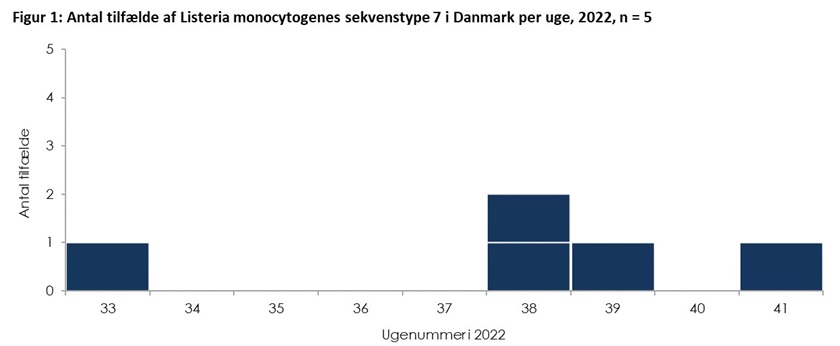
Between 18 August and 13 October 2022, the Statens Serum Institut registered five people who are infected with the same type of Listeria monocytogenes (figure 1). Among the sick are 2 men and 3 women. The patients are between 6-83 years old (median age is 75 years). The patients are infected throughout the country (table 1).

Figure 1 Number of cases of Listeria monocytogenes sequence type 7 per week 2022 in Denmark

Table 1. Patients with the same type of Listeria monocytogenes in Denmark, August to October 2022, per region (n=5)

Region

Number of patients

The capital  1
Central Jutland  1
Northern Jutland 0
Zealand 1
Southern Denmark 2
Total 5

The investigation of the outbreak

The outbreak is handled by the Central Outbreak Group, which consists of SSI, the Danish Veterinary and Food Administration and the DTU Food Institute. SSI stands for whole-genome sequencing of listeria isolates from the patients and interviews with patients or relatives with a view to identifying a possible source of infection.

The outbreak strain

The bacteria is of the type Listeria monocytogenes . By whole-genome sequencing of the Listeria monocytogenes bacteria isolated from the patients, it can be seen that they are very closely related and belong to sequence type 7.

Can noroviruses be transmitted through food?

MAST

Food Borne Illness - Norovirus -CDC Photo

In winter, an increase in norovirus cases can be expected, as the infection is called the winter plague in some languages ​​(eg vinterkräksjuka in Swedish). The main symptoms of norovirus infection are malaise, vomiting, diarrhea, fever and abdominal pain.

The virus is highly contagious and only a few viruses are needed to cause infection. Noroviruses can be transmitted through food from people who are ill or have recently been ill with norovirus. There are examples of norovirus being transmitted through food in Iceland and abroad, such as frozen raspberries, oysters and food from restaurants. Such infections can cause group infections.

For example, the consumption of frozen raspberries caused a widespread norovirus infection in Denmark a few years ago. Subsequently, the Danes established rules that frozen raspberries should be heated before consumption, and such instructions can often be seen on packaging.

But how can the virus be prevented from spreading to food at home, in canteens, restaurants and other food businesses?

  • The production, cooking and serving of food should be avoided during illness and for at least 48 hours. after the symptoms are over.
  • Wash hands before handling food.
  • Wash hands before eating
  • Offer options for hand disinfection at the buffet.
  • Prevent utensil handles from coming into contact with food.
  • Food companies have clear rules regarding staff illness and their return.

The risk of norovirus being transmitted through food can be reduced if these guidelines are followed.

Advanced material:

Research – The Ability of Shiga Toxin-Producing Escherichia coli to Grow in Raw Cow’s Milk Stored at Low Temperatures

MDPI

Despite the lack of scientific evidence, some consumers assert that raw milk is a natural food with nutritional and immunological properties superior to pasteurized milk. This has led to the increased popularity of unpasteurized cow milk (UPM) and disregard for the risks of being exposed to zoonotic infections. Dairy cattle are healthy carriers of Shiga toxin (Stx)-producing E. coli (STEC), and contaminated UPM has caused STEC outbreaks worldwide. The association between STEC, carrying the eae (E. coli attachment effacement) gene, and severe diseases is well-established. We have previously isolated four eae positive STEC isolates from two neighboring dairy farms in the Southeast of Norway. A whole genome analysis revealed that isolates from different farms exhibited nearly identical genetic profiles. To explore the risks associated with drinking UPM, we examined the ability of the isolates to produce Stx and their growth in UPM at different temperatures. All the isolates produced Stx and one of the isolates was able to propagate in UPM at 8 °C (p < 0.02). Altogether, these results highlight the risk for STEC infections associated with the consumption of UPM.

Research – Survey of the occurrence of Giardia duodenalis cysts and Cryptosporidium spp. oocysts in green leafy vegetables marketed in the city of Valencia (Spain)

Science Direct

Abstract

The role of vegetables usually consumed without prior culinary treatment is known to contribute to the prevalence of foodborne diseases. Cysts and oocysts can contaminate food, which can then be the source of infection in humans. The aim of the study was to assess the occurrence of Giardia duodenalis and Cryptosporidium spp. (oo)cysts in green leafy vegetables marketed in the city of Valencia (Spain) combining parasitological methods, two real-time qPCRs and light microscopy. An experimental field study was conducted on 129 vegetable samples, 64 from conventional farms and 65 from ecological (organic) farms. The samples were washed with water, and the resulting solution after removing the vegetables, was subjected to 24-hour sedimentation. The concentrated sediment was used for the search for protozoa. A positive result by both real-time PCRs, or a positive result by one qPCR and confirmation by microscopy was established as a positivity criterion. Giardia duodenalis was detected in 23.0 % of the samples, and Cryptosporidium spp. in 7.8 %. G. duodenalis (41.5 %) and Cryptosporidium spp. (20.0 %) were more frequent in ecological crops. The high level of contamination detected in organic vegetables may be due to the type of fertilizers and the quality of the water used for their irrigation and reinforces the need to take extreme hygiene measures in vegetables that are consumed raw.

USA – The Incident Command System and Foodborne Illness Outbreak Investigations

Food Safety Magazine

The Coordinated Outbreak Response and Evaluation (CORE) Network is the coordination focal point for all FDA resources during outbreak investigations

The Basics of Foodborne Illness Outbreak Investigations

When a foodborne illness outbreak is detected, public health and regulatory officials work together to determine what caused the outbreak and then take actions to avert additional illnesses from happening.1,2 During outbreak investigations, public health and regulatory authorities collect three types of data to determine a common food consumed by ill people: epidemiologic, traceback, and laboratory.

State and local partners, in collaboration with the Centers for Disease Control and Prevention (CDC), identify outbreaks and the foods that may be causing the illnesses through public health surveillance and epidemiologic evidence. State and local partners work with the U.S. Food and Drug Administration (FDA) to conduct traceback investigations and examine the food supply chain to determine the origin of the foods identified by the epidemiologic investigations.3 State and local authorities, in partnership with FDA, may use product and environmental sampling, followed by laboratory analyses, to further confirm the identified food as the outbreak source.

The data analyses and subsequent decision-making require extensive input from all investigation partners. Through a combination of the data gathered during an investigation, a food may be implicated as the source of an outbreak. FDA, CDC, and state and local partners work together to inform the public of outbreaks and provide information on how the public can protect themselves from foodborne illness. Based on investigational data, FDA, for example, may ask a firm to recall the product from the market or, in the case of imported products, may issue an import alert to provide additional information to the field to help stop outbreaks and protect public health.

Research – Joint FAO/WHO Expert Meeting on the pre- and post-harvest control of non-typhoidal Salmonella spp. in poultry meat

FAO

Conclusions
The expert consultation noted that no single control measure was sufficiently effective at reducing either the prevalence or the level of contamination of broilers and poultry meat with NT-Salmonella spp. Instead, it was emphasized that control strategies based on multiple intervention steps ( multiple or multi-hurdle)would provide the greatest impact in controlling NT-Salmonella spp. in the broiler production chain.
The expert consultation concluded the following: Primary production interventions for the control of NT-Salmonella spp. Biosecurity and management approaches for the control of NT-Salmonella spp.
•At all levels of farm production, stringent biosecurity measures including sanitation and hygiene are important factors to prevent and control NT-Salmonella spp.in flocks.
•It is important for breeding flocks to be NT-Salmonella-free, and this begins at the parent/grandparent flock level and in the production environment. Vaccination-based approaches for the control of NT-Salmonella spp.
•Vaccine-based strategies reduce the prevalence and/or level of shedding of NT-Salmonella spp.in flocks but do not eliminate NT-Salmonella spp. Antimicrobial approaches for the control of NT-Salmonella spp.

 •There was no strong evidence that the use of substances with antimicrobial activity such as additives in feed and water resulted in effective control of NT- Salmonella spp. in broilers. Competitive exclusion/probiotics approaches for the control of NT-Salmonella spp.
•A promising strategy for NT-Salmonella spp. control was a combination of different competitive exclusion products (e.g., probiotics and prebiotics) but there was a limited number of published studies using naturally contaminated chicks and/or under commercial conditions to allow for adequate conclusions. Feed and water characteristics and management approaches for the control of NT-Salmonella spp.
•The efficacy of specific feed- and water-based strategies were study-specific and dependent upon the physiological status of both the pathogen and the animal, the broiler gastrointestinal tract environment, the concentration of the additive, and the method of its application.
•The use of feed modifications, including the acidification of feed and water, are not stand-alone hazard-based control measures for the control of NT-Salmonella spp. in poultry. However, feed-based strategies, when used in conjunction with good hygienic practices, may further reduce NT-Salmonellaspp.in poultry.
•Based on the information available, further studies are needed to assess how extensive scale application of modified feed and management approaches could impact NT-Salmonella spp. levels Bacteriophage-based approaches for the control of NT-Salmonella spp.
•There is limited information as to the effectiveness of bacteriophage-based control of NT-Salmonella spp. at the farm level. Further research is needed, especially in the long-term efficacy of bacteriophage-based control. Processing interventions for the control of NT-Salmonella spp.
•Good hygienic practices are important in minimizing the risk of NT-Salmonella spp. contamination during slaughter and processing.
•The effect of processing interventions on NT-Salmonella spp. are influenced by a variety of conditions, including but not limited to characteristics of the NT-Salmonella strain, pH, agent concentration, temperature, contact time, absorbed dose, product characteristics, and processing parameters.
•There was extensive information on the use of water additives, but the current scientific literature is not sufficient to draw objective conclusions regarding the effectiveness of some of them. However, chlorine-based compounds and organic acids (lactic acid, peroxy acetic acid (PAA), and acidified chlorate solutions) showed potential effectiveness.
•High pressure processing may be effective in reducing NT-Salmonella spp. in poultry meat.
•An extensive body of scientific evidence suggested that ionizing radiation can achieve any level of NT-Salmonella spp. reduction from pasteurization to complete sterility.

 •Other interventions or combinations of interventions, including but not limited to novel additives, thermal processes and physical treatments applied to the meat still require further refinement. Post-processing interventions for the control of NT-Salmonella spp.
•Control measures applied during processing may extend shelf-life and control the growth of NT-Salmonella spp.at the retail or consumer level, however, the literature in this area is sparse and the application of post-processing interventions needs further examination to assess feasibility.
•Emphasis should be placed on encouraging a positive food safety culture through human behaviour and consumer education as it applies to transport, storage, handling and cooking practices.
The experts highlighted several paragraphs in the Guidelines for the Control of Campylobacter and Salmonella in Chicken Meat (CXG 78-2011) that could benefit from an update (Annex 2).Other factors that the expert panel considered that have the potential to impact NT-Salmonella spp. control strategies in the future included changes in climate, broiler value chain, human behaviour and awareness, food safety culture, pathogens and their hosts.
With the advent of next generation technologies including machine learning, omics, tools for traceability and a better understanding of the interactions between Salmonella and the microbiome will lead to more accurate quantitative microbial risk assessments (QMRA) and improved One Health.