Category Archives: Illness

RASFF Alert – EIEC Outbreak – Spring Onions

RASFF

Spring onions from Egypt suspected to be the source of an outbreak of EIEC in Denmark

Slovenia – Around 100 people in Ilirska Bistrica infected with Norovirus

STA

norovirus-1080x655

Ilirska Bistrica, 29 December – After the public broadcaster RTV Slovenija reported of a mass food poisoning in the Ilirska Bistrica area in south-eastern Slovenia, further investigations revealed that around a hundred people contracted norovirus, which can be transmitted in various ways, not just through food.

Research – Multistate Outbreak of Salmonella enterica Serovar Heidelberg with Unidentified Source, Australia, 2018–2019

CDC

Abstract

We report a multistate Salmonella enterica serovar Heidelberg outbreak in Australia during 2018–2019. Laboratory investigation of cases reported across 5 jurisdictions over a 7-month period could not identify a source of infection but detected indicators of severity and invasiveness. The hospitalization rate of 36% suggested a moderately severe clinical picture.

Salmonella enterica serovar Heidelberg is a frequently identified serotype among infections in humans in North America, East Africa, and Asia but is uncommon in Australia. An average of 37 cases of Salmonella Heidelberg were notified in Australia annually in 2009–2017, predominantly overseas acquired (1). Six outbreaks have been reported nationally since 1995; 1 outbreak in 1996 had >500 cases, but most have <7 cases (R. Bell, pers. comm. [email], 2020 Jun 16). We report a national outbreak of Salmonella Heidelberg infection across 5 jurisdictions over 7 months.

We report a national outbreak investigation of a locally uncommon S. enterica serovar of unknown origins in Australia. Although Salmonella Heidelberg outbreaks are relatively uncommon in Australia, given this outbreak’s comparatively high hospitalization rate and the presence of saf fimbrial genes in the implicated strain, future cases warrant prompt investigation to assess severity and invasiveness. A platform for real-time exchange of sequence data in Australia and use of routine WGS for salmonellosis cases, including comparison with local and international strain data, may enable more timely detection of outbreaks.

Research – Assessment of Food and Waterborne Viral Outbreaks by Using Field Epidemiologic, Modern Laboratory and Statistical Methods—Lessons Learnt from Seven Major Norovirus Outbreaks in Finland

MDPI

Food Borne Illness - Norovirus -CDC Photo

Seven major food- and waterborne norovirus outbreaks in Western Finland during 2014–2018 were re-analysed. The aim was to assess the effectiveness of outbreak investigation tools and evaluate the Kaplan criteria. We summarised epidemiological and microbiological findings from seven outbreaks. To evaluate the Kaplan criteria, a one-stage meta-analysis of data from seven cohort studies was performed. The case was defined as a person attending an implicated function with diarrhoea, vomiting or two other symptoms. Altogether, 22% (386/1794) of persons met the case definition. Overall adjusted, 73% of norovirus patients were vomiting, the mean incubation period was 44 h (4 h to 4 days) and the median duration of illness was 46 h. As vomiting was a more common symptom in children (96%, 143/149) and diarrhoea among the elderly (92%, 24/26), symptom and age presentation should drive hypothesis formulation. The Kaplan criteria were useful in initial outbreak assessments prior to faecal results. Rapid food control inspections enabled evidence-based, public-health-driven risk assessments. This led to probability-based vehicle identification and aided in resolving the outbreak event mechanism rather than implementing potentially ineffective, large-scale public health actions such as the withdrawal of extensive food lots. Asymptomatic food handlers should be ideally withdrawn from high-risk work for five days instead of the current two days. Food and environmental samples often remain negative with norovirus, highlighting the importance of research collaborations. Electronic questionnaire and open-source novel statistical programmes provided time and resource savings. The public health approach proved useful within the environmental health area with shoe leather field epidemiology, combined with statistical analysis and mathematical reasoning.

Research – Salmonella Serotypes Associated with Illnesses after Thanksgiving Holiday, United States, 1998–2018

CDC

Abstract

We sought to determine which Salmonella serotypes cause illness related to the Thanksgiving holiday in the United States and to foods disproportionately eaten then (e.g., turkey). Using routine surveillance for 1998–2018 and a case-crossover design, we found serotype Reading to be most strongly associated with Thanksgiving.

Thanksgiving, celebrated annually in the United States on the fourth Thursday of November, often brings together family and friends who eat specific traditional foods, such as mashed potatoes, cranberry sauce, and pumpkin pie; the most prominent food eaten is turkey (1). In 2017, ≈45 million turkeys were produced for Thanksgiving, ≈18% of annual production (2). Turkey is popular across regions, races, sexes, and generations; 88% of persons in the United States report eating turkey during their Thanksgiving meal (1,3,4).

Foodborne Salmonella infections cause substantial illness and death in the United States: an estimated 1 million cases, 20,000 hospitalizations, and 400 deaths occur annually (5). Typical illness consists of diarrhea, fever, and abdominal pain lasting 3–7 days; only a minority of persons seek health care. Incubation typically ranges from 6 hours to 6 days (5). Salmonella outbreaks caused by serotypes Hadar and Saint Paul have been most commonly attributed to turkey, and serotypes Enteritidis, Heidelberg, and Typhimurium have been frequent causes of turkey-associated outbreaks (6). During 2015‒2020, Reading and Hadar were the serotypes most often isolated from turkeys (7); less is known about which serotypes cause turkey-associated sporadic Salmonella infections. We aimed to determine which Salmonella serotypes cause sporadic enteric infections after the Thanksgiving holiday and are most likely related to foods disproportionately eaten then, particularly turkey.

Viking Sea Cruise – outbreak update: Vibrio and E. coli reported as causative agents

Outbreak News Today

Norovirus Food Safety kswfoodworld

In a follow-up on the gastrointestinal illness outbreak that affected 118 passengers and crew onboard a recent Viking Cruise Lines Viking Sea voyage, The Centers for Disease Control Prevention Vessel Sanitation Program (CDC-VSP) reported the causative agents as Vibrio (no species indicated) and E. coli on Wednesday.

This is the first and only cruise ship outbreak investigated and reported by VSP this year.

USA – FDA Core Outbreak Table – 5 Active Outbreaks

FDA

Date
Posted
Reference
#
Pathogen
Product(s)
Linked to
Illnesses

(if any)
12/20/2021 1039 Listeria
monocytogenes
Packaged Salad
12/15/2021 1048 Listeria
monocytogenes
Packaged Salad
11/24/2021 1044 Salmonella Javiana Not Yet
Identified
11/17/2021 1043 E. coli
O157:H7
Spinach

USA – Outbreak Investigation of Listeria monocytogenes: Dole Packaged Salad (December 2021)

FDA

The FDA, along with CDC and state and local partners, is investigating a multistate outbreak of Listeria monocytogenes infections potentially linked to Dole packaged leafy greens. According to the CDC, as of December 22, 2021, 16 people infected with the outbreak strain of Listeria monocytogenes have been reported from 13 states. Illnesses started on dates ranging from August 16, 2014 to October 17, 2021 (one case occurred in 2014 and the remaining cases occurred between 2018 and 2021).

CDC investigated this outbreak in 2019 and 2020 but was unable to gather enough data to identify the source in the past. CDC reopened the investigation in November 2021 when four new illnesses were reported since the end of August.

In October 2021, as a part of routine retail sampling, the Georgia Department of Agriculture collected a product sample of prepackaged salad mix from a grocery store for testing. The sample tested positive for Listeria monocytogenes. In response to the sample results, Dole initiated a recall of packaged garden salads in October 2021. These products are now past their “Best if Used By” dates. The positive sample was later sent for whole genome sequencing (WGS) analysis; and in December 2021, WGS analysis was completed. The results show that the Listeria monocytogenes in the product sample was a match to the outbreak strain. FDA is conducting an inspection at the facility that produced the product that tested positive for Listeria monocytogenes.

The Michigan Department of Agriculture and Rural Development also recently initiated retail sampling of Dole products in their state as part of this investigation. One product containing lettuce from the Dole facility in Yuma, AZ, tested positive for Listeria monocytogenes. WGS analysis showed that the Listeria monocytogenes in the product sample is also a match to the outbreak strain.

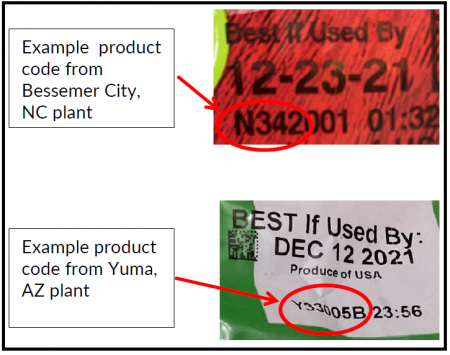
In response to the sample analyses and the ongoing outbreak investigation, Dole has agreed to voluntarily suspend operations at both the Bessemer City, NC, facility and Yuma, AZ, facility and has voluntarily recalled all products and brands from those facilities. Those products have production lot codes beginning with either the letter “N” or “Y” in the upper right-hand corner of the package and Best if Used By dates from November 30, 2021 to January 8, 2022.

This recall does not include whole head packaged lettuce. A full list of recalled products is available on FDA’s website.

This investigation is ongoing, and additional information will be provided as it becomes available.

Recommendation

Consumers, restaurants, and retailers, should not eat, sell, or serve recalled Dole packaged salads. A full list of recalled products is available on FDA’s website.

FDA recommends that anyone who received recalled products use extra vigilance in cleaning and sanitizing any surfaces and containers that may have come in contact with these products to reduce the risk of cross-contamination. Listeria can survive at refrigeration temperatures and can easily spread to other foods and surfaces.

Recall Information

In response to the sample analyses and the ongoing outbreak investigation, Dole has agreed to voluntarily suspend operations at both the Bessemer City, NC, facility and Yuma, AZ, facility and has voluntarily recalled all products and brands from those facilities. Those products have production lot codes beginning with either the letter “N” or “Y” in the upper right-hand corner of the package and Best if Used By dates from November 30, 2021 to January 8, 2022.

This recall does not include whole head packaged lettuce.

The following images are of example labels from recalled products highlighting where to find product codes. View a full list of recalled products

Outbreak Investigation of Listeria monocytogenes from Dole Packaged Salad - Sample Product Codes (December 22, 2021)

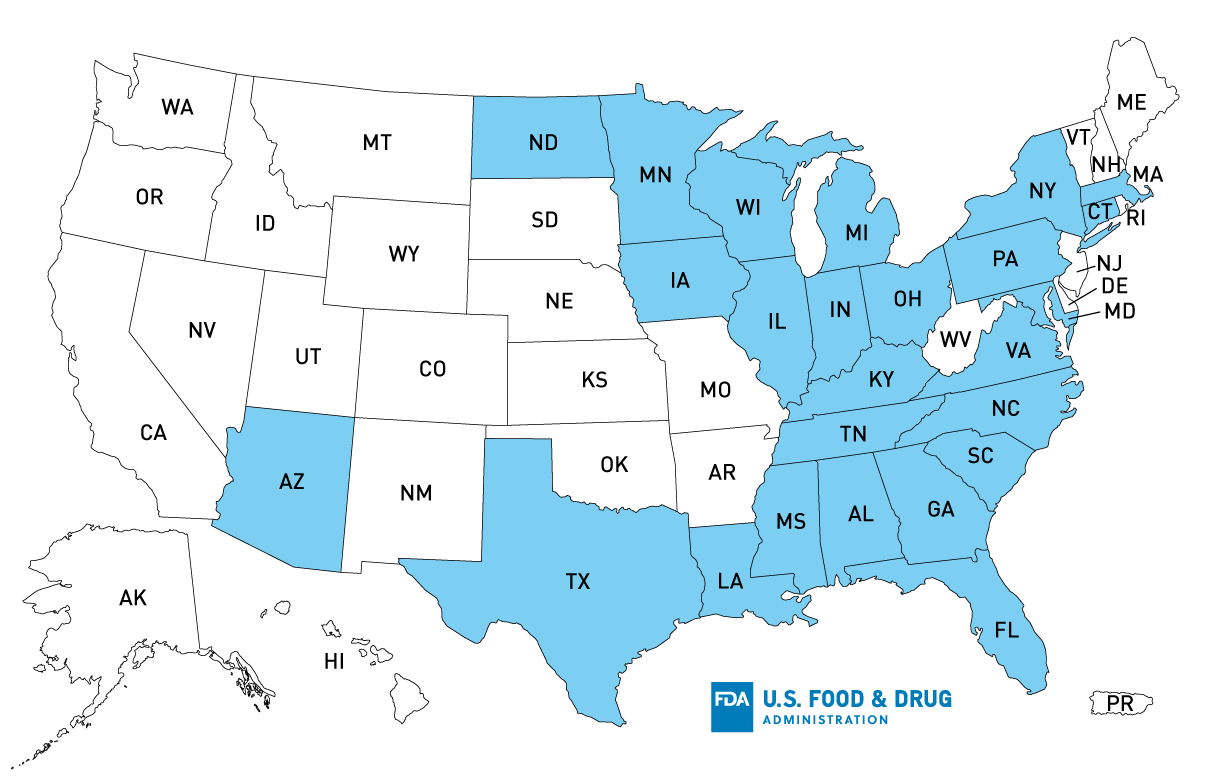
Map of U.S. Distribution of Recalled Packaged Salad

Outbreak Investigation of Listeria monocytogenes from Dole Packaged Salad - Map of U.S. Distribution of Recalled Packaged Salas (December 22, 2021)

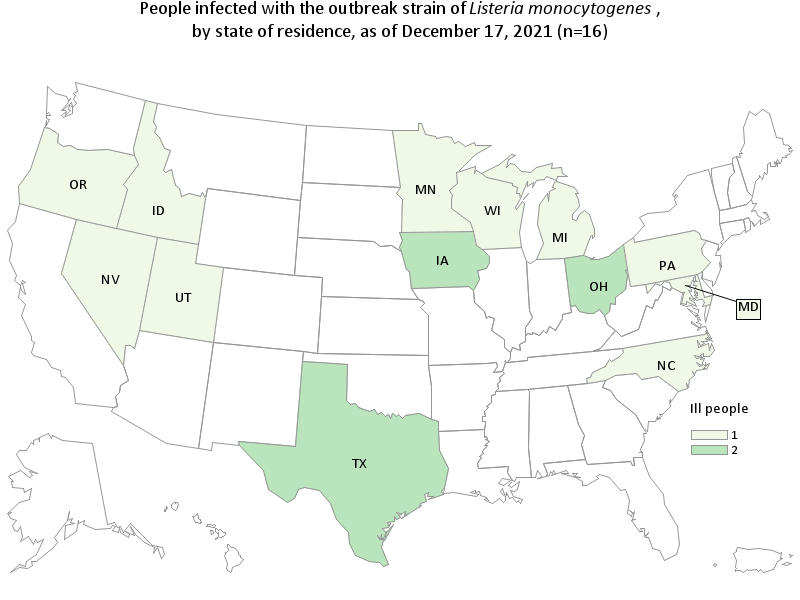
Case Count Map Provided by CDC

Outbreak Investigation of Listeria monocytogenes from Dole Packaged Salad - CDC Case Count Map (December 22, 2021)

Case Counts

Total Illnesses: 16
Hospitalizations: 12
Deaths: 2
Last Illness Onset: October 17, 2021
States with Cases: IA, ID, MD, MI, MN, NC, NV, OH, OR, PA, TX, UT, WI
Product Distribution*: AL, AZ, CT, FL, GA, IA, IL, IN, KY, LA, MA, MD, MI, MN, MS, NC, ND, NY, OH, PA, SC, TN, TX, VA, WI

*Distribution has been confirmed for states listed, but product could have been distributed further, reaching additional states


USA – Nationwide Onion Outbreak will likely be over 1,000 by Christmas -Salmonella

Food Poison Journal

As of November 12, 2021, 892 people infected with the outbreak strain of Salmonella Oranienburg have been reported from 38 states and Puerto Rico. Illnesses started on dates ranging from May 31, 2021, to October 25, 2021.

Sick people range in age from less than 1 year to 101 years, with a median age of 37, and 58% are female. Of 571 people with information available, 183 (32%) have been hospitalized.

According to other publicly available data, we expect to see the number of sickened in this outbreak to crest 1,000.

USA – FDA – Outbreak Investigation of Listeria monocytogenes: Fresh Express Packaged Salad (December 2021)

FDA

The FDA and CDC, in collaboration with state and local partners, are investigating a multistate outbreak of Listeria monocytogenes infections. According to the CDC, as of December 21, 2021, 10 people infected with the outbreak strain of Listeria monocytogenes have been reported from eight states. Illnesses started on dates ranging from July 26, 2016 to October 19, 2021.

As a part of routine sampling, the Michigan Department of Agriculture and Rural Development (MDARD) collected a product sample of Fresh Express Sweet Hearts salad mix with a Use-By-Date of December 8, 2021 for testing. The sample tested positive for Listeria monocytogenes and subsequent whole genome sequencing (WGS) analysis determined that the Listeria monocytogenes present in the samples matches the strain that has caused illnesses in this outbreak.

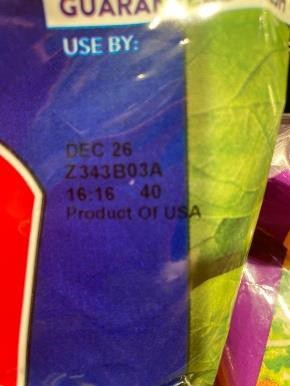
In response to the sample results and the ongoing outbreak investigation, Fresh Express voluntarily ceased production at the Streamwood, IL, facility and initiated a recall of certain varieties of its branded and private label salad products produced at the company’s Streamwood, Illinois facility. The recall includes all Use-By Dates of fresh salad items with product codes Z324 through Z350. Product codes are located on the front of the packages below the Use-By Date, as shown above. No other Fresh Express products are subject to recall. A full list of recalled products is available on FDA’s website.

This is an ongoing investigation and additional information will be provided as it becomes available.

Recommendation

Consumers, restaurants, and retailers, should not eat, sell, or serve recalled packaged salads. A full list of recalled products is available on FDA’s website.

FDA recommends that anyone who received recalled products use extra vigilance in cleaning and sanitizing any surfaces and containers that may have come in contact with these products to reduce the risk of cross-contamination. Listeria can survive in refrigerated temperatures and can easily spread to other foods and surfaces.


Product Images

Image – Bagged Salad, Use By Date

U.S. Distribution of Recalled Packaged Salad

Outbreak Investigation of Listeria monocytogenes: Packaged Salad: Case Count Map Provided by CDC (December 21, 2021)

Case Counts

Total Illnesses: 10
Hospitalizations: 10
Deaths: 1
Last Illness Onset: October 19, 2021
States with Cases: IL, MA, MI, NJ, NY, OH, PA, VA