Category Archives: Fusarium Toxin

RASFF Alerts – Aflatoxin – Broken Rice – Pistachios – Nutmeg – Peanuts – Groundnuts – Dried Figs

RASFF

Aflatoxins in pistachios from the United States in Germany

RASFF

Aflatoxin B1 in Indian groundnuts in the Netherlands

RASFF

Aflatoxins in nutmeg from Indonesia in the Netherlands

RASFF

Aflatoxin B1 in U.S.A. peanuts in the Netherlands

RASFF

Aflatoxins in Organic Nicaraguan Peanuts in Netherlands and Ireland

RASFF

Aflatoxins in dried figs from Turkey in Austria, Germany, Belgium, France, Netherlands, Switzerland

RASFF

Aflatoxin in broken rice from Pakistan in Italy and Belgium

RASFF

Aflatoxins in shelled pistachios from USA in Italy

Germany – CILOGLU ASURELIK INCIR 20 X 250 GR (Dried Figs) – Aflatoxins

LMW

Warning type: Food
Date of first publication: 08/30/2021
Product name:

CILOGLU ASURELIK INCIR 20 X 250 GR (Dried Figs)

Product pictures:

Image 1.PNG

Branch notice

Manufacturer (distributor):

Ciloglu Handels GmbH, Gärtringen

Reason for warning:

An increased content of aflatoxins (B1, B2, G1 and G2) was found in the present product.

Packaging Unit:250 g
Durability:

Best before 07.2022

Lot identification: LOT NUMBER (P. NO) L 0900 22475 / 1-11-52
Additional Information:

Reference is made to the company’s customer information.

Contact to the responsible authorities:

Baden-Württemberg:poststelle@mlr.bwl.de

Bavaria:poststelle@lgl.bayern.de
Berlin:poststelle@senjustva.berlin.de
Bremen:Schnellwarnung@gesundheit.bremen.de
Hamburg:poststelle@justiz.hamburg.de
Hesse:Schnellwarnung@rpda.hessen.de
Lower Saxony:poststelle@ml.niedersachsen.de
North Rhine-Westphalia:poststelle@mulnv.nrw.de
Rhineland-Palatinate:Poststelle.Referat22@lua.rlp.de
Saarland:poststelle-luv@lav.saarland.de
Saxony:poststelle@sms.sachsen.de
Saxony-Anhalt:poststelle@ms.sachsen-anhalt.de
Schleswig-Holstein:poststelle@jumi.landsh.de
Thuringia:LM-Ueberendung@tlv.thueringen.de
Press releases and information
title Attachment or web link
Recall – notification – end consumers

Research – Mycotoxins in aquaculture: A mitigation approach in turbot

All About Feed

Aquaculture is the fastest-growing food production industry in the world. Due to concerns about sustainability, the need to replace fish meal with plant-based protein alternatives becomes more urgent. However, plant-based ingredients are often contaminated with mycotoxins, increasing the health risks to fish.

Plant-based ingredients in commercial fish diets include maize, soybean meal and various cereal grains, each representing a potential source of mycotoxins.

Mycotoxins in fish feed a widespread problem

Mycotoxin-contaminated fish feed is a widespread problem, especially in tropical regions and developing countries where the farmers themselves often make fish feeds under inappropriate conditions with improper milling and/or storage. In addition to their impact on fish health, some mycotoxins can also accumulate in fish tissue, thereby posing a possible food safety risk.

About mycotoxins in aquaculture

According to a recent risk assessment study on mycotoxin contamination in fish feeds in Europe, deoxynivalenol (DON) is one of the primary mycotoxins present. DON is produced by over 50 species of Fusarium fungi, which mainly infect crops such as wheat and maize before harvest. Fusarium fungi produce a range of mycotoxins, such as fumonisins, the trichothecenes — most strongly associated with chronic and fatal toxic effects in animals and humans — and zearalenone, which is known to affect the fertility of many animal species, including aquatic species such as fish and shrimp.

The impact of mycotoxins depends on several factors including:

  • The type and quantity of mycotoxins in the feed,
  • Feeding level,
  • Duration of exposure
  • The species of fish

Most common issues include:

  • Reduced growth performance,
  • Immune suppression
  • Increased mortality

These are often associated with other on-farm concerns, so the mycotoxin risk is currently underestimated.


Research – Mycotoxins Affecting Animals, Foods, Humans, and Plants: Types, Occurrence, Toxicities, Action Mechanisms, Prevention, and Detoxification Strategies—A Revisit

MDPI

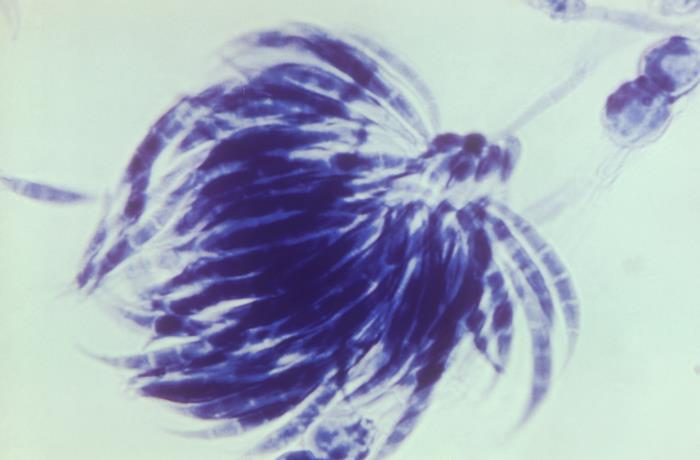
CDC Fusarium1

Mycotoxins are produced by fungi and are known to be toxic to humans and animals. Common mycotoxins include aflatoxins, ochratoxins, zearalenone, patulin, sterigmatocystin, citrinin, ergot alkaloids, deoxynivalenol, fumonisins, trichothecenes, Alternaria toxins, tremorgenic mycotoxins, fusarins, 3-nitropropionic acid, cyclochlorotine, sporidesmin, etc. These mycotoxins can pose several health risks to both animals and humans, including death. As several mycotoxins simultaneously occur in nature, especially in foods and feeds, the detoxification and/or total removal of mycotoxins remains challenging. Moreover, given that the volume of scientific literature regarding mycotoxins is steadily on the rise, there is need for continuous synthesis of the body of knowledge. To supplement existing information, knowledge of mycotoxins affecting animals, foods, humans, and plants, with more focus on types, toxicity, and prevention measures, including strategies employed in detoxification and removal, were revisited in this work. Our synthesis revealed that mycotoxin decontamination, control, and detoxification strategies cut across pre-and post-harvest preventive measures. In particular, pre-harvest measures can include good agricultural practices, fertilization/irrigation, crop rotation, using resistant varieties of crops, avoiding insect damage, early harvesting, maintaining adequate humidity, and removing debris from the preceding harvests. On the other hand, post-harvest measures can include processing, chemical, biological, and physical measures. Additionally, chemical-based methods and other emerging strategies for mycotoxin detoxification can involve the usage of chitosan, ozone, nanoparticles, and plant extracts. View Full-Text

RASFF Alerts – Mycotoxins – Fumonsins – Organic Corn Wafers

RASFF

Fumonisins in organic corn wafers from Slovakia in Germany

Spain – Enniatins, mycotoxins of emerging interest

ACSA

Molecular structure of enniatins

Origin and chemical structure

Enniatins (ENN) are a group of emerging mycotoxins produced by species of the genus Fusarium. They have a cyclic hexadepsipeptide structure that has three d-2 hydrocarboxylic amino acids and three N-methylamino amino acids linked alternately.

Enniatins have been found predominantly in cereal grains, such as barley, corn, oats, wheat, and rice, but they have also been found in nuts, dried fruit, bananas, Chinese medicinal herbs, and river water. Up to 29 natural analogs of enniatins are known, but only seven (A, A1, A2, B, B1, B2 and B3) have been detected in cereals and their derivatives, and enniatins A, A1, B and B1 are the findings most frequently in food and feed.

Table Functional groups that occupy the R positions in the figure and that determine enniatin.

Enniatina R1 R2 R3 R4 R5 R6
TO sec -butyl sec -butyl sec -butyl CH3 CH3 CH3
A1 iso- propyl sec -butyl sec -butyl CH3 CH3 CH3
A2 iso- propyl sec -butyl iso- propyl CH3 CH3 CH3
B iso- propyl iso- propyl iso- propyl CH3 CH3 CH3
B1 iso- propyl iso- propyl sec -butyl CH3 CH3 CH3
B2 iso- propyl iso- propyl iso- propyl H CH3 CH3
B3 iso- propyl iso- propyl iso- propyl H H CH3
B4 iso- propyl iso- propyl iso -butyl CH3 CH3 CH3
Beauvericin benzyl benzyl benzyl CH3 CH3 CH3

Since they originate from the same fungal species, enniatins are found concomitantly in food with other Fusarium mycotoxins , such as deoxynivalenol, moniliformin and fumonisins, and especially with beauvericin, another mycotoxin of emerging interest, since, in addition, it also shares the hexadipepsidic structure. This coincidence of origin and structural means that beauvericin is grouped analytically and toxicologically with the enniatins. Furthermore, analytical data show a high concomitance between enniatins and beauvericin in cereal grains.


RASFF Alert – Mycotoxin – Fumonsin – White Maize Flour

European Food Alerts

RASFF

fumonisins (1642 µg/kg – ppb) in white maize flour from Kosovo in Switzerland

Spain – Mycotoxin update on the Hazard Map

ACSA

In the Hazard Map database, we have updated all the sheets corresponding to the mycotoxins of the chemical hazards block:

  • Aflatoxins
  • Ochratoxins
  • Zearalenone
  • Deoxynivalenol
  • Fumonisins
  • Trichothecenes T-2 and HT2
  • Patulin

Mycotoxins are products of fungal metabolism and their ingestion, inhalation or skin absorption can cause disease or death in animals and people. The most important mycotoxins are produced by molds of the genera Aspergillus , Penicillium and Fusarium .

Among the most common mycotoxins are aflatoxins, ochratoxin A, patulin, fumonisins, zearanelone, deoxynivalenol, and T-2 and HT-2 toxins.

RASFF Alert – Mycotoxin – DON – Popcorn

European Food Alerts

RASFF

deoxynivalenol (DON) (2174 µg/kg – ppb) in popcorn from Hungary, packaged in Poland in Poland

Ireland – Recall of a Batch of Makar Bakalie Popcorn Due to Elevated Deoxynivalenol (DON) – Mycotoxin

FSAI

Thursday, 7 January 2021

Summary
Category 2: For Information
Alert Notification: 2021.02
Product: Makar Bakalie Popcorn ziarno kukurydzy do prazenia; pack size: 100g
Batch Code: 6447 2710; best before: 01/09/2021
Country Of Origin: Hungary

Message:

A batch of Makar Bakalie Popcorn is being recalled as it contains Deoxynivalenol (DON) in excess of the legal limit. Deoxynivalenol (DON) is a mycotoxin primarily produced by Fusarium fungi, occurring predominantly in cereal grains. Short-term (acute) exposure to high levels of DON has been reported to cause symptoms including nausea, vomiting, diarrhoea, abdominal pain, headaches, dizziness and fever in humans. Evidence of adverse health effects in humans due to long-term (chronic) exposure to DON is lacking, however, adverse effects such as reduced body weight gain have been observed in animal studies. The levels of DON detected exceed the maximum legal limit, however, health concerns are not expected from consuming the implicated batch.

Makar Popcorn