Category Archives: foodbourne outbreak

USA- Big Olaf Creamery Recalls Ice Cream Because of Possible Health Risk – Update

FDA

Photo 1 – Representative labeling, ice cream

Summary

Company Announcement Date:
FDA Publish Date:
Product Type:
Food & Beverages
Reason for Announcement:
Listeria monocytogenes
Company Name:
Big Olaf Creamery, LLC
Brand Name:
Big Olaf
Product Description:
Ice cream

Company Announcement

Big Olaf Creamery of Sarasota, Florida is recalling all flavors and all lots of Big Olaf brand ice cream products because it has the potential to be contaminated with Listeria monocytogenes, an organism which can cause serious and sometimes fatal infections in young children, frail or elderly people, and others with weakened immune systems. Although healthy individuals may suffer only short-term symptoms such as high fever, severe headache, stiffness, nausea, abdominal pain and diarrhea, Listeria infection can cause miscarriages and stillbirths among pregnant women.

The product was sold at Big Olaf retailers in Florida as well as to consumers in restaurants and senior homes, and one location in Fredericksburg, Ohio.

The Big Olaf brand ice cream was sold to consumers in plastic pint size containers, plastic ½ gallon containers, and plastic 2.5-gallon tubs, scoopable are sold to the independent retail stores. All flavors, lots, codes, and all expiration dates through 6/30/2022 are included in this recall.

Based on epidemiological information shared by the CDC and State Officials, Big Olaf may be a potential source of illness in an ongoing Listeria monocytogenes outbreak.

On Friday July 1, 2022, Big Olaf Creamery was informed of an outbreak investigation by the Florida Department of Health and Florida Department of Agriculture & Consumer Services and immediately ceased production and distribution of the ice cream product.

As of Friday, July 8th, 2022, the CDC reported that a total of 23 people were infected with the outbreak strain of Listeria monocytogenes from 10 states. Eighteen people interviewed reported eating ice cream, 10 reported eating Big Olaf Creamery brand ice cream or eating at locations that might have been supplied by Big Olaf Creamery. This is an ongoing investigation and other ice cream brands not related to Big Olaf were mentioned as a possible source as well.

Big Olaf Creamery and all retailers supplied did not receive any complaints regarding product defect or sickness. No formal complaints were filed with the Florida Department of Health as of July 1st, 2022.

Based on the information provided and upon the ongoing investigation, the company has ceased production and distribution of the ice cream product and is currently working with FDA by voluntarily recalling the product.

Big Olaf is cooperating fully with regulatory authorities to successfully return all suspected products and has requested retailers to stop sales and dispose of product. Consumers who have purchased Big Olaf Ice Cream Products should not consume these products and dispose of them immediately. Any areas, containers, and serving utensils that may have touched the ice cream should be cleaned.

Consumers that may have any questions about the recall may call 941-365-7483, Monday – Saturday from 8:00am – 5:00 pm EST.

FDA Outbreak Press Release


Company Contact Information

Consumers:
 941-365-7483
Media:
Rosie Peachey
 941-365-7483

USA – FDA CORE Table Updated: Big Olaf Ice Cream Listeria Outbreak

Food Poisoning Bulletin

The FDA Core Outbreak Investigation Table was updated, with ten active investigations. The FDA states that the Listeria monocytogenes outbreak that has sickened at least 23 people is linked to big Olaf ice cream. The quote is, “For the Listeria monocytogenes outbreak, a product linked to illnesses is ice cream from Big Olaf Creamery, located in Florida.”

USA – Outbreak Investigation of Listeria monocytogenes: Ice Cream (July 2022)

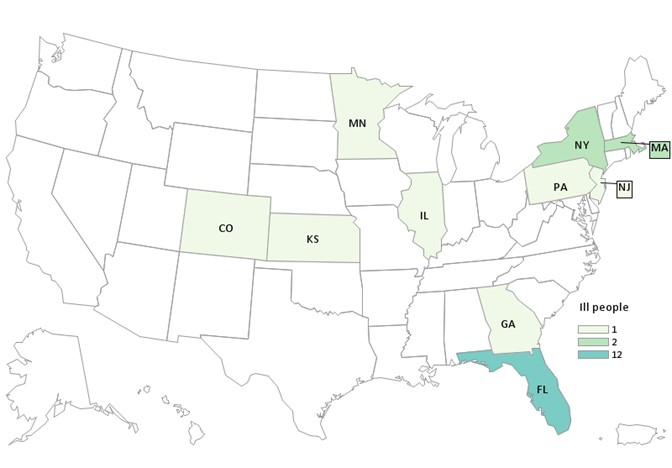
Outbreak Investigation of Listeria Monocytogenes in Florida-Based Big Olaf Ice Cream (July 2022) - CDC Case Count Map as of July 11, 2022

FDA

The FDA, along with CDC, is assisting the Florida Department of Health (FL DOH) and Florida Department of Agriculture & Consumer Services (FDACS) in investigating an outbreak of Listeria monocytogenes infections linked to ice cream supplied by Big Olaf Creamery of Sarasota, Florida.

Based on epidemiological information collected by CDC and the FL DOH, Big Olaf ice cream products are a likely source of illness in this outbreak. A total of 23 people infected with the outbreak strain of Listeria monocytogenes have been reported from 10 states. Of the 18 people interviewed, all (100%) reported eating ice cream. Among 18 people who remembered details about the type of ice cream they ate, 10 reported eating Big Olaf Creamery brand ice cream or eating ice cream at locations that might have been supplied by Big Olaf Creamery. Twelve sick people are residents of Florida and nine reported traveling to Florida before getting sick.

FDA is concerned that retailers may still be selling Big Olaf ice cream products. Retailers should not sell or serve Big Olaf ice cream products and should throw them away. Consumers who may still have these products in their freezers should not eat or serve any Big Olaf ice cream products and should also throw the product away.

This is an ongoing investigation, and the firm has initiated a voluntary recall of its ice cream products. The FDA is continuing to work with the FL DOH and FDACS to investigate and will update this advisory should additional consumer safety information become available.

Recommendation

Consumers, restaurants, and retailers should not eat, sell, or serve any Big Olaf ice cream products and should throw the product away, regardless of the “Best By” or expiration date.

Call your healthcare provider right away if you have these symptoms after eating Big Olaf ice cream products:

  • Pregnant people typically experience only fever, fatigue, and muscle aches. However, Listeria infection during pregnancy can lead to miscarriage, stillbirth, premature delivery, or life-threatening infection of the newborn.
  • People who are not pregnant may experience headache, stiff neck, confusion, loss of balance, and convulsions, in addition to fever and muscle aches.

Consumers, restaurants, and retailers who purchased or received any Big Olaf ice cream products should throw the products away, follow FDA’s safe handling and cleaning advice and use extra vigilance in cleaning and sanitizing any surfaces and containers that may have come in contact with these products to reduce the risk of cross-contamination. Listeria can survive in refrigerated temperatures and can easily spread to other foods and surfaces.

Case Counts

Total Illnesses: 23
Hospitalizations: 22
Deaths: 1
Fetal Loss: 1
Last illness onset: 6/12/2022
States with Cases: CO (1), FL (12), GA (1), IL (1), KS (1), MA (2), MN (1), NJ (1), NY (2), PA (1)
Product Distribution*: FL
*Distribution has been confirmed for states listed, but product could have been distributed further, reaching additional states

USA – Listeria Outbreak Connected to Big Olaf Creamery Allegedly Causes Death of One Woman

Food Poisoning News

A recent outbreak of Listeria infections is believed to be linked to an ice cream producer in Sarasota, Florida, called Big Olaf Creamery. The U.S. Center for Disease Control and Prevention (CDC) reports that there have been 23 people affected by the outbreak with 22 of these people seeking hospitalization due to the severity of their symptoms. One woman, Mary Billman, has passed away, allegedly due to the consumption of Big Olaf ice cream. Ms. Billman’s estate is pursuing legal action in response to her death.

Research – Collective food poisoning (TIAC) ​​with E. coli O157 producing Shiga toxins, associated with the consumption of raw cucumbers

Sante Publique

On September 9, 2021, the Regional Health Agency (ARS) of Hauts-de-France was informed of a suspicion of collective food poisoning (TIAC) ​​affecting half-board students, educated in several schools in a municipality. of the Lille metropolis. 

On September 13, 2021, two cases of haemolytic and uremic syndrome (HUS) were diagnosed in two hospitalized children attending school in this town. Public Health France Hauts-de-France was asked by the Hauts-de-France ARS to provide support for the investigations and management of this TIAC. A total of 35 cases of gastroenteritis, with bloody diarrhea and fever (>38°C) in half of the cases, were identified. Ten cases were hospitalized and two children developed HUS. 

The cases identified were half-board students in four school groups (29 cases), a parent of a student and elderly people benefiting from the municipality’s home meal delivery service (5 cases). The case canteens were all supplied by the central municipal kitchen. 

The shape of the epidemic curve was in favour of a common and point source of contamination during meals on September 2 or 3, 2021. The case-control survey, carried out in schools, concluded that only the consumption of cucumbers in salad, served with the meal on September 2, was statistically and significantly associated with the occurrence of the disease.

A strain of E. highly pathogenic Shiga toxin-producing (STEC) O157 coli was isolated from the stool cultures of eight cases, including the two children who developed HUS and in the offending cucumber salad. Genomic analysis of the strains confirmed the genetic clustering of clinical and food strains that belonged to the same genomic cluster. The veterinary investigation revealed that a failure in the decontamination process, associated with incomplete peeling of the contaminated cucumbers, contributed to the occurrence of this TIAC. 

The cucumbers in question came from Belgium and the Belgian health authorities were informed via the dedicated European alert circuits. No other episodes of clusters of STEC infection related to this TIAC have been reported to the ARS over the period while cucumbers from the same batch had been widely distributed in communities and commercial catering services in the Hauts-de-France region. The food vehicle, incriminated in this TIAC, is part of the plants at risk because of its raw mode of consumption. It is important to remind vulnerable populations and collective catering services that preventing the risk of STEC infection, linked to the consumption of raw vegetables, requires washing, disinfection and peeling.

Report

Canada – Mystery Cyclospora Outbreak spreads to Canada

Food Poison Journal

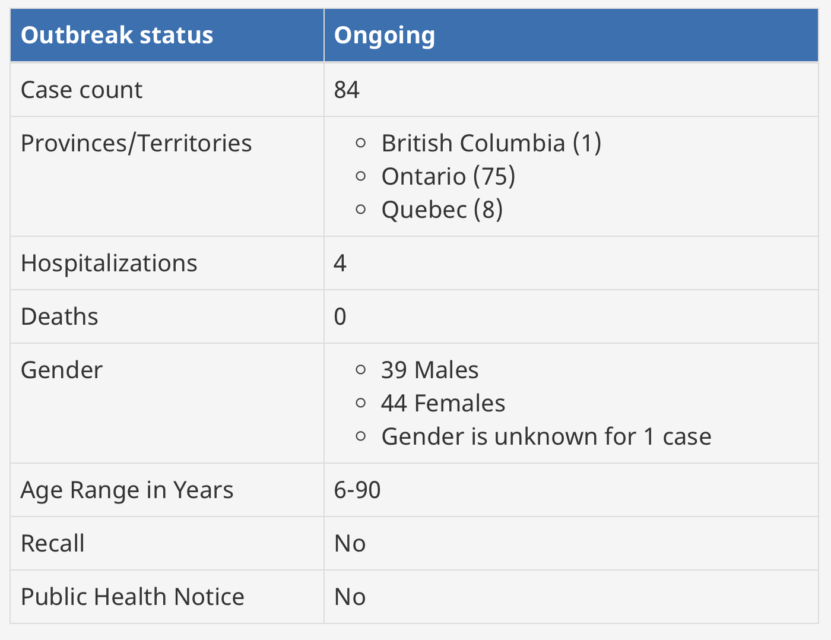
Public Heath Canada is working with its public health and food safety partners to identify possible ways non-travel related Cyclospora infections are occurring in Canada.

As of June 30, a total of 84 cases of Cyclospora infections were reported in the following provinces: British Columbia (1), Ontario (75), and Quebec (8). 4 individuals have been hospitalized and no deaths have been reported. To date, there is no recall or Public Health Notice, the investigation is ongoing.

In case you are experiencing Cyclosporiasis symptoms such as watery diarrhea (most common), cramping, bloating, increased gas, nausea, fatigue, and possibly vomiting and low-grade fever, it is important to report it. It can help to detect & resolve outbreaks early and prevent others from being harmed, and it enables better surveillance. If symptoms persist, seek medical care.

USA – Listeria Outbreak Linked to Ice Cream

CDC

Listeria Outbreak Linked to Ice Cream

Illustration with a triangle and exclamation mark and text reading Food Safety Alert

Posted July 8, 2022

CDC is concerned that Big Olaf Creamery ice cream could still be in people’s homes or available for sale in stores. Big Olaf Creamery ice cream is sold in Florida in Big Olaf Creamery stores and stores with different company names.

Fast Facts
  • Illnesses: 23
  • Hospitalizations: 22
  • Deaths: 1
  • States: 10
  • Recall: No
  • Investigation status: Active
Representative image for this outbreak
What Everyone Should Do

Do not eat Big Olaf Creamery ice cream.

  • If you have any Big Olaf Creamery ice cream at home, throw it away.
  • If you are in Florida and don’t know if the ice cream being sold is Big Olaf Creamery brand, ask the store before you buy or eat it.

Clean any areas, containers, and serving utensils that may have touched the ice cream.

What Businesses Should Do

Do not serve or sell any Big Olaf Creamery ice cream products.

  • Clean and disinfect any areas and equipment that may have touched Big Olaf Creamery ice cream products, including ice cream scoops and other serving utensils.
What People at Higher Risk Should Do

Listeria is most likely to sicken pregnant people and their newborns, adults aged 65 or older, and people with weakened immune systems. Other people can be infected with Listeria, but they rarely become seriously ill.

Call your healthcare provider right away if you have any of these Listeria symptoms:

  • Pregnant people typically experience only fever, fatigue, and muscle aches. However, Listeria infections during pregnancy can lead to miscarriage, stillbirth, premature delivery, or life-threatening infection of the newborn.
  • People who are not pregnant may experience headache, stiff neck, confusion, loss of balance, and convulsions, in addition to fever and muscle aches.

Research – Simulation and identification of foodborne outbreaks in a large supermarket consumer purchase dataset

Nature.com

Foodborne outbreaks represent a significant public health burden. Outbreak investigations are often challenging and time-consuming, and most outbreak vehicles remain unidentified. The development of alternative investigative strategies is therefore needed. Automated analysis of Consumer Purchase Data (CPD) gathered by retailers represents one such alternative strategy. CPD-aided investigations do not require trawling questionnaires to create a hypothesis and can provide analytical measures of association by direct data analysis. Here, we used anonymized CPD from 920,384 customers enrolled in Norway’s largest supermarket loyalty program to simulate foodborne outbreaks across a range of different parameters and scenarios. We then applied a logistic regression model to calculate an odds ratio for each of the different possible food vehicles. By this method, we were able to identify outbreak vehicles with a 90% accuracy within a median of 6 recorded case-patients. The outbreak vehicle identification rate declined significantly when using data from only one of two retailers involved in a simulated outbreak. Performance was also reduced in simulations that restricted analysis from product ID to the product group levels accessible by trawling questionnaires. Our results show that—assuming agreements are in place with major retailers—CPD collection and analysis can solve foodborne outbreaks originating from supermarkets both more rapidly and accurately than than questionnaire-based methods and might provide a significant enhancement to current outbreak investigation methods.

USA – FDA Core Investigation Table

FDA

What’s New

  • For the Salmonella Braenderup outbreak in a not yet identified food (ref# 1075), the case count has increased from 42 to 59 cases.
  • For the Listeria monocytogenes outbreak (ref# 1057), a product linked to illnesses is ice cream from Big Olaf Creamery, located in Florida.
Date
Posted
Ref
#
Pathogen or
Cause of Illness

Product(s)
Linked to
Illnesses

(if any)
Total
Case Count

Status
6/29/

2022

1076 Not Yet Identified Frozen Food See Outbreak
Advisory
Active
6/22/

2022

1075 Salmonella
Braenderup
Not Yet Identified 59 Active
6/22/

2022

1072 Salmonella
Paratyphi B var. L(+) tartrate+
Not Yet Identified 14 Active
6/15/

2022

1070 Listeria
monocytogenes
Not Yet Identified 12 Active
6/8/

2022

1068 E. coli
O157:H7
Not Yet Identified 10 Active
6/1/

2022

1066 Hepatitis A Virus Strawberries See Outbreak
Advisory
Active
5/25/

2022

1067 Salmonella 
Senftenberg
Peanut Butter See Outbreak Advisory Active
4/20/

2022

1064 Not Yet
Identified
Dry Cereal 558 adverse
event reports
Active
4/13/

2022

1057 Listeria
monocytogenes
Ice Cream See CDC’s Investigation Notice Active
3/30/

2022

1060 None
Identified
Meal Replacement
Drink
6 adverse
event reports
Closed
3/16/

2022

1055 Salmonella
Saintpaul
Not Identified 60 Closed
2/17/

2022

1056 Cronobacter
sakazakii
Powdered
Infant
Formula
See
Advisory
Active (IMG)
2/9/

2022

1040 Listeria
monocytogenes
Not Identified 20 Closed
2/2/

2022

1054 Enteroinvasive
E. coli
O143:H26
Not
Identified
16 Closed
1/10/

2022

1050 E. coli
O121:H19
Romaine 4 Closed

CDC – Listeria Outbreak Linked to Ice Cream

CDC

A bit late but it only came through to my inbox today!!

Fast Facts
  • Illnesses: 23Hospitalizations: 22
  • Deaths: 1
  • States: 10
  • Recall: No
  • Investigation status: Active
Representative image for this outbreak
What Everyone Should Do

Consumers who have Big Olaf Creamery brand ice cream at home should throw away any remaining product. Big Olaf Creamery brand ice cream is only sold in Florida.

  • Clean any areas, containers, and serving utensils that may have touched Big Olaf ice cream products.
What Businesses Should Do

Do not serve or sell any Big Olaf ice cream products.

  • Big Olaf Creamery in Sarasota, FL, is voluntarily contacting retail locations to recommend against selling their ice cream products until further notice.
  • Clean and disinfect any areas and equipment that may have touched Big Olaf ice cream products, including ice cream scoops and other serving utensils.
What People at Higher Risk Should Do

Listeria is most likely to sicken pregnant people and their newborns, adults aged 65 or older, and people with weakened immune systems. Other people can be infected with Listeria, but they rarely become seriously ill.

Call your healthcare provider right away if you have any of these Listeria symptoms:

  • Pregnant people typically experience only fever, fatigue, and muscle aches. However, Listeria infections during pregnancy can lead to miscarriage, stillbirth, premature delivery, or life-threatening infection of the newborn.
  • People who are not pregnant may experience headache, stiff neck, confusion, loss of balance, and convulsions, in addition to fever and muscle aches.