Category Archives: foodborne outbreak

Research – A Nosocomial Outbreak of Invasive Listeriosis in An Italian Hospital: Epidemiological and Genomic Features

MDPI

Listeria monocytogenes (L. monocytogenes) is a widespread opportunistic pathogen that causes the listeriosis foodborne disease. This bacterium has become a common contaminant of handled food, and a relevant public health issue. Here we describe a nosocomial outbreak of listeriosis caused by an ST451 strain of L. monocytogenes involving three cancer and one immunocompromised patients hospitalized in different units from the same hospital during September and October 2020. The epidemiological investigation was conducted using traditional microbiological methodology combined with a whole genome sequencing approach. The source of contamination was identified in the kitchen hospital, where a meat slicer used to prepare patients’ meals was tested positive to the same sequence type (ST) of L. monocytogenes. This is the first report of an outbreak of listeriosis caused by ST451 in Italy. View Full-Text
USA – More added to patient list in E. coli outbreak tied to organic yogurt

Food Safety News

An E. coli outbreak linked to locally produced organic yogurt is growing, with 15 people now confirmed infected. Eleven of the patients are children.

Washington State health officials report nine of the patients have required hospitalization and four have developed the potentially deadly kidney complication known as hemolytic uremic syndrome (HUS). No deaths have been reported as of the health department’s May 26 update.

“The outbreak is likely linked to PCC Community Market brand yogurt produced by Pure Eire Dairy,” according to the update and information previously reported by state and local officials. The dairy also produces organic yogurt under the Pure Eire brand.

RASFF Alerts – Foodborne outbreak -Salmonella Dublin in chilled raw milk cheese

RASFF

Foodborne outbreak suspected to be caused by Salmonella Dublin in chilled raw milk cheese from France

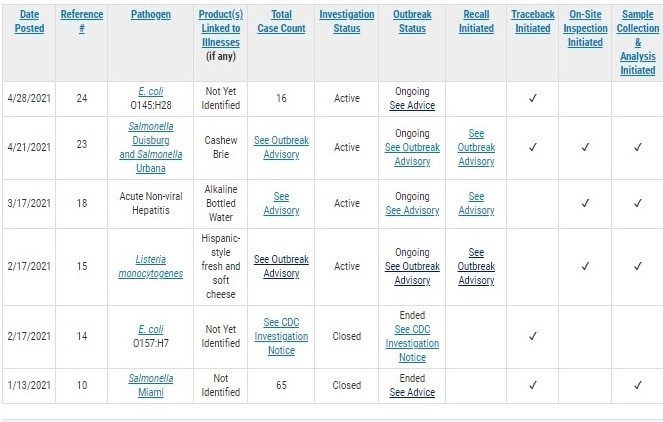
USA – FDA Core Investigation Table Update

FDA

0a

Research – Hepatitis A outbreak associated with consumption of dates, England and Wales, January 2021 to April 2021

Eurosurveillance

An outbreak of genetically related hepatitis A virus (HAV) infections among people with no travel history was identified by the Public Health England (PHE) Virus Reference Department (VRD) in conjunction with local teams noting that the cases had eaten dates.

We describe investigations including case characteristics, phylogenetics, analytical studies, and control measures. We aim to flag the possible risk of hepatitis A to populations in other countries through the consumption of contaminated dates, particularly as Ramadan, which is associated with an increase in consumption of dates, began on 12 April 2021, and hepatitis A has a long incubation period of 15 to 50 days.

A confirmed case was defined as a laboratory-confirmed HAV infection with one of three clustered sequences (sequences VRD21_HAV005, VRD21_HAV009 and VRD21_HAV020) and onset date from 1 January 2021 in England or Wales, no travel history or contact with a suspected or confirmed HAV case in the 60 days before onset. A probable case was a laboratory-confirmed HAV infection, with no or pending sequencing result, and with an epidemiological link to a confirmed HAV case with one of the three clustered sequences.

Samples from all locally diagnosed HAV infections in England and Wales are routinely sent to the VRD for characterisation. The outbreak cases had HAV from three closely related Middle Eastern genotype IB sequences (≤ 2 bp different in a 505 bp segment) which clustered most closely with those found in travellers returning from Syria and Lebanon. The sequences have been submitted to the European Nucleotide Archive (ENA), accession numbers OD998295–OD998297.

USA – Salmonella Outbreaks Linked to Backyard Poultry

CDC

Fast Facts
  • Illnesses: 163
  • Hospitalizations: 34
  • Deaths: 0
  • States: 43
  • Recall: No
  • Investigation status: Active
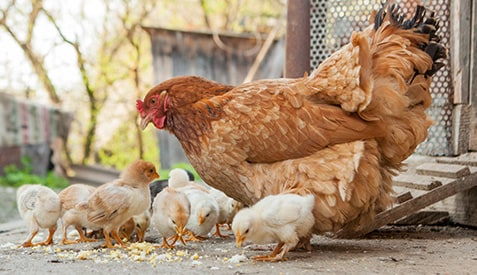
Backyard poultry with chickens eating

Backyard Poultry and Salmonella

Backyard poultry, like chicken and ducks, can carry Salmonella germs even if they look healthy and clean. These germs can easily spread to anything in the areas where they live and roam.

You can get sick from touching your backyard poultry or anything in their environment and then touching your mouth or food, and swallowing Salmonella germs.

What Backyard Flock Owners Should Do
  • Wash your hands
    • Always wash your hands with soap and water immediately after touching backyard poultry, their eggs, or anything in the area where they live and roam.
    • Use hand sanitizer if soap and water are not readily available. Consider having hand sanitizer at your coop.
  • Be safe around backyard flocks
    • Don’t kiss or snuggle backyard poultry, and don’t eat or drink around them. This can spread Salmonella germs to your mouth and make you sick.
    • Keep your backyard flock and supplies you use to care for them (like feed containers and shoes you wear in the coop) outside of the house. You should also clean the supplies outside the house.
  • Supervise kids around flocks
    • Always supervise children around backyard poultry and make sure they wash their hands properly afterward.
    • Don’t let children younger than 5 years touch chicks, ducklings, or other backyard poultry. Young children are more likely to get sick from germs like Salmonella.
  • Handle eggs safely
    • Collect eggs often. Eggs that sit in the nest can become dirty or break.
    • Throw away cracked eggs. Germs on the shell can more easily enter the egg though a cracked shell.
    • Rub off dirt on eggs with fine sandpaper, a brush, or a cloth. Don’t wash them because colder water can pull germs into the egg.
    • Refrigerate eggs to keep them fresh and slow the growth of germs.
    • Cook eggs until both the yolk and white are firm, and cook egg dishes to an internal temperature of 160°F to kill all germs.

Call your healthcare provider right away if you have any of these severe symptoms:

  • Diarrhea and a fever higher than 102°F
  • Diarrhea for more than 3 days that is not improving
  • Bloody diarrhea
  • So much vomiting that you cannot keep liquids down
  • Signs of dehydration, such as:
    • Not urinating (peeing) much
    • Dry mouth and throat
    • Feeling dizzy when standing up

Europe – Salmonella sickens up to 200 across EU and UK

Food Safety News

Salm2

More than 200 people in 11 countries could be part of a Salmonella outbreak across Europe. Investigations to find the source of the Salmonella Braenderup infections are ongoing.

The European Centre for Disease Prevention and Control (ECDC) confirmed to Food Safety News that it was supporting countries in their investigations and following the incident closely with the European Food Safety Authority (EFSA).

The hardest hit country is the United Kingdom with 52 confirmed infections while France only has one confirmed patient. Denmark has 27 and Sweden 25 confirmed infections with the Netherlands recording 13 people sick.

RASFF Alert – POSSIBLE OUTBREAK OF FOOD POISONING (SAMONELLA ENTERICA) DUE TO CONSUMPTION OF FUET MADE IN SPAIN

RASFF

POSSIBLE OUTBREAK OF FOOD POISONING (SAMONELLA ENTERICA) DUE TO CONSUMPTION OF FUET MADE IN SPAIN

USA – State investigates Chipotle near Denver for likely Norovirus outbreak

Food Safety News

Food Borne Illness - Norovirus -CDC Photo

State and local health authorities in Colorado are acknowledging they are investigating an apparent foodborne illness outbreak involving a Chipotle Mexican Grill near Denver.

Two agencies, the Colorado Department of Public Health and Environment and the local Tri-County Health Department, are involved, and CDPHE issued the following statement.

“CDPHE is partnering with the Tri-County Health Department on a suspected foodborne outbreak at the Chipotle located at 6710 S Cornerstar Way. The investigation is ongoing, and at this time, the cause of the illness has not been identified.

“Symptoms appear to be consistent with viral gastroenteritis, which is often caused by norovirus. So far, CDPHE has identified a total of 8 ill patrons and employees. Public health officials are working closely with the restaurant, which has implemented disease control measures.”

USA – Additional patients identified in outbreak tied to organic yogurt; one in Arizona – E.coli O157

Food Safety News

More patients are being identified by investigators working on an E. coli O157 outbreak that has been limited to Washington State. However, today Arizona officials confirmed there is a child in that state with an infection from the same strain of the pathogen.

There are 11 confirmed patients in Washington in the outbreak linked to locally produced organic yogurt sold by Pure Eire Dairy. Another three probable patients are from the Moses Lake area in Grant County, WA. Teresa McCallion of the Washington Department of Health said it is not unusual for counties and local health departments to know of probable cases before they are added to the state’s tally.

“We only report confirmed cases,” McCallion told Food Safety News on Wednesday evening. The Washington Health Department is working on a special outbreak information web page, which McCallion said should be available soon.