Category Archives: Food Poisoning Death

Japan – Elderly man, woman die after food poisoning sickens 33 at east Japan nursing facility – STEC E.coli

Mainichi

SHIZUOKA — Two people have died after dozens fell ill following the consumption of meals provided at a nursing facility in the Shizuoka Prefecture town of Nishiizu, the prefectural government announced on Nov. 15.

The meals in question included dishes such as “takikomi” rice, “tatsuta-age” deep-friend mackerel and stew containing “ganmodoki” tofu fritters. Of the 94 staff members and residents who ate the food, 33 aged 45 to 103 fell ill, complaining of symptoms such as diarrhea. A pathogenic O157 strain of E. coli bacteria was detected in the stools of 11 of those who fell ill.

U.S. researchers confirm canned sardines spread deadly botulism during Rugby World Club held in France

Food Safety News

They visited Bordeaux, France, last month for the Rugby World Cup and reported  eating home-canned sardines in the same bar and restaurant

The University of Minnesota  Center for Infectious Disease Research and Policy (CIDRAP) reports that 15 cases of botulism poisoning resulted, including one death.

The deadly outbreak was confirmed by the open-access platform known as  Eurosurveillance.

CIDRAP’s summary of the botulism outbreak follows:

The report presented the clinical case descriptions of eight patients seen at the Bordeaux University Hospital, where the first patient treated in the outbreak was admitted to the intensive care unit (ICU) on Sept. 6.

Home-canned sardines implicated
All three initial patients seen at the hospital reported visiting France for the rugby tournament. On Sept. 10, French investigators questioned the three, who all reported eating home-canned sardines in the same bar and restaurant in Bordeaux.

On Sept. 11 and Sept. 12, the hospital saw five more patients, all international visitors, for symptoms of botulism poisoning, including descending paralysis and extensive gastrointestinal illness.

The patients came from Canada, France, Ireland, and the United States. Two patients were men, six were women, and only one was younger than 50. The average time between the consumption of sardines and the first signs of illness was 13 hours.

“Six of eight cases required invasive mechanical ventilation because of respiratory muscle paralysis,” the CIDRAP authors said. The median delay between the onset of symptoms and intubation was 25 hours.

South Africa – GP POLICE WARN AGAINST VIGILANTISM AFTER 4 KIDS DIE FROM ALLEGED FOOD POISONING

EWN

JOHANNESBURG – Police are urging Gauteng residents not to take the law into their own hands following the death of four children from alleged food poisoning this week.

Authorities are probing the mysterious deaths of two children aged between two and three in the West Rand.

Preliminary investigations suggest that the pair died after eating snacks bought from a nearby taxi rank.

The incident comes just a few days after the passing of two other children from Soweto – who became fatally ill after eating biscuits they allegedly bought from a spaza shop in Naledi.

World Health Organisation – Botulism – France

WHO

Situation at a glance

On 12 September 2023, local public health authorities in France identified a cluster of 10 cases with suspected botulism, including one death. As of 14 September 2023, the National IHR Focal Point for France has notified WHO of a total of 15 cases of suspected botulism, including one death, reported in Bordeaux and Ile-de-France.

The epidemiological investigations indicated that the source of infection is the consumption of homemade preserved sardines , on different dates, at the same restaurant in Bordeaux during the week of 4–10 September 2023. The food item was made at the restaurant for consumption on premises.

Due to the incubation period of up to eight days and the restaurant attracting international visitors during the Rugby World Cup, there is a possibility that additional cases among international visitors may be reported in France, or possibly outside France as travellers returned home, until 18 September.

Description of the situation

On 12 September 2023, local public health authorities in France identified a cluster of 10 cases with suspected botulism, including one death.

As of 14 September 2023, the National IHR Focal Point for France has notified a total of 15 cases of suspected botulism, including one death, reported in Bordeaux and Ile-de-France. Of these 15 cases, 10 have been hospitalised, with eight patients being admitted to an Intensive Care Unit. Fourteen out of the 15 cases are reported among foreign citizens identified from six countries in addition to France. These include Canada, Germany, Greece, Ireland, the United Kingdom of Great Britain and Northern Ireland, and the United States of America. All suspected cases consumed the same product (sardines in jars) on different dates at the same restaurant in Bordeaux during the week of 4–10 September 2023. The epidemiological investigations indicated that the source of infection is the consumption of homemade preserved sardines. The food item was produced and served at the restaurant.

Epidemiology of the Botulism

Botulism is a serious neurological condition caused by a very potent toxin produced by the bacterium  Clostridium botulinum . It develops particularly in poorly preserved foods. Human botulism may refer to foodborne botulism, infant botulism, wound botulism, and inhalation botulism or other types of intoxication.

Foodborne botulism is a serious, potentially fatal disease. It is an intoxication caused by ingestion of potent neurotoxins—the botulinum toxins—formed in contaminated foods. Person-to-person transmission of botulism does not occur. The manifestations, or symptoms, of intoxication can vary, and  is characterized by descending, flaccid paralysis that can cause respiratory failure. Early symptoms include marked fatigue, weakness and vertigo, usually followed by blurred vision, dry mouth and difficulty in swallowing and speaking. Vomiting, diarrhoea, constipation and abdominal swelling may also occur. The disease can progress to weakness in the neck and arms, after which the respiratory muscles and muscles of the lower body are affected. There is no fever and no loss of consciousness. Symptoms usually appear from several hours up to 8 days following consumption of contaminated food.

Although botulism outbreaks are relatively rare, they are considered public health emergencies that require rapid recognition to identify the disease source, distinguish outbreak types (between natural, accidental or deliberate), prevent additional cases and effectively administer treatment to affected patients. Successful treatment depends significantly on early diagnosis and the rapid administration of the botulinum antitoxin and intensive respiratory care.

Incidence of botulism is low, but the mortality rate is high if prompt diagnosis and appropriate, immediate treatment is not given. The disease can be fatal in 5% to 10% of cases.

Public health response

  • On 11 September, food and serum samples were shipped to the French National Reference Center for Anaerobic Bacteria and Botulism, Institute Pasteur, Paris , and botulinum toxin was confirmed in serum samples and in a food sample (sardines) on 14 September 2023.
  • The local health authorities inspected the restaurant and all products prepared by the restaurant have been recalled. On 13 September, the local health authorities held a press conference and informed the local healthcare professionals.
  • The national health authorities have issued risk communication advice to sensitize the health care workers about the symptomatology and treatment.
  • Information on cases reported among citizens from foreign countries have been shared with the relevant health authorities in those countries.

WHO risk assessment

Local investigations have identified an estimated 25 persons through credit card receipts who have been exposed (i.e., who likely consumed the suspect food item). The exposure occurred at local level and measures have been implemented to eliminate the source of infection including the removal of the suspected food item, which was not distributed outside the venue. However, given the ranging incubation period of botulism—up to eight days—and that not all customers of the restaurant in Bordeaux may have been identified despite efforts, further cases linked to this event may still occur. This outbreak has occurred at the same time as the Rugby World Cup held from the week of 4 September 2023 attracting followers and rugby teams from all over the world.

Due to the incubation period up to eight days and the restaurant attracting international visitors, there is a possibility that additional cases among international visitors may be reported either from France or outside of France until 18 September.

WHO advice

Prevention of foodborne botulism is based on good practice in food preparation particularly during heating/sterilization and hygiene. Foodborne botulism may be prevented by the inactivation of the bacterium and its spores in heat-sterilized (for example, retorted) or canned products, or by inhibiting bacterial growth and toxin production in other products. The vegetative forms of bacteria can be destroyed by boiling, but the spores can remain viable after boiling even for several hours. However, the spores can be killed by very high temperature treatments such as (commercial) canning.

Commercial heat pasteurization (including vacuum packed pasteurized products and hot smoked products) may not be sufficient to kill all spores and therefore the safety of these products must be based on preventing bacterial growth and toxin production. Refrigeration temperatures combined with salt content and/or acidic conditions will prevent the growth of the bacteria and formation of toxin.

The neurotoxins themselves are heat-labile and will be destroyed within minutes at temperatures above 80°C; consequently, only foods improperly processed in which the bacteria or the spores survive, pose a risk.

The WHO five keys to safer food serve as the basis for educational programmes to train food handlers and educate the consumers. They are especially important in preventing food poisoning.

The five keys are:

  • keep clean
  • separate raw and cooked
  • cook thoroughly
  • keep food at safe temperatures
  • use safe water and raw materials.
France – Cases of food botulism in Bordeaux: 15 cases recorded, including 10 hospitalized and 1 death. Situation update as of September 14, 2023.

Sante Publique

As of September 14, 2023, 15 suspected cases of botulism have been identified, of which 10 are hospitalized. One person died. These people come from several countries (USA, Canada, Ireland, Great Britain, Spain, Germany, Greece). They all frequented the same restaurant-bar in Bordeaux, the Tchin Tchin Wine Bar, over the last week. The foods involved are jars of sardines in oil homemade by the restaurateur and served between September 4 and 10, 2023 in this Bordeaux restaurant. 
Type B botulism was confirmed by the National Reference Center in several of these cases and the bacteria in question was found in the suspected foods.

Investigations are continuing to find all the people who may have consumed these sardines and Public Health France is, in this context, in contact with the national public health agencies of the other countries concerned.

The health authorities, in conjunction with Public Health France and the National Reference Center (CNR) for Botulism (Institut Pasteur) recommend that people who have frequented the Bordeaux establishment Tchin Tchin Wine Bar (3 Rue Emile Duployé, 33000 Bordeaux), between Monday 4 and Sunday 10 September 2023, to consult a doctor urgently or to contact the 15th, mentioning cases of botulism, in the event of symptoms appearing after this attendance .  

The French health authorities, in collaboration with Santé publique France and the National Reference Center for Botulism (Institut Pasteur), advise anyone who attended the Tchin Tchin Wine Bar in Bordeaux (3 Rue Emile Duployé, 33000 Bordeaux) between Monday 4 and Sunday 10 September 2023 to urgently consult a doctor or contact emergency number 15, mentioning cases of botulism, if they present symptoms since attending the restaurant .

France – Emergency Serious food poisoning: 10 cases of botulism, including 8 hospitalized and 1 death, linked to visiting a restaurant in Bordeaux

Sante Publique

kswfoodworld

The health authorities, in conjunction with Public Health France and the National Reference Center for Botulism (Institut Pasteur) recommend that people who have visited the Bordeaux establishment Tchin Tchin Wine Bar (3 Rue Emile Duployé, 33000 Bordeaux) between Monday 4 and Sunday September 10, 2023 to consult a doctor urgently or to contact the 15th, mentioning cases of botulism, in the event of symptoms appearing after this attendance.

The people concerned all frequented the same restaurant-bar in Bordeaux, the Tchin Tchin Wine Bar, over the last week. The suspected foods are at this stage canned sardines in oil homemade by the restaurateur and served between September 4 and 10, 2023 in this Bordeaux restaurant. 

Botulism is a serious disease (fatal in 5 to 10% of cases) whose incubation time can range from a few hours to a few days. 
Symptoms include, to varying degrees: early digestive signs which may be fleeting (abdominal pain, nausea, vomiting and diarrhea), eye damage (failure to accommodate, blurred or double vision), dry mouth accompanied by a lack of swallowing or even speech, or neurological symptoms (wrong paths, more or less severe paralysis of the muscles). There is usually no fever.

If you have symptoms, consult a doctor urgently or contact 15, mentioning cases of botulism.

What are the possible sources of contamination?

Botulism is a serious neurological condition caused by a very potent toxin produced by the bacteria Clostridium botulinum. It develops particularly in poorly preserved foods. In France, the majority of cases of botulism correspond to food poisoning, by ingestion of the toxin produced by C. botulinum in preserved foods that have not undergone an extensive sterilization process: cured meats, cold meats or even family-made preserves. or artisanal.

It is the extremely powerful toxin that it synthesizes that is responsible for the disease.

Research – Foodborne Botulism, Canada, 2006–2021

cdc

kswfoodworld

Abstract

During 2006–2021, Canada had 55 laboratory-confirmed outbreaks of foodborne botulism, involving 67 cases. The mean annual incidence was 0.01 case/100,000 population. Foodborne botulism in Indigenous communities accounted for 46% of all cases, which is down from 85% of all cases during 1990–2005. Among all cases, 52% were caused by botulinum neurotoxin type E, but types A (24%), B (16%), F (3%), and AB (1%) also occurred; 3% were caused by undetermined serotypes. Four outbreaks resulted from commercial products, including a 2006 international outbreak caused by carrot juice. Hospital data indicated that 78% of patients were transferred to special care units and 70% required mechanical ventilation; 7 deaths were reported. Botulinum neurotoxin type A was associated with much longer hospital stays and more time spent in special care than types B or E. Foodborne botulism often is misdiagnosed. Increased clinician awareness can improve diagnosis, which can aid epidemiologic investigations and patient treatment.

USA – Summary of Possible Multistate Enteric (Intestinal) Disease Outbreaks in 2021

CDC

Outbreak Investigations At A Glance

Possible Multistate Outbreaks

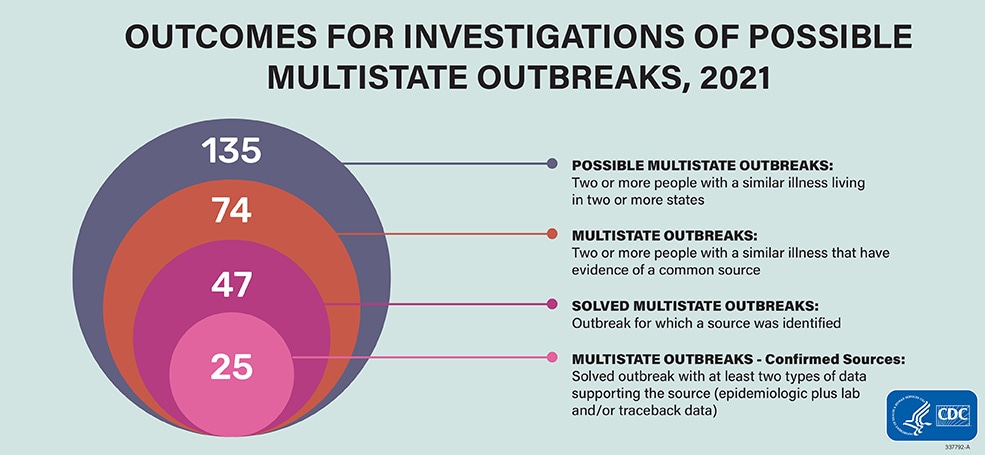
This analysis includes 135 possible multistate outbreak investigations during 2021.

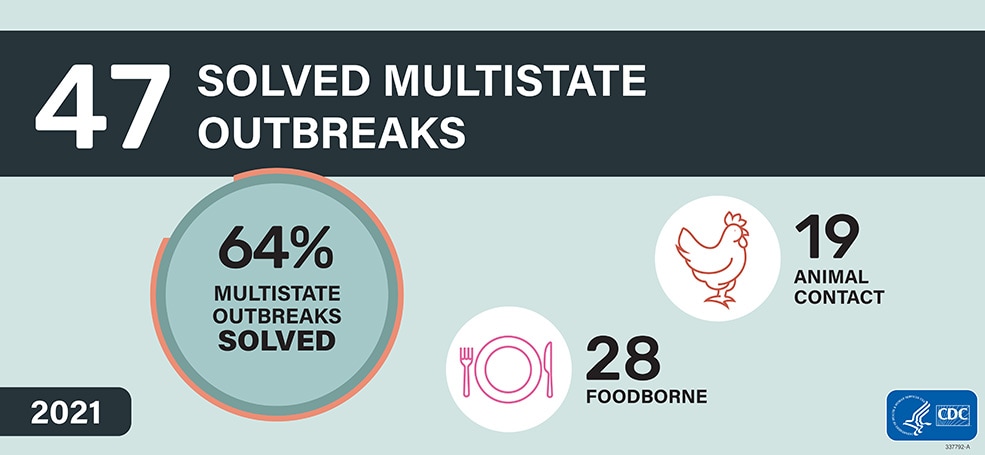
This analysis includes 135 investigations of possible multistate enteric (intestinal) outbreaks during 2021. Some possible outbreaks were excluded from this report because they were determined to be single state or because they were linked to international travel. After investigation, 74 (55%) of these were determined to be multistate outbreaks, and investigators solved 47 (64%) of these outbreaks.

Multistate Outbreaks

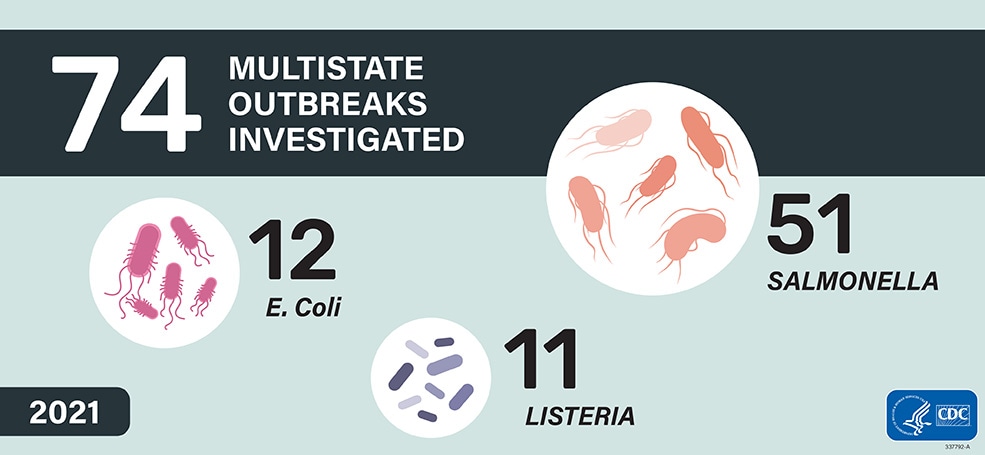
74 (55%) of the 135 investigations were determined to be multistate outbreaks.

The number of outbreaks increased from 2020 but was lower than the 82 investigated outbreaks in 2019. The number of outbreaks investigated in 2021 was likely lower than that in 2019 due in part to continued effects of the COVID-19 pandemic on enteric disease outbreak detection and investigation (e.g., decreased resources at local, state, and federal public health agencies, changes in healthcare-seeking behavior, and changed restaurant dining and grocery shopping patterns.) Additionally, changing diagnostic testing practices likely continued to affect enteric disease surveillance and the ability to identify possible outbreaks.

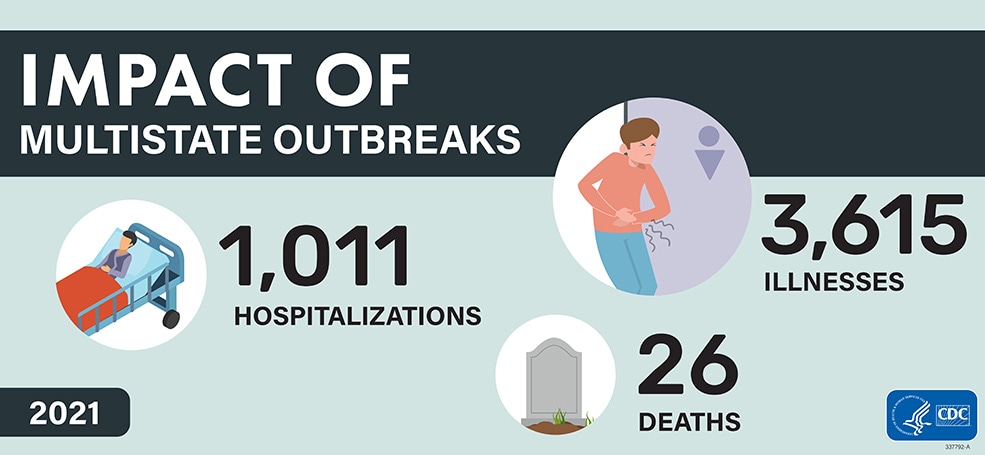
The 74 investigated multistate outbreaks resulted in 3,615 illnesses, 1,011 hospitalizations, and 26 deaths

Solved Multistate Outbreaks

Among the 74 investigated multistate outbreaks, 47 (64%) were solved, including 25 outbreaks with confirmed sources and 22 with suspected sources.

Among the 74 multistate outbreaks, 47 (64%) were solved, meaning a confirmed or suspected source of the outbreak was identified, including 25 (53%) outbreaks with confirmed sources and 22 (47%) with suspected sources. Among the 47 solved outbreaks, 28 (60%) were linked to contaminated foods, and 19 (40%) were linked to animal contact.

Solved multistate outbreaks caused at least 2,047 illnesses. Solved multistate outbreaks linked to contaminated food caused 1,740 illnesses, 496 hospitalizations, and 15 deaths, while multistate outbreaks linked to animal contact caused 1,307 illnesses, 329 hospitalizations, and 3 deaths.

India – Food Poisoning Kills Two Passengers On Board Kota-Patna Express, Six More Critical

The News Agency

Two passengers on board the Kota-Patna Express died late on Sunday when the train stopped at Agra. According to information available, the deceased dup was part of a 90-member contingent which was headed for a pilgrimage to Mathura. Condition of five more is critical and they are undergoing treatment at the Railway Hospital in the Taj city.

Their postmortem has been done and food poisoning seems to be the cause behind the severe dehydration which led to their deaths. The actual cause of death will be known after the report comes, officials said.

USA – Voluntary Recall of Specific Frozen Fruit Products Due to Possible Contamination by Listeria monocytogenes

FDA

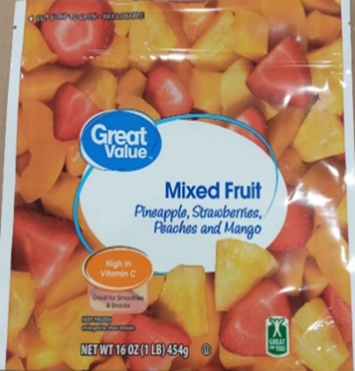
Image 1 – Labeling, Great Value Mixed Fruit packaged in a 16-ounce plastic bag

Minneapolis, Minn. – June 21, 2023 – SunOpta Inc’s subsidiary, Sunrise Growers Inc., has issued a voluntary recall of specific frozen fruit products linked to pineapple provided by a third-party supplier due to the potential for these products to be contaminated with Listeria monocytogenes.

Listeria monocytogenes is an organism which can cause serious and sometimes fatal infections in young children, frail or elderly people, and others with weakened immune systems. Although healthy individuals may suffer only short-term symptoms such as high fever, severe headache, stiffness, nausea, abdominal pain and diarrhea, Listeria infection can cause miscarriages and stillbirths among pregnant women. Any consumers concerned about an illness should contact a physician.

Products were distributed via the following retailers:

  • Walmart: Great Value Mixed Fruit, Great Value Dark Sweet Cherries, and Great Value Mango Chunks sold at stores in AR, AZ, CA, CO, DC, IA, ID, IL, IN, KS, KY, LA, MD, MN, MO, MT, ND, NE, NM, NV, OH, OK, OR, PA, SD, TX, UT, VA, WV and WY from January 19, 2023 to June 13, 2023
  • Whole Foods: 365 Organic Tropical Fruit Medley, 365 Organic Pineapple Chunks, 365 Pineapple Chunks, 365 Organic Whole Strawberries, 365 Organic Slice Strawberries and Bananas, and 365 Organic Blackberries distributed to select stores throughout the US from November 1, 2022 to June 21, 2023
  • Trader Joe’s: Trader Joe’s Organic Tropical Fruit Blend distributed to select distribution centers or stores in AK, AL, CT, CO, DE, IA, IL, IN, KS, KY, LA, MA, MD, ME, MI, MN, MO, NE, NH, NJ, NM, NY, OH, OK, PA, RI, TN, TX, VA, VT, WI, and Washington DC from March 28, 2023 to April 11, 2023
  • Target: Good & Gather Organic Cherries and Berries Fruit Blend, Good & Gather Dark Sweet Whole Pitted Cherries, Good & Gather Mango Strawberry Blend, Good & Gather Mixed Fruit Blend, Good & Gather Mango Chunks, Good & Gather Blueberries, and Good & Gather Triple Berry Blend distributed nationwide from October 14, 2022 to May 22, 2023
  • Aldi: Season’s Choice Tropical Blend distributed to select distribution centers or stores in AL, AR, CT, FL, GA, IA, KS, KY, MA, MD, MI, MO, MS, NC, NE, NH, NY, OH, OK, PA, RI, SC, TN, TX, VA, VT and WV from October 11, 2022 to May 22, 2023
  • AWG (Associated Wholesale Grocers): Best Choice Pitted Red Tart Cherries Unsweetened distributed to select distribution centers or stores in KS, MO, NE and OK from April 5, 2023 to May 4, 2023

To date, there have been no illnesses associated with this voluntary recall.