Category Archives: Food Microbiology Research

Research – Prevalence and Epidemiology of Non-O157 Escherichia coli Serogroups O26, O103, O111, and O145 and Shiga Toxin Gene Carriage in Scottish Cattle, 2014–2015

ASM

ABSTRACT

Cattle are a reservoir for Shiga toxin-producing Escherichia coli (STEC), zoonotic pathogens that cause serious clinical disease. Scotland has a higher incidence of STEC infection in the human population than the European average. The aim of this study was to investigate the prevalence and epidemiology of non-O157 serogroups O26, O103, O111, and O145 and Shiga toxin gene carriage in Scottish cattle. Fecal samples (n = 2783) were collected from 110 herds in 2014 and 2015 and screened by real-time PCR. Herd-level prevalence (95% confidence interval [CI]) for O103, O26, and O145 was estimated as 0.71 (0.62, 0.79), 0.43 (0.34, 0.52), and 0.23 (0.16, 0.32), respectively. Only two herds were positive for O111. Shiga toxin prevalence was high in both herds and pats, particularly for stx2 (herd level: 0.99; 95% CI: 0.94, 1.0). O26 bacterial strains were isolated from 36 herds on culture. Fifteen herds yielded O26 stx-positive isolates that additionally harbored the intimin gene; six of these herds shed highly pathogenic stx2-positive strains. Multiple serogroups were detected in herds and pats, with only 25 herds negative for all serogroups. Despite overlap in detection, regional and seasonal effects were observed. Higher herd prevalence for O26, O103, and stx1 occurred in the South West, and this region was significant for stx2 at the pat level (P = 0.015). Significant seasonal variation was observed for O145 prevalence, with the highest prevalence in autumn (P = 0.032). Negative herds were associated with Central Scotland and winter. Herds positive for all serogroups were associated with autumn and larger herd size and were not housed at sampling.

IMPORTANCE Cattle are reservoirs for Shiga toxin-producing Escherichia coli (STEC), bacteria shed in animal feces. Humans are infected through consumption of contaminated food or water and by direct contact, resulting in serious disease and kidney failure in the most vulnerable. The contribution of non-O157 serogroups to STEC illness was underestimated for many years due to the lack of specific tests. Recently, non-O157 human cases have increased, with O26 STEC of particular note. It is therefore vital to investigate the level and composition of non-O157 in the cattle reservoir and to compare them historically and by the clinical situation. In this study, we found cattle prevalence high for toxin, as well as for O103 and O26 serogroups. Pathogenic O26 STEC were isolated from 14% of study herds, with toxin subtypes similar to those seen in Scottish clinical cases. This study highlights the current risk to public health from non-O157 STEC in Scottish cattle.
Norway -Monitoring program 2020 – Monitoring and control of Salmonella in live animals, fresh meat and eggs

Mattilsynet

Since 1995, the Norwegian Food Safety Authority has carried out monitoring programs for Salmonella in live animals (cattle, pigs and poultry), fresh meat and eggs. The program documents that the incidence is very low compared to most other countries.

What did we investigate? The aim of the program is to ensure that food-producing animals, fresh meat and eggs from Norwegian domestic animals are virtually free of salmonella. The program also documents the very favorable salmonella situation Norway has, which in turn provides a basis for salmonella guarantees, ie when importing certain animals and certain animal products, the shipment must be examined for salmonella with a negative result in the country of dispatch before it can be sent to Norway. In the program, samples have been taken in herds, in the slaughterhouses and in downsizing companies.
Period: All year
What were we looking for? The samples were tested for Salmonella.
What did we find? In the program for 2020, one positive sample was found among a total of 8,285 from poultry, one positive sample from pigs among 3,245 examined, three positive samples from cattle out of a total of 2,975 samples and four positive samples from a total of 8,690 taken from fresh meat in slaughterhouses and cutting plants. .


The full report can be read here


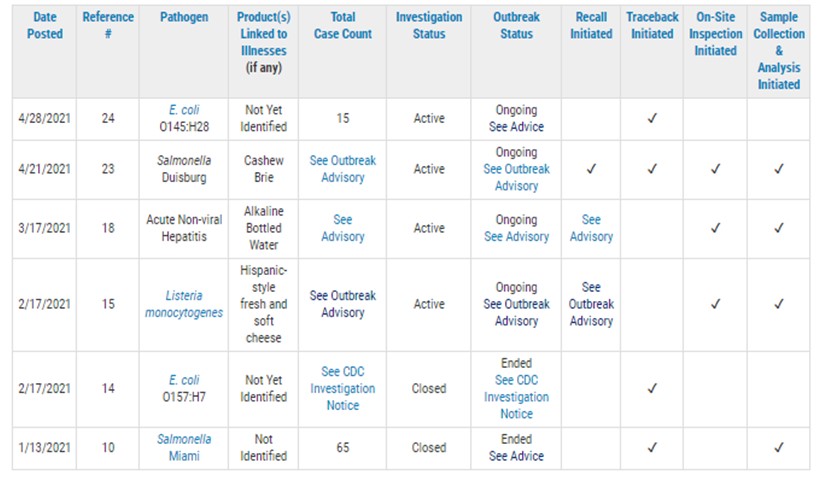
USA – FDA Core Investigation Table Update

FDA

USA – Notes from the Field: Multistate Outbreak of Escherichia coli O26 Infections Linked to Raw Flour — United States, 2019

CDC

On February 20, 2019, PulseNet, the molecular subtyping network for foodborne disease surveillance, identified six Shiga toxin–producing Escherichia coli (STEC) O26:H11 infections with the same pulsed-field gel electrophoresis (PFGE) pattern combination. This PFGE pattern combination matched that of infections from a July 2018 outbreak that was associated with ground beef. In response, CDC initiated an investigation with federal, state, and local partners to identify the outbreak source and implement prevention measures.

CDC defined a case as STEC O26 infection with an isolate matching the outbreak strain by PFGE or related by core genome multilocus sequence typing scheme (cgMLST), with dates of illness onset during December 11, 2018–May 21, 2019. Investigators initially hypothesized that ground beef was the outbreak cause because of the PFGE match to the July 2018 outbreak and because in early interviews, patients commonly reported eating ground beef and leafy greens. Investigators used cgMLST to compare the genetic sequences of isolates from both outbreaks and determined that they fell into separate genetic clades (differing by 6–11 alleles), suggesting that something other than ground beef caused the illness in 2019. CDC noted that one patient consumed raw cookie dough and that most patients were young adult females, similar to demographic distributions of past flour-associated STEC outbreaks (13). Investigators developed a supplemental questionnaire focusing on beef, leafy greens, and flour exposures.

Twenty-one cases were reported from nine states (Figure). The median age of patients was 24 years (range = 7–86 years); 71% were female. Three patients were hospitalized, and none died. Among 13 patients asked about flour exposures, six reported eating, licking, or tasting raw homemade dough or batter during the week before illness onset. Three patients reported eating raw dough or batter made with the same grocery store brand of all-purpose flour, including a patient who reported eating raw dough at a bakery in Rhode Island. Overall, of 18 patients with store information, 11 reported shopping at this same grocery store chain.

The Rhode Island Department of Health visited the bakery reported by the patient and collected flour for testing. On May 21, 2019, testing identified STEC O26 from an intact bag of all-purpose flour, which was the same grocery store brand reported by other patients. PulseNet confirmed that the STEC O26 isolated from the flour was highly related to clinical isolates using cgMLST (0–1 alleles). Product distribution records collected by the Food and Drug Administration indicated that the store brand flour purchased by six patients in three states was produced in a single milling facility in Buffalo, New York. Based on results of the investigation, the store chain recalled all lots of product from its retail locations in 11 states. The milling company also recalled all lots of this product and several other lots of flour produced in that facility, resulting in the recall of additional brands and products distributed to multiple states.

Flour is increasingly recognized as a cause of STEC outbreaks (15). Raw flour is not a ready-to-eat product, and this outbreak highlights the continuing risk for illness associated with consumption of flour and raw dough or batter. The investigation was aided by considering demographic information early in the investigation because these characteristics were similar to those in past flour-associated outbreaks (13). These similarities, coupled with the discriminatory power of cgMLST, helped to guide the consideration of alternative hypotheses regarding the outbreak source and the successful identification of flour as the cause of this outbreak.

Singapore – NTUSingapore, Singapore Food Agency, and A*STAR launch Future Ready Food Safety Hub(FRESH)to build Singapore’s capabilities in food safety science

Click to access ntu-singapore-singapore-food-agency-and-a-star-launch-future-ready-food-safety-hub-(fresh)-to-build-singapore-s-capabilities-in-food-safety-science.pdf

France – Product recall: JECA brand sundried tomato and Mediterranean herb terrine – Listeria monocytogenes

Oulah

Product recall: JECA brand sundried tomato and Mediterranean herb terrine

ENCOUNTERED PROBLEM

Presence of Listeria monocytogenes

PROPOSED SOLUTION

People who may have this product are asked not to consume it and to return it to the point of sale where it was purchased.

People who have consumed this product and who have a fever, isolated or accompanied by headaches, are invited to consult their doctor, notifying him of this consumption.
Pregnant women should pay special attention to these symptoms, as well as immunocompromised people and the elderly. These symptoms may suggest listeriosis, a disease that can be serious and can take up to eight weeks to incubate.

FURTHER INFORMATION

▸ Barcode
3271620042399

▸ Lot
21041610200

▸ DLC
05/26/2021


Terrine packaging of 2.8 kg

▸ Start date / End of marketing
From 04/20/2021 to 04/27/2021

▸ Health mark
BE B 202 CE

▸ Geographical sales area

▸ Distributors
• Carrefour
• Leclerc
• Intermarché
• Cora
• Auchan
• U

▸ Consumer service contact
0387876510

▸ Source
https://rappel.conso.gouv.fr/

Research – Outbreak of Shiga toxin-producing Escherichia coli O157 linked with consumption of a fast-food product containing imported cucumbers, United Kingdom, August 2020

IJID Online

Background

In August 2020, an outbreak of Shiga toxin-producing Escherichia coli (STEC) O157:H7 occurred in the United Kingdom. Whole genome sequencing revealed these cases formed a genetically distinct cluster.

Methods

Hypotheses generated from case interviews were tested in analytical studies, and results informed environmental sampling and food chain analysis. A case-case study used non-outbreak ‘comparison’ STEC cases; a case-control study used a market research panel to recruit controls.

Results

A total of 36 cases were identified; all cases reported symptom onset between 3rd and 16th August 2020. The majority of cases (83%) resided in the Midlands region of England or Wales. A high proportion of cases reported eating out, with one fast-food restaurant chain mentioned by 64% (n = 23) of cases. Both case-case (adjusted odds ratio (aOR) 31.8, 95% confidence interval (CI) 1.6 – 624.9) and case-control (aOR 9.19, 95% CI 1.0 – 82.8) studies provided statistically significant results that consumption of a specific fast-food product was independently associated with infection.

Research – Survival of Salmonella and Shiga Toxin-producing Escherichia coli and Changes in Indigenous Microbiota During Fermentation of Kombucha Made from Home-brewing Kits

Journal of Food Protection

Survival and growth of Salmonella and Shiga toxin-producing Escherichia coli (STEC) in kombucha prepared from four brands of commercially available kombucha kits intended for use by home brewers were investigated. Changes in microbiota responsible for fermentation were also determined. An initial population of Salmonella (6.77 log CFU/mL) decreased to below the detection limit (0.30 log CFU/mL) within 10 d in kombucha prepared from two of the four test brands. Populations of 1.85 and 1.20 log CFU/mL were detected in two brands fermented for 14 d. An initial population of STEC (7.02 log CFU/mL) decreased to <0.30 log CFU/mL in two of the four brands within 14 d; 0.20 and 0.87 log CFU/mL were detected in kombucha prepared from the other two brands. Salmonella and STEC increased in populations within 1 d in three brands of base tea used to prepare kombucha, and were stable throughout 14 d of incubation. Both pathogens steadily declined in base tea prepared from one brand of kombucha kit. Inactivation of the pathogens occurred as the pH of kombuchas decreased, but a clear correlation between rates of inactivation and decrease in pH was not evident when comparing kombuchas prepared from the four kits. Growth and peak populations of mesophilic aerobic microorganisms, yeasts, lactic acid bacteria, and acetic acid bacteria varied, depending on the kombucha kit brand. There was not strong evidence to correlate the behavior of Salmonella and STEC with any of these groups of indigenous microbiota. Results of this study show that the ability of Salmonella and STEC to survive in kombucha and base tea used to prepare kombucha is dependent on inherent differences in commercially available kombucha kits intended for use in home settings. Strict application of hygienic practices with the goal of preventing contamination with Salmonella or STEC is essential for reducing the risk of illness associated the consumption of kombucha.

Research – Histamine Control in Raw and Processed Tuna: A Rapid Tool Based on NIR Spectroscopy

MDPI

The present study was designed to investigate whether near infrared (NIR) spectroscopy with minimal sample processing could be a suitable technique to rapidly measure histamine levels in raw and processed tuna fish. Calibration models based on orthogonal partial least square regression (OPLSR) were built to predict histamine in the range 10–1000 mg kg−1 using the 1000–2500 nm NIR spectra of artificially-contaminated fish. The two models were then validated using a new set of naturally contaminated samples in which histamine content was determined by conventional high-performance liquid chromatography (HPLC) analysis. As for calibration results, coefficient of determination (r2) > 0.98, root mean square of estimation (RMSEE) ≤ 5 mg kg−1 and root mean square of cross-validation (RMSECV) ≤ 6 mg kg−1 were achieved. Both models were optimal also in the validation stage, showing r2 values > 0.97, root mean square errors of prediction (RMSEP) ≤ 10 mg kg−1 and relative range error (RER) ≥ 25, with better results showed by the model for processed fish. The promising results achieved suggest NIR spectroscopy as an implemental analytical solution in fish industries and markets to effectively determine histamine amounts. View Full-Text

Research – Thermal Inactivation Kinetics of Salmonella and Enterococcus faecium NRRL-B2354 on whole chia seeds (Salvia hispanica L.)

Journal of Food Protection

Intervention technologies for inactivating Salmonella in whole chia seeds are currently limited. The determination of the thermal inactivation kinetics of Salmonella o n chia seeds and selection of an appropriate nonpathogenic surrogate will provide a knowledge foundation for selecting and optimizing thermal pasteurization processes for chia seeds. In this study, chia seed samples from three separate production lots were inoculated with a five strain Salmonella cocktail or Enterococcus faecium NRRL-B2354 and equilibrated to 0.53 aw at room temperature (25 °C). After equilibration for at least three days, the inoculated seeds were subjected to isothermal treatments at 80, 85, or 90 °C. Samples were taken out at six timepoints and enumerated for survivors. Initial dilution of whole chia seeds was performed in a filter bag at a 1:30 ratio after it was shown to have similar recovery to grinding the seeds. Survivor data were fitted to consolidated models consisting of a primary model (log-linear or Weibull) and one secondary model (Bigelow). E. faecium exhibited higher thermal resistance than Salmonella , suggesting its suitability as a conservative nonpathogenic surrogate. The Weibull model was a better fit for the survivor data than the log-linear model for both bacteria due to its lower root mean square error and corrected Akaike’s Information Criterion values. Measurements of lipid oxidation and fatty acid content indicated a few statistically different values compared to the control samples, but the overall difference in magnitudes were relatively small. The thermal inactivation kinetics of Salmonella and E. faecium o n chia seeds as presented in this study can serve as a basis for developing thermal pasteurization processes for chia seeds.