Category Archives: Food Microbiology Research

Research – Global spread of Salmonella Enteritidis via centralized sourcing and international trade of poultry breeding stocks

Nature.com

kswfoodworld Salmonella

A pandemic of Salmonella enterica serotype Enteritidis emerged in the 1980s due to contaminated poultry products. How Salmonella Enteritidis rapidly swept through continents remains a historical puzzle as the pathogen continues to cause outbreaks and poultry supply becomes globalized. We hypothesize that international trade of infected breeding stocks causes global spread of the pathogen. By integrating over 30,000 Salmonella Enteritidis genomes from 98 countries during 1949–2020 and international trade of live poultry from the 1980s to the late 2010s, we present multifaceted evidence that converges on a high likelihood, global scale, and extended protraction of Salmonella Enteritidis dissemination via centralized sourcing and international trade of breeding stocks. We discovered recent, genetically near-identical isolates from domestically raised poultry in North and South America. We obtained phylodynamic characteristics of global Salmonella Enteritidis populations that lend spatiotemporal support for its dispersal from centralized origins during the pandemic. We identified concordant patterns of international trade of breeding stocks and quantitatively established a driving role of the trade in the geographic dispersal of Salmonella Enteritidis, suggesting that the centralized origins were infected breeding stocks. Here we demonstrate the value of integrative and hypothesis-driven data mining in unravelling otherwise difficult-to-probe pathogen dissemination from hidden origins.

Research – Mycotoxin – Europe sets new ergot alkaloids limits

EU

The European Commission is to introduce new rules around a type of mycotoxin in certain food products.

The limits are for ergot alkaloids in barley, wheat, spelt, rye and oats and processed cereal-based food for infants and young children.

There are also changes to the legislation for ergot sclerotia, which contain ergot alkaloids. Lower levels of ergot sclerotia can already be achieved in most cereals by use of good agricultural practices and by sorting and cleaning techniques.

Ingestion of ergot alkaloids can cause ergotism in humans and animals. This was common in humans centuries ago but is rare nowadays. It can cause hallucinations and in extreme cases loss of limbs. Other symptoms include abdominal pains, vomiting, burning sensations of the skin and insomnia.

Research – A Systematic Review on the Effectiveness of Pre-Harvest Meat Safety Interventions in Pig Herds to Control Salmonella and Other Foodborne Pathogens

MDPI

myco

This systematic review aimed to assess the effectiveness of pre-harvest interventions to control the main foodborne pathogens in pork in the European Union. A total of 1180 studies were retrieved from PubMed® and Web of Science for 15 pathogens identified as relevant in EFSA’s scientific opinion on the public health hazards related to pork (2011). The study selection focused on controlled studies where a cause–effect could be attributed to the interventions tested, and their effectiveness could be inferred. Altogether, 52 studies published from 1983 to 2020 regarding Campylobacter spp., Clostridium perfringens, Methicillin-resistant Staphylococcus aureusMycobacterium avium, and Salmonella spp. were retained and analysed. Research was mostly focused on Salmonella (n = 43 studies). In-feed and/or water treatments, and vaccination were the most tested interventions and were, overall, successful. However, the previously agreed criteria for this systematic review excluded other effective interventions to control Salmonella and other pathogens, like Yersinia enterocolitica, which is one of the most relevant biological hazards in pork. Examples of such successful interventions are the Specific Pathogen Free herd principle, stamping out and repopulating with disease-free animals. Research on other pathogens (i.e., Hepatitis E, Trichinella spiralis and Toxoplasma gondii) was scarce, with publications focusing on epidemiology, risk factors and/or observational studies. Overall, high herd health coupled with good management and biosecurity were effective to control or prevent most foodborne pathogens in pork at the pre-harvest level. View Full-Text

Research – Implementation of a national waterborne disease outbreak surveillance system: overview and preliminary results, France, 2010 to 2019

Eurosurveillance

Waterborne disease outbreaks (WBDO) are still a public health issue worldwide [13]. They are generally caused by the microbiological contamination of tap water, and acute gastroenteritis (AGE) is the most common syndrome in affected people. Faced with this issue, many countries have implemented dedicated surveillance systems [1,35]. However, notification processes (voluntary or mandatory) vary, as do definitions for WBDO. Standardised information is collected including epidemiological, clinical and, occasionally, biological data, as well as data on the drinking water supply zone (WSZ) in question and operating and distribution incidents. A WSZ refers to a geographically defined area within which water intended for human consumption comes from one or more sources, and where water quality may be considered as approximately uniform. Although most surveillance systems are affected by under  detection, assessments all tend to highlight the same risk factors: rainy events leading to pollution and flooding of the water resource, microbiological vulnerability of the resource, operating incidents (disinfection failure, filtration incident) or a distribution incident (pipeline break, backflow of waste water to the drinking water supply) [6]. Moreover, contributing environmental factors may be aggravated by climate change, thereby increasing the health burden attributable to tap water [7,8].

In France, health authorities notify WBDO to Santé publique France (SpFrance, the French Public Health Agency). SpFrance then investigates the reported issue [912]. There is no standard declaration procedure for reporting WBDO. They are usually notified to health authorities through voluntary reporting by general practitioners or pharmacists following official drinking water monitoring results, or following consumer complaints (smell, taste, etc). Rarely, WBDO are also notified through the Food-borne Infectious Outbreak (FIO) mandatory surveillance system, which is also managed by SpFrance. The lack of a specific WBDO surveillance system leads to underestimation of their health impact. Studies based on improving sensitivity, by using health insurance data to record medicalised acute gastroenteritis (mAGE) cases, have proven both their utility in the study of infectious risk attributable to tap water, and their applicability in retrospective WBDO detection systems [1316].

In this context, SpFrance, in partnership with the Ministry of Health and regional health agencies (ARS), designed a national French WBDO surveillance system based on health insurance data. The 3-year start-up period to test the system commenced in April 2019. Its main objectives are (i) to facilitate the identification and management of WSZ that need to be secured and made safe to protect consumers’ health and (ii) to improve contamination prevention through increased knowledge of WBDO in France and associated risk factors. Furthermore, this new system will provide epidemiological indicators to better estimate the health impact of WBDO.

This article presents the structure and organisation of this new French WBDO surveillance system. We focus on the web-based application EpiGEH, which was specially developed for the system by SpFrance.


Information – Safe Minimum Cooking Temperatures Chart

Food Safety.GOV

Follow the guidelines below for minimum cooking temperatures and rest time for meat, poultry, seafood, and other cooked foods. Be sure to use a food thermometer to check whether meat has reached a safe internal temperature that is hot enough to kill harmful germs that cause food poisoning.

Food Safety.GOV

Research -Application of Whole Genome Sequencing to Aid in Deciphering the Persistence Potential of Listeria monocytogenes in Food Production Environments

MDPI

Listeria monocytogenes is the etiological agent of listeriosis, a foodborne illness associated with high hospitalizations and mortality rates. This bacterium can persist in food associated environments for years with isolates being increasingly linked to outbreaks. This review presents a discussion of genomes of Listeria monocytogenes which are commonly regarded as persisters within food production environments, as well as genes which are involved in mechanisms aiding this phenotype. Although criteria for the detection of persistence remain undefined, the advent of whole genome sequencing (WGS) and the development of bioinformatic tools have revolutionized the ability to find closely related strains. These advancements will facilitate the identification of mechanisms responsible for persistence among indistinguishable genomes. In turn, this will lead to improved assessments of the importance of biofilm formation, adaptation to stressful conditions and tolerance to sterilizers in relation to the persistence of this bacterium, all of which have been previously associated with this phenotype. Despite much research being published around the topic of persistence, more insights are required to further elucidate the nature of true persistence and its implications for public health.

Research – Monitoring by a Sensitive Liquid-Based Sampling Strategy Reveals a Considerable Reduction of Listeria monocytogenes in Smeared Cheese Production over 10 Years of Testing in Austria

MDPI

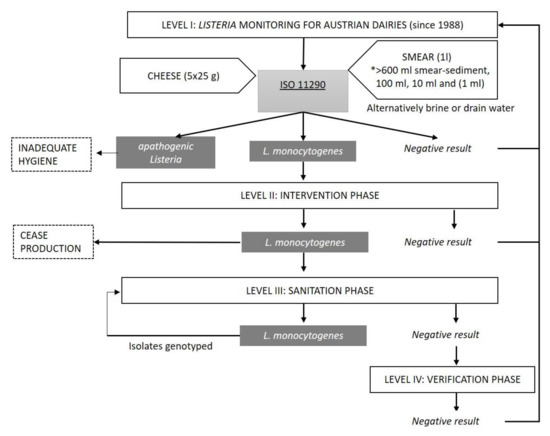
Most Austrian dairies and cheese manufacturers participated in a Listeria monitoring program, which was established after the first reports of dairy product-associated listeriosis outbreaks more than thirty years ago. Within the Listeria monitoring program, up to 800 mL of product-associated liquids such as cheese smear or brine are processed in a semi-quantitative approach to increase epidemiological sensitivity. A sampling strategy within cheese production, which detects environmental contamination before it results in problematic food contamination, has benefits for food safety management. The liquid-based sampling strategy was implemented by both industrial cheese makers and small-scale dairies located in the mountainous region of Western Austria. This report considers more than 12,000 Listeria spp. examinations of liquid-based samples in the 2009 to 2018 timeframe. Overall, the occurrence of L. monocytogenes in smear liquid samples was 1.29% and 1.55% (n = 5043 and n = 7194 tested samples) for small and industrial cheese enterprises, respectively. The liquid-based sampling strategy for Listeria monitoring at the plant level appears to be superior to solid surface monitoring. Cheese smear liquids seem to have good utility as an index of the contamination of cheese up to that point in production. A modelling or validation process should be performed for the new semi-quantitative approach to estimate the true impact of the method in terms of reducing Listeria contamination at the cheese plant level. View Full-Text

Research – Epidemiological investigations identified an outbreak of Shiga toxin-producing Escherichia coli serotype O26:H11 associated with pre-packed sandwiches

Cambridge Org

In October 2019, public health surveillance systems in Scotland identified an increase in the number of reported infections of Shiga toxin-producing Escherichia coli (STEC) O26:H11 involving bloody diarrhoea. Ultimately, across the United Kingdom (UK) 32 cases of STEC O26:H11 stx1a were identified, with the median age of 27 years and 64% were male; six cases were hospitalised. Among food exposures there was an association with consuming pre-packed sandwiches purchased at outlets belonging to a national food chain franchise (food outlet A) [odds ratio (OR) = 183.89, P < 0.001]. The common ingredient identified as a component of the majority of the sandwiches sold at food outlet A was a mixed salad of Apollo and Iceberg lettuce and spinach leaves. Microbiological testing of food and environmental samples were negative for STEC O26:H11, although STEC O36:H19 was isolated from a mixed salad sample taken from premises owned by food outlet A. Contamination of fresh produce is often due to a transient event and detection of the aetiological agent in food that has a short-shelf life is challenging. Robust, statistically significant epidemiological analysis should be sufficient evidence to direct timely and targeted on-farm investigations. A shift in focus from testing the microbiological quality of the produce to investigating the processes and practices through the supply chain and sampling the farm environment is recommended.

Research – Intensive Environmental Surveillance Plan for Listeria monocytogenes in Food Producing Plants and Retail Stores of Central Italy: Prevalence and Genetic Diversity

MDPI

Listeria monocytogenes (Lm) can persist in food processing environments (FPEs), surviving environmental stresses and disinfectants. We described an intensive environmental monitoring plan performed in Central Italy and involving food producing plants (FPPs) and retail grocery stores (RSs). The aim of the study was to provide a snapshot of the Lm circulation in different FPEs during a severe listeriosis outbreak, using whole genome sequencing (WGS) to investigate the genetic diversity of the Lm isolated, evaluating their virulence and stress resistance profiles. A total of 1217 samples were collected in 86 FPEs with 12.0% of positive surfaces at FPPs level and 7.5% at RSs level; 133 Lm isolates were typed by multilocus sequencing typing (MLST) and core genome MLST (cgMLST). Clonal complex (CC) 121 (25.6%), CC9 (22.6%), CC1 (11.3%), CC3 (10.5%), CC191 (4.5%), CC7 (4.5%) and CC31 (3.8%) were the most frequent MLST clones. Among the 26 cgMLST clusters obtained, 5 of them persisted after sanitization and were re-isolated during the follow-up sampling. All the CC121 harboured the Tn6188_qac gene for tolerance to benzalkonium chloride and the stress survival islet SSI-2. The CC3, CC7, CC9, CC31 and CC191 carried the SSI-1. All the CC9 and CC121 strains presented a premature stop codon in the inlA gene. In addition to the Lm Pathogenicity Island 1 (LIPI-1), CC1, CC3 and CC191 harboured the LIPI-3. The application of intensive environmental sampling plans for the detection and WGS analysis of Lm isolates could improve surveillance and early detection of outbreaks. View Full-Text

Research – Ongoing High Incidence and Case-Fatality Rates for Invasive Listeriosis, Germany, 2010–2019

CDC

We used 10 years of surveillance data to describe listeriosis frequency in Germany. Altogether, 5,576 cases were reported, 91% not pregnancy associated; case counts increased over time. Case-fatality rate was 13% in non–pregnancy-associated cases, most in adults ≥65 years of age. Detecting, investigating, and ending outbreaks might have the greatest effect on incidence.

The aging of the population of Germany as a result of demographic shifts that will continue in the coming years may partially explain the increase in listeriosis cases and the median age of patients. In addition, factors related to the foodborne nature of the disease and an increase in exposure to Listeria must be presumed; it is possible that people eat more RTE food or that RTE food is more likely to become contaminated, although only single-case findings of L. monocytogenes >100 CFU/g have been detected in RTE foods in recent years.