Category Archives: Food Microbiology Research

Information – Preventive Controls – A novel approach to kill pathogens utilizing non-flammable alcohol spraying technology:

Food Safety Tech

It is a common misconception that low numbers of Salmonella, Cronobacter and other pathogens are not a problem in low moisture foods because these products do not support growth. Certain organisms can persist for prolonged periods of time in low-moisture products, and heat resistance of Salmonella is greatly increased at reduced water activities in food matrices.

The low water activity level found in most dry ingredients and finished products usually results in severely dehydrated bacteria. It is only when there is adequate moisture, temperature and growing conditions that these stressed bacteria recover and multiply.

Physical cleaning should be followed by chemical or equivalent disinfection procedures and all contact surfaces should be dry before use. If disinfection measures are inadequate, bacteria may adapt to the stress conditions and become more resistant to control efforts. Clean breaks for in-shift sanitizing are becoming more common, so speed of application and drying time must be considered when evaluating new interventions.

Newer technology used in food and medical applications include concentrated alcohol products applied through inert gases to eliminate flammability. Biomist, Inc. has developed new high-grade sanitizing systems and automation for food manufacturers to bolster their sanitation programs by safely applying alcohol-based sanitizers to processing equipment, pneumatic pipes, electronics and other vectors of contamination.
Information – The Raw Story

Click to access the_raw_story.pdf

Information – Raw Milk

Click to access raw-milk-infographic2-508c.pdf

Information – Cleaning Your Refrigerator Because of a Food Recall

CDC

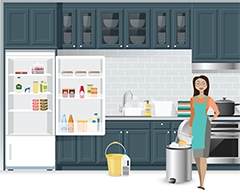
If you have a recalled food item in your refrigerator, it’s important to throw out the food and clean your refrigerator. Germs in the recalled food could spread to drawers or shelves in your refrigerator.

How to Clean Your Refrigerator After a Food Recall

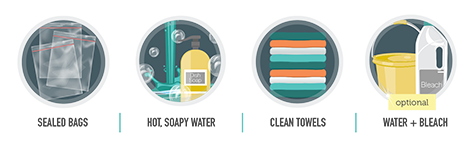
Items needed to clean your refrigerator:

items needed to clean refrigerator

  • Sealed bags
  • Hot, soapy water
  • Clean towels
  • Optional: water + bleach

Step 1 – Throw out recalled food

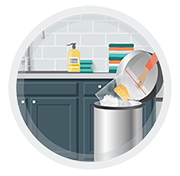
  • Throw out the recalled food, and any other foods stored with it or touching it.
  • Put it in a sealed bag in the garbage.
  • If the recalled food was stored in a reusable container, wash it with hot, soapy water before reusing.
Step 1 to cleaning your fridge throw out recalled food

Step 2 – Empty your refrigerator

  • Empty the rest of the items in your refrigerator and put them on a counter or table while you clean.
  • Take out shelving, drawers, and any other removable parts.
  • Don’t leave unrefrigerated food out for more than 2 hours.

Step 3 – Wash removable parts

  • Wash shelving, drawers, and any other removable parts by hand with hot, soapy water.
  • Dry with a clean towel.
  • Don’t run cold glass shelves or drawers under hot water because the glass could crack. Let them come to room temperature first.

Step 4 – Clean and sanitize inside the refrigerator

  • Wipe the inside of the empty refrigerator with hot, soapy water; then wipe with clean water to rinse off soap.
  • Dry with a clean towel.
  • Don’t forget to wipe inside the doors and any drawers that cannot be removed.
Step 2 of cleaning fridge wash shelving and removable parts with soap and water

* Optional step

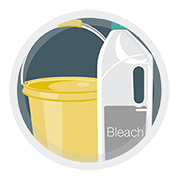
Use a solution of 1 tablespoon of liquid bleach in 1 gallon of water to sanitize your refrigerator. Do this after cleaning the refrigerator with hot, soapy water.

Picture of bleach and bucket

Step 5 – Return shelves, drawers, and food

  • Put the shelves, drawers, and other removable parts back in the refrigerator, along with the other items you took out.
  • Wipe food containers and drink containers with hot, soapy water before returning to the clean refrigerator.

And don’t forget!

  • Wash your hands with water and soap once you’ve finished cleaning.
  • Use hot, soapy water to wipe kitchen counters that held food, drinks, refrigerator parts, and any cleaning materials.
  • Wash any towels you used to dry the refrigerator before using them again.

Research – The influence of organic load and free chlorine on Salmonella cross-contamination of tomatoes in a model flume system

Journal of Food Protection

The process of washing tomatoes in dump (flume) tanks has been identified as a potential source of cross-contamination. This study’s objective was to assess the potential for Salmonella enterica cross-contamination at various inoculation levels at the presence of 0 and 25 mg/L free chlorine (HOCl) and organic matter.  Uninoculated tomatoes were introduced into a laboratory-based model flume containing tomatoes inoculated with a cocktail of five rifampicin-resistant Salmonella enterica serovars at 104, 106, or 108 CFU/tomato in water containing 0 or 25 mg/L HOCl and 0 or 300 mg/L chemical oxygen demand (COD). Uninoculated tomatoes were removed from the water at after 5, 30, 60, 120 s and were placed in bags containing tryptic soy broth supplemented with rifampicin and 0.1% sodium thiosulfate. Following incubation, enrichments were plated on tryptic soy agar supplemented with rifampicin and xylose lysine deoxycholate agar to determine the presence of Salmonella. HOCl and pH were measured before and after each trial. The HOCl in water containing 300 mg/L COD significantly (P≤0.05) declined by the end of each 120 s trial, most likely due to the increased demand for the oxidant. Higher inoculum levels and lower HOCl concentrations were (P≤0.05) significant factors that contributed to increased cross-contamination seen in this study. When HOCl levels were at 25 mg/L, no Salmonella was recovered on non-inoculated tomatoes under all conditions when inoculum levels were at 104 CFU/tomato. When the inoculum was increased to 106 and 108 CFU/tomato, cross-contamination was observed, independent of COD levels. The results from this study show that the currently required sanitizer level (e.g., 100 or 150 mg/L) for flume water may be higher than necessary and warrants re-evaluation.

Information – Lettuce, Other Leafy Greens, and Food Safety

CDC

Eurofins Food Testing UK

Vegetables are an important part of a healthy, balanced diet. Leafy vegetables (called leafy greens on this page) such as lettuce, spinach, cabbage, kale, and bok choy, provide nutrients that help protect you from heart diseasestroke, and some cancers.

But leafy greens, like other vegetables and fruits, are sometimes contaminated with harmful germs. Washing does not remove all germs because they can stick to the surfaces of leaves and even get inside them. If you eat contaminated raw (uncooked) leafy greens, such as in a salad, you might get sick. To prevent contamination, leafy greens should be grown and handled safely at all steps in the journey from farm to fork.

  • CDC estimates that germs on produce that is eaten raw cause a large percentage of U.S. foodborne illnesses (also called food poisoning).
  • Leafy greens and other vegetable row crops are a major source of E. coli O157 infections.
  • Other harmful germs found on leafy greens include norovirus, SalmonellaListeria, and Cyclospora.

Although anyone can get food poisoning, these groups are more likely to get sick and to have a more serious illness:

  • Adults aged 65 and older
  • Children younger than 5 years
  • People who have health problems or take medicines that lower the body’s ability to fight germs and sickness (a weakened immune system)
  • Pregnant women

Research – Survival of Escherichia coli and Listeria innocua on Lettuce after Irrigation with Contaminated Water in a Temperate Climate

MDPI

Microbial disease outbreaks related to fresh produce consumption, including leafy green vegetables, have increased in recent years. Where contamination occurs, pathogen persistence may represent a risk for consumers’ health. This study analysed the survival of E. coli and L. innocua on lettuce plants watered with contaminated irrigation water via a single irrigation event and within stored irrigation water. Separate lettuce plants (Lactuca sativa var. capitata) were irrigated with water spiked with Log10 7 cfu/mL of each of the two strains and survival assessed via direct enumeration, enrichment and qPCR. In parallel, individual 20 L water microcosms were spiked with Log10 7 cfu/mL of the individual strains and sampled at similar time points. Both strains were observed to survive on lettuce plants up to 28 days after inoculation. Direct quantification by culture methods showed a Log10 4 decrease in the concentration of E. coli 14 days after inoculation, and a Log10 3 decrease in the concentration of L. innocua 10 days after inoculation. E. coli was detected in water samples up to 7 days after inoculation and L. innocua was detected up to 28 days by direct enumeration. Both strains were recovered from enriched samples up to 28 days after inoculation. These results demonstrate that E. coli and L. innocua strains are able to persist on lettuce after a single contamination event up until the plants reach a harvestable state. Furthermore, the persistence of E. coli and L. innocua in water for up to 28 days after inoculation illustrates the potential for multiple plant contamination events from stored irrigation water, emphasising the importance of ensuring that irrigation water is of a high quality. View Full-Text

Research – Germany reveals insights from enlarged Campylobacter surveillance

Food Safety News

German experts have presented results so far from increased surveillance of Campylobacter infections.

In Germany, around 60,000 cases are reported every year. Mainly contaminated food of animal origin are identified or suspected as sources of infection.

Intensified molecular surveillance of Campylobacter from human infections at the National Reference Center (NRZ) for Salmonella and other Bacterial Enteric Pathogens at the Robert Koch-Institut (RKI) was set up in 2019.

In 2020, the NRZ received 1,299 Campylobacter isolates from human infections for surveillance and subtyping. There were 55,831 reported cases in the same year. More than 25 different laboratories contributed a diverse range of isolates. More than 80 percent were Campylobacter jejuni and 15 percent Campylobacter coli.

Research – Impact of Interventions on the Survival of Salmonella enterica I 4,[5],12:I:- in Pork

Journal of Food Protection

A mixed culture of different isolates of Salmonella serovar I 4,[5], 12:i:- was compared to a mixed culture of reference Salmonella serovars as well as non-pathogenic Escherichia coli surrogates.. The two groups of Salmonella were compared for their resistance to commonly used pork carcass interventions, survival in ground pork and thermal resistance in ground pork. There were no observed differences between the response of the two different groups of Salmonella serovars and the non-pathogenic E. coli surrogates within intervention type.  There were no observed differences in the recovery and survival of the two different groups of Salmonella serovars in pork which had been treated with interventions, ground and stored at 5 o C for two weeks. Finally, there were no observed differences in heat resistance between the two different groups of Salmonella serovars in ground pork which had been treated with interventions, ground and stored at 5 o C for two weeks. However, there were observed differences in heat resistance in both groups of Salmonella serovars associated with refrigerated storage. The heat resistance of both groups of Salmonella serovars decreased after refrigerated storage. The results of these experiments demonstrate that there were no observed differences between the responses of Salmonella serovar I 4,[5], 12:i:- when compared to the reference Salmonella serovars to commonly used interventions in the pork industry, and therefore do not present a unique challenge to the pork industry.

Research – High Occurrence of Shiga Toxin-Producing Escherichia coli in Raw Meat-Based Diets for Companion Animals—A Public Health Issue

MDPI

Feeding pets raw meat-based diets (RMBDs) is becoming increasingly popular but comes with a risk of pathogenic bacteria, including Shiga toxin-producing Escherichia coli (STEC). In humans, STEC may cause gastrointestinal illnesses, including diarrhea, hemorrhagic colitis (HC), and the hemolytic uremic syndrome (HUS). The aim of this study was to evaluate commercially available RMBDs with regard to the occurrence of STEC. Of 59 RMBD samples, 59% tested positive by real-time PCR for the presence of Shiga toxin genes stx1 and/or stx2. STECs were recovered from 41% of the 59 samples, and strains were subjected to serotyping and virulence gene profiling, using whole genome sequencing (WGS)-based methods. Of 28 strains, 29% carried stx2a or stx2d, which are linked to STEC with high pathogenic potential. Twenty different serotypes were identified, including STEC O26:H11, O91:H10, O91:H14, O145:H28, O146:H21, and O146:H28, which are within the most common non-O157 serogroups associated with human STEC-related illnesses worldwide. Considering the low infectious dose and potential severity of disease manifestations, the high occurrence of STEC in RMBDs poses an important health risk for persons handling raw pet food and persons with close contact to pets fed on RMBDs, and is of concern in the field of public health.