Category Archives: ECDC

EU – Outbreak results reported at ECDC conference

Food Safety News

Experts have shared findings from Cryptosporidium, Listeria, Trichinella, and Salmonella outbreaks at an event in Europe.

Among presentations at the European Scientific Conference on Applied Infectious Disease Epidemiology (ESCAIDE) was one about the Danish perspective on two multi-country outbreaks. These included a Salmonella outbreak linked to chicken meat from Poland and Listeria in fish from a Danish producer.

The meeting organized by the European Centre for Disease Prevention and Control (ECDC) also discussed a July 2023 botulism outbreak linked to potato omelets (tortilla de patata) eaten in Spain. Italy and Norway had two cases of people who had been to Spain. Potential contamination pathways remain unknown.

Research – Multi-country Salmonella outbreak linked to chicken from Ukraine

Food Safety News

More than 100 patients have been added to a multi-country Salmonella outbreak that began in 2021.

By mid-March 2024, 300 Salmonella Mbandaka patients have been reported, according to the European Centre for Disease Prevention and Control (ECDC) and European Food Safety Authority (EFSA).

The United Kingdom has the most cases with 173 and Finland has 98. France has 16, Ireland has seven, while a few have also been reported in Estonia, Germany, and the Netherlands.

Twenty-three patients were hospitalized, six in Finland had septicaemia and one person died in the UK. Patients range in age from less than 1 year old to 100 and 165 are females.

EU – Multi-country outbreak of Salmonella Enteritidis in chicken meat and chicken meat products

EFSA

Between January and October 2023, 14 EU/EEA countries, the UK and the US reported 335 cases related to this outbreak.

Chicken meat and chicken meat products (kebab) are the likely source of a multi-country outbreak caused by three types of Salmonella Enteritidis, according to EFSA and ECDC’s latest Rapid Outbreak Assessment.

Bacteria similar to those causing the outbreak have been detected in samples of chicken meat and chicken kebab. While food traceability data points to producers located in Poland (7 producers) and Austria (1 producer), no microbiological evidence of a contamination at their facilities has been found.

Scientists expect that new cases are likely to occur in this multi-country outbreak as the source has not yet been identified. EFSA and ECDC experts recommend further investigations to identify the potential locations within the chicken meat production chain where the contamination may have occurred.

ECDC -Botulism – Annual Epidemiological Report for 2021

ECDC

In 2021, 82 confirmed cases of botulism were reported in the EU/EEA. Among 30 reporting countries, 19 countries notified zero cases. The overall notification rate was 0.02 cases per 100 000 population. Denmark reported the highest notification rate (0.10 cases per 100 000 population), followed by Romania (0.06 cases per 100 000 population) and Italy (0.05 cases per 100 000 population).

Download

Research – Zoonotic diseases and foodborne outbreaks on the rise, but still below pre-pandemic levels

EFSA

In 2021 there was an overall increase in reported cases of zoonotic diseases and foodborne outbreaks compared to the previous year, but levels are still well below those of the pre-pandemic years, reveals the latest annual EU One Health zoonosis report released by EFSA and ECDC.

The general drop compared to pre-pandemic years in reported cases and outbreaks is probably linked to COVID-19 control measures, which were still in place in 2021. Among the few exceptions are the number of cases for yersiniosis and those of foodborne listeriosis outbreaks, which exceeded pre-pandemic levels.

Most foodborne outbreaks (773) were caused by Salmonella, which accounted for 19.3% of the total. Foodborne outbreaks differ from overall reported disease cases in that they are events in which at least two people contract the same illness from the same contaminated food. The most common sources of salmonellosis outbreaks were eggs, egg products, and “mixed foods”, which are meals composed of various ingredients.

The number of outbreaks caused by Listeria monocytogenes (23) was the highest ever reported. This might be linked to the increased use of whole genome sequencing techniques, which allow scientists to better detect and define outbreaks.

The report also covers overall reported zoonotic disease cases, which are not necessarily linked to outbreaks. Campylobacteriosis remains the most frequently reported zoonosis, with the number of reported cases increasing to 127,840 compared to 120,946 in 2020. Meat from chicken and turkeys was the most common source. Salmonellosis was the second most reported zoonotic disease, affecting 60,050 people compared to 52,702 in 2020. The next commonly reported diseases were yersiniosis (6,789 cases), infections caused by Shigatoxin-producing E. coli (6,084 cases), and listeriosis (2,183 cases).

The report also includes data on Mycobacterium bovis/caprae,BrucellaTrichinellaEchinococcus, Toxoplasma gondii, rabies, Q fever, West Nile virus infections and tularaemia.

EU – Outbreak of Salmonella Mbandaka ST413 linked to chicken meat

ECDC

Foodborne Pathogen

As of 8 November 2022, 196 cases have been reported in Czechia, Estonia, Finland, France, Germany, Ireland, the Netherlands, the United Kingdom and Israel. Nineteen cases have been hospitalised and five cases have had septicaemia; there has been one fatal case in the UK. Cases have occurred across all age groups and there is no overall difference when gender is taken into account. 

Based on case interviews from Finland and the UK, ready-to-eat (RTE) chicken products and/or fresh chicken meat, such as those used in sandwiches and wraps, are the likely vehicles of infection. 

Following investigations, the food safety authority in Finland linked the suspected RTE products to an Estonian company, however, this link could not be verified by the identification of batches nor by microbiological evidence. The Estonian company received processed chicken meat from different suppliers, and its role as a source of infection could not be established. 

Epidemiological data and microbiological evidence from whole genome sequencing of human isolates indicate there are several active sources through different food distribution chains, with a likely common source further up the supply chain. New cases are likely to occur in the EU/EEA until the source has been identified and controlled. 

ECDC encourages Member States to sequence S. Mbandaka isolates from human cases and interview cases with S. Mbandaka ST413 infection focusing on the consumption of various poultry meat and related products. Further investigations are recommended in cooperation with food safety authorities. 

EU – 19 April update: Monophasic Salmonella Typhimurium outbreak

ECDC

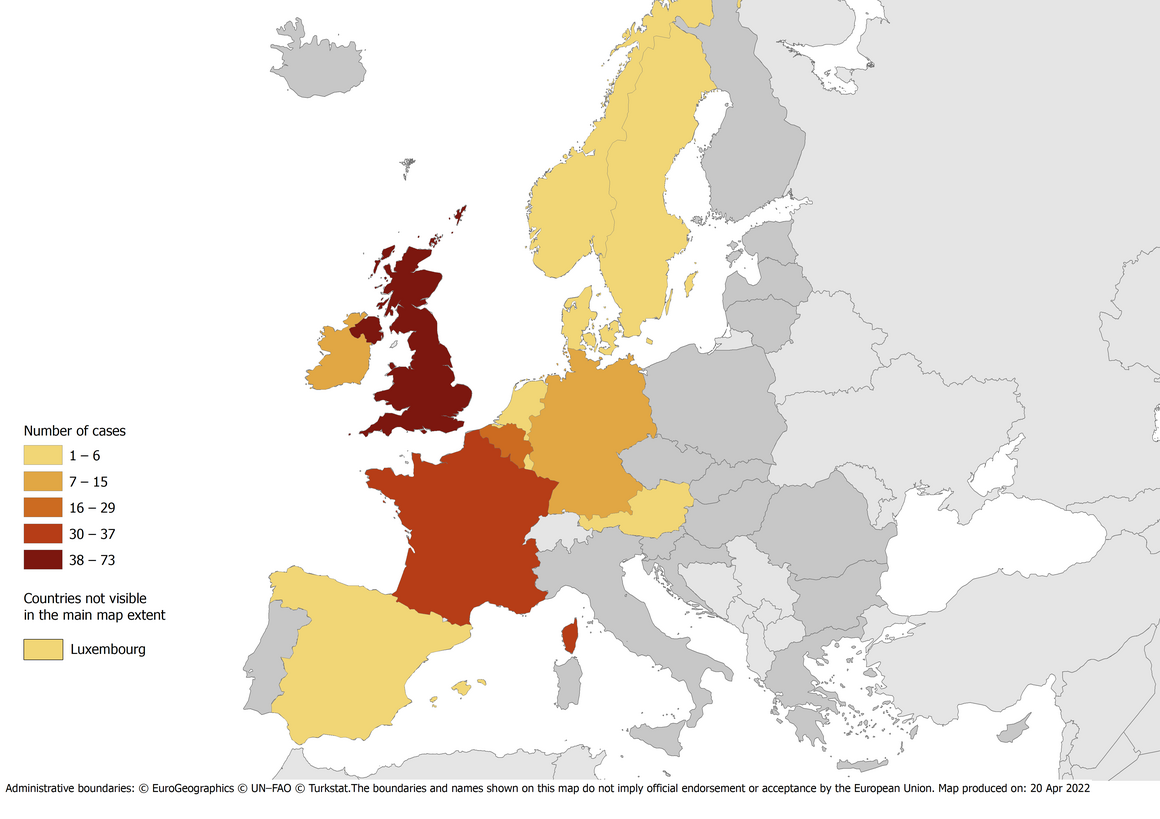
As of 19 April 2022, an outbreak of 187 confirmed and probable cases of monophasic S. Typhimurium (cluster 1) has been identified in the EU/EEA and the United Kingdom.

Number of confirmed and probable cases* with monophasic S. Typhimurium infection by country, EU/EEA and the UK, as of 19 April 2022

The outbreak is characterised by an unusually high proportion of children being hospitalised, some with severe clinical symptoms such as bloody diarrhoea. Based on interviews with patients and initial analytical epidemiological studies, specific chocolate products have been identified as the likely route of infection. Affected cases have been identified through advanced molecular typing techniques. As this method of testing is not routinely performed in all countries, some cases may be undetected.

Product recalls have been launched globally and examples of these can be found on several countries web sites including BelgiumFranceGermanyIrelandLuxembourgNetherlandsNorway, and the UK. The recalls aim to prevent the consumption of products potentially contaminated with Salmonella. Further investigations are being conducted by public health and food safety authorities in countries where cases are reported, to identify the cause and the extent of the contamination, and to ensure contaminated products are not put on the market.

ECDC and EFSA published a rapid outbreak assessment on 12 April 2022. The second strain of monophasic S. Typhimurium in non-human samples (cluster 2), which is mentioned in the published ROA, was found matching with 23 human cases from Belgium (n=5), France (n=5), Germany (n=4), Ireland (n=1), the Netherlands (n=1), and the UK (n=7).

Questions regarding ongoing product recalls should be addressed to national food safety authorities.

Number of confirmed and probable cases* with monophasic S. Typhimurium infection (cluster 1) by country, EU/EEA and the UK, as of 19 April 2022

Country Confirmed cases Probable cases Total cases
Austria 5 1 6
Belgium 7 22 29
Denmark 1 0 1
France 37 0 37
Germany 11 3 14
Ireland 15 0 15
Luxembourg 1 1 2
Netherlands 2 0 2
Norway 1 0 1
Spain 1 2 3
Sweden 4 0 4
Total EU/EEA 85 29 114
United Kingdom 73 0 73
Total 158 29 187

*According to the European outbreak case definition

ECDC – Cholera – Annual Epidemiological Report for 2019

ECDC

Food Illness

Key facts

•In the European Union/European Economic Area (EU/EEA), cholera is a rare disease that is primarily associated with travel to endemic countries outside of the EU/EEA.

•In 2019, seven EU countries reported 26 confirmed cases of cholera, which was similar to previous years.

•Most cases (16/26) were reported by the United Kingdom.

Click to access CHOL_AER_2019_Report.pdf

Europe – Yersiniosis – Annual Epidemiological Report for 2019

ECDC

Yersinia p

For 2019, 29 countries reported 7 048 confirmed yersiniosis cases in the EU/EEA. The overall notification rate of 1.7 per 100 000 population remained stable from 2015 to 2019. The highest rates were reported by Finland, Lithuania and Czechia. The highest rate was detected in 0–4 year-old children, with 7.2 per 100 000 population for males and
5.9 per 100 000 population for females.

Download

Europe – Legionnaires’ disease – Annual Epidemiological Report for 2018

ECDC European Centre for Disease Prevention and Control

Legionnaires’ disease remains an uncommon and mainly sporadic respiratory infection with an overall notification rate of 2.2 per 100 000 for the EU/EEA in 2018. There is heterogeneity in notification rates between EU/EEA countries, with the highest rate reported by Slovenia (7.7 per 100 000). The annual notification rate increased continuously over the period 2014–2018, from 1.3 per 100 000 in 2014 to 2.2 in 2018. There was a 23% increase in the number of cases in 2018 compared with 2017.Four countries (France, Germany, Italy and Spain) accounted for 71% of all notified cases in 2018. Males aged 65 years and above were most affected (8.5 per 100 000).