Category Archives: E.coli

USA – A Decade of E. coli Outbreaks in Leafy Greens in the U.S. and Canada – Podcast

CDC

Katherine Marshall, an epidemiologist at CDC, and Sarah Gregory discuss E. coli outbreaks in leafy greens in the United States and Canada from 2009 to 2018.

More info on this topic
Topics: E. coli InfectionFoodborne DiseasePodcasts
Published: 9/24/2020
Last Updated: 9/24/2020

This podcast belongs to the Emerging Infectious Diseases series.

Subscribe to this Series

Press Play to listen to this CDC Podcast

Running time = 28:10
To save the Podcast, right click the “Save this file” link below and select the “Save Target As…” option.
Save This File (25.8 MB) [right click]

Other Formats: https://tools.cdc.gov/podcasts/media/pdf/EID_10_20_EcoliLeafyGreens.pdf

Research – Salmonella and Campylobacter continue to show high levels of antibiotic resistance

EFSA

Antibiotic resistance in Salmonella and Campylobacter bacteria is still high, says a report released today by the European Centre for Disease Prevention and Control (ECDC) and the European Food Safety Authority (EFSA).

Campylobacteriosis was the most reported zoonosis in the EU in 2020 and the most frequently reported cause of foodborne illness. Campylobacter bacteria from humans and poultry continues to show very high resistance to ciprofloxacin, a fluoroquinolone antibiotic, that is commonly used to treat some types of bacterial human infection.

Increasing trends of resistance against the fluoroquinolone class of antibiotics has been observed in humans and broilers for Campylobacter jejuni. In Salmonella Enteritidis, the most common type of Salmonella in humans, increasing trends of resistance to the quinolone/fluoroquinolone class of antibiotics were observed. In animals, resistance to these antibiotics in Campylobacter jejuni and Salmonella Enteritidis were generally moderate to high.

However, despite the increasing trends of resistance against certain antibiotics, simultaneous resistance to two critically important antibiotics – remains low for E. coliSalmonella and Campylobacter in bacteria from both humans and food-producing animals.

A decline in resistance to tetracyclines and ampicillin in Salmonella from humans was observed in nine and ten countries, respectively, over the period 2016-2020, and this was particularly evident in Salmonella Typhimurium. Despite the decline, resistance to these antibiotics still remains high in bacteria from both humans and animals.

Furthermore, in more than half of the European Union countries, a statistically significant decreasing trend in the prevalence of extended-spectrum β-lactamase (ESBL)-producing E. coli was observed in food-producing animals. This is an important finding as particular strains of ESBL-producing E. coli are responsible for serious infections in humans.

Carbapenem resistance remains extremely rare in E. coli and Salmonella from food-producing animals. Carbapenems are a class of last resort antibiotics and any findings showing resistance to these in zoonotic bacteria are concerning.

Although findings and trends are consistent with data reported in previous years, the COVID-19 pandemic had an impact on the amount of data reported, particularly with regards to public health.

An interactive data visualisation tool shows resistance levels in humans, animals and food, country-by-country in 2019 and 2020.

Additionally, the human food and waterborne antibiotic resistance data is published in ECDC’s Surveillance Atlas of Infectious Diseases (under the diseases campylobacteriosis, salmonellosis and shigellosis, respectively).

Norway – Analyzes of Pathogenic Escherichia coli in bacon sausages 2022

Mattilsynet

On behalf of the Norwegian Food Safety Authority, the Norwegian Veterinary Institute has examined 137 Norwegian bacon sausages for pathogenic E. coli bacteria (STEC). There was a discovery of such bacteria, but this type does not usually cause serious illness in humans. Although the sample was small, the conclusion is that the prevalence of STEC in Norwegian bacon sausages is low.

Mattilsynet

What we investigated: 137 Norwegian bacon sausages
Period: The samples were obtained in 2020 and analyzed in 2021
What we were looking for: E. coli and pathogenic STEC variants
What we found: A positive E. coli sample. This was not the type that usually causes serious illness in people, ie good results.
Who carried out the assignment: Veterinary Institute
Escherichia coli is present in the gastro intestinal tract of humans and warm-blooded animals, and are usually harmless. However, some groups of E.coli may cause infections in humans. Shiga toxin-producing E. coli (STEC) is one of the groups of pathogenic E. coli. Ruminants, in particular cattle, are assumed to be the main reservoir for STEC.
The results from previous surveys of cattle and sheep in Norway for the occurrence of STEC of the serogroups most often associated with infection, have indicated a low occurrence. Similar results were observed in a survey of minced meat from cattle, on the Norwegian market. The Norwegian Food Safety Authority commissioned a survey of STEC in domestically produced fermented sausages. The samples were collected in 2020 with subsequent analysis in 2021.
A total of 137 samples of domestically produced fermented sausage were collected and analysed. Enriched samples were examined for the presence of the genetic markers stx1, stx2 and eae. Attempts of isolation were carried out from samples that were positive for one or more of the virulence markers. Isolates identified as STEC were further characterized using whole genome sequencing.
STEC was isolated from only one sample, and the isolate was characterized as STEC O76:H19 harbouring stx1c, but did not carry eae. In the primary screening of enriched samples, only a few samples were positive for the virulence markers. The results from this study indicates that the occurrence of STEC in
Norwegian fermented sausages is low.
Although STEC was isolated, none of the serogroups associated with severe infections were isolated. It must be taken into account that a low number of samples were analysed. Since this type of products has not been analysed previously, the present survey provides knowledge for the industry, authorities and knowledge institutions. It is important to carry out similar surveys regularly to generate updated Norwegian data.

Czech Republic – Shoots “China Rose”- Sprouted Seeds – EPEC E.coli

Potravinynapranyri

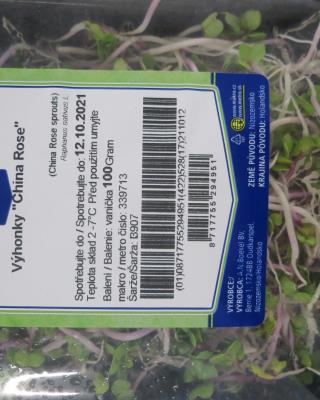
Illustration photo no. 1

Place of inspection:
Brno ( Kaštanová 506/50, 620 00 Brno )
ID: 26450691
Food group: Sprouted seeds and sprouts Sprouted seeds and sprouts

Shoots “China Rose”
Category: Dangerous food
Unsatisfactory parameter:

Escherichia coli enteropathogenic (EPEC)

The product has been found to contain the pathogenic bacterium Escherichia coli enteropathogenic (EPEC), which causes diarrheal diseases.

Lots: L3907
Expiration date: 10/12/2021
Packaging: PP tray with label
Quantity of product in package: 0.1 kg
Producer: AN BOEKEL BV, Berrie 1, 1724BB Oudkarspel, The Netherlands
Country of origin:  Netherlands
Sampling date: 4. 10. 2021
Reference number: 22-000095-CAFIA-CZ

Research – Levels and genotypes of Salmonella and levels of Escherichia coli in frozen ready-to-cook chicken and turkey products in England tested in 2020 in relation to an outbreak of S. Enteritidis

Science Direct

Highlights

Six serovars, with S. Infantis and S. Enteritidis most common, found in 9% of samples

Serovar-specific PCR and Cragie’s motility method used for co-contaminated samples

All S. Enteritidis were outbreak strains and affected six products from two plants.

The highest MPN/g was 54 for S. Infantis and 28 and S. Enteritidis.

Detection of Salmonella spp. was associated with higher levels of generic E. coli.

Abstract

Frozen reformulated (FR) breaded chicken products have previously been implicated in causing human salmonellosis. A multi-country Salmonella enterica serovar Enteritidis outbreak involving several strains with >400 reported human cases in the UK occurred in 2020. Initially S. Infantis was detected in one sample from a case home but S. Enteritidis was then also isolated using a S. Enteritidis specific PCR in combination with isolation via a Craigie-tube. This prompted a survey to examine the presence and levels of Salmonella and E. coli in ready-to-cook FR poultry products in England in 2020.

From a total of 483 samples, including two from cases’ homes, Salmonella was detected in 42 chicken samples, these originated from six out of 53 production plants recorded. Salmonella detection was associated with elevated levels of generic E. coli (OR = 6.63). S. Enteritidis was detected in 17 samples, S. Infantis in 25, S. Newport in four and S. Java, S. Livingstone and S. Senftenberg in one each. The highest levels of Salmonella were 54 MPN/g for S. Infantis and 28 MPN/g for S. Enteritidis; 60% of the Salmonella-positive samples had <1.0 MPN/g. S. Enteritidis was detected together with S. Infantis in five samples and with S. Livingstone in one. Where S. Enteritidis was detected with other Salmonella, the former was present at between 2 and 100-fold lower concentrations. The Salmonella contamination was homogeneously distributed amongst chicken pieces from a single pack and present in both the outer coating and inner content. The S. Enteritidis were all outbreak strains and detected in six products that were linked to four production plants which implicated a Polish origin of contamination. Despite S. Infantis being most prevalent in these products, S. Infantis from only two contemporaneous human cases in the UK fell into the same cluster as isolates detected in one product. Except for one human case falling into the same cluster as one of the S. Newport strains from the chicken, no further isolates from human cases fell into clusters with any of the other serovars detected in the chicken samples.

This study found that higher E. coli levels indicated a higher probability of Salmonella contamination in FR chicken products. The results also highlight the importance of recognising co-contamination of foods with multiple Salmonella types and has provided essential information for detecting and understanding outbreaks where multiple strains are involved.

UK – Trewithen Dairy Unsalted Butter 250G – E.coli

Tesco

Trewithen Dairy Unsalted Butter 250G
Date of recall: 22/03/22
Batch Code G2 073
As a precaution, Trewithen Dairy is recalling one batch code of its unsalted butter, as it’s been found to contain high levels of E. coli.

RASFF Alert – E.coli – Mussels

RASFF

Escherichia coli (350-1600 MPN/100g) in mussels (Mytilus galloprovincialis) from Italy with raw material from Spain in France, Monaco and Spain

Belgium – BUITONI brand frozen pizzas – STEC E.coli O26

AFSCA

PRODUCT RECALL
 Printable version   |   Last updated on21.03.2022
03/21/2022
Recall from Leader Price
Products: BUITONI brand frozen pizzas.
Problem: possible presence of E. COLI.


In agreement with the FASFC, BUITONI withdraws the following products from sale and recalls them from consumers due to the possible presence of E. Coli.BUITONI asks its customers not to consume these products and to return them to the point of sale where they were purchased for reimbursement.

Description of products:

Product

Mark

Bar code Expiry date (DDM) / Batch number
FRAICH’UP Brbc Chicken Pizza 8x600g N3 FR

An image containing text Description automatically generated

3,033,210,822,992 DDM before or equal to 12/2022
FRAICH’UP Royal Pizza 8x600g N7 FR

An image containing text Description automatically generated

7,613,034,225,795 DDM before or equal to 12/2022
FUP Little Italy Piz Burger N1 8x590g EN

An image containing text Description automatically generated

7,613,035,768,154 DDM before or equal to 12/2022

The product was sold via various Leader Price stores in Belgium:
 

219 PHILIPPEVILLE CHASTE 6010 COILLET CHARLEROI
1 CORNER OF RUE DU SEWAGE/CONCORDE 4100 SERAING
90 ERNEST SOLVAY COMICS 4040 HERSTAL
70 RUE PHILIPPE MONNOYER 6180 COURCELLES
13 LAGUESSE STREET 4460 GRACE HOLLAND
160 RTE DE CHARLEROI 7134 BINCH
280 MONS STREET 7301 BELGIUM
31 INDUSTRY AVENUE 4500 TIHANGE
787 CHASTE DE CHARLEROI 6220 FLOWERUS

For any additional information , you can contact consumer service by dialing the number: 00 33 800 22 32 42 Monday to Friday from 8:30 a.m. to 6 p.m.

Research – Hygiene indicators and Salmonella sp. on swine carcass surfaces from two slaughterhouses in northern Portugal.

Journal of Food Protection

The monitorization of carcass surfaces contamination along the slaughter lines enables the verification of the slaughter operations hygiene and the good manufacturing practices. Pork meat is a common source of human non-typhoidal salmonellosis, one of the most frequently reported foodborne illnesses worldwide. This study aimed to gather data on microbial loads in carcass surfaces in two slaughterhouses, before and after evisceration. Salmonella enterica search was made after evisceration, due to the frequent reference to pork as being a common carrier of this microorganism. The contamination of carcass surfaces was evaluated by delimitation of surface area with sterilized templates (100 cm2), and sampled by gauze swabs. Enumeration of total aerobic mesophilic microorganisms, Enterobacteriaceae, and Escherichia coli was performed. The detection of Salmonella was performed for carcass surfaces after evisceration, and from animal liver and floor drains (environmental). Significant differences (p < 0.05) were observed for mesophilic microorganisms, Enterobacteriaceae, and E. coli counts on the external surfaces, with higher counts after evisceration. The neck and abdominal area presented higher levels for mesophilic microorganisms, Enterobacteriaceae and E. coli, and a high prevalence of Salmonella. Salmonella was detected only in one of the studied slaughterhouses; 19 out of 259 analysed carcass samples were positive for Salmonella (7.3%). Salmonella was also detected in two livers and in two floor drains. A collection of 52 Salmonella isolates (44 from carcasses, 5 from livers, 3 from drains) was gathered. Three serovars of Salmonella were identified (Typhimurium 4,5:i- , Wernigerone and Derby), and 53.8% of isolates were multidrug-resistant. The results demonstrate the need for continuous improvement of slaughtering operations and good manufacturing practices, to ensure food safety of pork produced in Portugal.

RASFF Alert – VTEC/STEC E.coli – Beef Tartar

RASFF

Verotoxin E.coli in beef tartar from Poland in Lithuania