Category Archives: E.coli O145

Research -Microbiological Testing Program for E. coli O157:H7 and non-O157 Shiga Toxin-Producing E. coli: Individual Positive Results for Raw Ground Beef (RGB) and RGB Components

USDA

Table 1. Raw Ground Beef Products (RGB) Analyzed for E. coli O157:H7, Current Calendar Year

Sample Source1 Collection Date Where Collected Product Status Positives this Year Samples Analyzed this Year Total Positives2 Total Samples Analyzed2
Federal RGB Verification, Beef Oct 15, 2018 MN Held 4 9,541 540 238,301
Federal RGB Verification, Beef Oct 9, 2018 NC Held 3 9,297 539 238,057
Federal RGB Verification, Beef Mar 26, 2018 OR Held 2 3,085 538 231,845
Federal RGB Verification, Beef Feb 8, 2018 CA Held 1 1,704 537 230,464

Z7_0Q0619C0JGR010IFST1G5B1055

Web Content Viewer (JSR 286)

Actions

Loading…

Microbiological Testing Program for E. coli O157:H7 and non-O157 Shiga Toxin-Producing E. coli: Individual Positive Results for Raw Ground Beef (RGB) and RGB Components

View by Year:  
2018 Positive Results
2017 Positive Results
2016 Positive Results
2015 Positive Results
2014 Positive Results
2013 Positive Results
2012 Positive Results
2011 Positive Results
2010 Positive Results
2009 Positive Results
2008 Positive Results
2007 Positive Results
2006 Positive Results
2005 Positive Results
2004 Positive Results
2003 Positive Results
2002 Positive Results
2001 Positive Results

The table below includes all positive results as of November 4, 2018.

Table 1. Raw Ground Beef Products (RGB) Analyzed for E. coli O157:H7, Current Calendar Year 

Sample Source1 Collection Date Where Collected Product Status Positives this Year Samples Analyzed this Year Total Positives2 Total Samples Analyzed2
Federal RGB Verification, Beef Oct 15, 2018 MN Held 4 9,541 540 238,301
Federal RGB Verification, Beef Oct 9, 2018 NC Held 3 9,297 539 238,057
Federal RGB Verification, Beef Mar 26, 2018 OR Held 2 3,085 538 231,845
Federal RGB Verification, Beef Feb 8, 2018 CA Held 1 1,704 537 230,464

1Sample Sources may include these types of establishments and samples:

  • Federal (verification; follow-up)
  • Retail (verification; follow-up)
  • State (verification; follow-up)
  • Import (verification; follow-up). For Import samples, the column “Where Collected” is defined as Country of Origin. <!–
  • Source may also refer to the type of product (beef, veal, or mixed), as listed on the product label.
  • –>

2Totals: “Total Positives” and “Total Samples Analyzed” are the totals since FSIS began its testing program to detect E. coli O157:H7 in raw ground beef on October 17, 1994.


The table below includes all positive results as of November 4, 2018.

Table 2. Raw Ground Beef Components (RGBC) Analyzed for Target STECs, Current Calendar Year3

Sample Source4 Collection Date Target STECs Where Collected Product Status Posi-
tives this Year
Samples Analyzed this Year5 Total Posi-
tives
Total Samples Analyzed6
Trim Verification, Beef Oct 18, 2018 O111 PA Held 19 6,594 415 59,239
Trim Verification, Beef Oct 9, 2018 O157:H7 SD Held 18 6,262 414 58,907
Trim Verification, Beef Sep 5, 2018 O157:H7 PA Held 17 5,641 413 58,286
Trim Verification, Beef Aug 14, 2018 O103 PA Held 16 5,018 412 57,663
Trim Verification, Beef Jun 6, 2018 O157:H7 MO Held 15 3,583 411 56,228
Trim Verification, Veal Jun 6, 2018 O26 PA Held 14 3,428 410 56,073
Follow-up to RGBC Positive, Beef May 30, 2018 O103 PA Held 13 3,266 409 55,911
Follow-up to RGBC Positive, Beef May 29, 2018 O103 PA Held 12 3,266 408 55,911
Trim Verification, Beef May 21, 2018 O157:H7 TX Held 11 3,147 407 55,792
Trim Verification, Beef May 16, 2018 O103 PA Held 10 2,968 406 55,613
Trim Verification, Beef May 15, 2018 O103 NY Held 9 2,968 405 55,613
Trim Verification, Beef May 9, 2018 O103 PA Held 8 2,968 404 55,613
Other RGBC Verification May 9, 2018 O157:H7 NE Held 7 2,968 403 55,613
Trim Verification, Beef Mar  19, 2018 O157:H7 NM Held 6 1,814 402 54,455
Trim Verification, Beef Mar 1, 2018 O121 ID Held 5 1,507 401 54,148
Trim Verification, Veal Feb 27, 2018 O103 WA Held 4 1,347 400 53,988
Follow-up to RGBC Positive, Beef Jan 27, 2018 O45 WI Held 3 583 400 53,225
Other RGBC Verification Jan 4, 2018 O157:H7 SD Held 2 107 399 52,749
Trim Verification, Beef Dec 28, 2017 O157:H7 WI Held 1 107 398 52,749

Research – USA – Microbiological Testing Program for Escherichia coli O157:H7 and non-O157 Shiga toxin-producing Escherichia coli (STEC)

FSIS USDA USDA

FSIS considers raw, non-intact beef products or the components of these products found to have six Shiga toxin-producing Escherichia coli (STEC) to be adulterated, in addition to E. coli O157:H7. (Refer to the Federal Register notice Shiga Toxin-Producing Escherichia coli in Certain Raw Beef Products | PDF). These six non-O157 STECs are O26, O45, O103, O111, O121, and O145.

On June 4, 2012, FSIS began verification testing for these non-O157 STEC in domestic and imported beef manufacturing trimmings from cattle slaughtered on or after June 4, 2012. Beef manufacturing trimmings collected from cattle slaughtered before June 4, 2012, or that contain other components such as cheek meat are analyzed for E. coli O157:H7 only.

USA – Florida company recalls 3 tons of ground beef for E. coli risk

Food Safety News

Operators of institutional kitchens in Florida are being urged to check their refrigerators and freezers for fresh and frozen raw ground beef products because the producer found E. coli in the meat.

Win Opportunity Knocks, doing business as Ottomanelli Wholesale Meats Inc. in St. Petersburg, FL, reported the ground beef products could be contaminated with three different E. coli serotypes, O45, O130 and O145, according to a recall notice posted July 18.

The notice on the USDA’s Food Safety and Inspection Service (FSIS website, did not indicate what type of institutions received the recalled beef. The notice also did not say whether there have been any reported or confirmed illnesses in relation to the recalled products.

Holland – Research on pathogens in dairy goat and dairy sheep farms

RIVM 

Synopsis

Animals can carry pathogens that can cause disease in humans (zoonoses). In 2016, the RIVM and the NVWA investigated whether dairy goats and dairy sheep carry such pathogens; sometimes this is also done for livestock farmers, their family members and employees. These pathogens usually cause diarrhoea but sometimes the infections are more severe.

Research shows that a few pathogens occur often on dairy goat and dairy sheep farms. These bacteria reside in the intestines of the animals, and are excreted in manure. A small amount of manure is enough to contaminate raw milk or unpasteurised cheese. Visitors to these farms can also become infected if they come into contact with the animals or their environment. Contamination can be prevented by consuming or processing all milk pasteurized. Visitors can reduce the risk of disease by washing their hands if they have been in contact with the animals or their environment.

STEC and Campylobacter bacteria, in particular, were frequently found. STEC was detected at virtually all the farms that were investigated. Campylobacter was detected at 33 percent of the goat farms and 95.8 percent of the sheep farms. These bacteria were found much less often among the farmers and their family members. Listeria was detected less often: at 8.8 percent of the goat farms and 16.7 percent of the sheep farms, and not among people. However, it is a relevant pathogen since unpasteurised soft cheese is the most important source of Listeria infection in humans.

Salmonella was not found at dairy goat farms but was found at 12.5 percent of the dairy sheep farms. On most farms, only a type of Salmonella that is not transmitted to humans was found. ESBL-producing bacteria, which are insensitive to many antibiotics, were detected at 1.7 percent of the goat farms and 4.2 percent of the sheep farms. They were also found in 6.8 percent of the people. This percentage is not higher than for the general population.

Information – FSA – E.coli Fact Sheet

FSA 

CDC E.coli

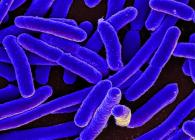
Image CDC


Escherichia Coli (known as E. coli) is a type of bacteria that can be found in the intestines of animals and humans. Many strains of E. coli are harmless to humans, but some can cause serious illness. Most cases of foodborne illness are caused by a strain known as E. coli O157.

Research – Shiga toxin-producing E. coli found in food

Science Daily 


Escherichia coli (E. coli) is a germ that occurs naturally in the gut of mammals and birds, as well as in the human intestinal flora. However, certain E. coli types can cause severe diarrhea in humans. These virulent E. coli types include Shiga toxin-producing E. coli (STEC), also known as Verotoxin-producing E. coli (VTEC).

Their damaging effect is due to the fact that STEC produce toxins known as Shiga toxins (Stx), which can cause disease in the human gut. As the best known STEC representative, an enterohaemorrhagic E. coli (EHEC) strain of the serotype O104:H4 was responsible for numerous severe cases of haemolyticuremic syndrome (HUS) and bloody diarrhea in Germany in 2011, as a result of which 53 people died.

USA- Beef Products Recall – STEC E.coli

E.coli Blog

PFP Enterprises, a Fort Worth, Texas, establishment, is recalling approximately 15,865 pounds of beef products because they may be contaminated with E. coli O103, E. coli O111, E. coli O121, E. coli O145, E. coli O26 and E. coliO45, the U.S. Department of Agriculture’s Food Safety and Inspection Service (FSIS) announced today.

FSIS personnel became aware of the problem during a Food Safety Assessment when they discovered that beef trim tested presumptive positive for multiple non-O157 Shiga toxin-producing E. coli (STEC) strains through the company’s testing program. The company inadvertently did not carry the test out to confirmation, and not all affected product was held.


USDA – STEC E.coli Testing in Raw Meats Data 2013

USDAEurofins Food Testing UK

Microbiological Testing Program for E. coli O157:H7 and non-O157 Shiga Toxin-Producing E. coli: Individual Positive Results for Raw Ground Beef (RGB) and RGB Components

RASFF Alerts – Shiga Toxin E.coli – Beef

RASFF – Shigatoxin-producing Escherichia coli (presence /25g) in bovine meat (Bos taurus) from Argentina in the Netherlands

RASFF -Shigatoxin-producing Escherichia coli in chilled boneless beef (Bos taurus) from Argentina in the Netherlands

RASFF – Shigatoxin-producing Escherichia coli in bovine meat from Belgium

Research – Study Pinpoints Pathogens Causing Biggest Diarrhea Burden in Kids

CIDRAP

While many pathogens cause serious diarrhea in children in developing countries, four stand out as culprits in most of the infections, a finding that could drive new prevention strategies, an international research team reported today.

The group spent 3 years in seven developing countries, collecting health information, lab samples, and outcome data on 3,439 youngsters who had moderate-to-severe diarrhea. They published their findings today in an early online release from The Lancet.

On a global scale each year, diarrheal diseases kill about 800,000 children under age 5, most of them in sub-Saharan Africa and southern Asia, according to the report.

Though interventions such as rotavirus vaccines are starting to have an impact on deaths and disease incidence, scientific data to guide other strategies to curb the diseases are scarce, especially in regions where child deaths are the highest, the group wrote.

To fill the gap, the team focused their analysis on kids under age 5 who did and didn’t have moderate-to-severe diarrhea in selected cities in Bangladesh, Gambia, India, Kenya, Mali, Mozambique, and Pakistan. The study included 13,129 matched controls.

The researchers collected clinical and epidemiologic information, took anthropometric measurements, and took fecal samples to identify pathogens. For each child they made a follow-up home visit 60 days later to assess health status, clinical outcome, and growth measures.

Four pathogens were the most common causes of diarrhea across all sites: rotavirus, Cryptosporidium, enterotoxigenic Escherichia coli (ETEC) producing heat-stable toxin (ST), and Shigella, according to the study.