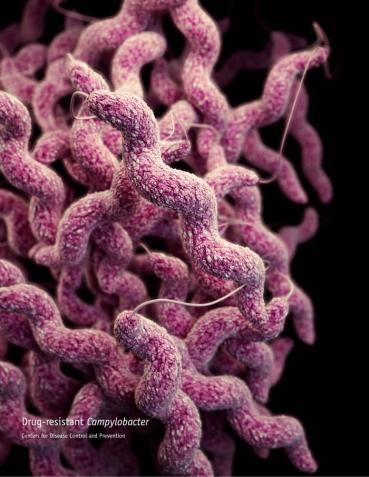
Category Archives: Campylobacter

Research – Genetic insights could help tackle food bug

Roslin

Scientists have identified regions in the genetic makeup of chickens that are linked to resistance to Campylobacter  ̶  the leading bacterial cause of food-borne gastroenteritis worldwide.

Data obtained in the study inform the extent to which parts of the chicken genetic code can be linked to the prevalence of Campylobacter in the chicken gut.

A study led by researchers from the Roslin Institute, in collaboration with the poultry breeding company Aviagen, investigated the genetic make-up of 3,000 chickens bred for meat, to discover whether parts of their genetic code were associated with resistance to Campylobacter colonisation.

This was achieved by looking for variation at specific positions in the chickens’ genome and their association with numbers of Campylobacter in the gut of the birds.

Scientists combined this with analyses of the expression of genes in chickens that were resistant or susceptible to colonisation by the bacteria.

All the chickens were naturally exposed to Campylobacter present in their environment, which mimics how chickens are exposed on a commercial farm.

Campylobacter infections are common in people, who can develop diarrhoea and severe complications after handling or eating contaminated chicken meat.

Each year, it is estimated that more than 500,000 people in the UK are infected, costing the country approximately £50 million.

These results show that whilst there are genetic factors that influence Campylobacter colonisation, these factors play a minor role and therefore it is crucial to characterise and understand the role of the non-genetic and environmental factors to further reduce Campylobacter levels in poultry.

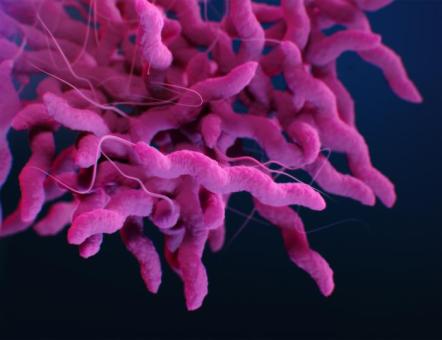
New Zealand – Campylobacter Action Plan 2020-2021

MPI

Campylobacter kswfoodworld

The 2020 –2021 Action Plan incorporates a risk-based, whole-of-food chain approach to identification, selection and implementation of new control measures that will significantly reduce the foodborne campylobacteriosis burden in New Zealand.

The Action Plan includes: prioritisation of selected actions for immediate evaluation/implementation; identification of a further list of potential control measures on the basis of current knowledge, and establishing a framework for their systematic evaluation, prioritisation and implementation; setting of a public health improvement goal for the reduction of foodborne campylobacteriosis; and a lead in to medium-term control measures that will likely be implemented in out-years 2022 –2023.

New Zealand Food Safety will be primarily responsible for agreed actions and reporting against the work schedule. Industry will have responsibility for implementing both legislated and non-legislated actions.

USA – Sources of Foodborne Illness Report Released – IFSAC

Click to access P19-2018-report-TriAgency-508.pdf

New Zealand – Clean, cook and chill to decrease risk of food poisoning

RNZ

As the festive season kicks off, people are being reminded of the increased risk of food poisoning at home.

The Ministry for Primary Industries has launched a food safety campaign reminding everyone to “Clean Cook, and Chill”.

Food Safety Minister Dr Ayesha Verrall said with rising summer temperatures, the risk of food poisoning increased.

“Food poisoning is a significant issue in New Zealand with an estimated 100,000 people getting sick from unsafe food handling practices at home.

“That’s why the Ministry for Primary Industries is launching an awareness campaign, reminding consumers to follow the 3 C’s: clean, cook and chill, when handling, cooking and storing raw meats such as poultry, to avoid getting sick and paying the price,” she said.

MPI has also teamed up with MasterChef winning sisters Karena and Kasey Bird to offer additional advice and helpful cooking tips on social media this summer.

Verrall said a recent study found that most New Zealanders don’t believe that food poisoning can be deadly or create long-term health consequences.

She said while for many, food poisoning will just mean a few days of an upset stomach, for others it can be more serious.

“Some people can and do experience more severe forms of foodborne illnesses as a result of picking up harmful bacteria and viruses like Campylobacter, Norovirus, Salmonella, Listeria, Escherichia coli (E. coli) and Bacillus cereus.

“This is especially true for young tamariki, our elderly community, pregnant mothers and Kiwis who suffer from other health issues,” she said.

USA – Cannibal Sandwiches: Wisconsin officials advise against this holiday tradition.

Outbreak News Today

The Wisconsin Department of Health Services (DHS) reminded the public to abstain from the state holiday tradition– eating raw meat sandwiches, sometimes called Tiger Meat or Cannibal Sandwiches.

What is a cannibal sandwich?

A cannibal sandwich or Tiger meat sandwich is by definition, raw ground beef typically served on rye bread or crackers with onions. Occasionally, a raw egg will be mixed with the meat. It is a traditional winter holiday specialty in certain regions of the upper Midwest.

Health officials say there are foodborne illness risks with eating raw meat like ground beef like SalmonellaE. coli O157:H7, Campylobacter and Listeria and it doesn’t matter where you buy the meat.

Since 1986, eight outbreaks have been reported in Wisconsin linked to eating a raw ground beef dish, including a large Salmonella outbreak involving more than 150 people during December 1994. Ground beef should ALWAYS be cooked to an internal temperature of 160° F.

Research – Source attributed case-control study of campylobacteriosis in New Zealand

IJID

Campylobacter kswfoodworld

Image CDC

Background

Following an initial reduction in human campylobacteriosis in New Zealand after the implementation of poultry food chain-focused interventions during 2006–2008, further decline has been relatively small.
We report a year-long study of notified campylobacteriosis cases, incorporating a case control study combined with a source attribution study. The purpose was to generate up-to-date evidence on the relative contributions of different sources of campylobacteriosis in New Zealand.

Methods

The study approach included: A case-control study of notified cases (aged six months or more) sampled in a major urban centre (Auckland, every second case) and a mixed urban/rural area (Manawatū/Whanganui, every case), between 12 March 2018 and 11 March 2019.
Source attribution of human campylobacteriosis cases sampled from these two regions over the study period by modelling of multilocus sequence typing data of Campylobacter jejuni and C. coli isolates from faecal samples of notified human cases and relevant sources (poultry, cattle, sheep).

Results

Most cases (84%) were infected with strains attributed to a poultry source, while 14% were attributed to a cattle source. Approximately 90% of urban campylobacteriosis cases were attributed to poultry sources, compared to almost 75% of rural cases.
Poultry consumption per se was not identified as a significant risk factor. However specific risk factors related to poultry meat preparation and consumption did result in statistically significantly elevated odds ratios.

Conclusions

The overall findings combining source attribution and analysis of specific risk factors indicate that poultry meat remains a dominant pathway for exposure and infection.

Research – Attributing Human Foodborne Diseases to Food Sources and Water in Japan Using Analysis of Outbreak Surveillance Data

Journal of Food Protection

ABSTRACT

In Japan, strategies for ensuring food safety have been developed without reliable scientific evidence on the relationship between foodborne diseases and food sources. This study aimed to provide information on the proportions of foodborne diseases caused by seven major causative pathogens (Campylobacter spp., Salmonella, enterohemorrhagic Escherichia coli [EHEC], Vibrio parahaemolyticus, Clostridium perfringens, Staphylococcus aureus, and norovirus) attributed to foods and to explore factors affecting changes in these source attribution proportions over time using analysis of outbreak surveillance data. For the calculation of the number of outbreaks attributed to each source, simple-food outbreaks were assigned to the single-food category in question, and complex-food outbreaks were classified under each category proportional to the estimated probability. During 2007 to 2018, 8,730 outbreaks of foodborne diseases caused by seven pathogens were reported, of which 6,690 (76.6%) were of unknown source. We estimated the following source attribution proportions of foodborne diseases: chicken products (80.3%, 95% uncertainty interval [UI] 80.1 to 80.4) for Campylobacter spp.; beef products (50.1%, UI 47.0 to 51.5) and vegetables (42.3%, UI 40.9 to 45.5) for EHEC; eggs (34.6%, UI 27.8 to 41.4) and vegetables (34.4%, UI 27.8 to 40.8) for Salmonella; finfish (50.3%, UI 33.3 to 66.7) and shellfish (49.7%, UI 33.3 to 66.7) for V. parahaemolyticus; grains and beans (57.8%, UI 49.7 to 64.9) for S. aureus; vegetables (63.6%, UI 48.5 to 74.6), chicken products (12.7%, UI 4.6 to 21.5), and beef products (11.1%, UI 8.5 to 13.1) for C. perfringens; and shellfish (75.5%, UI 74.7 to 76.2) for norovirus. In this study, we provide the best available evidence-based information to evaluate the link between foodborne diseases and foods. Our results on source attribution for Campylobacter spp. and EHEC suggest that the strict health regulations for raw beef were reflected in the proportions of these diseases attributed to this food.

HIGHLIGHTS
  • Source attribution proportions of foodborne diseases in Japan were estimated.
  • Source attribution was useful to guide interventions and evaluate their effect.
  • Strict health regulations for raw beef affected source attribution proportions.

Research – Quantification of cross-contamination of Campylobacter jejuni during food preparation in a model kitchen in China

Journal of Food Protection

campy2

Image CDC

Numerous outbreak investigations and case-control studies of campylobacteriosis have provided evidence that handling Campylobacter -contaminated chicken products is a high risk factor for infection and illness. In this study, the cross-contamination and transfer rates of Campylobacter jejuni from chicken to ready-to-eat foods were determined in various food-handling scenarios. Skinless raw chicken breasts were artificially contaminated with Campylobacter jejuni and diced on three kinds of texture cutting boards. Whether cold water or cold water with detergent or hot water was used, statistically significant differences were found between the transfer rate of Campylobacter jejuni to unwashed and washed cutting boards or hands, respectively. When both kitchen knife and cutting board were reused after dicing the artificially contaminated chicken, the transfer rates of Campylobacter jejuni to cucumber cut on bamboo, wooden and plastic cutting board were 16.28%, 12.82% and 5.32%, respectively. The transfer rates from chicken to bread, a large lift-up water faucet handle and a small twist faucet handle via unwashed hands were 0.49%, 4.64% and 3.14%, respectively. This research provides scientific evidence that various types of contaminated kitchen-ware and cook’s hand are vital potential vehicles for the cross-contamination of Campylobacter from raw chicken to ready-to-eat food, and emphasizes the importance of timely and properly cleaning to prevent cross-contamination during food handling, therefore a high quality consumer education to reduce the risk of foodborne infection is urgent and necessary.

Research – Iceland – Electronic publication of salmonella and campylobacter monitoring

MAST

Official results of monitoring Salmonella spp. and Campylobacter spp. in poultry and Salmonella spp. in pigs have been published in a live and interactive dashboard on the website of the Food Administration. The publication is part of the transfer of Matvælastofnun’s monitoring results from the agency’s databases to an accessible electronic form with transparency in mind.

The dashboard offers easy access to information where the user chooses the period he wants to view, whether on an annual or monthly basis, all the way back to 2013. He can also look up when the selected Salmonella serum type was detected and how often. With explanations on the help page (green field Help), the reader is quick to realize options.

Related material

Netherlands – Netherlands records more than 700 outbreaks in 2019

Food Safety News

More than 700 food-related outbreaks were reported in the Netherlands in both 2018 and 2019.

In 2018, 756 foodborne outbreaks with 2,805 illnesses were recorded and in this past year 735 outbreaks with 3,058 illnesses were reported. The number of outbreaks went up from 2017 but illnesses declined.

The data comes from an overview by the National Institute for Public Health and the Environment (RIVM) of the main zoonoses and their prevalence in the country for the Netherlands Food and Consumer Product Safety Authority (NVWA). It features 2018 and 2019 figures. The NVWA did not report 2018 outbreak data in 2019 because of a technical issue.

Norovirus was the main cause of outbreaks with 16 and 17 in 2018 and 2019, respectively, and most patients in both years with 370 and 375. The number of outbreaks is lower than 2017 but higher than 2016.