Author Archives: KSW

RASFF Alerts – Animal Feed – Salmonella – Dog Chews – Rapeseed Meal – Corn Germs – SoybeanMeal

RASFF

Salmonella Montevideo in dog chews from France in Germany

RASFF

Salmonella Senftenberg in rapeseed meal from Ukraine in Lithuania

RASFF

Salmonella infantis in corn germs from Austria in Germany and Hungary

RASFF

Salmonella Senftenberg in soybean meal from the Netherlands in Belgium

Sweden – Norrköping dairy recalls cheeses – may contain Listeria monocytogenes

Livsmedelsverket

2024-01-18

Norrköping’s dairy is recalling cheeses because they may contain listeria.

The following cheeses are recalled:

Basimo Msanara 800g, best before date 240416, batch 26956

Basimo Vitost 1300 g, best before date 240322, batch 22937

Basimo Vitost, 900 g, best before date 240225, batch 01922

Basimo Akawi, 400 g, best before date 240307, ​​batch 21936

Basimo Msanara 800 g, best before date 240314, batch 14931

Basimo Msanara 800g, best before date 240413, batch 27957

The Swedish Food Agency urges consumers to throw away the cheese. Listeria is a bacterium that can cause serious illness in people with compromised immune systems, the frail elderly and pregnant women.

USA – Oyster Norovirus Outbreak hits 191 in Los Angeles and San Diego

Food Poison Journal

The Los Angeles County Department of Public Health is reporting that there are more than 150 suspected local cases of gastrointestinal illness linked to the consumption of raw oysters, likely caused by norovirus. At this time, Public Health is warning consumers not to eat raw oysters from Laguna De Guerrero Negro, Baja California, Mexico; Laguna Manuela, Baja California, Mexico; and Bahia Salina, Sonora, Mexico because they may be linked to outbreaks of norovirus illnesses in California. Before eating raw oysters, consumers should ask the vendor/restaurant where the oysters were harvested.

Belgium – Salami “Yayla Sucuk” (200g) from the Yayla brand – STEC E.coli

afsca

Recall by Beyco bv
Product: Salami “Yayla Sucuk” (200g) from the Yayla brand.
Problem: possible presence of STEC bacteria (E. Coli).


In agreement with the FASFC, Beyco bv is withdrawing the Yayla brand “Yayla Sucuk” salami (200g) from sale and recalling it from consumers due to the possible presence of STEC bacteria (E. Coli). Beyco asks its customers not to consume this product and to return it to the point of sale where it was purchased, where they will be refunded.

Product description

– Product name: Yayla Sucuk
– Brand: Yayla
– Consumption dates (DLC = Consume until): 01/14/2024 – 01/26/2024 – 02/23/2024 – 03/01 /2024
– Batch number: 10865984
– Sales period: from 11/30/2023 to 01/15/2024
– Nature of packaging: plastic
– Weight: 200g

Hong Kong – Food Safety Bulletin 95th Issue

CFS

Feature Article

Shellfish Poisoning

The Centre for Food Safety (CFS) received in April 2023 a referral from the Centre for Health Protection of a suspected case of diarrhoetic shellfish poisoning in which the affected persons developed diarrhoea, nausea, vomiting and abdominal pain within an hour after consuming venus clams at a restaurant.  This article gives a brief introduction on shellfish poisoning.

What is Shellfish Poisoning?

Shellfish poisoning is caused by shellfish toxins produced by certain species of algae.  When shellfish eat toxin-producing algae, the toxins can accumulate in their tissue.  Consumption of shellfish containing shellfish toxins by humans can cause a variety of gastrointestinal and neurological illnesses, known as shellfish poisoning.  Examples of shellfish that have been involved in shellfish poisoning include mussels, clams, oysters, scallops and geoducks.

Numerous shellfish toxins have been discovered around the world; they could cause different types of shellfish poisoning.  Five major types of shellfish poisoning are discussed below:

(i) Paralytic shellfish poisoning (PSP) — caused by paralytic shellfish toxins (PSTs), which are a group of water-soluble alkaloid neurotoxins, including saxitoxins (STXs).

(ii) Diarrhoetic shellfish poisoning (DSP) — caused by diarrhoetic shellfish toxins (DSTs), which are a group of lipid-soluble polyether toxins, including okadaic acid (OA).

(iii) Neurotoxic shellfish poisoning (NSP) — caused by neurotoxic shellfish toxins (NSTs), which are a group of lipid-soluble polyether toxins, including brevetoxins (BTXs).

(iv) Amnesic shellfish poisoning (ASP) — caused by amnesic shellfish toxins (ASTs), including the water-soluble amino acid domoic acid (DA).

(v) Azaspiracid shellfish poisoning (AZP) — caused by azaspiracid shellfish toxins (AZTs), including the lipid-soluble toxin azaspiracid (AZA).

Characteristics of Shellfish Toxins

Different groups of shellfish toxins display multifarious chemical structures, which can be broadly classified into amino acids (DA), alkaloids (STXs) and polyketides (OA, BTXs and AZA).

The reasons why some algae produce shellfish toxins remain unknown.  These toxins are secondary metabolites with no explicit function for the algae.  They are probably used by the algae to compete for space, defence against predators or prevent the overgrowth of other organisms.

In general, shellfish toxins are heat stable, odourless, tasteless and not destroyed by cooking, freezing or other food preparation procedures.  It is hard to distinguish between toxic and non-toxic shellfish visually.

Bioaccumulation of Shellfish Toxins in Bivalve Molluscs

Algae are part of the natural diet of bivalve molluscs.  After shellfish has ingested shellfish toxin-producing algae, shellfish toxins will accumulate and concentrate in their internal organs, such as hepatopancreas of bivalves (Figure 1).  Generally speaking, the adductor muscle contains only a low level of shellfish toxins.
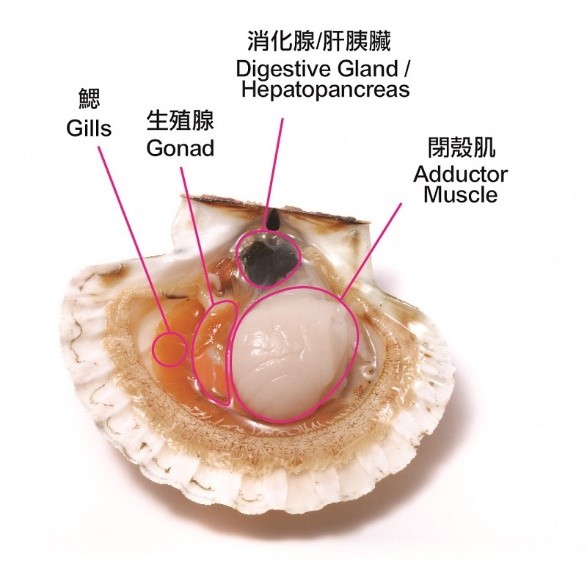
Figure 1: Internal parts of a scallop

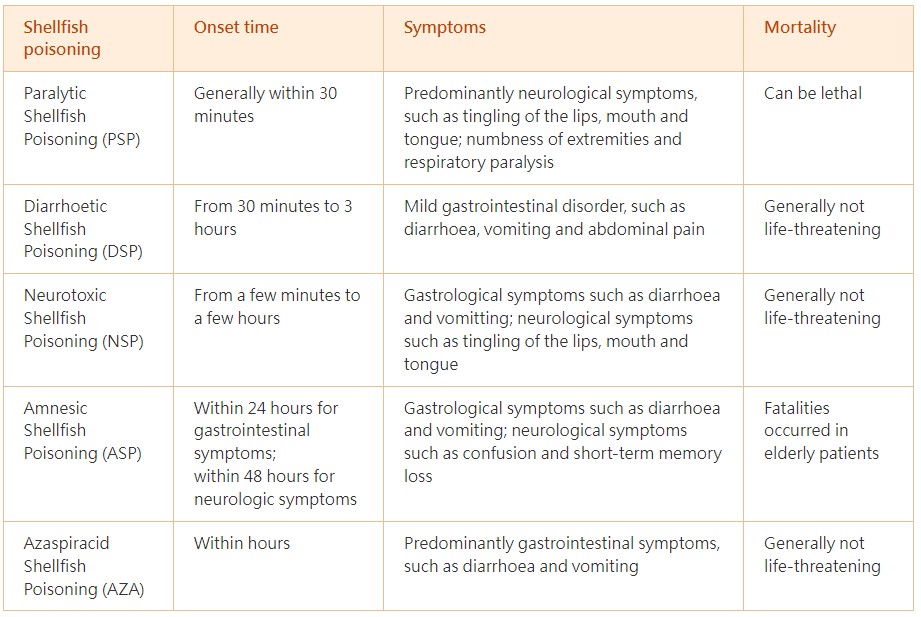
Symptoms of Shellfish Poisoning

Shellfish toxins can cause a wide variety of symptoms in humans, depending on the type and amount of toxins ingested.  Symptoms of different types of shellfish poisoning are summarised below:
Safety Levels of Shellfish Toxins

The toxicity of various shellfish toxins was evaluated by a joint expert working group of the Food and Agriculture Organization of the United Nations (FAO), the World Health Organization (WHO) and the Intergovernmental Oceanographic Commission of UNESCO in 2004.  Acute reference doses (ARfDs) (i.e. the amount of toxins that can be ingested in a period of 24 hours or less without appreciable health risk) have been established for these shellfish toxins.  In addition, the Codex Alimentarius Commission (Codex) has established the maximum levels (MLs) for shellfish toxins in edible parts (the whole or any part intended to be eaten separately) of live bivalve molluscs.  While the ARfDs are critical in assessing the safety of food in terms of the level of shellfish toxins contained, Codex MLs are the levels recommended by Codex to be permitted in shellfish.
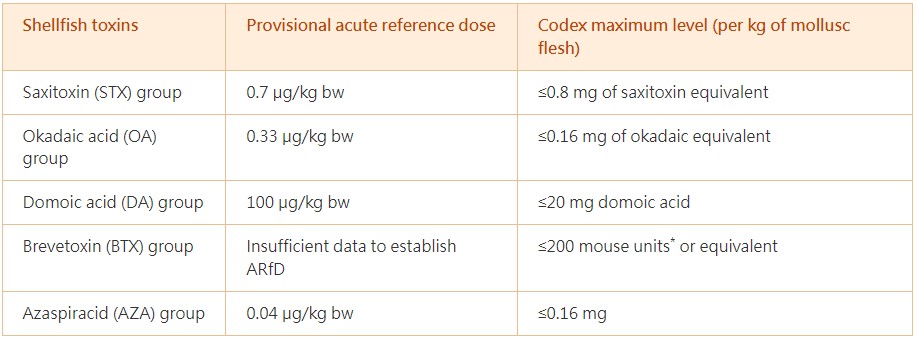
*An estimate of toxicity of the toxin made by mouse bioassay.

Key Points to Note

  • Shellfish toxins are heat stable, odourless, tasteless and not destroyed by cooking, freezing or other food preparation procedures.
  • It is hard to distinguish between toxic and non-toxic shellfish visually.
  • In general, shellfish toxins accumulate and concentrate in the internal organs of bivalves. 

Advice to Consumers 

  • Purchase shellfish from reliable sources.
  • To reduce the health risk of shellfish poisoning, remove and discard all internal organs of shellfish where possible before consumption.
  • Seek medical attention immediately if you feel ill after eating shellfish.

Hong Kong – Food Safety Tips for Chinese New Year

CFS

Choosing and handling Chinese New Year foods and snacks

While purchasing or preparing new year foods, purchase them from reputable retail outlets. Buy sweetened lotus seeds and pistachio with natural colour and avoid those looking extraordinarily white because they may have been bleached with chemicals. Avoid buying melon seeds that are too glossy as they may contain mineral oil, which may cause gastrointestinal discomfort.

You should check the expiry date before buying any pre-packaged festive items like puddings, sesame balls and sweets, and make sure the packaging is intact. Note the hygienic condition of the shop and the food containers and the hygiene practices of the staff, when buying unpackaged items like crispy triangles, sweetened dried fruits and melon seeds.

After purchase, pre-cooked foods like puddings should be stored in the refrigerator as soon as possible and be consumed before the “use by” date shown on the package. Fried festive foods such as sesame balls and crispy triangles should be kept in air-tight containers and stored in the refrigerator or in a cool, dry place.

Melon seeds and nuts are often served during the Chines Year. However, these foods contain hard hulls. Cracking melon seeds and nuts with your own teeth can result in tooth damage. Use a seed or nut cracker instead. Nut are also often used in making Chinese New Year foods. Should you be allergic to nuts or have other food allergy , read food allergen information on food labels to identify if any food or food ingredients of your allergic concern are present in the food. Avoid the food or food ingredients which you are allergic to.

Keep poon choi at safe temperatures

Chinese New Year is a great time of year to have ‘winter warmers’ such as poon choi when we host large gatherings. These dishes are often prepared through bulk cooking ahead of time, due to the large number of portions required. Poon choi contains various food ingredients and requires complicated and long preparation procedures such as cutting, marinating, precooking and cooling and finally re-heating. If the food is left at room temperature for too long after precooking, foodborne pathogens can multiply and some can even produce heat-stable toxins which are not readily eliminable by reheating.

Therefore, it is important to store food properly by storing precooked ingredients at 4°C or below to prevent the formation of toxins, cool down the precooked ingredients by dividing into small portions, placing in shallow containers or placing in ice bath. Reheating foods thoroughly to the core temperature of at least 75°C or above. Keep hot food above 60°C if it is not consumed immediately. Do not leave reheated food at room temperature for long, and discard it if held at room temperature for more than four hours. Of note, heat from the heat source may not be evenly distributed in a large poon choi during reheating, therefore requiring more time to bring poon choi to a boil before eating.

USA – Brightfarms Recalls Spinach and Salad Kits Because of Possible Health Risk as a Result of Supplier Element Farms Recall – Listeria monocytogenes

FDA

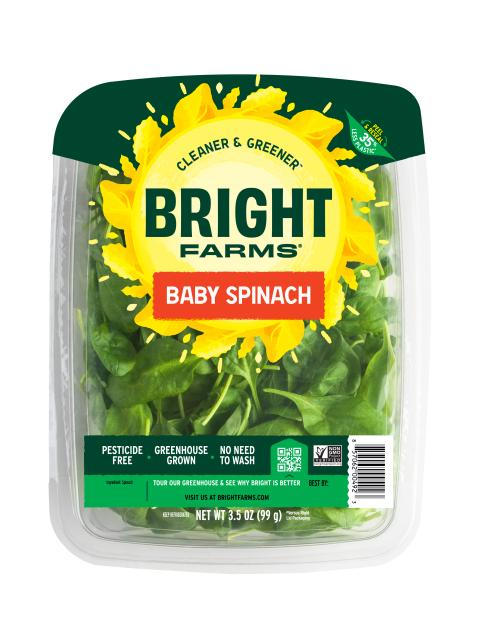
“BrightFarms Baby Spinach”

Company Announcement Date:
FDA Publish Date:
Product Type:
Food & Beverages
Reason for Announcement:
Potential Foodborne Illness-Listeria monocytogenes
Company Name:
BrightFarms
Brand Name:
BrightFarms
Product Description:
Spinach and Salad Kits

Company Announcement

Selinsgrove, PA (January 17, 2024) –– BrightFarms has issued a voluntary recall of spinach grown by its supplier Element Farms in their Pompton Plains, New Jersey farm and distributed under the BrightFarms brand because the spinach has the potential to be contaminated with Listeria monocytogenes. Due to potential cross-contamination, BrightFarms is also issuing a voluntary recall of a limited quantity of four salad kit products (shown below) from its Selinsgrove, PA facility.

Listeria monocytogenes is an organism that can cause serious and sometimes fatal infections in young children, frail or elderly people, and others with weakened immune systems. Although healthy individuals may suffer only short-term symptoms such as high fever, severe headache, stiffness, nausea, abdominal pain and diarrhea, Listeria infection can cause miscarriage and stillbirths among pregnant women.

The recalled products were distributed to retailers in seven states including Connecticut, Massachusetts, New York, New Jersey, Pennsylvania, Virginia, and West Virginia.

The products come in 4-oz, clear, plastic containers. Information about the “best by” date, UPC, and facility code can be found at the bottom of the package. Pictures to assist customers in identifying the recalled products are found at the end of this announcement.

Product Ounce UPC
Codes
Facility
Code
Best-By Date
BrightFarms Baby Spinach 3.5oz 8-57062-00492-3 PEN8 1/11/2024,
1/13/2024,
1/18/2024,
1/20/2024
BrightFarms Mediterranean
Crunch Kit
6.35oz 8-50051-82501-1 PEN4 1/15/2024,
1/20/2024
BrightFarms Chickpea Caesar
Crunch Kit
6.50oz 8-57062-00415-2 PEN4 1/15/2024,
1/20/2024
BrightFarms Bacon Ranch
Crunch Kit
6.70oz 8-57062-00416-9 PEN4 1/15/2024
BrightFarms Southwest
Chipotle
5.85oz 8-50051-82500-4 PEN4 1/15/2024

No illnesses have been reported to date.

The recall of spinach was initiated after routine sampling conducted by Element Farms yielded a positive result for Listeria monocytogenes. Due to potential cross-contamination at BrightFarms’s Selinsgrove, Pennsylvania facility, BrightFarms is also recalling a limited quantity of four select salad kit products. No positive test results or reported illness have been received on those products, to date.

As a result of today’s recall, the company has temporarily suspended distribution of Element Farms grown spinach.

Retailers have been instructed to remove all recalled products from store shelves. Consumers who have purchased the affected products should not consume the products and discard them or present a photo of the product or receipt to their place of purchase for a full refund and then discard.

Consumers with questions are encouraged to call 1-866-857-8745 between 8:00am-6:00pm EDT or email info@brightfarms.com with the subject line: Recall.

###


Company Contact Information

Consumers:
 1-866-857-8745
 info@brightfarms.com

France – Sliced ​​bread for Rye Toast 300g CASINO – Mycotoxins

Gov France

Product category
Food
Product subcategory
Cereals and bakery products
Product brand name
CASINO
Model names or references
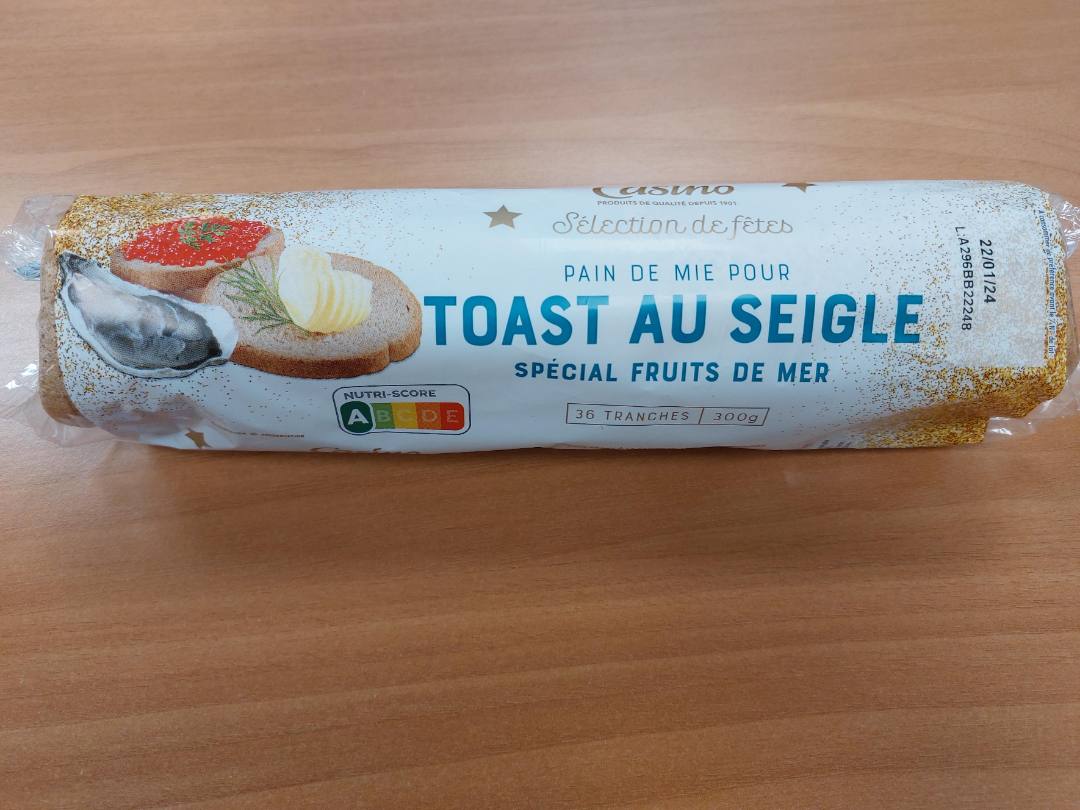
Sliced ​​bread for Rye Toast 300g CASINO
Product identification
GTIN Batch Date
3222477758353 A296BB Minimum durability date 01/22/2024
Start/end date of marketing
From 04/11/2023 to 06/12/2023
Storage temperature
Product to be stored at room temperature
Geographical sales area
Whole France
Distributors
CASINO, VIVAL, SPAR and Casino distribution networks

Hungary – Nett Food Bulgur, 1 kg – Mycotoxin – DON – Deoxynivalenol

Nebih

Date 2024-01-16
Name of Product Nett Food Bulgur, 1 kg
Nature of the problem Mycotoxin (DON – deoxynivalenol) content exceeding the limit value
DetailsNébih asks customers not to consume the product that matches the identification data below!

Notifier: Bio Fair Trade Kft.

Product name: Nett Food Bulgur, 1 kg

Brand: NETTFOOD

Product origin: Ukraine

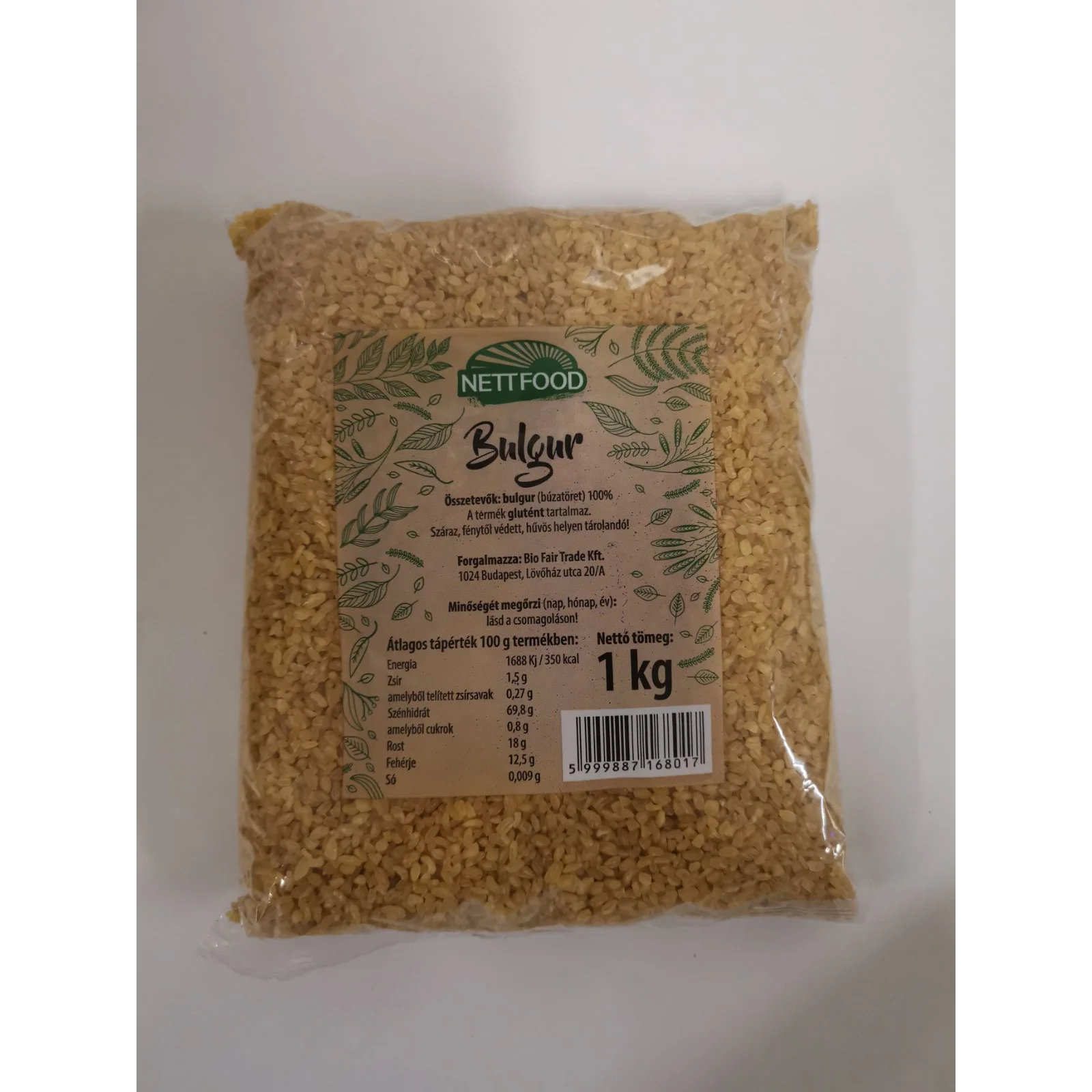
Picture of the product:

Nett Food Bulgur, 1 kg

Nature of the problem: Mycotoxin (DON – deoxynivalenol) content exceeding the limit value

Quality retention times: 

• 01.07.2024.
• 01.08.2024. 
• 08.05.2024.

Packaging: 1 kg

Manufacturer: Bio Fair Trade Kft.

Distributor: Bio Fair Trade Kft.

Action: Product recall

Bio Fair Trade Kft. informed its customers about the recall on its website . 

The affected product can be returned to any Auchan store, and the full purchase price of the product will be refunded.

You can read more about the nature of the problem here .

The product recall only applies to the product identified by the above data.

USA – 4 Washington Counties linked to Charcuterie Salmonella Outbreak

Food Poison Journal

Chelan-Douglas Health District is one of four Washington health jurisdictions working with Washington State Department of Health and Federal Partners in a multi-state salmonella outbreak investigation linked to charcuterie meats.

Washington currently has four cases included in this outbreak from four counties including Chelan (1), Douglas (1), King (1) and Spokane (1). Note: As of January 12th, 2024, two of the Washington cases have not been added to the CDC outbreak page.

The four Washington cases all report consuming some form of charcuterie meat prior to their illness. However, none of the cases consumed the recalled Busseto Charcuterie Sampler which was linked to the outbreak in other states. Washington State Department of Health officials are investigating additional charcuterie meat products.