Apologies for those of you waiting for the RASFF Alerts, the consumer portal is down for some reason so I cannot get access. As soon as I can I will post the alerts
KSWFoodWorld

Apologies for those of you waiting for the RASFF Alerts, the consumer portal is down for some reason so I cannot get access. As soon as I can I will post the alerts
Posted in Uncategorized

A number of countries are reporting increasing rates of viral gastroenteritis over recent months, and experts suggest greater use of hand sanitizers, known to have little effect on pathogens such as norovirus, may be partly responsible.
New data released by health authorities in the Australian state of Victoria is reporting a four-fold increase in gastroenteritis outbreaks across childcare facilities over the first few months of 2021, compared to the five-year average. Other countries such as New Zealand and Taiwan have also reported spikes in norovirus outbreaks over recent months.
http://www.china.org.cn/world/Off_the_Wire/2021-04/28/content_77448785.htm
SYDNEY, April 28 (Xinhua) — Health authorities in Australia urged people to use soap and water rather than relying solely on hand sanitizers to ward off the norovirus.
The Food Safety Information Council (FSIC) made the suggestion on Wednesday following hundreds of outbreaks of the gastro virus around the nation in the past five months. Nearly 390 cases have been recorded this year in the state of Victoria, four times higher than average.
“Norovirus is highly contagious. A single infected person can easily spread it to many others, especially if they don’t wash their hands properly or prepare food or drink for others while they’re sick,” said FSIC chairwoman Cathy Moir.
She said not all viruses are the same and although hand sanitizers are very effective against reducing the spread of COVID-19, it has little effect on the spread of norovirus.
The FSIC suggested people to frequently wash their hands with soap and warm water for 20 seconds and drying for another 20 seconds to effectively remove norovirus.
The most important times to wash hands are after going to the toilet, vomiting, changing nappies, cleaning up vomit or faeces (poo) or attending to a sick person who has vomited, and before eating and preparing food.
The FSIC also suggested not to prepare food or drink for others if having gastro, and not to share plates, utensils or drink bottles with others.
Recall / advisory date: April 22, 2021
Reason for recall / advisory: Microbiological – Non harmful (Quality/Spoilage)
Hazard classification: Class 3Company / Firm:Give and Go Prepared Foods Corp.Distribution:Alberta, Manitoba, Saskatchewan
Extent of the distribution: RetailReference number:14373
Between August and December 2020, the U.S. Food and Drug Administration (FDA) and multiple state and federal partners were involved in an outbreak investigation related to E. coli O157:H7 illnesses and the consumption of leafy greens. The outbreak, which caused 40 reported domestic illnesses, was linked via whole genome sequencing (WGS) and geography to outbreaks traced back to the California growing region associated with the consumption of leafy greens in 2019 and 2018. FDA, alongside state and federal partners, investigated the outbreak to identify potential contributing factors that may have led to leafy green contamination with E. coli O157:H7. The E. coli O157:H7 outbreak strain was identified in a cattle faeces composite sample taken alongside a road approximately 1.3 miles upslope from a produce farm with multiple fields tied to the outbreaks by the traceback investigations. In addition, several potential contributing factors to the 2020 leafy greens outbreak were identified.
Isolates within this cluster of illnesses are part of a reoccurring strain of concern and are associated with outbreaks that have occurred in leafy greens each fall since 2017. The two most recent outbreaks associated with this strain were an outbreak in 2018 (linked to romaine lettuce from the Santa Maria growing region of California) and an outbreak in 2019 (linked to romaine lettuce from the Salinas growing region of California). Clinical isolates from cases in this 2020 outbreak appear more closely related to those from the 2019 outbreak than the 2018 outbreak. In addition, several specific food and environmental isolates that appear to be highly related to this 2020 outbreak include a faecal-soil composite sample collected by FDA in February 2020 from the Salinas growing region and two leafy green samples collected in 2019 by state partners as a part of the 2019 investigation that traced back to the Salinas growing region.
As part of this investigation, tracebacks of leafy greens consumed by ten ill individuals from eleven points of service were conducted. Although that traceback investigation was based on a relatively small number of the total cases, it was based on those cases which presented the strongest evidence via purchase card information, invoices, bills of lading, and electronic data. The traceback investigation identified the Salinas growing region of California as a geographical region of interest.
In light of this most recent finding, combined with previous outbreak investigation findings in the region, FDA has identified key trends regarding the issues of a reoccurring strain, a reoccurring region, and reoccurring issues around adjacent and nearby land use of primary importance in understanding the contamination of leafy greens by E. coli O157:H7 that occurred in 2020 and previous years.
FDA also recognizes the interconnection between people, animals, plants, and their shared environment when it comes to public health outcomes. As such, we strongly encourage collaboration among various groups in the broader agricultural community (i.e. livestock owners; leafy greens growers, state and federal government agencies, and academia) to address this issue. With this collaboration, the agricultural community, alongside academic and government partners, can work to identify and implement measures to prevent contamination of leafy greens. FDA recommends that these parties participate in efforts to understand and address the challenge of successful coexistence of various types of agricultural industries to ensure food safety and protect consumers against foodborne illnesses.
Download the Full Report (PDF 563KB)
Posted in E.coli O157, E.coli O157:H7, food bourne outbreak, food contamination, Food Hazard, Food Hygiene, Food Illness, Food Inspections, Food Micro Blog, Food Microbiology, Food Microbiology Blog, Food Microbiology Research, Food Microbiology Testing, Food Pathogen, Food Poisoning, food recall, Food Safety, Food Safety Alert, Food Testing, Food Toxin, foodborne outbreak, foodbourne outbreak, outbreak, Research, STEC, STEC E.coli
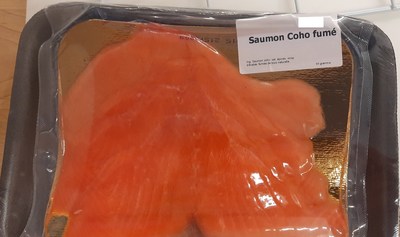
QUEBEC, April 29, 2021 / CNW Telbec / – The Ministry of Agriculture, Fisheries and Food (MAPAQ), in collaboration with the company Boucherie O’Max, located at 85, rue Saint-Joseph , in Gracefield , is advising the public not to consume the product indicated in the table below if it has not been kept in the freezer at all times since the time of purchase. This is because the product packaging does not include the required “Keep frozen until use” statement.
|
Product name |
Format |
Targeted lot |
|
“Smoked Coho Salmon” |
65 g |
Units sold until April 28, 2021 |
The product that is the subject of this warning was offered for sale until April 28, 2021 inclusive, and only at the establishment designated above. It was vacuum packed and sold frozen. The product label includes, in addition to its own name, the list of ingredients and the price of the product.
The operator is voluntarily recalling the product in question. He agreed with MAPAQ to disseminate this warning as a precautionary measure. People who have this product in their possession and have not kept it in the freezer at all times since the time of purchase are advised not to consume it. They must either return it to the establishment where they bought it or throw it away. Even if the affected product does not show any signs of spoilage or a suspicious odor, consuming it may represent a health risk. It should be noted that no case of illness associated with the consumption of this food has been reported to MAPAQ so far.
Additional information
The Ministry publishes various information documents concerning food safety. Those interested can consult them in the “Food consumption” section of the MAPAQ website: www.mapaq.gouv.qc.ca/consommation . They also have the option of registering online, by visiting www.mapaq.gouv.qc.ca/rappelsaliments , to receive, by email, the food recall releases published by the Department. Finally, it is possible to follow “MAPAQaliments” on Twitter at the following address: www.twitter.com/MAPAQaliments .

Presence of Escherichia Coli
People who hold the product in question are asked not to consume them – and more particularly young children, pregnant women, immunocompromised people and the elderly – and to return them to the point of sale where they were purchased.
People who have consumed it and who present symptoms such as diarrhea, abdominal pain or vomiting should consult their doctor as soon as possible, mentioning this consumption and the possible link with the bacterium Escherichia coli.
In the absence of symptoms within 10 days after consuming the affected products, there is no need to worry and consult a doctor.
The bacterium E. coli is naturally present among the digestive microflora of humans and warm-blooded animals. Some strains of E. coli are pathogenic, and can be responsible in humans for various disorders ranging from mild diarrhea to more serious forms such as hemorrhagic diarrhea or severe kidney damage such as HUS, mainly in young children.
▸ Lot
100221
▸ DDM
04/25/2021
▸ Packaging individually
wrapped in paper
▸ Start date / End of marketing
From 03/15/2021 to 04/16/2021
▸ Health mark
FR 86 042 001 CE
▸ Geographical sales area
• INDRE-ET-LOIRE (37)
• VIENNE (86)
▸ Distributors
• Retailers on 86 and 37,
• Amap at 37,
• Tours Beaujardin market
• farm gate sale
▸ Consumer service contact
0247920402
▸ Source
EARL DES FRISONNES EARL des Frisonnes
Cattle are a reservoir for Shiga toxin-producing Escherichia coli (STEC), zoonotic pathogens that cause serious clinical disease. Scotland has a higher incidence of STEC infection in the human population than the European average. The aim of this study was to investigate the prevalence and epidemiology of non-O157 serogroups O26, O103, O111, and O145 and Shiga toxin gene carriage in Scottish cattle. Fecal samples (n = 2783) were collected from 110 herds in 2014 and 2015 and screened by real-time PCR. Herd-level prevalence (95% confidence interval [CI]) for O103, O26, and O145 was estimated as 0.71 (0.62, 0.79), 0.43 (0.34, 0.52), and 0.23 (0.16, 0.32), respectively. Only two herds were positive for O111. Shiga toxin prevalence was high in both herds and pats, particularly for stx2 (herd level: 0.99; 95% CI: 0.94, 1.0). O26 bacterial strains were isolated from 36 herds on culture. Fifteen herds yielded O26 stx-positive isolates that additionally harbored the intimin gene; six of these herds shed highly pathogenic stx2-positive strains. Multiple serogroups were detected in herds and pats, with only 25 herds negative for all serogroups. Despite overlap in detection, regional and seasonal effects were observed. Higher herd prevalence for O26, O103, and stx1 occurred in the South West, and this region was significant for stx2 at the pat level (P = 0.015). Significant seasonal variation was observed for O145 prevalence, with the highest prevalence in autumn (P = 0.032). Negative herds were associated with Central Scotland and winter. Herds positive for all serogroups were associated with autumn and larger herd size and were not housed at sampling.
IMPORTANCE Cattle are reservoirs for Shiga toxin-producing Escherichia coli (STEC), bacteria shed in animal feces. Humans are infected through consumption of contaminated food or water and by direct contact, resulting in serious disease and kidney failure in the most vulnerable. The contribution of non-O157 serogroups to STEC illness was underestimated for many years due to the lack of specific tests. Recently, non-O157 human cases have increased, with O26 STEC of particular note. It is therefore vital to investigate the level and composition of non-O157 in the cattle reservoir and to compare them historically and by the clinical situation. In this study, we found cattle prevalence high for toxin, as well as for O103 and O26 serogroups. Pathogenic O26 STEC were isolated from 14% of study herds, with toxin subtypes similar to those seen in Scottish clinical cases. This study highlights the current risk to public health from non-O157 STEC in Scottish cattle.
Since 1995, the Norwegian Food Safety Authority has carried out monitoring programs for Salmonella in live animals (cattle, pigs and poultry), fresh meat and eggs. The program documents that the incidence is very low compared to most other countries.
| What did we investigate? | The aim of the program is to ensure that food-producing animals, fresh meat and eggs from Norwegian domestic animals are virtually free of salmonella. The program also documents the very favorable salmonella situation Norway has, which in turn provides a basis for salmonella guarantees, ie when importing certain animals and certain animal products, the shipment must be examined for salmonella with a negative result in the country of dispatch before it can be sent to Norway. In the program, samples have been taken in herds, in the slaughterhouses and in downsizing companies. |
| Period: | All year |
| What were we looking for? | The samples were tested for Salmonella. |
| What did we find? | In the program for 2020, one positive sample was found among a total of 8,285 from poultry, one positive sample from pigs among 3,245 examined, three positive samples from cattle out of a total of 2,975 samples and four positive samples from a total of 8,690 taken from fresh meat in slaughterhouses and cutting plants. . |
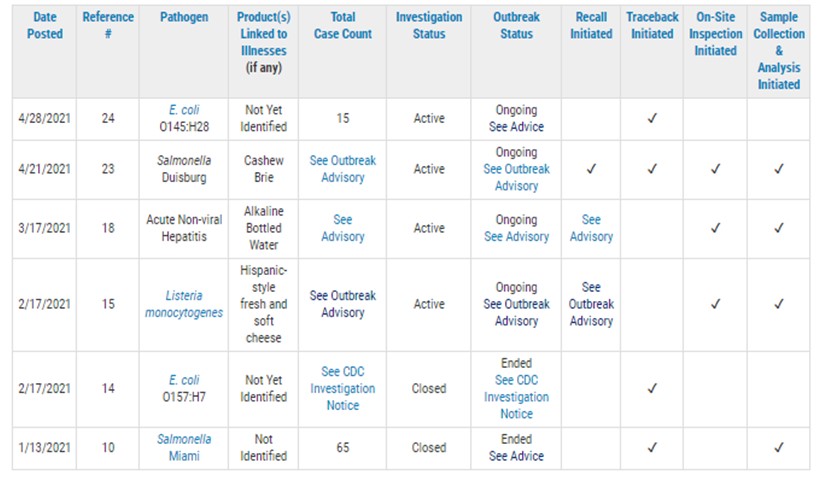
A new E. coli O145:H28 outbreak has been posted on the FDA’s CORE Investigation outbreak table. This new outbreak has sickened at least 15 people. There is no more information provided, which is typical for a posting on that table. The FDA only gives out more information about these outbreaks when they believe there are actionable steps that consumers can take to protect themselves, such as a recall.
Posted in E.coli, E.coli O145, FDA, food bourne outbreak, food contamination, Food Hazard, Food Hygiene, Food Inspections, Food Micro Blog, Food Microbiology, Food Microbiology Blog, Food Microbiology Testing, Food Pathogen, Food Poisoning, food recall, Food Safety, Food Safety Alert, Food Testing, Food Toxin, foodborne outbreak, foodbourne outbreak, outbreak, STEC, STEC E.coli
Posted in food bourne outbreak, food contamination, Food Hazard, Food Hygiene, Food Inspections, Food Micro Blog, Food Microbiology, Food Microbiology Blog, Food Microbiology Research, Food Microbiology Testing, Food Pathogen, Food Poisoning, food recall, Food Safety, Food Safety Alert, Food Testing, foodborne outbreak, foodbourne outbreak, outbreak, Research

 FoodWorld