France – MORTADELLA BOLOGNA PGI 100 G – Listeria monocytogenes

Gov france

Identification information of the recalled product

  • Product category Food
  • Product subcategory Meats
  • Product brand name the Tradizioni D’Italia Charcuterie Workshop
  • Model names or references MORTADELLA BOLOGNA PGI 100 G
  • Identification of products
    GTIN Batch Date
    3664335100049 L213097 Use-by date 05/12/2022
  • Packaging Transparent tray 100g
  • Marketing start/end date From 19/04/2022 to 10/05/2022
  • Storage temperature Product to be stored in the refrigerator
  • Health mark IT 1907 L EC
  • Further information Only products bearing the additional code 01 following the barcode are affected by the recall.
  • Geographic area of ​​sale Whole France
  • Distributors E.LECLERC.

Practical information regarding the recall

  • Reason for recall Presence of Listeria monocytogenes
  • Risks incurred by the consumer Listeria monocytogenes (causative agent of listeriosis)

Italy – Food safety, episode of botulism linked to the consumption of a package of pesto and almonds

Salute

kswfoodworld

It is reported that a laboratory confirmed case of botulism occurred in Rome. 

The epidemiological investigation has identified as a suspect food a Sicilian broccoli and almond pesto which , according to the information available to date, appears to have been given as a gift about two months earlier .  

In the food exhibit analyzed by the ISS for the search for toxins and botulinum spores, which was still negative, it was reported  in the label of the glass jar.

“ The biodynamic farm – Sicilian broccoli pesto and almonds.
Product grown strictly following the biodynamic method controlled by BIO -DYNAMIC RESEARCH INSTITUTE and packaged by The biodynamic farm, Strada Freddano, 20 – 01100 Viterbo.
210g and Ingredients: biodynamic Sicilian broccoli, almonds.

Store in the refrigerator after opening, at a temperature of 4 ° C and consume quickly “.

No batch or expiry date was indicated on the label and on the guarantee seal of the jar .

Following the investigations of the local competent authorities at the farm  and  as declared by the current owner , it emerged that   the  pesto was produced for self –  consumption  and that from November 2021  the production of all the preserves   was  suspended  . It was not possible to trace the exact number of jars of Sicilian broccoli pesto and almonds produced, nor how many were possibly given away.

Citizens are therefore invited, as a precaution, not to consume the aforementioned Sicilian broccoli and almond pesto, possibly received as a gift, paying attention to non-compliant labeling due to lack of batch and expiry  or  even absent.

The Istituto Superiore di Sanità  represents that  Clostridium  botulinum  (botulinum) is an environmental spore-forming microorganism that can naturally contaminate raw materials and composite foods. Generally the level of environmental contamination in botulinum spores is very low and can be punctate, therefore in the same production batch, it can occur that only some packages are contaminated. Since the consumption of minimal quantities of food contaminated with botulinum toxins can cause the disease, anyone holding a jar that corresponds to the above characteristics should also avoid tasting it.

Possessors of suspicious packs can safely eliminate them using the following procedure:

  • Completely immerse the package in a pot containing water (bain marie).
  • Bring the water to a boil for at least 30 minutes.
  • Cool the package.
  • Open the package and dispose of its contents following the procedures currently used for the disposal of organic waste.

Research – International outbreak of salmonellosis in young children linked to the consumption of Kinder brand products. Update on May 4, 2022.

Sante Publique

Following the investigations carried out by the Belgian health authorities, together with their English, European and in particular French counterparts, the company Ferrero proceeded on April 5, 2022 to the recall of several Kinder range products manufactured in a factory in Belgium due to suspected contamination by Salmonella Typhimurium . On April 8, 2022, the recall finally affected all Kinder products from this factory, regardless of their expiry date. On April 14, 2022, an update of the recalled products, including the 2021 Christmas Advent Calendars, was released.

Case of salmonellosis in France: update on May 4, 2022

In total, as of 05/04/2022: 81 cases of salmonellosis with a strain belonging to the epidemic have been identified by the National Reference Center (CNR) for salmonella at the Institut Pasteur in France.

The 81 cases are spread over 12 regions (Grand-Est (14 cases), Ile-De-France (13 cases), Provence-Alpes-Côte d’Azur (13 cases), Auvergne-Rhône-Alpes (11 cases), Hauts-de-France (8 cases), Normandy (5 cases), Bourgogne-Franche-Comté (4 cases), New Aquitaine (4 cases), Occitanie (4 cases), Brittany (3 cases), Pays de la Loire (1 case) and Corsica (1 case)), with a median age of 4 years, and concern 42 girls and 39 boys.

Fifty-one cases were interviewed by Public Health France. All the cases, except 1, report, before the onset of their symptoms (which occurred between 20/01 and 04/04/2022), the consumption of chocolates of the brand cited here.

Twenty-two people were hospitalized for their salmonellosis, all since discharged. No deaths were reported.

The foods in question having been identified and the management measures taken, the weekly situation updates are drawn up. Public Health France continues to monitor the reporting of cases by the NR, which are expected due to the different delays inherent in monitoring ( see the infographic dedicated to food alerts ).

The successive withdrawals and recalls of the Kinder brand products concerned, produced by the Belgian factory with its closure by the Belgian authorities, should limit the occurrence in France of new cases of salmonellosis in connection with these chocolates.

The possible identification of new cases with dates of isolation at a distance from the recall withdrawal measures will be the subject of investigations if necessary.

To find out the list of products concerned by the withdrawal-recall: https://rappel.conso.gouv.fr/

People who have consumed the products mentioned above and who present symptoms (gastrointestinal disorders, fever within 72 hours of consumption), are invited to consult their doctor without delay, notifying him of this consumption.

In order to limit person-to-person transmission (especially in households with young children), it is recommended to wash your hands well with soap and water after using the toilet, after changing your child, and before to cook.

International situation

See the previous points

Research – Investigation of grouped cases of haemolytic-uremic syndrome (HUS) and shiga-toxin-producing E. coli (STEC) infections linked to the consumption of Buitoni® brand Fraîch’Up pizzas. Update on May 4, 2022.

Sante Publique

Public Health France and the National Reference Center (CNR) E. coli and its associated laboratory (Institut Pasteur, Paris, and Microbiology Laboratory of the Robert Debré Hospital, Paris), in conjunction with the Directorate General for Food, the Directorate General for Competition, Consumer Affairs and Fraud Prevention, and in coordination with the Directorate General for Health, have been investigating since 02/10/2022 an increase in the number of cases of haemolytic uremic syndrome (HUS) pediatric infections and Shiga toxin-producing Escherichia coli (STEC) infections.

The epidemiological, microbiological and traceability investigations carried out since that date have confirmed a link between the occurrence of these grouped cases and the consumption of frozen pizzas from the Buitoni brand Fraîch’Up range contaminated with STEC bacteria. On 03/18/2022, the company proceeded with the withdrawal-recall of all the pizzas in the Fraîch’Up range, marketed since June 2021 and the authorities asked the people who hold these pizzas not to consume them and to destroy them.

The total number of HUS cases linked to the consumption of these pizzas has stabilized since the withdrawal-recall. Other reports of STEC infection are investigated as part of routine surveillance. To date, these reports are not linked to grouped cases or consumption of Fraîch’Up pizzas.

Case of SHU in France: update on 04/05/22

As of 04/05/2022, 56 confirmed cases have been identified, of which 54 are linked to STEC O26 strains, and 2 to STEC O103 strains.

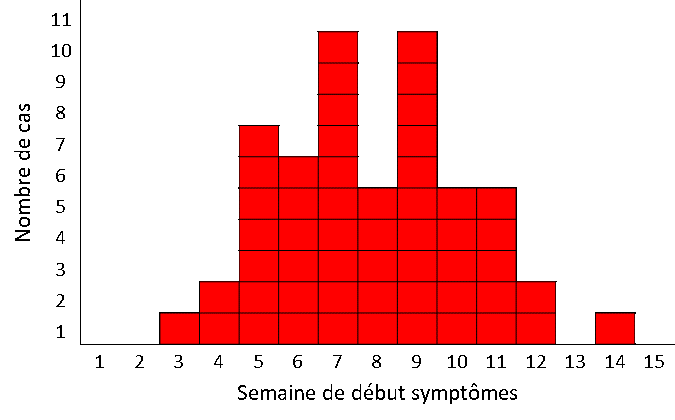
These 56 cases occurred in 55 children and 1 adult, who presented symptoms between 18/01/2022 (week 3) and 05/04/2022 (week 14) (Figure 1). The epidemic peak is in week 7 (14/02 to 20/02) and week 9 (28/02 to 06/03), with 10 cases each of these weeks.

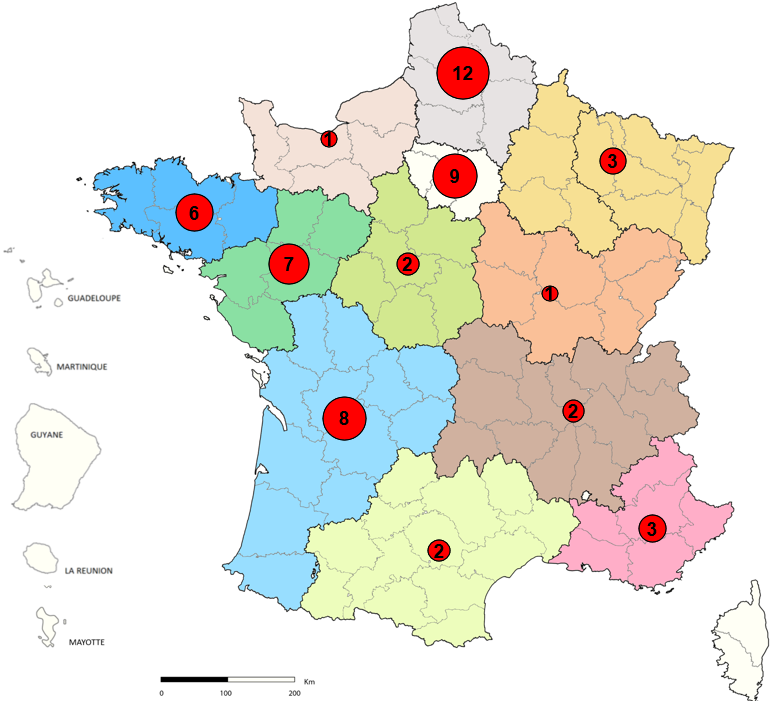
These 56 cases occurred in 12 regions of metropolitan France: Hauts-de-France (12 cases), Ile-de-France (9 cases), New Aquitaine (8 cases), Pays de la Loire (7 cases), Brittany ( 6 cases), Grand Est (3 cases), Provence-Alpes-Côte d’Azur (3 cases), Auvergne-Rhône-Alpes (2 cases), Occitanie (2 cases), Center Val-de-Loire (2 cases) , Bourgogne Franche-Comté (1 case) and Normandy (1 case) (Figure 2).

The 55 sick children are aged from 1 to 17 years old with a median age of 6 years; 25 (45%) are female; 48 (87%) presented with HUS, 7 (13%) with STEC gastroenteritis. Two children died. The adult did not present with HUS.

Figure 1: Epidemic curve: number of confirmed cases of HUS and STEC infections, by week of onset of symptoms – metropolitan France, weeks 3 to 14, 2022 (N=54: week of onset of symptoms not specified for 2 cases )
Figure 1: Epidemic curve: number of confirmed cases of HUS and STEC infections, by week of onset of symptoms - metropolitan France, weeks 3 to 14, 2022 (N=54: week of onset of symptoms not specified for 2 cases )
Figure 2: Geographical distribution of confirmed cases of HUS and STEC infections (N=56) linked to the consumption of Buitoni® brand Fraîch’Up pizzas, by region of residence in metropolitan France, weeks 3 to 14, 2022
Figure 2: Geographical distribution of confirmed cases of HUS and STEC infections (N=56) linked to the consumption of Buitoni® brand Fraîch'Up pizzas, by region of residence in metropolitan France, weeks 3 to 14, 2022

Italy – LATTERIA VALCONTADINO – Listeria monocytogenes

Salute

Brand : CIRESA SRL

Name : LATTERIA VALCONTADINO

Reason for reporting : Recall due to microbiological risk

Publication date : 10 May 2022

Documentation

Documentation

Italy – WURSTEL POLLI MPACK 3X100 GR -Salmonella

Salute

Brand : FIORUCCI

Name : WURSTEL POLLI MPACK 3X100 GR

Reason for reporting : Recall due to microbiological risk

Publication date : 10 May 2022
Documentation

Documentation

UK – Aldi recalls Eat + Go Chicken & Bacon Caesar Wrap and Eat + Go Chicken & Bacon Caesar Wrap Triple because of the possible presence of Salmonella

FSA

Aldi is recalling Eat + Go Chicken & Bacon Caesar Wrap and Eat + Go Chicken & Bacon Caesar Wrap Triple because of the possible presence of salmonella in these products.

Product details

Eat + Go Chicken & Bacon Caesar Wrap
Use by 11 May 2022
Eat + Go Chicken & Bacon Caesar Wrap
Use by 12 May 2022
Eat + Go Chicken & Bacon Caesar Wrap
Pack size Triple
Use by 11 May 2022
Eat + Go Chicken & Bacon Caesar Wrap
Pack size Triple
Use by 12 May 2022

Risk statement

The possible presence of salmonella in the products listed above.

Symptoms caused by salmonella usually include fever, diarrhoea, and abdominal cramps.

Action taken by the company Aldi is recalling the above products. Point of sale notices will be displayed in all retail stores that are selling these products. These notices explain to customers why the products are being recalled and tell them what to do if they have bought the products. Please see the attached notice.
Our advice to consumers If you have bought any of the above products do not eat them. Instead, return them to the nearest store for a full refund. For further information please visit http://www.aldi.co.uk and https://customerservice.aldi.co.uk/contact

Research – USDA-NIFA grant awarded to Arkansas food scientist to investigate low-moisture food safety

Food Safety News

The U.S. Department of Agriculture’s National Institute of Food and Agriculture has awarded an Arkansas Agricultural Experiment Station researcher a $200,000 grant to learn more about how much moisture is required to allow bacterial survival in low-moisture foods. 

The institute recognizes the dangers of pathogens in low-moisture foods as just two months ago the FDA confirmed five different strains of Cronobacter sakazakii bacteria at an Abbott Nutrition plant in Sturgis, MI, that makes infant formula that was linked to four illnesses and two deaths.

Jennifer Acuff, the awarded researcher and assistant professor in food safety and microbiology with the University of Arkansas System Division of Agriculture, says her research will help develop foundational knowledge on how bacteria persist in low-moisture food processing environments.

“We don’t really know how much water or nutrients are required to sustain these contaminating populations, but we know they can persist in the dry environment for a long time,” Acuff said. 

According to Acuff, the goal of the grant is to develop protocols for a laboratory that simulate these persistent bacteria so that they can study how to prevent their formation or mitigate the risks once they do form in a low-moisture food processing environment.

Pakistan – Heatwave, unhygienic food increase risk of seasonal infections

The News

Islamabad: Water and food-borne seasonal infections on the rise in the twin-cities of Rawalpindi and Islamabad as the current intense heatwave that has engulfed many parts of Pakistan has made favourable conditions for such infections to transmit rapidly.

The consumption of unhygienic food and locally made beverages has added to the situation as all the major public and private hospitals in the twin-cities including Holy Family Hospital, District Headquarters Hospital, Benazir Bhutto Hospital, and Pakistan Institute of Medical Sciences (PIMS) received a large number of patients with gastroenteritis.

One the major reasons behind the transmission of water-borne infections such as viral hepatitis A&E, and gastroenteritis is the inferno-like temperatures that are hitting the country hard and compelling people to consume more water and locally prepared juices, said Dr Naeem Yousaf.

“My children were also affected with diarrhoea as they went for swimming to beat the heat and unintentionally swallowed contaminated water of the swimming pool,” he added

India – 200 hotels shut in crackdown on stale food after food poisoning death in Kerala

Hindustan Times

A week after a 16-year-old girl died in north Kerala after consuming stale shawarma, the government launched a crackdown on the eateries during which over 200 hotels were shut and large quantity of stale meat and fish was seized in a week-long operation across the state.

“During the drive, over 500 kg stale meat and 6,000 kg fish laced with chemicals was seized in the state,”said a food safety official said, adding, “the checking drive will be intensified.” Last week, the high court had registered a case suo motu and asked the government and food safety officials to conduct regular examinations instead of acting only after a tragedy.