RASFF Alert – Animal Feed – Enterobacteriaceae – Dog Chews

RASFF

Enterobacteriaceae in dog chews from the Netherlands in Belgium

RASFF Alerts – Animal Feed – Salmonella – Dog Chews – Organic Soya Cake – Soybean Meal – Chicken Necks – Complementary Feed for Dogs – Fish Meal – Sunflower Seed Cake

RASFF

Salmonella enterica ser. Agona in organic soybean meal from the Netherlands in Belgium

RASFF

Salmonella in organic soya cake from the Netherlands in Sweden and Denmark

RASFF

Salmonella in soybean meal from USA in Finland and Canada

RASFF

Salmonella spp. in chicken necks as feed material from Poland in Germany

RASFF

Salmonella spp. in chews for dogs from Poland in Lithuania

RASFF

Salmonella spp. in complementary feed for dogs from China in Austria, France and Germany

RASFF

Salmonella Senftenberg in sunflower seed cake from the Netherlands in Belgium

RASFF

Salmonella in fishmeal from Denmark in Belgium

USA – Irvington Seafood recalls crab due to Listeria monocytogenes

Food Poison Journal

Irvington Seafood of Irvington, AL, is recalling its 1 lb. packages of “Crabmeat: Jumbo, Lump, Finger, and Claw meat” because they have the potential to be contaminated with Listeria monocytogenes, an organism which can cause serious and sometimes fatal infections in young children, frail or elderly people, and others with weakened immune systems. Although healthy individuals may suffer only short-term symptoms such as high fever, severe headache, stiffness, nausea, abdominal pain and diarrhea, Listeria infection can cause miscarriages and stillbirths among pregnant women.

The recalled “Crabmeat: Jumbo, Lump, Finger, and Claw meat” were distributed to distributors located in Alabama, Georgia, Louisiana, and Mississippi.

The product comes in a 1 lb. containers, package marked with license number AL 111-C with the company name “Irvington Seafood.”

Please look for the following batch number written on the bottom of the container: 130, 131, 132, 134, 137, 139, 141, 144, 145, 146,148, 150

No illnesses have been reported to date in connection with this problem.

Canada – Whole raspberries (frozen) recalled due to Norovirus

CFIA

Summary

Product
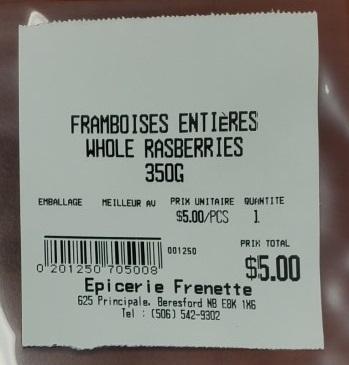
Whole raspberries (frozen)
Issue
Food – Microbial Contamination – Norovirus
What to do

Do not consume recalled products

Affected products

Issue

Épicerie Frenette is recalling the affected product from the marketplace due to possible norovirus contamination.

The recalled product has been sold at Épicerie Frenette, 625 rue Principale, Beresford, New Brunswick.

What you should do

  • If you think you became sick from consuming a recalled product, call your doctor
  • Check to see if you have recalled products
  • Do not consume recalled products
  • Recalled products should be thrown out or returned to the location where they were purchased

People with norovirus illness usually develop symptoms of gastroenteritis within 24 to 48 hours, but symptoms can start as early as 12 hours after exposure. The illness often begins suddenly. Even after having the illness, you can still become re-infected by norovirus. The main symptoms of norovirus illness are diarrhea, vomiting (children usually experience more vomiting than adults), nausea and stomach cramps. Other symptoms may include low-grade fever, headache, chills, muscle aches and fatigue (a general sense of tiredness).  Most people feel better within one or two days, with symptoms resolving on their own, and experience no long-term health effects. As with any illness causing diarrhea or vomiting, people who are ill should drink plenty of liquids to replace lost body fluids and prevent dehydration. In severe cases, patients may need to be hospitalized and given fluids intravenously.

Canada – Certain Tri-Star Seafood Supply Ltd. Spot Prawns recalled due to Norovirus

CFIA

Summary

Product
Certain Spot Prawns
Issue
Food – Microbial Contamination – Norovirus
What to do

Do not consume, use, sell, serve, or distribute the recalled products

Affected products

Issue

Tri-Star Seafood Supply Ltd. is recalling certain Spot Prawns from the marketplace due to possible norovirus contamination.

The recalled products have been sold in British Columbia and Ontario and may have been distributed in other provinces and territories.

What you should do

  • If you think you became sick from consuming a recalled product, call your doctor
  • Check to see if you have the recalled products in your home or establishment
  • Do not consume the recalled products
  • Do not serve, use, sell, or distribute the recalled products
  • Recalled products should be thrown out or returned to the location where they were purchased
  • Consumers who are unsure if they have purchased the affected products are advised to contact their retailer

People with norovirus illness usually develop symptoms of gastroenteritis within 24 to 48 hours, but symptoms can start as early as 12 hours after exposure. The illness often begins suddenly. Even after having the illness, you can still become re-infected by norovirus. The main symptoms of norovirus illness are diarrhea, vomiting (children usually experience more vomiting than adults), nausea and stomach cramps. Other symptoms may include low-grade fever, headache, chills, muscle aches and fatigue (a general sense of tiredness).  Most people feel better within one or two days, with symptoms resolving on their own, and experience no long-term health effects. As with any illness causing diarrhea or vomiting, people who are ill should drink plenty of liquids to replace lost body fluids and prevent dehydration. In severe cases, patients may need to be hospitalized and given fluids intravenously.

USA – CDC – Food Safety Materials

CDC

CDC offers many free educational resources about preventing food poisoning. Read feature stories to learn more, share infographics and videos on social media, and syndicate our web pages on your site to help educate others.

Research – Emergent marine toxins risk assessment using molecular and chemical approaches

EFSA

Cyanobacteria harmful blooms represent a deviation to the normal equilibrium in planktonic communities involving a rapid and uncontrolled growth. Owing to the capacity to produce toxins as secondary metabolites, cyanobacteria may cause huge economic losses in the fishing and aquaculture industries and poisoning incidents to humans due to their accumulation in the food chain. The conditions which promote toxic blooms have not yet been fully understood, but climate change and anthropogenic intervention are pointed as significant factors. For the detection of toxins in edible marine organisms, the establishment of international regulations and compulsory surveillance has been probed as exceptionally effective. However, not regulation nor monitoring have been settled concerning emergent marine toxins. In the light of this scenario, it becomes essential to apply fast and reliable surveillance methodologies for the early detection of cyanobacterial blooms as well as the occurrence of emergent marine toxins. Shotgun metagenomic sequencing has potential to become a powerful diagnostic tool in the fields of food safety and One Health surveillance. This culture‐independent approach overcomes limitations of traditional microbiological techniques; it allows a quick and accurate assessment of a complex microbial community, including quantitative identification and functional characterisation, in a single experiment. In the framework of the EU‐FORA fellowship, with the final goal of evaluate metagenomics as a promising risk assessment tool, the fellow worked on the development of an innovative workflow through state‐of‐the‐art molecular and chemical analytical procedures. This work programme aims to evaluate the occurrence of emergent marine toxins and the producing organisms in Cabo Verde coastal cyanobacteria blooms. Our results show the outstanding potential of a holistic metagenomic approach for the risk assessment of emergent marine toxins and the producing organisms. Additionally, we have also highlighted its value for the identification and evaluation of secondary metabolites as natural bioactive compounds with biotechnological and industrial interest.

Research – Clinical Escherichia coli: From Biofilm Formation to New Antibiofilm Strategies

MDPI

Escherichia coli is one of the species most frequently involved in biofilm-related diseases, being especially important in urinary tract infections, causing relapses or chronic infections. Compared to their planktonic analogues, biofilms confer to the bacteria the capacity to be up to 1000-fold more resistant to antibiotics and to evade the action of the host’s immune system. For this reason, biofilm-related infections are very difficult to treat. To develop new strategies against biofilms, it is important to know the mechanisms involved in their formation. In this review, the different steps of biofilm formation in E. coli, the mechanisms of tolerance to antimicrobials and new compounds and strategies to combat biofilms are discussed. View Full-Text

Research – Integration of genomics in surveillance and risk assessment for outbreak investigation

EFSA

Keeping food safe is a challenge that needs continuous surveillance for the sake of consumers’ health. The main issue when a food‐borne pathogen outbreak occurs is represented by the identification of the source(s) of contamination. Delivering this information in a timely manner helps to control the problem, with positive outcomes for everyone, especially for the consumers, whose health is in this way preserved, and for the stakeholders involved in food production and distribution, who could face enormous economic losses if recalls or legal issues occur. Whole genome sequencing (WGS) is a tool recently implemented for the characterisation of isolates and the study of outbreaks because of its higher efficiency and faster results, when compared to traditional typing methods. Lower sequencing costs and the development of many bioinformatic tools helped its spread, and much more attention has been given to its use for outbreak investigation. It is important to reach a certain level of standardisation, though, for ensuring result reproducibility and interoperability. Moreover, nowadays it is possible, if not mandatory for Open Science Practices, to share WGS data in publicly available databases, where raw reads, assembled genomes and their corresponding metadata can be easily found and downloaded. The scope of this Fellowship was to provide the Fellow all the training necessary for successfully integrating genomics to surveillance and risk assessment of food‐borne pathogens from farm to fork.

Research – What to know about Scombroid Poisoning

Medical News Today

Read the full article at the link above.

Scombroid poisoning is a form of food poisoning. It happens when a person eats fish species containing high amounts of a chemical called histidine.

Histidine is an amino acid that naturally occurs in fish. When people do not keep the fish in a refrigerator, bacteria break down the histidine and turn it into histamine.

Histamine is responsible for the toxicity that causes scombroid poisoning, according to the American Academy of Allergy, Asthma & Immunology (AAAAI).

When a person consumes large quantities of fish with histamine, they experience symptoms that resemble an allergic reaction, such as hives. However, it is not a true allergy to a particular fish, according to the National Capital Poison Center.

The condition usually is not long-term or severe, according to the Food and Drug Administration (FDA)Trusted Source. Mild cases often disappear on their own without treatment, but antihistamine medications may help some people.

A person experiencing severe symptoms, such as chest pain or breathing trouble, should go to an emergency room or call local emergency services.