Category Archives: Yersinia

Australia – Paris Creek Farms – Bio-dynamic fresh butter unsalted – Yersinia enterocolitica

FSANZ

Product information

B.-d. Farm Paris Creek is conducting a recall of Bio-dynamic fresh butter unsalted, 200g. The product has been available for sale at Foodies and Harris Farms in NSW, Foodland in SA and independent food retailers including IGA in SA, NT, VIC and WA.

Date markings

Best Before: 13JAN24​

Fresh butter unsalted

Problem

The recall is due to microbial (Yersinia enterocolitica) contamination​.

Food safety hazard

Food products contaminated with Yersinia enterocolitica may cause illness if consumed.
What to do​

Consumers should not eat this product. Any consumers concerned about their health should seek medical advice and should return the product to the place of purchase for a full refund.

For further information please contact:

B.-d. Farm Paris Creek
08 8388 3339

Related links:

Research – Annual report concerning Foodborne Diseases in New Zealand 2022

NZFS

Human health surveillance and its relationship to foodborne illness is essential for informing
the strategic direction that New Zealand Food Safety (NZFS) takes and regulatory measures
it puts in place to minimise foodborne illness in New Zealand and overseas consumers. The
annual ESR foodborne disease reports are critical, allowing NZFS to monitor trends in
foodborne illness in New Zealand by describing in a consistent manner evidence from case
notifications, case enquiries, outbreak investigations, and other epidemiological studies of
human enteric disease.
This report is the latest in a series providing a consistent source of data annually to monitor
trends in foodborne illness in New Zealand. The series can be found here.
When reading these reports, it is necessary to bear in mind that notified cases of illness
represent only a subset of all the cases that occur in New Zealand each year.
• Many sick individuals do not visit a GP or otherwise come to the attention of the
health system.
• Multiple factors (e.g., change in sensitivity of testing methods, proportion of human
faecal specimens being tested) affect the notification rates on top of any underlying
changes to disease incidence happening in New Zealand. Some cases notified in
New Zealand are due to exposure to a pathogen or toxin while they were overseas.
Most cases of foodborne diseases in New Zealand are sporadic, which makes attribution to a
source or event difficult. In contrast, outbreaks offer a better opportunity to identify the source
and most of the 271 outbreaks (253 cases) of potential foodborne disease in 2022 were
associated with commercial food operators and only five outbreaks in 2022 were associated
with food prepared in consumer’s homes. Despite robust investigation, some outbreaks
reported as “foodborne with an unidentified food source” could also be attributed to other
routes of transmission, such as water, animal contact, or person to person contact.
Listeriosis is perhaps the only disease fully attributable to consumption of contaminated food.
Campylobacteriosis, yersiniosis, infection by shiga toxin-producing E. coli (STEC), and
salmonellosis remain the predominant notified foodborne illnesses. Notification rates per
100,000 population are generally stable, being highest for very young children (0 to 4 years
age group) and for elderly people (70+ years)

Spain records Salmonella and Yersinia increases in 2022

Food Safety News

Salmonella and Yersinia infections went up in Spain in 2022, based on the latest figures.

A total of 8,777 Salmonella infections were reported, as well as 39 imported cases. In the previous year, 6,156 infections and four imported cases were recorded.

Salmonellosis affected men slightly more than women. The age group with the highest incidences were those younger than 5 years old, according to data from the National Epidemiological Surveillance Network (RENAVE).

The main Salmonella serotype identified was Typhimurium, with 708 cases, followed by Enteritidis, with 630 cases. A clear seasonal pattern was observed for both, with cases increasing during the warmest months of the year and reaching a peak in August.

In 2022, there were 1,015 cases of yersiniosis reported as well as three imported infections. This is up from 744 cases in 2021.

Illness mainly affected children, with the highest incidence reported in those younger than 5. Males were more often sick than females.

In all cases with information on the species, Yersinia enterocolitica was identified in 779 cases, and there were two cases of Yersinia pseudotuberculosis. The median age of Yersinia enterocolitica cases was 16, while the two Yersinia pseudotuberculosis cases were 47 and 48 years old.

Research USA – FoodNet 2022 Preliminary Data

CDC

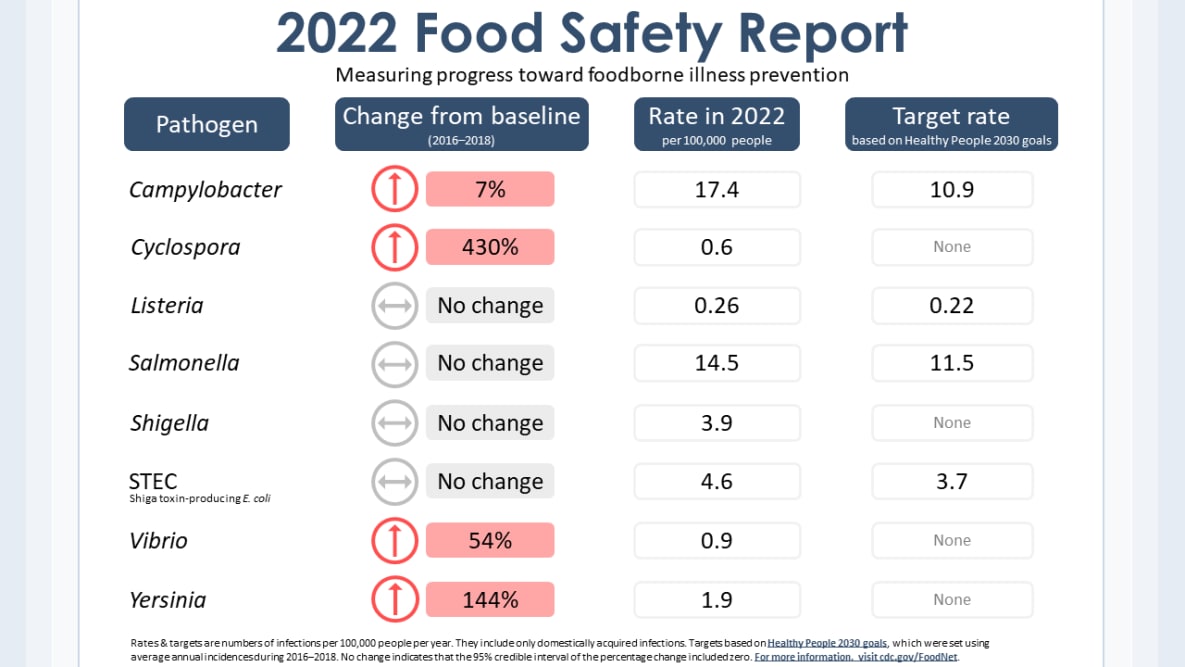
Graphic showing progress in 2022 toward foodborne illness prevention, with changes from the 2016–2018 baseline, rates in 2022, and target rates based on Healthy People 2030 goals. Rates increased for Campylobacter, Cyclospora, Vibrio, and Yersinia and did not change for Listeria, Salmonella, Shigella, and Shiga toxin-producing E. coli. Rates for Campylobacter, Listeria, Salmonella, and Shiga toxin-producing E. coli are all higher than their established target rates.

This year’s report summarizes 2022 preliminary surveillance data. It describes 2022 incidence compared with the average incidence for 2016–2018, the reference period used for the U.S. Department of Health and Human Services (HHS) Healthy People 2030 goals. The report also summarizes cases of hemolytic uremic syndrome (HUS) during 2021.

  • In 2022, enteric (intestinal) infections monitored by FoodNet generally returned to or exceeded levels observed in 2016–2018 (before the COVID-19 pandemic).
    • Incidence of CampylobacterListeriaSalmonella, and Shigella infections did not change in 2022 compared with 2016–2018.
    • Incidence of Cyclospora, STEC, Vibrio, and Yersinia infections increased in 2022 compared with 2016–2018.
  • Campylobacter and Salmonella remain the top causes of enteric infections monitored by FoodNet.
  • Increased use of CIDTs contributed to the increased detection of infections.
  • FoodNet data show lack of progress during 2022 toward Healthy People 2030 goals for reducing foodborne illness. Concerted efforts are needed to implement effective prevention strategies to reduce disease burden.

USA – Preliminary Incidence and Trends of Infections Caused by Pathogens Transmitted Commonly Through Food — Foodborne Diseases Active Surveillance Network, 10 U.S. Sites, 2022

CDC

The figure is a photo of a worker in a produce section with information about foodborne illnesses.

Summary

What is already known about this topic?

Campylobacter and Salmonella are the leading causes of bacterial enteric infections transmitted commonly by food. Reported incidence of enteric infections was lower during the COVID-19 pandemic (2020–2021) compared with previous years.

What is added by this report?

During 2022, FoodNet identified higher incidences of Shiga toxin-producing Escherichia coliYersiniaVibrio, and Cyclospora infections compared with 2016–2018. Campylobacter, Salmonella, Shigella, and Listeria incidences did not change.

What are the implications for public health practice?

Progress in reducing enteric infection incidence was not observed during 2022, as influences of the COVID-19 pandemic subsided. Collaboration among food growers, processors, retail stores, restaurants, and regulators is needed to reduce pathogen contamination during poultry slaughter and to prevent contamination of leafy greens.

France sees a rise in outbreaks in 2021

Food Safety News

The number of outbreaks in France went up in 2021 but was still below 2018 and 2019 levels.

Figures from Santé publique France show there were 1,309 outbreaks affecting 11,056 people in 2021. A total of 512 people went to hospitals and 16 died.

Reported outbreaks rose from 1,010 in 2020 when figures were strongly impacted by the COVID-19 pandemic, according to officials.

For 327 incidents in 2021, a pathogen could be microbiologically confirmed in food or in at least one sick person per outbreak. A pathogen was suspected without microbiological confirmation for 734 outbreaks.

16 deaths in outbreaks
The most frequently microbiologically confirmed pathogen was Salmonella 147 times. It was mostly Salmonella Enteritidis, followed by monophasic Salmonella Typhimurium but the type was not known in 92 incidents. Confirmed Salmonella outbreaks were responsible for 935 patients and 166 hospitalizations.

Campylobacter caused 52 outbreaks with 178 patients and Bacillus cereus had 46 with 665 patients. Nineteen norovirus outbreaks sickened 493 and 11 histamine outbreaks affected 35 people.

Seven outbreaks were due to E. coli, six to Yersinia enterocolitica, four to Shiga toxin-producing E. coli (STEC), and one each because of Listeria monocytogenes, Clostridium botulinum, and Shigella.

The pathogen was identified in patients for 208 outbreaks, of which 143 were confirmed with Salmonella. Identification of the agent took place in food samples for 89 epidemics with 67 confirmed as Bacillus cereus, Staphylococcus aureus and Clostridium perfringens.

The top suspected pathogens based on epidemiological and clinical information, but not microbiologically confirmed, were the toxins Bacillus cereus, Staphylococcus aureus and Clostridium perfringens. For these three pathogens, 3,787 patients and 169 hospital trips were recorded.

Research – Norway records rise in outbreaks in 2022

Food Safety News

The number of outbreaks and people sick in them in 2022 went up from the year before, based on new data from Norway.

A total of 34 foodborne outbreaks were reported in 2022, which is up from 23 and 25 outbreaks in 2020 and 2021 but lower than the 46 outbreaks in 2019.

Overall, 628 people were sick this past year with the largest incident affecting 100 people, according to a report published by the Norwegian Institute of Public Health (FHI). In the 25 outbreaks in 2021, 327 patients were recorded.

Eight norovirus outbreaks sickened 135 people in 2022. Five outbreaks with 148 cases were caused by Salmonella. Cryptosporidium and Yersinia were behind three each with 14 and 51 patients, respectively.

Ten people were sick in two Listeria outbreaks. One Campylobacter outbreak had six patients and one E. coli event affected seven people. The agent was unknown for 11 outbreaks with 257 cases.

Most foodborne outbreaks were reported in connection with restaurants, cafes and other catering establishments.

Research – Forgotten but not gone: Yersinia infections in England, 1975 to 2020

Eurosurveillance

Yersiniosis, most often caused by  is one of the most common bacterial food-borne zoonoses in Europe with reported overall incidence of 1.8 cases per 100,000 population in 2020 [1]. There is, however, marked variation among countries, with the highest numbers of cases per 100,000 population reported in Denmark and Finland (7.1 and 7.0, respectively) and the lowest in Romania and Bulgaria (0.03 and 0.06, respectively) [1]. Transmission is primarily faecal–oral via food or water contaminated with animal faeces [2]. Yersiniosis has been associated with the consumption of pork meat (raw or undercooked), occupational exposure to pigs, untreated drinking water, milk, vegetables, juices, ready-to-eat and other foods [36]. The incidence of yersiniosis in Europe is higher in males and in children under 5 years, and no clear seasonal pattern has been reported over the last decade [1,3]. Yersiniosis commonly presents as diarrhoea, abdominal pain and fever, and can manifest as acute mesenteric lymphadenitis and terminal ileitis. Although it is usually self-limiting with a low case fatality rate (0.05%), symptoms often persist for several weeks [3,6].

The reported incidence of  infections in the United Kingdom (UK) is well below the European average (0.2 cases per 100,000 in 2019) [3]. Routine testing for  is not currently recommended in the UK, unless there is a clinical suspicion (e.g. appendicitis, mesenteric lymphadenitis, terminal ileitis or reactive arthritis) [7]. The aim of this study was to describe the changing incidence and epidemiology of diagnosed  infections in England between 1975 and 2020 and to estimate the potential under-ascertainment of  due to the lack of routine testing.

Research – Presence of Foodborne Bacteria in Wild Boar and Wild Boar Meat—A Literature Survey for the Period 2012–2022

MDPI

Abstract

The wild boar is an abundant game species with high reproduction rates. The management of the wild boar population by hunting contributes to the meat supply and can help to avoid a spillover of transmissible animal diseases to domestic pigs, thus compromising food security. By the same token, wild boar can carry foodborne zoonotic pathogens, impacting food safety. We reviewed literature from 2012–2022 on biological hazards, which are considered in European Union legislation and in international standards on animal health. We identified 15 viral, 10 bacterial, and 5 parasitic agents and selected those nine bacteria that are zoonotic and can be transmitted to humans via food. The prevalence of CampylobacterListeria monocytogenesSalmonella, Shiga toxin-producing E. coli, and Yersinia enterocolitica on muscle surfaces or in muscle tissues of wild boar varied from 0 to ca. 70%. One experimental study reported the transmission and survival of Mycobacterium on wild boar meat. BrucellaCoxiella burnetiiListeria monocytogenes, and Mycobacteria have been isolated from the liver and spleen. For Brucella, studies stressed the occupational exposure risk, but no indication of meat-borne transmission was evident. Furthermore, the transmission of C. burnetii is most likely via vectors (i.e., ticks). In the absence of more detailed data for the European Union, it is advisable to focus on the efficacy of current game meat inspection and food safety management systems.

Research – Austria reports Salmonella and Yersinia data for 2022

Food Safety News

Submissions of human Salmonella isolates are approaching pre-COVID-19 pandemic levels in Austria after a decline in 2020 and 2021, according to the Federal Ministry of Labour, Social Affairs, Health and Consumer Protection (BMSGPK).

In 2022, the number of isolates sent to the National Reference Centre for Salmonella increased by 118. This past year, 1,166 Salmonella isolates were submitted to the reference center compared with 1,048 in 2021. It is still below the 1,872 sent in 2019.

In 2022, the Austrian National Reference Centre for Yersinia at the Austrian Agency for Health and Food Safety (AGES) received 201 human isolates.

Of these, 107 were pathogenic, and 94 were non-pathogenic. Among the pathogenic ones, 105 belonged to Yersinia enterocolitica including 88 serovar O:3; biovar 4, and two were Yersinia pseudotuberculosis.

A total of 130 cases of yersiniosis were reported to BMSGPK. This was about the same level as in 2021. Based on data from 38 patients, 22 cases reported diarrhea, 11 had cases of abdominal pain and three each mentioned vomiting and fever.