Category Archives: USDA

USA – Wayne Farms, LLC Recalls Ready-To-Eat Chicken Breast Fillet Products That May Be Undercooked

FSIS USDA

EDITOR’S NOTE:  May 7, 2022: This release is being reissued to include an expansion of the recall to a new product that was distributed to retail locations. Additionally, the recall has been expanded from 30,285 pounds to 585,030 pounds. There are five new production codes (23618, 24357, 24512, 24583, and 24957) and 66 different “use by” dates (ranging from 5-10-22 through 4-29-23). This release has been updated to include the new product, the expanded weight, additional labels, and additional distribution information.

WASHINGTON, April 29, 2022 – Wayne Farms, LLC., a Decatur, Ala. establishment, is recalling approximately 585,030 pounds of a ready-to-eat (RTE) chicken breast fillet product that may be undercooked, the U.S. Department of Agriculture’s Food Safety and Inspection Service (FSIS) announced today.

USA – Wayne Farms, LLC Recalls Ready-to-Eat Chicken Breast Fillet Products that may be Undercooked

FSIS USDA

WASHINGTON, April 29, 2022 – Wayne Farms, LLC., a Decatur, Ala. establishment, is recalling approximately 30,285 pounds of a ready-to-eat (RTE) chicken breast fillet product that may be undercooked, the U.S. Department of Agriculture’s Food Safety and Inspection Service (FSIS) announced today.

The RTE chicken breast fillet products were produced on March 1 and 21, 2022. The following products are subject to recall [view labels]:

  • 9-lb. cases containing 8 packages of 6-oz “ALL NATURAL FIRE GRILLED CHICKEN BREAST” with “use by” date 5/30/22
  • 9-lb. cases containing 12 packages of 4-oz “ALL NATURAL FIRE GRILLED CHICKEN BREAST” with “use by” date 6/19/22

The products subject to recall bear establishment number “EST. 20214” on the case. These items were shipped to These items were shipped to a distributor in Illinois and further distributed to restaurants.

The problem was discovered when the firm received a customer complaint that the RTE chicken product appeared to be undercooked.

There have been no confirmed reports of adverse reactions due to consumption of these products. Anyone concerned about an injury or illness should contact a healthcare provider.

FSIS is concerned that some products may be in distributors’ or restaurant freezers or refrigerators. Restaurants are urged not to serve these products. These products should be thrown away or returned to the place of purchase.

USA – FSIS Issues Public Health Alert for Ground Beef Products Due to Possible E. coli O26 Contamination

FSIS USDA

WASHINGTON April 27, 2022, – The U.S. Department of Agriculture’s Food Safety and Inspection Service (FSIS) is issuing a public health alert due to concerns that specific ground beef products may be adulterated with E. coli O26. A recall was not requested because the products are no longer available for purchase.

The ground beef items for this public health alert were produced on December 16 and 17, 2021. The following products subject to the public health alert are [view labels]:

  • 1-lb. foam trays containing “ALL NATURAL LAURA’S LEAN BEEF 92% LEAN 8% FAT GROUND BEEF.” The product is labeled with 350/(timestamp)/Est.31805/002, with the timestamp ranging from 0602 to 1721.
  • 1-lb. foam trays containing “Kroger GROUND BEEF CARNE MOLIDA 96% LEAN 4% FAT.” The product is labeled with 350/(timestamp)/Est.31805/002, with the timestamp ranging from 0602 to 1721.
  • 1-lb. foam trays containing “Kroger GROUND BEEF CARNE MOLIDA 85% LEAN 15% FAT.” The product is labeled with 350/(timestamp)/Est.31805/002, with the timestamp ranging from 0602 to 1721.
  • 1.3-lb. foam trays containing “PRIVATE SELECTION ANGUS BEEF 90% LEAN 10% FAT GROUND SIRLOIN.” The product is labeled with 350/(timestamp)/Est.31805/002, with the timestamp ranging from 0602 to 1721. Additional product is labeled with 351/(timestamp)/Est. 31805/003, with the timestamp ranging from 1549 to 1651.
  • 1-lb. foam trays containing “Kroger GROUND BEEF CARNE MOLIDA 93% LEAN 7% FAT.” The product is labeled with 350/(timestamp)/Est.31805/002, with the timestamp ranging from 0602 to 1721.
  • 1-lb. foam trays containing “Kroger GROUND BEEF CARNE MOLIDA 80% LEAN 20% FAT.” The product is labeled with 350/(timestamp)/Est.31805/002, with the timestamp ranging from 0602 to 1721.

The ground beef products were distributed to warehouses in Oregon and Washington and sold at retail locations.

The problem was discovered after a consumer submitted a retail package of ground beef produced by Empire Packing bearing a use or freeze by date of “December 24, 2021” to a third-party laboratory for microbiological analysis. The consumer reported previously becoming ill but did not get tested for E coli.  The third-party laboratory confirmed the ground beef sample was positive for E. coli O26.

Anyone concerned about an injury or illness should contact a healthcare provider.

Many clinical laboratories do not test for non-O157 STEC, such as O26 because it is harder to identify than STEC O157:H7. People can become ill from STECs 2–8 days (average of 3–4 days) after consuming the organism.

Most people infected with STEC O26 develop diarrhea (often bloody) and vomiting. Some illnesses last longer and can be more severe. Infection is usually diagnosed by testing of a stool sample. Vigorous rehydration and other supportive care is the usual treatment; antibiotic treatment is generally not recommended. Most people recover within a week, but, rarely, some develop a more severe infection. Hemolytic uremic syndrome (HUS), a type of kidney failure, is uncommon with STEC O26 infection. HUS can occur in people of any age but is most common in children under 5 years old, older adults and persons with weakened immune systems. It is marked by easy bruising, pallor and decreased urine output. Persons who experience these symptoms should seek emergency medical care immediately

FSIS is concerned that some product may be in consumers’ freezers. Consumers who have purchased these products are urged not to consume them. These products should be thrown away or returned to the place of purchase.

FSIS advises all consumers to safely prepare their raw meat products, including fresh and frozen, and only consume ground beef that has been cooked to a temperature of 160 F. The only way to confirm that ground beef is cooked to a temperature high enough to kill harmful bacteria is to use a food thermometer that measures internal temperature, https://www.fsis.usda.gov/safetempchart.

Media and consumers with questions regarding the public health alert can contact Debbie Robinson, Vice President of Customer Service, Empire Packing, at drobinson@empirepk.com.

Consumers with food safety questions can call the toll-free USDA Meat and Poultry Hotline at 888-MPHotline (888-674-6854) or live chat via Ask USDA from 10 a.m. to 6 p.m. (Eastern Time) Monday through Friday. Consumers can also browse food safety messages at Ask USDA or send a question via email to MPHotline@usda.gov. For consumers that need to report a problem with a meat, poultry, or egg product, the online Electronic Consumer Complaint Monitoring System can be accessed 24 hours a day at https://foodcomplaint.fsis.usda.gov/eCCF/.

Product Images

Company Information

ESTABLISHMENT ID
PROCESSING CATEGORY

Raw – Non Intact

Company Contact Information

COMPANY MEDIA CONTACT
Empire Packing
Debbie Robinson, Vice President of Customer Service

FSIS Contact Information

MEDIA CONTACT
Congressional and Public Affairs
Cody Kahlig
(202)720-9113

USA -Lakeside Refrigerated Services Recalls Ground Beef Products Due to Possible E. coli O103 Contamination

FSIS USDA

WASHINGTON, April 25, 2022 – Lakeside Refrigerated Services, a Swedesboro, N.J. establishment, is recalling approximately 120,872 pounds of ground beef products that may be contaminated with E. coli O103, the U.S. Department of Agriculture’s Food Safety and Inspection Service (FSIS) announced today.

The ground beef products were produced from February 1, 2022, through April 8, 2022. The complete list of products and product codes for the beef products that are subject to recall can be found here. Labels for the ground beef products can be found here.

The products subject to recall bear establishment number “EST. 46841” inside the USDA mark of inspection. These items were shipped to retail locations nationwide.

The problem was discovered during routine FSIS testing of imported products. There have been no confirmed reports of illness or adverse reactions due to consumption of these products.

Many clinical laboratories do not test for non-O157 Shiga toxin-producing E. coli (STEC) such as O103 because it is harder to identify than STEC O157:H7. People can become ill from STECs 2–8 days (average of 3–4 days) after consuming the organism.

Most people infected with STEC O103 develop diarrhea (often bloody) and vomiting. Some illnesses last longer and can be more severe. Infection is usually diagnosed by testing of a stool sample. Vigorous rehydration and other supportive care is the usual treatment; antibiotic treatment is generally not recommended. Most people recover within a week, but, rarely, some develop a more severe infection. Hemolytic uremic syndrome (HUS), a type of kidney failure, is uncommon with STEC O103 infection. HUS can occur in people of any age but is most common in children under 5 years old, older adults and persons with weakened immune systems. It is marked by easy bruising, pallor and decreased urine output. Persons who experience these symptoms should seek emergency medical care immediately.

FSIS is concerned that some products may be in consumers’ refrigerators or freezers.  Consumers who have purchased these products are urged not to consume them. These products should be thrown away or returned to the place of purchase.

FSIS routinely conducts recall effectiveness checks to verify recalling firms notify their customers of the recall and that steps are taken to make certain that the product is no longer available to consumers. When available, the retail distribution list(s) will be posted on the FSIS website at www.fsis.usda.gov/recalls.

Media and consumers with questions regarding the recall can contact Lakeside Refrigerated Services at 800-493-9042 or customercare@lakesiderefrigerated.com.

Consumers with food safety questions can call the toll-free USDA Meat and Poultry Hotline at 888-MPHotline (888-674-6854) or live chat via Ask USDA from 10 a.m. to 6 p.m. (Eastern Time) Monday through Friday. Consumers can also browse food safety messages at Ask USDA or send a question via email to MPHotline@usda.gov. For consumers that need to report a problem with a meat, poultry, or egg product, the online Electronic Consumer Complaint Monitoring System can be accessed 24 hours a day at https://foodcomplaint.fsis.usda.gov/eCCF/.

Click to access 011-2022-labels_0.pdf

USA – New Salmonella outbreak possibly linked to chicken under investigation by USDA

Food Safety News

The USDA is investigating a new Salmonella Enteritidis outbreak but little information has been released.

Chicken has been identified as the possible source for the pathogen, according to the U.S. Department of Agriculture’s Food Safety Inspection Service.

The agency has not released any information regarding the number of infected people or where they live. Similarly, no information  has been released about companies involved in the investigation or brands of chicken involved.

As of April 19 the Centers for Disease Control and Prevention had not released any information regarding the outbreak.

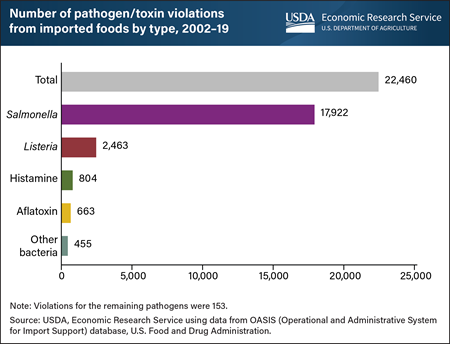
USA – Salmonella accounted for nearly 80 percent of pathogen violations in U.S. food imports from 2002 to 2019

USDA

<i>Salmonella</i> accounted for nearly 80 percent of pathogen violations in U.S. food imports from 2002 to 2019

As the quantity of food imported into the United States continues to rise, it is increasingly important to minimize foodborne illness risks for U.S. consumers. Foods contaminated with pathogens or toxins can result in foodborne illnesses. A recent USDA, Economic Research Service (ERS) study examined the number of U.S. import refusals caused by pathogen/toxin contamination and which pathogens accounted for those safety violations. From 2002 to 2019, 22,460 pathogen/toxin violations were discovered among imported shipments. Salmonella was the most frequently identified agent among imported foods during the period with 80 percent, or 17,922 of total pathogen/toxin violations. Listeria recorded the second largest number of violations at 2,463, accounting for 11 percent of the total. It was followed by histamine with 804 violations (3.6 percent), aflatoxin with 663 violations (3 percent), and bacteria other than Salmonella or Listeria with 455 violations (2 percent). Those five most frequently detected pathogens and toxins accounted for 99.3 percent of the total pathogen/toxin violations from imported foods over the period. This chart was drawn from the ERS report Examining Pathogen-Based Import Refusals: Trends and Analysis From 2002 to 2019, published December 2021.

USA – Boyd Specialties, LLC Recalls Jerky Products Due to Possible Listeria Contamination

FSIS USDA

WASHINGTON, March 4, 2022 – Boyd Specialties, LLC, a Colton, Calif. establishment, is recalling approximately 1,634 pounds of ready-to-eat (RTE) jerky products that may be adulterated with Listeria monocytogenes, the U.S. Department of Agriculture’s Food Safety and Inspection Service (FSIS) announced today.

The multiple jerky products were produced on February 23, 2022. The products subject to the recall can be found here, and the labels can be found here.

The products subject to recall bear establishment number “EST. 40269” inside the USDA mark of inspection. These items were shipped to retail locations in Alabama, California, Connecticut, Michigan, New Jersey, North Carolina, Pennsylvania, and Texas.

The problem was discovered by FSIS during follow-up procedures after a routine FSIS product sample confirmed positive for Listeria monocytogenes.

There have been no confirmed reports of adverse reactions due to consumption of these products. Anyone concerned about an injury or illness should contact a healthcare provider.

Consumption of food contaminated with Listeria monocytogenes can cause listeriosis, a serious infection that primarily affects older adults, persons with weakened immune systems, and pregnant women and their newborns. Less commonly, persons outside these risk groups are affected.

Listeriosis can cause fever, muscle aches, headache, stiff neck, confusion, loss of balance and convulsions sometimes preceded by diarrhea or other gastrointestinal symptoms. An invasive infection spreads beyond the gastrointestinal tract. In pregnant women, the infection can cause miscarriages, stillbirths, premature delivery or life-threatening infection of the newborn. In addition, serious and sometimes fatal infections in older adults and persons with weakened immune systems. Listeriosis is treated with antibiotics. Persons in the higher-risk categories who experience flu-like symptoms within two months after eating contaminated food should seek medical care and tell the health care provider about eating the contaminated food.

FSIS is concerned that some product may be in consumers’ pantries. These products should be thrown away or returned to the place of purchase.

FSIS routinely conducts recall effectiveness checks to verify recalling firms notify their customers of the recall and that steps are taken to make certain that the product is no longer available to consumers. When available, the retail distribution list(s) will be posted on the FSIS website at www.fsis.usda.gov/recalls.

Media and consumers with questions regarding the recall can contact Anthony Middleton, Production Manager at Boyd Specialties, at (909) 219-5120.

Consumers with food safety questions can call the toll-free USDA Meat and Poultry Hotline at 888-MPHotline (888-674-6854) or live chat via Ask USDA from 10 a.m. to 6 p.m. (Eastern Time) Monday through Friday. Consumers can also browse food safety messages at Ask USDA or send a question via email to MPHotline@usda.gov. For consumers that need to report a problem with a meat, poultry, or egg product, the online Electronic Consumer Complaint Monitoring System can be accessed 24 hours a day at https://foodcomplaint.fsis.usda.gov/eCCF/.

Company Information

Colton, CA

ESTABLISHMENT ID

M40269+P40269+V40269

PROCESSING CATEGORY

Heat Treated – Shelf Stable

Company Contact Information

COMPANY MEDIA CONTACT
Boyd Specialties
Anthony Middleton, Production Manager

USA – Kick off your Super Bowl gathering with critical food safety precautions

Food Safety News

Sport football.svg

Here are some food safety tips for Super Bowl Sunday from the USDA:

#1 Remember Your Four Steps to Food Safety

  • Clean: Wash hands for 20 seconds before and after handling food, especially raw meat and poultry. Clean hands, surfaces and utensils with soap and warm water before cooking, during preparation and serving. After cleaning surfaces that raw meat and poultry have touched, apply a commercial or homemade sanitizing solution (1 tablespoon of liquid chlorine bleach per gallon of water). Use hand sanitizer that contains at least 60 percent alcohol.
  • Separate: Use separate cutting boards, plates and utensils to avoid cross-contamination between raw meat or poultry and foods that are ready-to-eat, such as raw vegetables and fruits.
  • Cook: Confirm foods are cooked to a safe internal temperature by using a food thermometer.
  • Chill: Chill foods promptly if not consuming immediately after cooking. Don’t leave food at room temperature for longer than two hours. Set out portions of foods and refill serving dishes instead of setting out all of the food at the beginning of the game.

#2 Cook Your Food to a Safe Internal Temperature

  • Using a food thermometer, ensure you reach a safe internal temperature when cooking: meat (whole beef, pork and lamb) 145 degrees F with a 3-minute resting time after removing from heat; ground meats 160 degrees F; poultry (ground and whole) 165 degrees F; eggs 160 degrees F; fish and shellfish 145 degrees F; and leftovers and casseroles 165 degrees F.
  • If chicken wings are on the menu, use a food thermometer on several wings to gauge the doneness of the entire batch. If one is under 165 F, continue cooking all wings until they reach that safe internal temperature.

#3 Avoid the Danger Zone

  • Bacteria multiply rapidly between 40 degrees F and 140 degrees F. This temperature range is called the Danger Zone.
  • Perishable foods, such as chicken wings, deli wraps and meatball appetizers, should be discarded if left out for longer than two hours. To prevent food waste, refrigerate or freeze perishable items within two hours.
    • Keep cold foods at a temperature of 40 degrees F or below by keeping food nestled in ice bowls or refrigerated until ready to serve.
    • Keep hot foods at a temperature of 140 degrees F or above by placing food in a preheated oven, warming trays, chafing dishes or slow cookers.
  • Divide leftovers into small portions and refrigerate or freeze them in shallow containers, which helps leftovers cool quicker than storing them in large containers.

#4 Keep Takeout Food Safe

  • If you order food and it’s delivered or picked up in advance of the big game, divide the food into smaller portions or pieces, place in shallow containers and refrigerate until ready to reheat and serve. You can also keep the food warm (above 140 degrees F) in a preheated oven, warming tray, chafing dish or slow cooker.
  • When reheating food containing meat or poultry, make sure the internal temperature reaches 165 degrees F as measured by a food thermometer.
  • If heating food in the microwave, ensure that contents are evenly dispersed. Because microwaved food can have cold spots, be sure to stir food evenly until the food has reached a safe internal temperature throughout.

A special word on salsa and guacamole:

“The reason that salsa and guacamole are so susceptible to contamination is that they are made with multiple raw, uncooked vegetables and are often stored at room temperature,” according to the Food and Drug Administration.

In addition to being left out for long periods of time, salsa and guacamole often contain diced raw produce including hot peppers, tomatoes and cilantro, increasing their chance of carrying harmful bacteria.

Anyone preparing fresh salsa and guacamole at home should be aware that these foods contain raw ingredients and that they should be carefully prepared and refrigerated to help prevent illness.

To prevent bacteria growth, these side dishes should be refrigerated within two hours. Those serving these foods should be aware of the length of time they have been out at room temperature.

USA – FSIS Issues Public Health Alert for Ready-To-Eat Chicken Salad Products Due to Possible Listeria Contamination

FSIS USDA

WASHINGTON, Jan. 28, 2022 – The U.S. Department of Agriculture’s Food Safety and Inspection Service (FSIS) is issuing a public health alert due to concerns that ready-to-eat (RTE) chicken salad products produced by Simply Fresh Market, a Marietta, Ga. establishment, may be contaminated with Listeria monocytogenes. A recall was not requested because the known affected product is no longer available in commerce for consumers to purchase.

The RTE chicken salad with apples and walnuts items were produced on Jan. 17, 2022. The following product is subject to the public health alert [view label]:

  • 8-oz and 16-oz. deli hinged containers of “simply fresh MARKET CHICKEN SALAD Apples & Walnuts” with a sell by date of “1/25” printed on the label.

The products bear establishment number “EST. P47170” inside the USDA mark of inspection. These items were shipped to three local markets in Atlanta, Ga.

The problem was discovered when the company notified FSIS that product sampling reported positive Listeria monocytogenes results.

There have been no confirmed reports of adverse reactions due to consumption of these products. Anyone concerned about an illness should contact a health care provider.

Consumption of food contaminated with L. monocytogenes can cause listeriosis, a serious infection that primarily affects older adults, persons with weakened immune systems, and pregnant women and their newborns. Less commonly, persons outside these risk groups are affected.

Listeriosis can cause fever, muscle aches, headache, stiff neck, confusion, loss of balance and convulsions sometimes preceded by diarrhea or other gastrointestinal symptoms. An invasive infection spreads beyond the gastrointestinal tract. In pregnant women, the infection can cause miscarriages, stillbirths, premature delivery or life-threatening infection of the newborn. In addition, serious and sometimes fatal infections can occur in older adults and persons with weakened immune systems. Listeriosis is treated with antibiotics. Persons in the higher-risk categories who experience flu-like symptoms within two months after eating contaminated food should seek medical care and tell the health care provider about eating the contaminated food.

FSIS is concerned that some product may be in consumers’ refrigerators. Consumers who have purchased these products are urged not to consume them. These products should be thrown away or returned to the place of purchase.

Click to access PHA-Simply-Fresh-Label-1-28-22.pdf

USA – Interstate Meat Dist. Inc., Recalls Ground Beef Products Due To Possible E. Coli O157:H7 Contamination

FSIS USDA

WASHINGTON, Jan. 6, 2022 – Interstate Meat Dist. Inc., a Clackamas, Ore., establishment, is recalling approximately 28,356 pounds of ground beef products that may be contaminated with E. coli O157:H7, the U.S. Department of Agriculture’s Food Safety and Inspection Service (FSIS) announced today.

The raw, ground beef items were produced on Dec. 20, 2021. The products subject to recall and the labels can be viewed here.

The products subject to recall bear establishment number “EST. 965” inside the USDA mark of inspection or printed next to the time stamp and use or freeze by date. These items were shipped to retail locations in Arizona, California, Nevada, Oregon, Utah, Washington and Wyoming.

The issue was reported to FSIS after a retail package of ground beef was purchased and submitted to a third-party laboratory for microbiological analysis and the sample tested positive for E. coli O157:H7.  FSIS conducted an assessment of the third-party laboratory’s accreditation and methodologies and determined the results were actionable.

Anyone concerned about an illness should contact a healthcare provider. E. coli O157:H7 is a potentially deadly bacterium that can cause dehydration, bloody diarrhea and abdominal cramps 2–8 days (3–4 days, on average) after exposure the organism. While most people recover within a week, some develop a type of kidney failure called hemolytic uremic syndrome (HUS). This condition can occur among persons of any age but is most common in children under 5-years old and older adults. It is marked by easy bruising, pallor, and decreased urine output. Persons who experience these symptoms should seek emergency medical care immediately.

FSIS is concerned that some product may be in consumers’ refrigerators or freezers. Consumers who have purchased these products are urged not to consume them. These products should be thrown away or returned to the place of purchase.

FSIS routinely conducts recall effectiveness checks to verify recalling firms notify their customers of the recall and that steps are taken to make certain that the product is no longer available to consumers. When available, the retail distribution list(s) will be posted on the FSIS website at www.fsis.usda.gov/recalls.

FSIS advises all consumers to safely prepare their raw meat products, including fresh and frozen, and only consume ground beef that has been cooked to a temperature of 160 °F. The only way to confirm that ground beef is cooked to a temperature high enough to kill harmful bacteria is to use a food thermometer that measures internal temperature, https://www.fsis.usda.gov/safetempchart.

Consumers and members of the media with questions about the recall can contact Sales Manager Mike Sinner and Quality Assurance Manager Rodolfo Mendoza, Interstate Meat Dist., Inc., at (503) 656-6168.

Click to access recall-001-2022-labels.pdf