Category Archives: Uncategorized

Research – Essential Oils: Their Antibacterial Properties and Potential Applications in Foods–A Review

Pub Med

Abstract

In vitro studies have demonstrated antibacterial activity of essential oils (EOs) against Listeria monocytogenes, Salmonella typhimurium, Escherichia coli O157:H7, Shigella dysenteria, Bacillus cereus and Staphylococcus aureus at levels between 0.2 and 10 microl ml(-1). Gram-negative organisms are slightly less susceptible than gram-positive bacteria. A number of EO components has been identified as effective antibacterials, e.g. carvacrol, thymol, eugenol, perillaldehyde, cinnamaldehyde and cinnamic acid, having minimum inhibitory concentrations (MICs) of 0.05-5 microl ml(-1) in vitro. A higher concentration is needed to achieve the same effect in foods. Studies with fresh meat, meat products, fish, milk, dairy products, vegetables, fruit and cooked rice have shown that the concentration needed to achieve a significant antibacterial effect is around 0.5-20 microl g(-1) in foods and about 0.1-10 microl ml(-1) in solutions for washing fruit and vegetables. EOs comprise a large number of components and it is likely that their mode of action involves several targets in the bacterial cell. The hydrophobicity of EOs enables them to partition in the lipids of the cell membrane and mitochondria, rendering them permeable and leading to leakage of cell contents. Physical conditions that improve the action of EOs are low pH, low temperature and low oxygen levels. Synergism has been observed between carvacrol and its precursor p-cymene and between cinnamaldehyde and eugenol. Synergy between EO components and mild preservation methods has also been observed. Some EO components are legally registered flavourings in the EU and the USA. Undesirable organoleptic effects can be limited by careful selection of EOs according to the type of food.

Research – Quantitative Risk Assessment of Human Campylobacteriosis Associated With Thermophilic Campylobacter Species in Chickens

PubMed

campy2

Image CDC

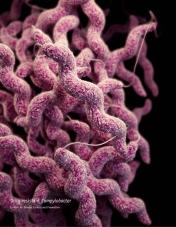
A quantitative risk assessment comprising the elements hazard identification, hazard characterization, exposure assessment, and risk characterization has been prepared to assess the effect of different mitigation strategies on the number of human cases in Denmark associated with thermophilic Campylobacter spp. in chickens. To estimate the human exposure to Campylobacter from a chicken meal and the number of human cases associated with this exposure, a mathematical risk model was developed. The model details the spread and transfer of Campylobacter in chickens from slaughter to consumption and the relationship between ingested dose and the probability of developing campylobacteriosis. Human exposure was estimated in two successive mathematical modules. Module 1 addresses changes in prevalence and numbers of Campylobacter on chicken carcasses throughout the processing steps of a slaughterhouse. Module 2 covers the transfer of Campylobacter during food handling in private kitchens. The age and sex of consumers were included in this module to introduce variable hygiene levels during food preparation and variable sizes and compositions of meals. Finally, the outcome of the exposure assessment modules was integrated with a Beta-Poisson dose-response model to provide a risk estimate. Simulations designed to predict the effect of different mitigation strategies showed that the incidence of campylobacteriosis associated with consumption of chicken meals could be reduced 30 times by introducing a 2 log reduction of the number of Campylobacter on the chicken carcasses. To obtain a similar reduction of the incidence, the flock prevalence should be reduced approximately 30 times or the kitchen hygiene improved approximately 30 times. Cross-contamination from positive to negative flocks during slaughter had almost no effect on the human Campylobacter incidence, which indicates that implementation of logistic slaughter will only have a minor influence on the risk. Finally, the simulations showed that people in the age of 18-29 years had the highest risk of developing campylobacteriosis.

Viet Nam – 37 suffer food poisoning at Son La athletics training center

VN Express

At 11 p.m. on Tuesday, 29 of them were taken to Life General Hospital in the northern province and the rest to Son La General Hospital.

According to the latter, some of the victims were in stable condition by Wednesday afternoon, but the rest were still having symptoms like vomiting and headache.

On Tuesday night around 100 athletes, all aged 10 to 15, had dinner at the training center cafeteria. Soon afterward some of them began to vomit and complain of stomachache, dizziness and headache.

The patients had eaten chicken onion salad, winter melon soup, ribs, and fried eggs.

The Son La Department of Health said it has taken samples of the food and the test results would come in a day or two.

Research – Poland’s Salmonella poultry problem continues

Food Safety News


A variety of European countries have issued nearly 100 warnings about Salmonella in chilled and frozen poultry from Poland since the start of March this year.

Data from the Rapid Alert System for Food and Feed (RASFF) portal shows alerts from Bulgaria, Croatia, Czech Republic, Slovakia, Lithuania, Estonia, Latvia, Italy, France and Romania. Most notifications were made by Lithuania, followed by Czech Republic and Bulgaria.

Involved serotypes include Enteritidis, Infantis, Typhimurium, Saintpaul, Derby, Newport, and Mbandaka. European regulation on fresh poultry mentions Salmonella Enteritidis and Typhimurium as a food safety criterion as these serotypes represent the main risk for public health. It considers chicken contaminated with other types as compliant or that it should be assessed on a case-by-case basis.

The EU produced an estimated 15.2 million tons of poultry meat in 2018. The main producer in that year with 2.5 million tons was Poland.

RASFF Alerts – Salmonella – Black Pepper – Ground Pepper and Anything to do with Chicken from Poland!!

RASFF-Logo

RASFF – Salmonella enterica ser. Enteritidis (presence /25g) in frozen chicken wings from Poland in Poland

RASFF – Salmonella enterica ser. Enteritidis (present /25g) in frozen chicken fillets from Poland in France

RASFF – Salmonella enterica ser. Typhimurium (in 1 out of 5 samples /25g) in chilled sliced turkey breasts from Poland in Lithuania

RASFF – Salmonella enterica ser. Infantis (in 4 out of 5 samples /25g) in chilled chicken legs from Poland in the Czech Republic

RASFF – Salmonella enterica ser. Infantis (presence /25g) in chilled chicken broiler quarters from Poland in Lithuania

RASFF – Salmonella (presence /25g) in black pepper from Brazil in the Netherlands

RASFF – Salmonella (presence /25g) in ground pepper from China in Spain

RASFF – Salmonella enterica ser. Mbandaka (presence /25g) in frozen chicken drumstick from Poland in Bulgaria

RASFF – Salmonella enterica ser. Enteritidis (presence /25g) in chilled chicken from Poland in Poland

RASFF – Salmonella enterica ser. Enteritidis (presence /25g) in chilled chicken breasts from Poland in the Czech Republic

RASFF – Salmonella enterica ser. Enteritidis (presence /25g) in chilled chicken breast fillets and boneless chicken legs with skin from Poland in Croatia

RASFF – Salmonella enterica ser. Enteritidis (in 2 out of 5 samples /25g) in chilled chicken breast from Poland in the Czech Republic

RASFF – Salmonella enterica ser. Enteritidis (in 1 out of 5 samples /25g) in chilled chicken breast from Poland in the Czech Republic

RASFF – Salmonella enterica ser. Enteritidis (in 1 out of 5 samples /25g) in chilled chicken breast from Poland in the Czech Republic

RASFF – Salmonella enterica ser. Enteritidis (presence /25g) in chilled chicken breast from Poland in the Czech Republic

RASFF – Salmonella enterica ser. Infantis (presence /25g) in chilled chicken from Poland in the Czech Republic

RASFF – Salmonella enterica ser. Infantis (presence /25g) in chilled chicken breast from Poland in the Czech Republic

RASFF – Salmonella enterica ser. Enteritidis (presence /25g) in chilled chicken breast from Poland in Slovkia

RASFF Alert – Diarrhoeic Shellfish Poisoning (DSP) – Live Mussels

RASFF-Logo

RASFF – Diarrhoeic Shellfish Poisoning (DSP) toxins – okadaic acid (133 µg/kg – ppb) in live mussels (Mytilus galloprovincialis) from Italy in Italy

RASFF Alert – Moulds – Ketchup with Onions

RASFF-Logo

RASFF – ketchup with onions from Denmark infested with moulds in Denmark

RASFF Alert – Aflatoxin – Groundnuts

RASFF-Logo

RASFF – aflatoxins (B1 = 28.7; Tot. = 42.5 µg/kg – ppb) in groundnuts from Cameroon in Belgium

RASFF Alert – E.coli – Betel Leaves

RASFF-Logo

RASFF – high count of Escherichia coli (2200 CFU/g) in betel leaves from Sri Lanka in the UK

RASFF Alert – Listeria monocytogenes – Chilled Smoked Codfish

RASFF-Logo

RASFF – Listeria monocytogenes (1100 CFU/g) in chilled smoked codfish from Spain in Portugal