Category Archives: STEC

France -Minced Beef Steak PARTHENAISE 5% and 15% – STEC E.coli O157

Gov france

Identification information of the recalled product

  • Product category Feed
  • Product subcategory Meats
  • Product brand name ANDRE BUTCHERS
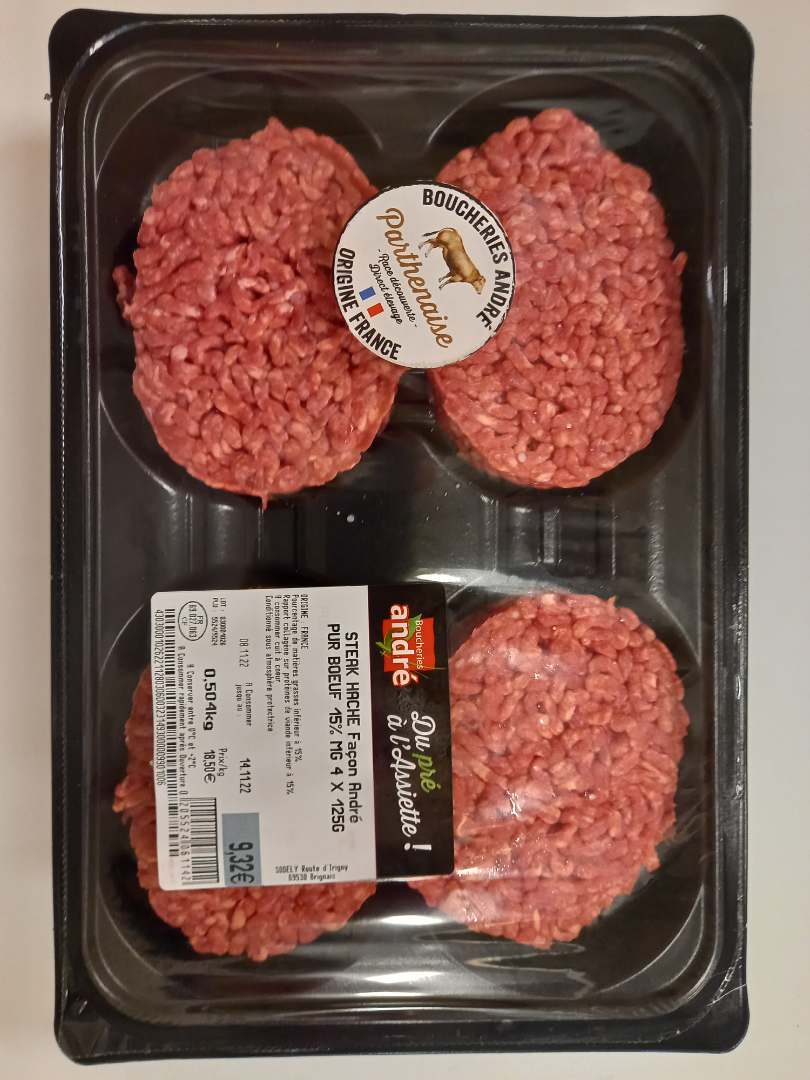
  • Model names or referencesminced beef steak PARTHENAISE 5% and 15%
  • Identification of products
    Batch Date
    030001026 Use-by date 14/11/2022
  • Packaging Trays of 2 or 4 minced steaks in a protective atmosphere
  • Marketing start/end date From 09/11/2022 to 14/11/2022
  • Storage temperature Product to be stored in the refrigerator
  • Health mark EN 69.027.063 EC
  • Further information Oval tag identifying the PARTHENAISE breed
  • Geographic area of ​​sale Departments: AIN (01), ISERE (38), RHONE (69), SAONE-ET-LOIRE (71)
  • Distributors Butcher André (Rillieux, Vaulx en Velin, Isle d’Abeau, Champagne, Villefranche, Tignieu, Vinzelles, Bourg en Bresse)

Practical information regarding the recall

  • Reason for recall Self-monitoring detection of Escherichia coli O157:H7
  • Risks incurred by the consumer Toxigenic Shiga Escherichia coli (STEC)

Research – Project looks at E. coli risk during romaine post-harvest cooling

CPS

Several researchers have examined the fate of Shiga toxin-producing E. coli O157:H7 bacteria on romaine lettuce in the field and during post-harvest washing at processors. But little is known about potential changes in the microorganism’s physiology during post-harvest cooling and refrigerated transport to processors, which could affect virulence and/or detectability.
Teresa Bergholz, Ph.D., with Michigan State University, hopes to characterize those changes on inoculated romaine lettuce under simulated post-harvest cold storage.
The goal is to develop an easily accessible online tool the industry can use to identify practices to help reduce the risks of E. coli O157:H7 transmission via romaine lettuce.

Key Take-Aways

• Project focuses on period during romaine lettuce post-harvest cooling and refrigerated transport.
• Researchers will gauge pathogen physiological changes on inoculated romaine lettuce under lab-simulated post-harvest cooling.
• Researchers also will examine cooling’s impacts on E. coli O157:H7 persister cells — a form of dormancy.
• Goal is to develop an online tool to help the industry identify practices that reduce risk of E. coli O157:H7.
Compared to the growing season and processing, the time romaine spends in coolers and refrigerated transport after harvest is relatively small.
“But I think it’s a great place where our project can contribute information about what happens during this short period of time,” Bergholz said.
Also involved in the project, titled “Quantifying risk associated with changes in EHEC physiology during post-harvest pre-processing stages of leafy green production,” is co-principal investigator Jade Mitchell, Ph.D., also with MSU. She brings a background in quantitative microbial risk assessment.
“This project really requires both of our expertise,” said Bergholz, a microbiologist. “This couldn’t be possible without both of us.”
They’ve completed the first of the project’s two parts by systematically reviewing published literature on the subject and identifying data gaps. The information gleaned from the review will be used to develop the basis of a risk model.
At the same time, the researchers are conducting laboratory experiments that simulate cooling and transportation of romaine.
To ensure the results accurately reflect real-world scenarios, Bergholz said they sought industry input.
“We’ve benefited so much from our industry partners who shared their anonymized harvest temperature data,” she said. “We could never have collected the 5,000 data points that they shared with us. They’ve been collecting this data for years.”
The real-world data also changed some of the researchers’ initial assumptions.
“This data is invaluable because we need to have conditions in the lab that make sense,” Bergholz said. “When we have a better sense of the conditions that are actually happening in the field, it helps us tremendously.”
The research also involves E. coli O157:H7 strains from 2018, 2019 and 2020 national foodborne outbreaks.
After inoculating multiple lettuce plants with the pathogen, the researchers put them in a growth chamber for a day. They then cut the romaine and placed it in a cooler to simulate harvest and cold storage.
Each day over a five-day period, the researchers pulled samples and assayed them for the pathogen. Of particular interest was its state of dormancy.
When under stress, some microorganisms — such as E. coli O157:H7 — transition to a dormant state known as persister cells. With a slowed metabolism, persisters don’t reproduce but may still cause disease. When the stressor is removed, the cells’ metabolism returns to normal.
Another form of dormancy is viable but nonculturable, or VBNC. As their name implies, these cells cannot be cultured on agar medium, preventing commonly used detection methods.
As part of the project, the researchers plan to examine whether cold storage impacts persister and VBNC transition.
“There’s still so much that we don’t understand about the persister state and how that might be part of the continuum into VBNC,” she said. “We don’t know if being in the persister state impacts detection. We plan to purposely force cells into the persister state and determine whether we can detect them with industry detection methods.”
The research results will be used to help fill in the gaps of the risk-assessment model, which will focus on practices to reduce E. coli O157:H7 risk during the short window between romaine harvest and pre-processing.
“Maybe there’s something you can do to modify the way you’re harvesting and cooling that lets you reduce risk,” Bergholz said. “Can we shift the harvest time and how quickly we get it to the cooling center?”

Research – Prevalence and Implications of Shiga Toxin-Producing E. coli in Farm and Wild Ruminants

MDPI

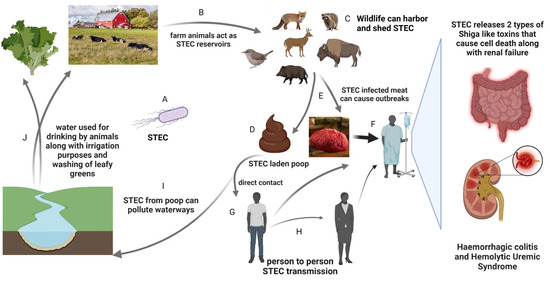
Shiga-toxin-producing Escherichia coli (STEC) is a food-borne pathogen that causes human gastrointestinal infections across the globe, leading to kidney failure or even death in severe cases. E. coli are commensal members of humans and animals’ (cattle, bison, and pigs) guts, however, may acquire Shiga-toxin-encoded phages. This acquisition or colonization by STEC may lead to dysbiosis in the intestinal microbial community of the host. Wildlife and livestock animals can be asymptomatically colonized by STEC, leading to pathogen shedding and transmission. Furthermore, there has been a steady uptick in new STEC variants representing various serotypes. These, along with hybrids of other pathogenic E. coli (UPEC and ExPEC), are of serious concern, especially when they possess enhanced antimicrobial resistance, biofilm formation, etc. Recent studies have reported these in the livestock and food industry with minimal focus on wildlife. Disturbed natural habitats and changing climates are increasingly creating wildlife reservoirs of these pathogens, leading to a rise in zoonotic infections. Therefore, this review comprehensively surveyed studies on STEC prevalence in livestock and wildlife hosts. We further present important microbial and environmental factors contributing to STEC spread as well as infections. Finally, we delve into potential strategies for limiting STEC shedding and transmission. View Full-Text

RASFF Alerts – STEC E.coli – Raw Milk Cheese – Goat Faisselle Cheese

RASFF

Detection of E.coli STEC in goat faisselle from France in Belgium

RASFF

STEC in raw milk cheese from the Netherlands in Germany

USA – Another Seattle area E. coli O157 Outbreak

Food Poison Journal

Public Health is investigating an outbreak of three people infected with Shiga toxin-producing E. coli O157:H7 (also known as STEC). Between October 4 – 16, 2022, 3 people from 3 separate households reported becoming ill. Cases have been among people ranging in age from 18 to 36 years old. Symptoms reported include diarrhea and abdominal pain.

The investigation is ongoing, and no source has been identified. Two of the three ill people report eating dishes that were prepared with raw or undercooked beef but we cannot rule out other possible sources at this time.

Confirmed cases have been linked through genetic fingerprinting results (whole genome sequencing) which indicate that they have the same genetic strain, meaning they likely have a common source of infection.

France – DRY GOAT CHEESE – STEC E.coli

Gov france

Identification information of the recalled product

  • Product category Feed
  • Product subcategory Milk and dairy products
  • Product brand name CHEVRIGNY – CHEVRIER DES CRAYS
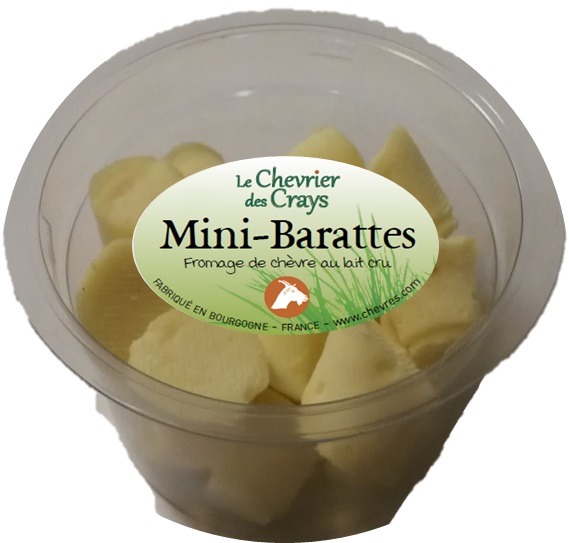
  • Model names or references Churns Mini Churns
  • Identification of products
    GTIN Batch Date
    3503965270008 272 Date of minimum durability 14/11/2022
    3503965270008 273 Date of minimum durability 21/11/2022
  • Products ListList_of_dry_products.pdfAttachment
  • Packaging plastic tray or bare product in traditional network
  • Marketing start/end date From 09/12/2022 to 09/20/2022
  • Storage temperature Product to be stored in the refrigerator
  • Health markFR-71-235-001-CE
  • Further information Dry goat cheese
  • Geographic area of ​​sale Whole France
  • Distributors CARREFOUR France GRAND FRAIS France INTERMARCHE Bourgogne Franche Comté METRO Chalon sur Saône METRO Dijon HYPER U, SUPER U Burgundy Rhône Alpes Alsace

Practical information regarding the recall

  • Reason for recall Recall information for health reasons
  • Risks incurred by the consumer Toxigenic Shiga Escherichia coli (STEC)

France – FRESH GOAT CHEESE – STEC E.coli

Gov france

Identification information of the recalled product

  • Product category Feed
  • Product subcategory Milk and dairy products
  • Product brand name GOATHERD OF CRAYS
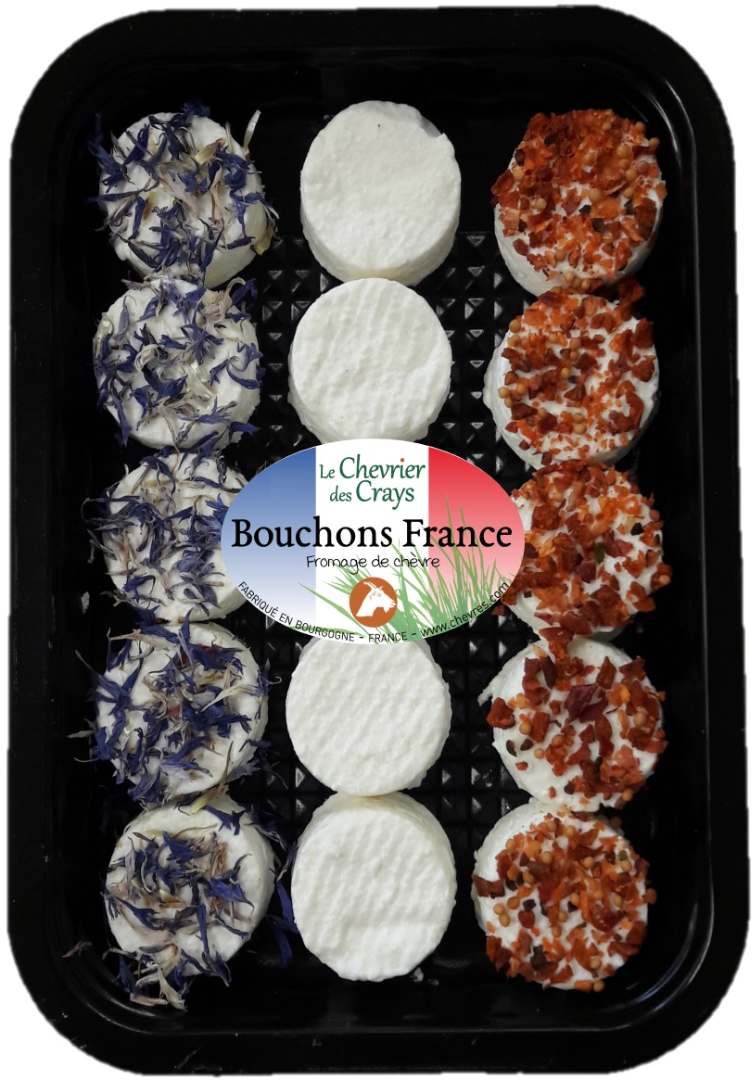
  • Model names or references Cornflower corks Goat cheese cork France
  • Identification of products
    GTIN Batch Date
    3503961124008 256 Date of minimum durability 11/10/2022
    3503961124008 263 Date of minimum durability 10/18/2022
    3503961129003 258 – 259 – 262 – 264 – 269 – 270 – 271 – 272 – 273 Date of minimum durability between 11/10/2022 and 01/11/2022
  • Packaging Plastic tray
  • Marketing start/end date From 09/12/2022 to 09/30/2022
  • Storage temperature Product to be stored in the refrigerator
  • Health mark FR-71-235-001-CE
  • Further information Fresh goat cheese
  • Geographic area of ​​sale Whole France
  • Distributors CARREFOUR France LECLERC Mâcon

Practical information regarding the recall

  • Reason for recall Recall information for health reasons
  • Risks incurred by the consumer Toxigenic Shiga Escherichia coli (STEC)

France – CABRIFRAIS Cheese – STEC E.coli O103

Gov france

Identification information of the recalled product

  • Product category Feed
  • Product subcategory Milk and dairy products
  • Product brand name Crays goatherd
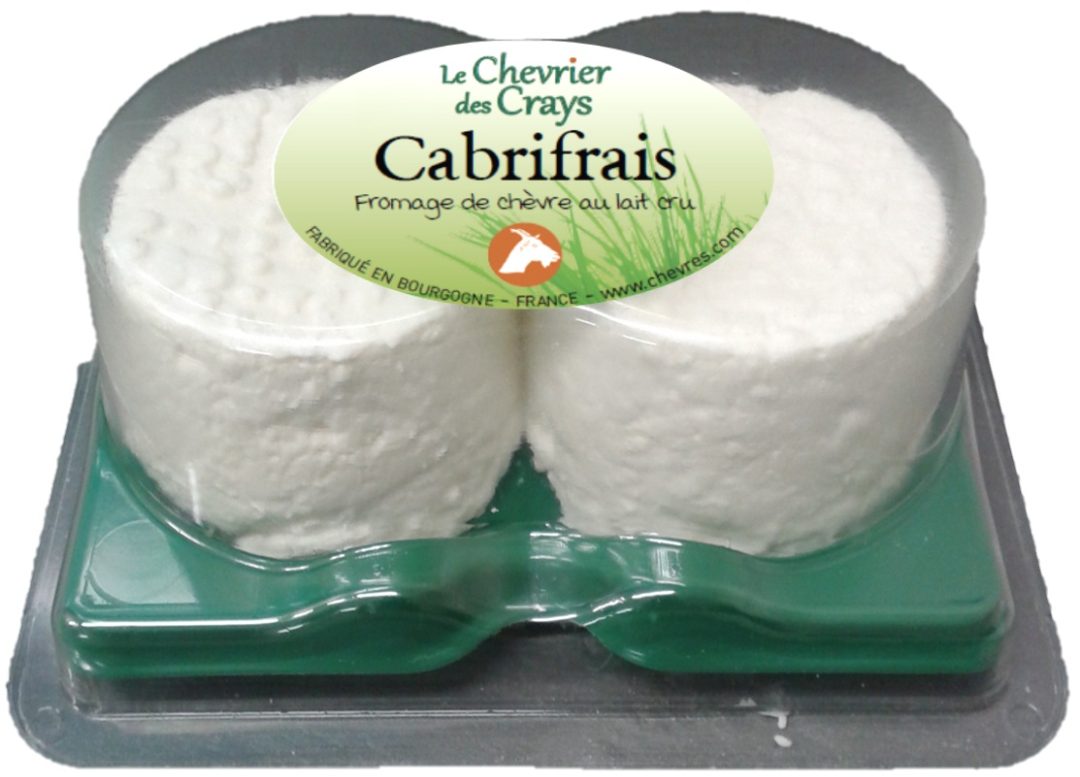
  • Model names or references CABRIFRAIS with raw milk
  • Identification of products
    GTIN Batch Date
    3503961317004 255 Date of minimum durability 11/10/2022
    3503961315062 255 – 258 Date of minimum durability 11/10/2022
    3503965317024 256 Date of minimum durability 11/10/2022
    3503961317028 255 Date of minimum durability 11/10/2022
    3503961314126 255 – 259 Date of minimum durability between 10/11/2022 and 10/18/2022
    3503961321124 255 – 256 Date of minimum durability 11/10/2022
  • Marketing start/end date From 09/12/2022 to 09/20/2022
  • Storage temperature Product to be stored in the refrigerator
  • Health markEN.71235001.CE
  • Geographic area of ​​sale Regions: Auvergne-Rhône-Alpes, , Burgundy-Franche-Comté, , Grand-Est
  • Distributors Auchan, Carrefour, Intermarché, System U, Leclerc, Colruyt

Practical information regarding the recall

  • Reason for recall Presence of Escherichia coli O103:H2
  • Risks incurred by the consumer Toxigenic Shiga Escherichia coli (STEC)

France – FRESH GOAT CHEESE – STEC E.coli

Gov france

Identification information of the recalled product

  • Product category Feed
  • Product subcategory Milk and dairy products
  • Product brand name GOATHERD OF CRAYS
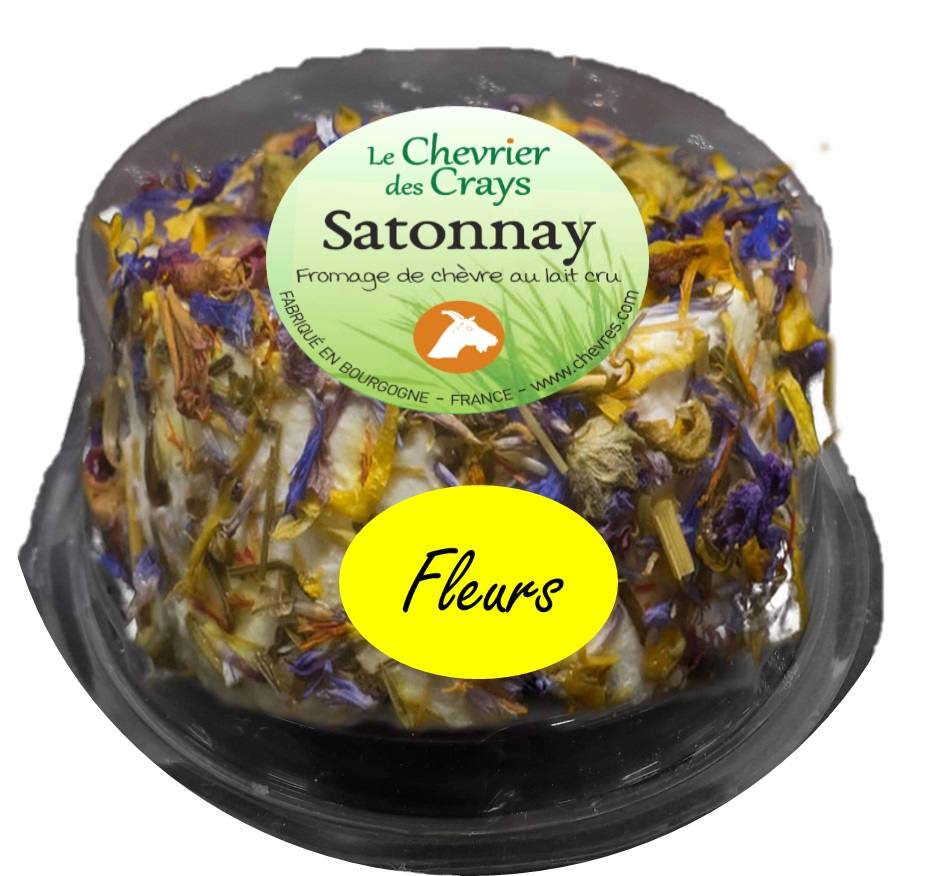
  • Model names or references Satonnay flower petals Satonnay Truffle Tuber Aestivum Vitt. Satonnay shell 140g
  • Identification of products
    GTIN Batch Date
    3503965475007 255 Date of minimum durability 11/10/2022
    3503965472006 255 Date of minimum durability 11/10/2022
    3503965452008 255 Date of minimum durability 11/10/2022
  • Packaging plastic tray or bare product in traditional network
  • Marketing start/end date From 09/12/2022 to 09/20/2022
  • Storage temperature Product to be stored in the refrigerator
  • Health mark FR-71-235-001-CE
  • Further information Fresh goat cheese
  • Geographic area of ​​sale Whole France
  • Distributors AUCHAN GRAND FRESH CROSSROADS

Practical information regarding the recall

  • Reason for recall Recall information for health reasons
  • Risks incurred by the consumer Toxigenic Shiga Escherichia coli (STEC)

Research – Another drop in outbreaks was recorded in Germany for 2021

Food Safety News

The amount of foodborne outbreaks reported in Germany has continued to fall, according to the latest figures.

In 2021, the Robert Koch-Institut (RKI) and Federal Office of Consumer Protection and Food Safety (BVL) received slightly fewer reports of outbreaks with 168 compared to 193 in the previous year.

At least 1,179 cases, 196 hospitalizations, and two deaths were related to them in 2021. As in previous years, the top causes were Campylobacter and Salmonella.

Other agents involved in outbreaks were norovirus, Bacillus cereus, hepatitis A virus, Listeria monocytogenes, Clostridium perfringens, Yersinia enterocolitica, Shiga toxin-producing E. coli (STEC), Clostridium botulinum, Cronobacter sakazakii, histamine, Shigella, and Staphylococcus aureus. In seven outbreaks with 73 cases, the pathogen remained unknown.

Nineteen of the 22 outbreaks with more than five patients were caused by Salmonella.