Category Archives: STEC E.coli

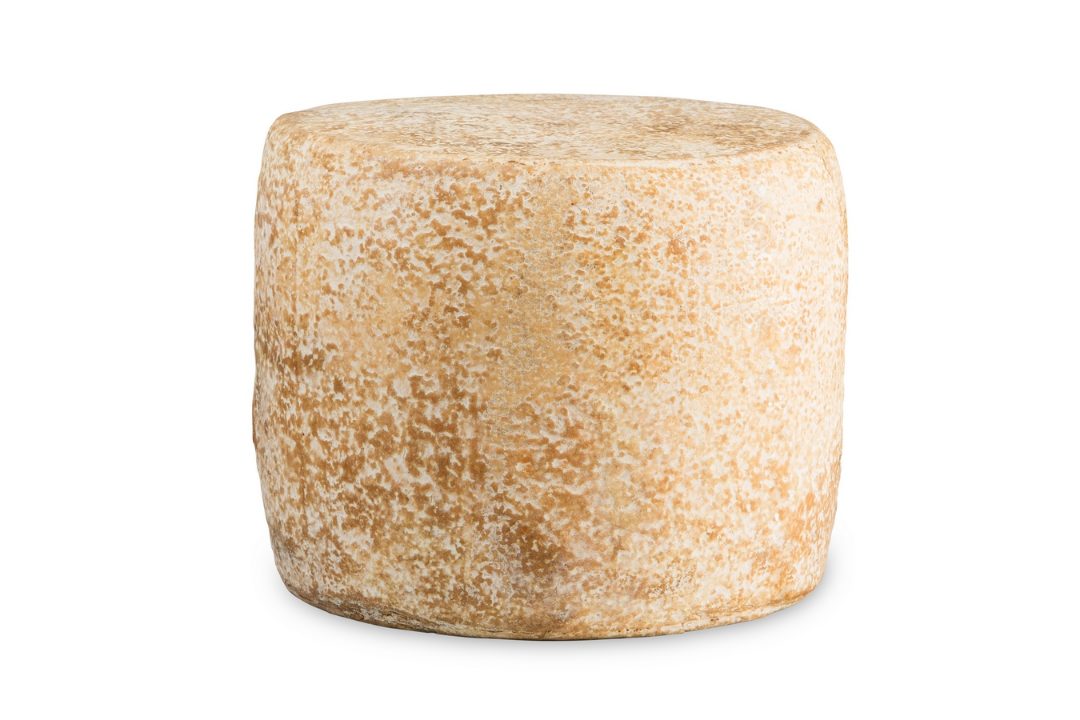
France – Cantal Entre Deux raw milk – STEC E.coli O26

Gov france

Identifying information for the recalled product

  • Product category Food
  • Product sub-category Milk and dairy products
  • Product brand name Nouaille
  • Names of models or references Cantal between two with raw milk whole wheel Cantal between two with raw milk 1/2 wheel Cantal between two with raw milk 1/4 of a wheel Cantal between two with raw milk 1/8 of a wheel
  • Product identification
    GTIN Lot Dated
    3760071554327 016821 Date of minimum durability between 04/01/2022 and 05/01/2022
    3760070000870 016821 Date of minimum durability between 12/12/2021 and 22/12/2021
    3760071554426 016821 Date of minimum durability between 13/12/2021 and 27/12/2021
    3760070000610 016821 Date of minimum durability between 12/15/2021 and 12/27/2021
  • Products List FT.1904_Cantal_ED_Lait_Cru_v2.pdf Enclosed
  • Packaging Whole wheel 1/2 1/4 1/8
  • Start date / End of marketing From 11/09/2021 to 11/23/2021
  • Storage temperature Product to be stored in the refrigerator
  • Health mark FR 15 219 009 CE
  • Geographical sales area Whole France
  • Distributors Fromi Comptoir Fromager Mont Royal selection Rolland Henri Subirana le Mont Dore Subirana La bourboule The house of good cheese Sacpa Cora Vichy Intermarché Mauriac Le Bistrot d’Arsène Boxwood creamery Farandole d’Auvergne
  • List of points of sale001904-DDPP.PDF

Practical information regarding the recall

  • Reason for recall presence of pathogenic E. coli STEC O26: H11
  • Risks incurred by the consumer Toxinogenic Escherichia coli shiga (STEC)

France – Cantal Entre Deux with Raw Milk – E.coli STEC O26

Gov france

Identifying information for the recalled product

  • Product category Food
  • Product sub-category Milk and dairy products
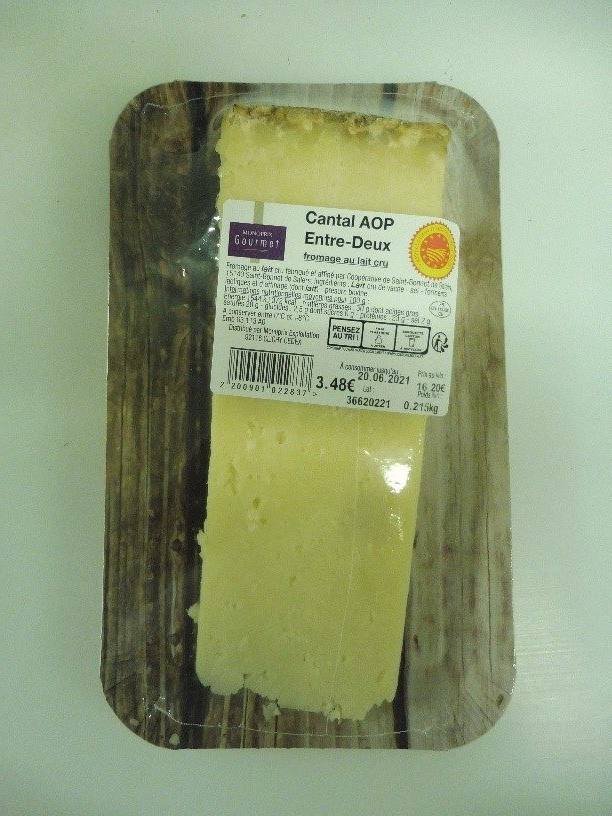
  • Product brand name MONOPRIX GOURMET
  • Names of models or references Cantal Entre Deux Monoprix Gourmet Cantal Entre Deux Monoprix Gourmet 1/8
  • Product identification
    GTIN Lot Dated
    22009010 16821451 Use-by date 11/28/2021
    3350033300491 16821 Use-by date 12/07/2021
  • Packaging Packaged fresh: tray + film 1 / 8th of a wheel sold by the cut under creamer paper
  • Start date / End of marketing From 11/10/2021 to 12/08/2021
  • Storage temperature Product to be stored in the refrigerator
  • Health mark FR 63 113 081 CE
  • Geographical sales area Whole France
  • Distributors MONOPRIX

Practical information regarding the recall

  • Reason for recall Following a non-compliant analysis: Detection of STEC O26: H11 strains
  • Risks incurred by the consumer Toxinogenic Escherichia coli shiga (STEC)

Wales – Two E. coli O157 infections in children under investigation in Wales

Food Safety News

Public health officials in Wales are investigating two E. coli O157 infections at different primary schools in the country.

Public Health Wales, Conwy County Borough Council and Betsi Cadwaladr University Health Board are looking into a case of E. coli O157 at a primary school in Abergele.

The same three agencies are also investigating a probable case of E. coli O157 at a primary school in Conwy to try and find the source.

There is currently no evidence in either case to suggest the child acquired the infection at the school.

“Parents and guardians of pupils that attend the school and who may have had contact with this case have been contacted and advised on infection prevention and control measures, and what steps to take if their child develops symptoms. Contacts have been asked to submit samples for testing and to remain off school until negative results are received,” he said.

USA – Outbreak Investigation of E. Coli O157:H7 – Spinach (November 2021)

FDA

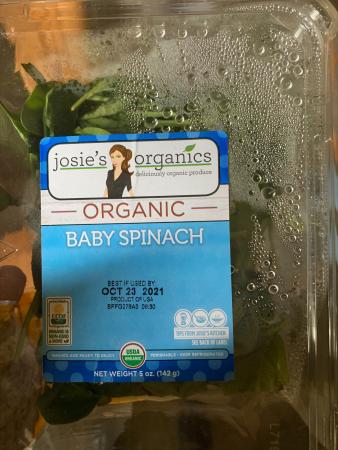
Outbreak Investigation of E. Coli O157:H7 in Spinach (November 2021): Sample Image of Josie's Organics Baby Spinach

The FDA and CDC, in collaboration with state and local partners, are investigating illnesses in a multistate outbreak of E. coli O157:H7. According to the CDC, as of November 15, 2021, 14 people infected with the outbreak strain of E. coli O157:H7 have been reported from nine states. Illnesses started on dates ranging from October 13 to October 27, 2021. 10 people in this outbreak report eating spinach in the week before becoming sick and six people reported Josie’s Organics brand.

On November 15, 2021, the Minnesota Department of Agriculture reported that, as part of this outbreak investigation, a sample of Josie’s Organics Baby Spinach collected from the home of an ill person tested positive for E. coli O157:H7. This sample had a “Best If Used By” date of October 23, 2021. Whole Genome Sequencing (WGS) analysis determined that the strain of E. coli O157:H7 present in the product sample matches the outbreak strain.

FDA traced the supply chain for this positive product sample back to a small number of farms in two different geographic regions and deployed Investigators along the supply chains of interest. FDA continues tracing back reported spinach exposures to identify if spinach from additional farms could have been implicated.

FDA and state partners are working with the firm to determine if additional products could be affected. This is an ongoing investigation and additional information will be provided as it becomes available.

Recommendation

Consumers, restaurants, and retailers, should not eat, sell, or serve Josie’s Organics Baby Spinach with a “Best If Used By” date of October 23, 2021. Josie’s Organics Baby Spinach is sold in a clear plastic clamshell with the Best If Used By Date on the top label.

Although this product is past expiration and should no longer be available for purchase, consumers should check their homes for product and discard it. If consumers froze fresh Josie’s Organics Baby Spinach, they should discard it.

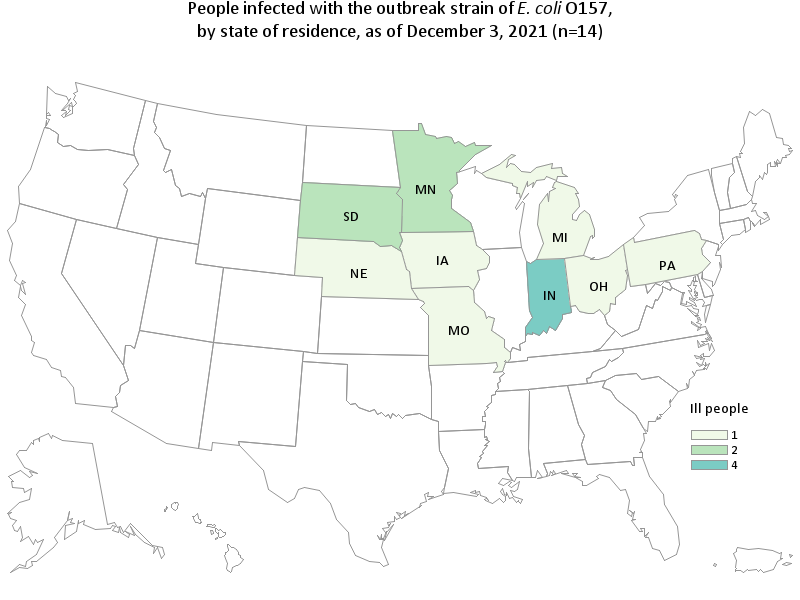
Case Count Map Provided by CDC

Outbreak Investigation of E. Coli O157:H7 in Spinach: Case Count Map Provided by CDC (December 3, 2021)

Case Counts

Total Illnesses: 14
Hospitalizations: 4
Deaths: 0
Last Illness Onset: October 27, 2021
States with Cases: IA (1), IN (4), MI (1), MN (2), MO (1), NE (1), OH (1), PA (1), SD (1)

RASFF Alerts – STEC E.coli – Boneless Beef – Dough for Cookies

RASFF

STEC stx2 in Chilled boneless beef from Brazil in Belgium and Netherlands

RASFF

VTEC/STEC in ready dough for cookies from Germany in Austria

Germany – E. coli in lamb and flour prompts warning in Germany

Food Safety News

Findings of E. coli in lamb and flour has triggered a warning from German authorities.

Basic rules of kitchen hygiene, such as using different cutting boards for raw meat and vegetables, should be followed. Proper cooking is one of the best ways to avoid food poisoning from E. coli.

As part of zoonosis monitoring in Germany in 2020, Shiga toxin-producing E. coli (STEC) were detected in 50 of 380 samples of fresh lamb.

Lamb from Germany was significantly more often STEC-positive than that from other countries with 36 of 190 samples positive compared to 12 of 177.

Consumers, especially small children, the elderly, the immunocompromised and pregnant women, should only consume lamb that has been well cooked, advised the Federal Office for Consumer Protection and Food Safety (BVL).

“An infection with STEC should not be underestimated. In children in particular, it can lead to the development of hemolytic uremic syndrome (HUS), which is often associated with acute kidney failure,” said Friedel Cramer, BVL president.

STEC was detected in 22 of 242 samples of wheat flour from milling operations. Consumers can minimize this risk by not eating raw dough, cake batter or other foods containing raw flour. E. coli was also found in six of 318 samples of raw milk soft cheese sold at retail, from wholesale and at import points.

In total, 94 isolates belonged to 28 different O serogroups with O146 as the most common while O157 was not detected.

Austria -Dr. Oetker Chocolate Cookies -STEC E.coli

AGES

Product recall Dr. Oetker Schoko Ausstech Cookies
Opinion of the Dr. Oetker GmbH on the test report of the Institute for Food Safety Innsbruck with the order number 2112838.

Villach (OTS) – Object of
investigation Dr. Oetker Schoko
Cookie Cutter Lot / Batch / Best before: L169

When a sample was taken by the Innsbruck Institute for Food Safety, Vero / Shiga toxin-forming Escherichia coli were detected in the above-mentioned object of investigation.

Although according to the Federal Institute for Risk Assessment (BfR) in its opinion no. Oetker, who learned of the examination results on November 26th, 2021, received batch L 169 from Dr. Oetker chocolate cookie cutters back.
We would like to point out that E.Coli proof would only be possible in the raw dough, but baked biscuits can be enjoyed without hesitation.

Item No. 1-01-870700

GTIN EVE 4000521013288

Article description Chocolate cookie

cutter Best before 02.2023

The product concerned was placed on the Austrian market from September 2021. He was informed immediately. To avoid health risks, consumers are asked to return the recalled goods to the shop where the product was purchased. The purchase price will be refunded. Dr. Oetker apologizes to its customers for any inconvenience this may cause.

Original broadcast

More info

Verotoxin-producing Escherichia coli (VTEC)

Research – Evaluation of the use of ampicillin- and streptomycin-resistant Shiga toxin-producing Escherichia coli to reduce the burden of background microbiota during food safety studies

Wiley Online

Tracking artificially seeded foodborne pathogens in foods with high background microbiota is challenging. Wheat flour and its subsidiary products are known to carry a high native microbial load, which could interfere with tracking and enumeration of target organisms in such matrices. Shiga toxin-producing Escherichia coli (STEC) serogroups O26, O121, and O157:H7 were transformed with the pGFPuv plasmid encoding ampicillin resistance (+Amp) and green fluorescent protein and were additionally conferred resistance to streptomycin (+Amp + Strep) through exposure to incremental concentrations of the antibiotic. Growth characteristics of these antibiotic-resistant strains were compared to those of the nonresistant native strains (NR). The supplementation of ampicillin and ampicillin + streptomycin in growth media was evaluated for its ability to suppress growth of the native microbial load of three different commercial cake mixes. Antibiotic supplementation in growth media was successful in suppressing the native microbiota of the cake mixes, while the growth characteristics of the +Amp + Strep variants of the three STEC strains did not differ significantly from the NR strains (p > .05). These results indicate that STEC strains with ampicillin and streptomycin resistance markers have improved trackability over their wild-type counterparts when isolated from food matrices with high background microbiota. These strains would be advantageous for use in laboratory experiments on STEC survival in wheat and wheat derived products as their detection and enumeration can occur without interference from native microbial load.

USA – Outbreak Investigation of E. Coli O157:H7 – Spinach (November 2021)

FDA

Outbreak Investigation of E. Coli O157:H7 in Spinach (November 2021): Sample Image of Josie's Organics Baby Spinach

The FDA and CDC, in collaboration with state and local partners, are investigating illnesses in a multistate outbreak of E. coli O157:H7. According to the CDC, as of November 15, 2021, 10 people infected with the outbreak strain of E. coli O157:H7 have been reported from 7 states. Illnesses started on dates ranging from October 15 to October 27, 2021. Five people in this outbreak report eating spinach in the week before becoming sick and one person reported Josie’s Organics brand.

On November 15, 2021, the Minnesota Department of Agriculture reported that, as part of this outbreak investigation, a sample of Josie’s Organics Baby Spinach collected from the home of an ill person tested positive for E. coli O157:H7. This sample had a “Best If Used By” date of October 23, 2021 and is undergoing Whole Genome Sequencing (WGS) analysis to determine if the strain of E. coli O157:H7 present in the product sample matches the outbreak strain.

As WGS analysis of the sample is underway, FDA is tracing back the supply of the baby spinach in the positive product sample. Thus far, FDA has traced supply chains for this product back to a small number of farms in two different geographic regions and is deploying investigators along the supply chains of interest.

FDA and state partners are working with the firm to determine if additional products could be affected. This is an ongoing investigation and additional information will be provided as it becomes available.

Recommendation

Consumers, restaurants, and retailers, should not eat, sell, or serve Josie’s Organics Baby Spinach with a “Best If Used By” date of October 23, 2021. Josie’s Organics Baby Spinach is sold in a clear plastic clamshell with the Best If Used By Date on the top label.

Although this product is past expiration and should no longer be available for purchase, consumers should check their homes for product and discard it. If consumers froze fresh Josie’s Organics Baby Spinach, they should discard it.

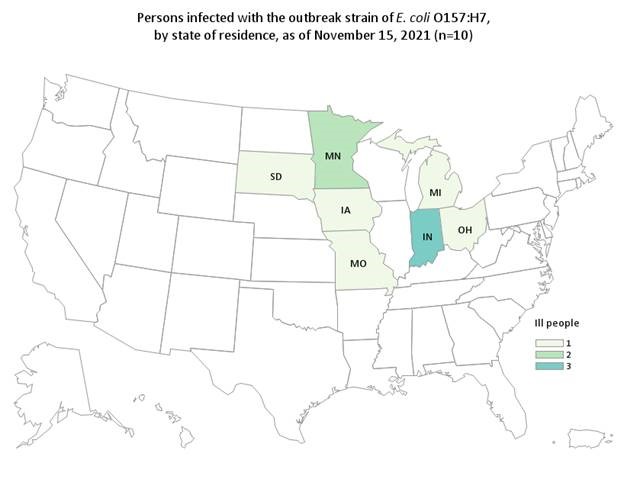
Case Count Map Provided by CDC

Outbreak Investigation of E. Coli O157:H7 in Spinach: Case Count Map Provided by CDC (November 15, 2021)

Case Counts

Total Illnesses: 10
Hospitalizations: 2
Deaths: 0
Last Illness Onset: October 27, 2021
States with Cases: IA (1), IN (3), MI (1), MN (2), MO (1), OH (1), SD (1)

Research – Attachment of Shiga Toxin-Producing Escherichia coli (STEC) to Pre-Chill and Post-Chill Beef Brisket Tissue

MDPI

Shiga toxin-producing Escherichia coli (STEC) has caused numerous foodborne illness outbreaks where beef was implicated as the contaminated food source. Understanding how STEC attach to beef surfaces may inform effective intervention applications at the abattoir. This simulated meat processing conditions to measure STEC attachment to adipose and lean beef tissue. Beef brisket samples were warmed to a surface temperature of 30 °C (warm carcass), while the remaining samples were maintained at 4 °C (cold carcass), prior to surface inoculation with an STEC cocktail (O26, O45, O103, O111, O121, O145, and O157:H7). Cocktails were grown in either tryptic soy broth (TSB) or M9 minimal nutrient medium. Loosely and firmly attached cells were measured at 0, 3, 5, and 20 min and 1, 3, 8, 12, 24 and 48 h. TSB-grown STEC cells became more firmly attached throughout storage and a difference in loosely versus firmly attached populations on lean and adipose tissues was observed. M9-grown STEC demonstrated a 0.2 log10 CFU/cm2 difference in attachment to lean versus adipose tissue and variability in populations was recorded throughout sampling. Future research should investigate whether a decrease in intervention efficacy correlates to an increase in firmly attached STEC cells on chilled carcasses and/or subprimals, which has been reported. View Full-Text