Category Archives: Salmonella

Research -Antibiotic-free poultry meat less likely to harbor multidrug-resistant Salmonella

CIDRAP Campylobacter kswfoodworld

An analysis by researchers in Pennsylvania found that meat from conventionally raised poultry harbored nearly twice as much multidrug-resistant Salmonella as meat from antibiotic-free poultry, according to a study reported today at IDWeek 2019.

The findings come from a study conducted by scientists with the Pennsylvania Department of Health, Penn State College of Medicine, and the Food and Drug Administration (FDA) that examined non-typhoidal Salmonella cultures from nearly 3,500 samples of chicken and turkey bought from randomly selected stores in Pennsylvania from 2008 through 2017. Analysis of the Salmonella cultures found that 55% of those from conventionally raised poultry meat were resistant to three or more antibiotic classes, compared with 28% of the cultures from the antibiotic-free poultry meat.

Salmonella is a leading cause of foodborne illness, affecting more than 1.2 million Americans each year. While most cases are self-limiting, some salmonellosis cases require antibiotics and hospitalization. Drug-resistant Salmonella is harder to treat and can cause more severe and sometimes deadly infections.

Research – Microbiological Testing Results of Boneless and Ground Beef Purchased for the U.S. National School Lunch Program, School Years 2015 to 2018

Journal of Food Protection

ABSTRACT

The Agricultural Marketing Service (AMS) purchases beef for the National School Lunch Program and other federal nutrition assistance programs. For beef that will be delivered to food service facilities raw, each ca. 900-kg lot of boneless beef raw material and each ca. 4,500-kg sublot of resultant ground beef is tested for standard plate count (SPC) organisms, coliforms, Escherichia coli, Salmonella, and E. coli O157:H7. In addition, 1 of every 10 lots of boneless beef, randomly selected, is tested for E. coli O26, O45, O103, O111, O121, and O145. For beef that will be cooked using a validated lethality step at a federally inspected establishment before delivery, each lot of boneless beef and each sublot of ground beef is tested for SPC organisms, coliforms, and E. coli only. Any lot or sublot exceeding predefined critical limits (CLs) of 100,000 CFU g−1 for SPC organisms, 1,000 CFU g−1 for coliforms, or 500 CFU g−1 for E. coli or for beef containing Salmonella or any of previously mentioned E. coli serotypes is rejected for purchase. For school years 2015 through 2018 (July 2014 through June 2018), 220,497,254 kg of boneless beef and 189,347,318 kg of ground beef were produced for AMS. For boneless beef, 133 (0.06%), 164 (0.07%), and 106 (0.04%) of 240,488 lots exceeded CLs for SPC organisms, coliforms, and E. coli, respectively; 2,038 (1.30%) and 116 (0.07%) of 156,671 lots were positive for Salmonella and E. coli O157:H7, respectively; and 59 (0.36%) of 16,515 lots were positive for non-O157 Shiga toxin–producing E. coli. For ground beef, 46 (0.10%), 27 (0.06%), and 19 (0.04%) of 45,769 sublots exceeded CLs for SPC organisms, coliforms, and E. coli, respectively; and 329 (1.40%) and 18 (0.08%) of 23,475 sublots were positive for Salmonella and E. coli O157:H7, respectively. All lots and sublots found to exceed indicator organism CLs or to contain pathogens were identified, rejected for purchase, and diverted from federal nutrition assistance programs.

HIGHLIGHTS
  • AMS purchases beef for the National School Lunch Program.

  • Less than 0.10% of beef samples exceeded indicator organism critical limits.

  • Salmonella was found in 1.4% and E. coli O157:H7 was found in 0.08% of samples.

  • Indicator critical limit exceedance was weakly associated with pathogen presence.

  • Beef with excessive indicator organisms or containing pathogens was rejected for purchase.

USA – Salmonella and Hepatitis A Outbreak at Crow Wing County Jail in MN

Food Poisoning Bulletin

A Salmonella and Hepatitis A outbreak at the Crow Wing County Jail in Minnesota has been announced by the Crow Wing County Sheriff’s Office. The number of those sickened has not yet been released. We also do not know the ages of patients or whether or not anyone has been hospitalized.

Canada – Canada’s Deadly Salmonella Outbreak Has Now Affected At Least 110 People – One Dead

Narcity

The Public Health Agency of Canada revealed on Tuesday afternoon that their Salmonella outbreak investigation has now uncovered an additional 14 cases of the disease in Canada, taking the total number of confirmed cases to 110. According to a statement from the Health Agency, Salmonella has been found across multiple provinces and territories, and the cases are part of an ‘ongoing’ outbreak in the country.

Daily Hive

One person has died after year-long Salmonella outbreak in Canada

RASFF Alerts – Salmonella – Hot Chicken Wings – Organic Almond Protein – Turkey Meat and Giblets – Turkey Hearts – Chicken Breast – Minced Meat Preparation – Doner Kebab – Sesame Seeds – Whitish Sesame Seeds – Chicken Prime Wings in Blueberry Marinade – Poultry Meat – Chicken Legs – Ground Black Pepper – Marinated Poultry Fillets

RASFF-Logo

RASFF – Salmonella (present /25g) in frozen hot chicken wings from the Netherlands in France

RASFF – Salmonella (presence /25g) in organic almond protein from Spain in Germany

RASFF – Salmonella enterica ser. Typhimurium monophasic (1 ,4, [5], 12:i:-) (presence /25g) in chilled turkey meat and giblets from France in France

RASFF – Salmonella enterica ser. Kentucky (presence /25g) in chilled turkey hearts from Poland in Lithuania

RASFF – Salmonella (presence /25g) in frozen salted chicken breasts from Brazil in the UK

RASFF – Salmonella (presence /25g) in minced meat preparation from Belgium in Belgium

RASFF – Salmonella enterica ser. Infantis (presence /25g) in chilled chicken breast fillet and chicken quarters from Poland in Lithuania

RASFF – Salmonella (presence /25g) in frozen doner kebab from the Netherlands in the Netherlands

RASFF – Salmonella (presence /25g) in sesame seeds from Sudan in Greece

RASFF – Salmonella (presence /25g) in sesame seeds from Ethiopia in Greece

RASFF – Salmonella (presence /25g) in sesame seeds from Sudan in Greece

RASFF – Salmonella (in 3 out of 5 samples /25g) in whitish sesame seeds from Sudan in Greece

RASFF – Salmonella enterica ser. Infantis (presence /25g) in chilled chicken prime wings in blueberry marinade from Lithuania in Estonia

RASFF – Salmonella enterica ser. Enteritidis (presence /25g) in chilled poultry meat from Poland in Poland

RASFF – Salmonella group C1 (presence /25g) in chilled chicken legs from Poland in Poland

RASFF – Salmonella (presence in 1 out of 5 samples /25g) in whitish sesame seeds from Sudan in Greece

RASFF – Salmonella (present /25g) in ground black pepper from Brazil in Spain

RASFF – Salmonella (presence in 1 out of 5 samples /25g) in whitish sesame seeds from Sudan in Greece

RASFF – Salmonella (presence /25g) in chilled marinated poultry fillets from Slovenia in Croatia

RASFF – Salmonella (presence /25g) in sesame seeds from Sudan in Greece

RASFF – Salmonella (presence /25g) in sesame seeds from Sudan in Greece


RASFF Alerts – Animal Feed – Salmonella- Lamb Meal – Turkey Meat Meal – Rapeseed Meal

RASFF-Logo

RASFF – Salmonella (present /25g) in lamb meal from New Zealand in Belgium

RASFF – Salmonella (present /25g) in lamb meal from New Zealand in Belgium

RASFF – Salmonella enterica ser. Senftenberg (presence /25g) in turkey meat meal (processed animal protein) from Hungary in Hungary

RASFF – Salmonella (presence /25g) in rapeseed meal from Germany in Germany

RASFF – Salmonella (presence /25g) in rapeseed meal from Ukraine in Hungary

Europe – Epidemiological update: Multi-country outbreak of Salmonella Enteritidis infections linked to Polish eggs

ECDC

Since the joint ECDC-EFSA rapid outbreak assessment ’Multi-country outbreak of Salmonella Enteritidis infections linked to Polish eggs’ published on 12 December 2017, 15 EU/EEA countries (Belgium, Czech Republic, Denmark, France, Hungary, Iceland, Ireland, Italy, Luxembourg, Netherlands, Norway, Poland, Slovenia, Sweden and United Kingdom) have reported 336 confirmed, 94 probable and 3 new historical-confirmed cases associated with this ongoing multi-country outbreak of Salmonella Enteritidis in the EU/EEA. In the same period, seven historical probable cases were reclassified as excluded.

Overall, 1 412 cases have been found associated with this outbreak: 532 confirmed and 166 probable cases since 1 February 2017 and 343 historical-confirmed and 367 historical-probable cases between 2012 and 31 January 2017. In addition, no dates have been reported for four outbreak-confirmed cases, so they are unclassifiable as current or historical cases (Table 1).

Table 1. Distribution of cases by case classification and country, EU/EEA, February 2012 to November 2018 (n=1 420; 4 cases missing date of onset or sampling or receipt at reference laboratory), as of 12 November 2018

Reporting country Confirmed cases Probable cases Historical-confirmed cases Probable-confirmed cases Total number of cases
Belgium 0 46 14 127 187
Croatia 0 0 4 0 4
Czech Republic 0 6 0 3 9
Denmark 16 0 6 2 24
Finland 0 0 0 1 1
France 21 0 8 0 29
Greece 0 0 0 2 2
Hungary 0 29 0 5 34
Ireland 12 0 4 4 20
Ireland 1 0 0 0 1
Italy 0 12 1 19 32
Luxembourg 4 0 5 0 9
Netherlands 8 25 90 164 287
Norway 22 18 11 32 83
Poland 25 0 0 0 25
Slovenia 0 7 3 0 10
Sweden 11 20 12 2 45
United Kingdom 412 3 185 6 606
Total 532 166 343 367 1408
              698                 710


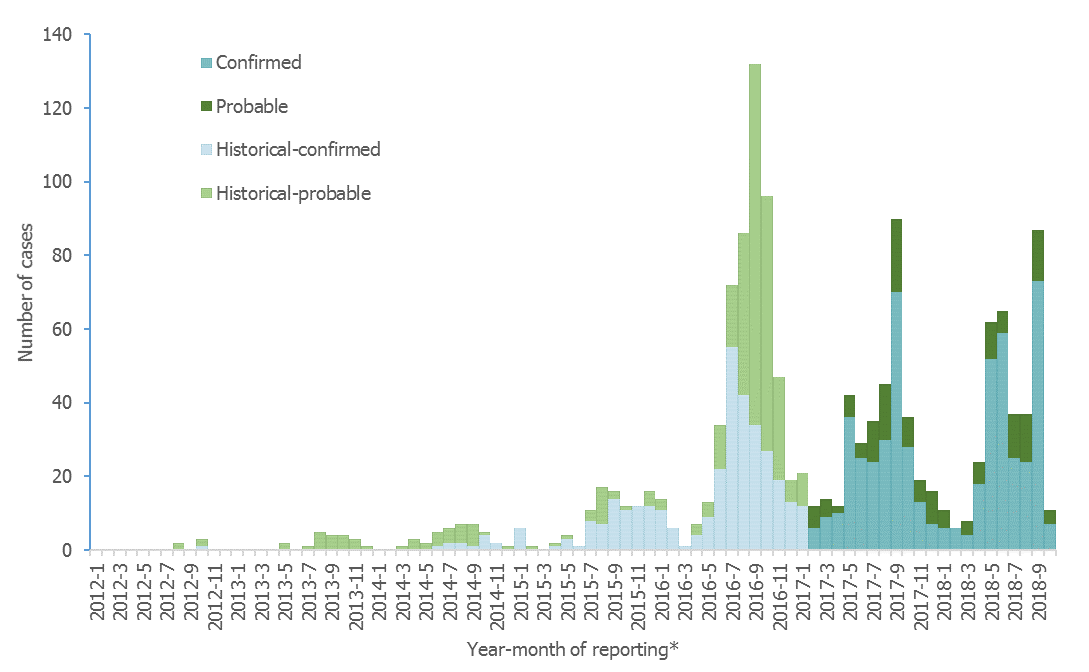
Most outbreak cases were reported during the summer months (Figure 1). Due to reporting delays, additional cases are expected to be reported with onset in recent months.

A total of 112 confirmed or historical-confirmed cases were reported with travel history in an EU country during the incubation period and therefore were likely infected there. Countries where infections likely took place were Poland (25 cases identified from 2016 to 2018), Bulgaria (22 cases from 2015 to 2018), Cyprus (14 cases in 2016 and 2018), Portugal (11 cases from 2015 to 2017) and Hungary (10 cases from 2016 to 2018). Additional travel-associated cases were also reported (<10 cases per country) with travel history to Austria, Belgium, Greece, Italy, the Netherlands, Romania, Slovenia and Spain.

Figure 1. Distribution of cases by month of onset* and case classification (n=1 412; 4 cases missing any date of report), EU/EEA, January 2012 to October 2018, as of 12 November 2018

Salmonella Enteritidis - Distribution of cases by month of onset* and case classification (n=1 412; 4 cases missing any date of report), EU/EEA, January 2012 to October 2018, as of 12 November 2018
 *: month of sampling or month of receipt by the reference laboratory if month of onset is not available.

The 2016 and 2017 European outbreak investigations identified eggs originating from Poland as the vehicle of infection in this outbreak (ECDC/EFSA rapid outbreak assessments published in March and December 2017). Outbreak-confirmed cases belong to four different WGS clusters.

Assessment

As reported in the previous ECDC/EFSA rapid outbreak assessment, in 2016 and 2017, evidence from epidemiological, microbiological, environmental and tracing investigations identified eggs originating from Poland as the vehicle of infections in this multi-strain outbreak. Control measures were implemented following these investigations. However, new outbreak cases were notified in 2017 and in 2018 with similar magnitude and temporal patterns. Based on the analysis of the travel-associated cases, it is likely that more countries where molecular typing is not performed routinely for human S. Enteritidis isolates are affected by the outbreak, including Bulgaria, Cyprus and Portugal.

Actions

ECDC monitors the occurrence of human cases associated with this threat and offers sequencing services for countries reporting probable cases of human S. Enteritidis isolates with MLVA profile 2-9-7-3-2 or 2-9-6-3-2 or
2-9-10-3-2 or 2-10-6-3-2 or 2-10-8-3-2 or 2-11-8-3-2. EU/EEA countries should consider interviewing new outbreak-confirmed cases.

Research – Inactivation of Listeria monocytogenes, Staphylococcus aureus, and Salmonella enterica under High Hydrostatic Pressure: A Quantitative Analysis of Existing Literature Data

Journal of Food Protection

ABSTRACT

High hydrostatic pressure processing (HPP) is a mild preservation technique, and its use for processing foods has been widely documented in the literature. However, very few quantitative synthesis studies have been conducted to gather and analyze bacterial inactivation data to identify the mechanisms of HPP-induced bacterial inactivation. The purpose of this study was to conduct a quantitative analysis of three-decimal reduction times (t) from a large set of existing studies to determine the main influencing factors of HPP-induced inactivation of three foodborne pathogens (Listeria monocytogenes, Staphylococcus aureus, and Salmonella enterica) in various foods. Inactivation kinetics data sets from 1995 to 2017 were selected, and t values were first estimated by using the nonlinear Weibull model. Bayesian inference was then used within a metaregression analysis to build and test several models and submodels. The best model (lowest error and most parsimonious) was a hierarchical mixed-effects model including pressure intensity, temperature, study, pH, species, and strain as explicative variables and significant factors. Values for t and ZP associated with inactivation under HPP were estimated for each bacterial pathogen, with their associated variability. Interstudy variability explained most of the variability in t values. Strain variability was also important and exceeded interstudy variability for S. aureus, which prevented the development of an overall model for this pathogen. Meta-analysis is not often used in food microbiology but was a valuable quantitative tool for modeling inactivation of L. monocytogenes and Salmonella in response to HPP treatment. Results of this study could be useful for refining quantitative assessment of the effects of HPP on vegetative foodborne pathogens or for more precisely designing costly and labor-intensive experiments with foodborne pathogens.

HIGHLIGHTS
  • A meta-analysis was performed to identify factors influencing HPP inactivation of pathogens.

  • Three-decimal reduction times following HPP were estimated from existing data.

  • Staphylococcus aureus is the most piezoresistant of the three pathogens studied.

  • These three foodborne pathogens are less HPP resistant in acidic products.

Research – Culture-Independent Evaluation of Bacterial Contamination Patterns on Pig Carcasses at a Commercial Slaughter Facility

Journal of Food Protection

ABSTRACT

Traditionally, the microbiological status of meat is determined by culture-based techniques, although many bacteria are not able to grow on conventional media. The aim of this study was to obtain quantitative data on total bacterial cell equivalents, as well as taxa-specific abundances, on carcass surfaces during pig slaughter using quantitative real-time PCR. We evaluated microbial contamination patterns of total bacteria, Campylobacter, Escherichia coli, Lactobacillus group, Listeria monocytogenes, Salmonella, and Pseudomonas species throughout slaughtering and on different carcass areas. In addition, we compared contamination levels of breeding sow carcasses with fattening pig carcasses, and we assessed the efficacy of carcass polishing machines under two water amount conditions. Our results demonstrate that relevant meat-spoilage organisms show similar contamination patterns to total bacteria. The highest bacterial load was detected in the stunning chute (4.08 × 10⁵ bacterial cell equivalents per cm2) but was reduced by 3 log levels after singeing and polishing (P < 0.001). It increased again significantly by a 4.73-fold change until the classification step. Levels of Campylobacter, Lactobacillus, and Pseudomonas species and of E. coli followed a similar trend but varied between 0 and 2.49 × 10⁴ bacterial cell equivalents per cm2. Microbial levels did not vary significantly between sampled carcass areas for any analyzed taxa. Running the polishing machine with a low water amount proved to be less prone to microbial recontamination compared with a high water amount (17.07-fold change, P = 0.024). In the studied slaughterhouse, slaughter of breeding sows did not produce microbiologically safe meat products (>104 cells per cm2) and the implementation of specific hazard analysis critical control point systems for the slaughter of breeding sows should be considered. A larger cohort from different abattoirs is needed to confirm our results and determine whether this is universally valid.

HIGHLIGHTS
  • Spoilage bacteria maintain consistent populations throughout slaughtering.

  • Greater water volume during polishing creates higher bacterial populations on carcasses.

  • Microbial populations on breeding sows are higher compared with fattening pigs.

USA – Norovirus most common foodborne pathogen in 2017

Barf Blog

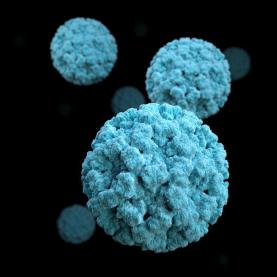
Food Borne Illness - Norovirus -CDC Photo

Image CDC

The Centers for Disease Control and Prevention (CDC) late last week released a summary of foodborne illnesses in 2017 based on an annual analysis of data from the Foodborne Disease Outbreak Surveillance System, and Norovirus was the most common pathogen reported, responsible for 46% of illnesses. Salmonella and Shiga toxin–producing Escherichia coli were also linked to a substantial number of outbreaks.  

In 2017, the CDC tracked 841 foodborne outbreaks, which included 14,481 illnesses, 827 hospitalizations, 20 deaths, and 14 food product recalls. A single etiologic agent was confirmed in 395 outbreaks (47%), which are defined as two or more related cases.