Category Archives: Salmonella

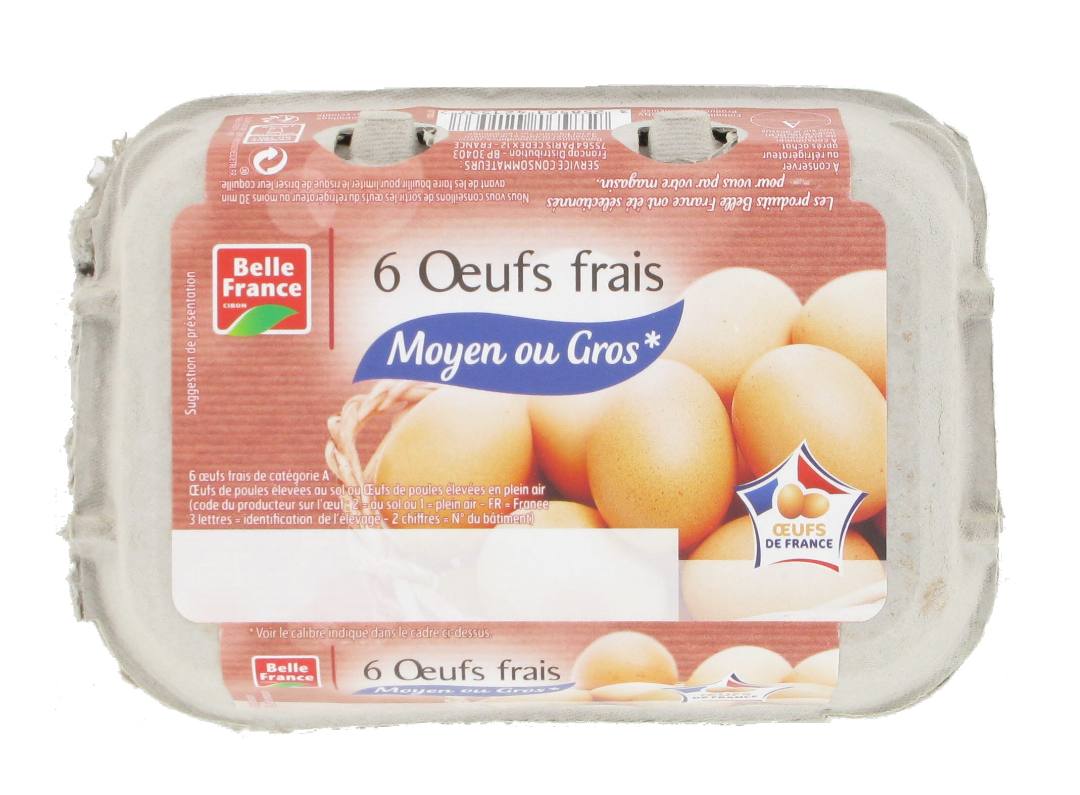
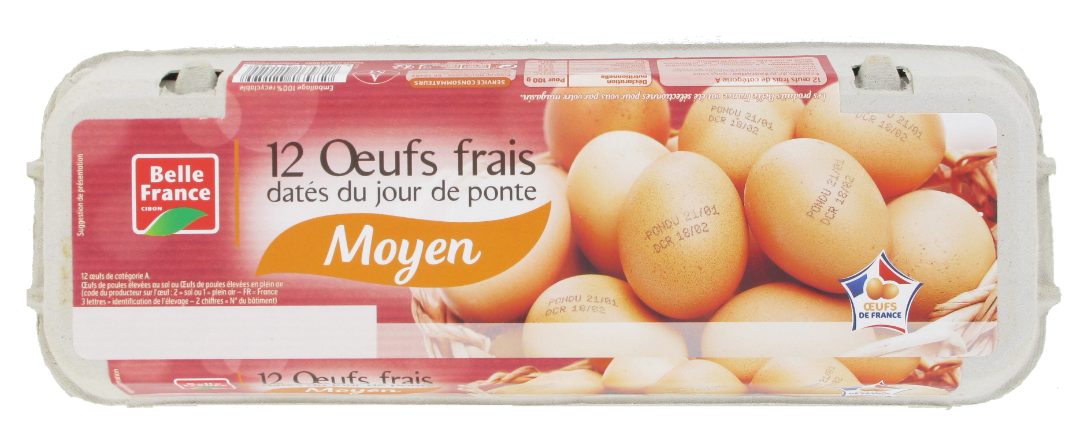
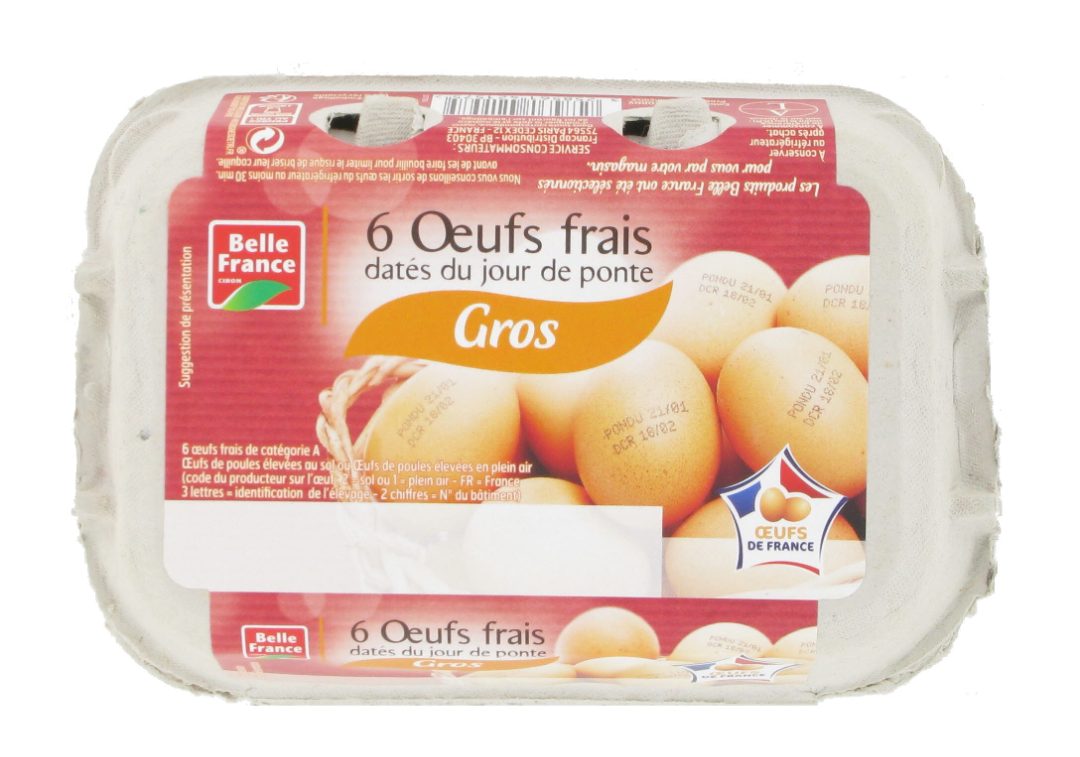
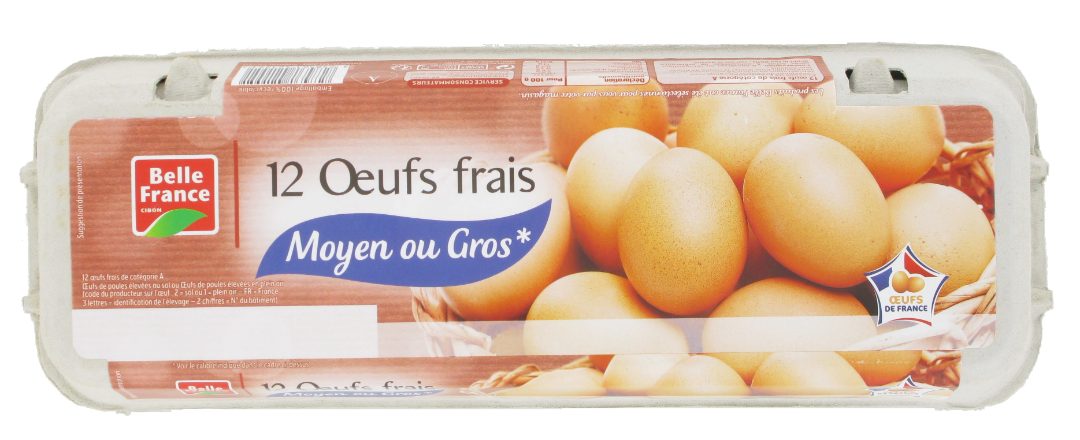
France – Belle France shell eggs – Salmonella

Gov france

Identification information of the recalled product

  • Product category Feed
  • Product subcategory Eggs and egg products
  • Product brand name BEAUTIFUL FRANCE
  • Model names or references12 fresh eggs raised on the floor medium or large Belle France 6 fresh eggs raised on the floor medium or large Belle France 12 fresh eggs dated the day of laying medium Belle France 6 fresh eggs dated the day of lay large Belle France
  • Identification of products
    GTIN Date
    3258561421551 Use-by date 05/28/2022
    3258561421551 Use-by date 06/03/2022
    3258561421537 Use-by date 06/03/2022
    3258561421537 Use-by date 09/06/2022
    3258561421599 Use-by date 06/03/2022
    3258561421599 Use-by date 09/06/2022
    3258561421575 Use-by date 06/03/2022
    3258561421575 Use-by date 09/06/2022
  • Marketing start/end date From 06/03/2022 to 06/16/2022
  • Storage temperature Product to be stored at room temperature
  • Geographic area of ​​sale Whole France
  • Distributors Ladybug; Cocci Market; Cool Basket; Rapid’Market; independent convenience stores

Practical information regarding the recall

  • Reason for recall Presence of Salmonella Enteritidis
  • Risks incurred by the consumer Salmonella spp (causative agent of salmonellosis)

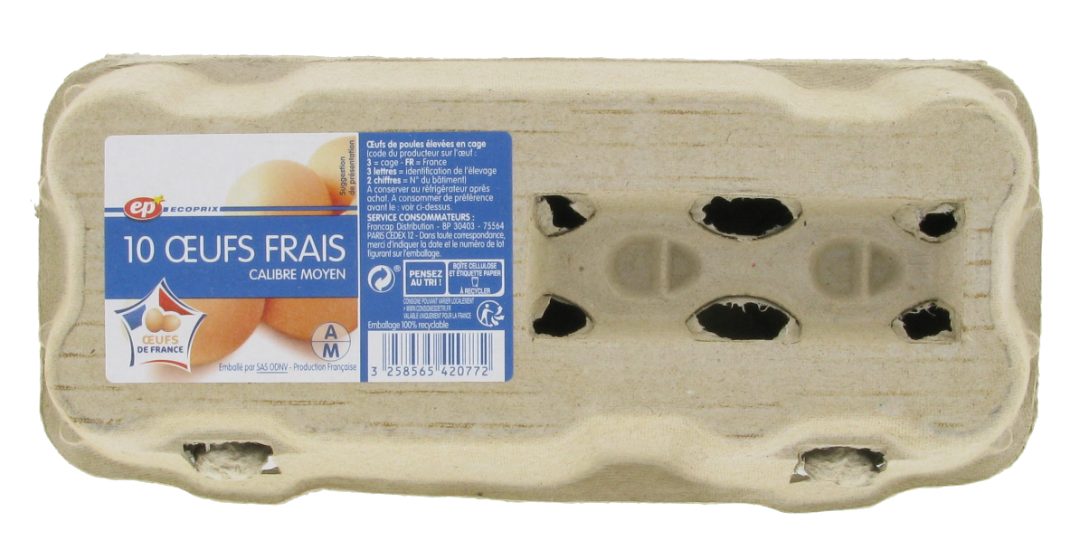
France – ECOPRIX shell eggs – Salmonella

Gov france

Identification information of the recalled product

  • Product category Feed
  • Product subcategory Eggs and egg products
  • Product brand name ECOPRICE
  • Model names or references10 medium fresh eggs ECOPRIX 10 fresh eggs raised on the floor ECOPRIX
  • Identification of products
    GTIN Date
    3258565420772 Use-by date 06/24/2022
    3258565420796 Use-by date 06/25/2022
    3258565420796 Use-by date 01/07/2022
  • Marketing start/end date From 06/03/2022 to 06/16/2022
  • Storage temperature Product to be stored at room temperature
  • Geographic area of ​​sale Whole France
  • Distributors Ladybug; Cocci Market; Cool Basket; Rapid’Market; Independent convenience stores

Practical information regarding the recall

  • Reason for recall Presence of Salmonella Enteritidis
  • Risks incurred by the consumer Salmonella spp (causative agent of salmonellosis)

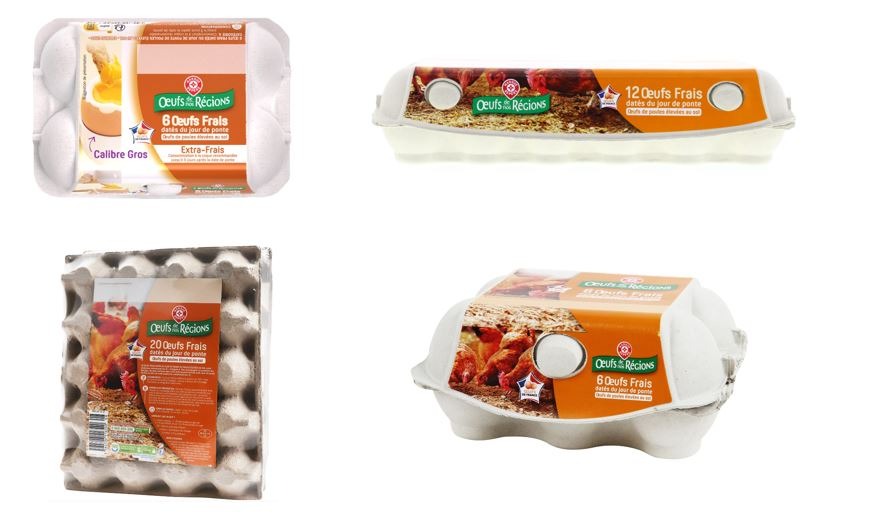
France – DAY-DATED EGGS FROM LAYING HENS FARMED ON THE FLOOR – Salmonella

Gov france

Identification information of the recalled product

  • Product category Feed
  • Product subcategory Eggs and egg products
  • Product brand name EGGS FROM OUR REGIONS
  • Model names or references DAY-DATED EGGS FROM LAYING HENS FARMED ON THE FLOOR
  • Identification of products
    GTIN Batch
    3564706542556 See list of DCRs and lots attached
    3564706516564 See list of DCRs and lots attached
    3564706516540 See list of DCRs and lots attached
    3564706516557 See list of DCRs and lots attached
  • Products List Poster_reminder_ODNV_Marque_Repère.pdf Attachment
  • Packaging BOXES OF 6, 12 or 20 EGGS
  • Marketing start/end date From 30/05/2022 to 24/06/2022
  • Storage temperature Product to be stored in the refrigerator
  • Health mark FR 78.263.001
  • Further information For barcodes, see the attachment which specifies the 2 additional digits following the barcode to identify the products.
  • Geographic area of ​​sale Whole France
  • Distributors E.LECLERC

Practical information regarding the recall

  • Reason for recall Risk of presence of Salmonella
  • Risks incurred by the consumer Salmonella spp (causative agent of salmonellosis)

France – 10 FRESH EGGS FROM FLOOR HEN – Salmonella

Gov france

Identification information of the recalled product

  • Product category Feed
  • Product subcategory Eggs and egg products
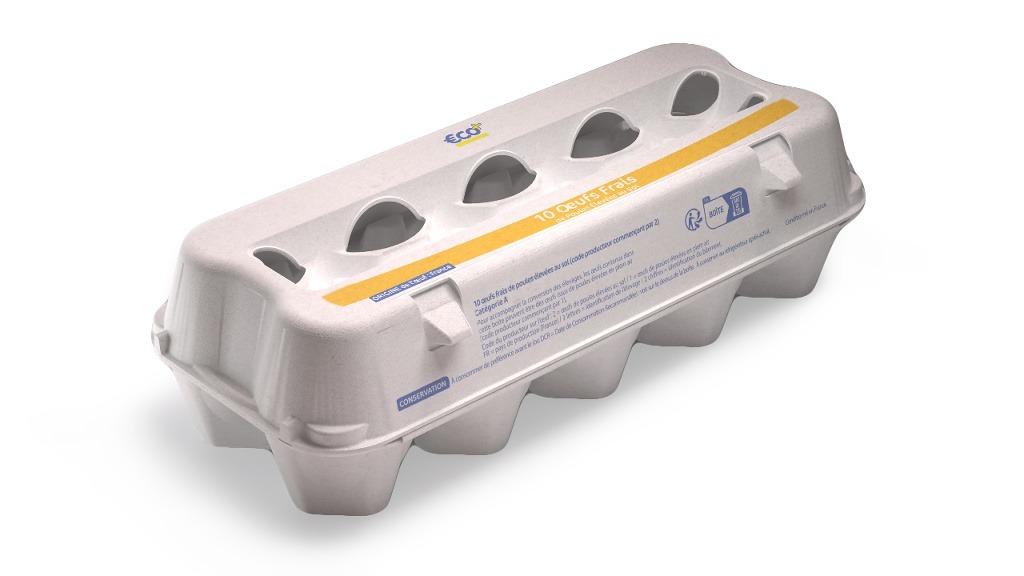
  • Product brand name ECO +
  • Model names or references10 FRESH EGGS FROM FLOOR HEN
  • Identification of products
    GTIN Batch
    3450970169103 See list of DCRs and lots attached
  • Products List Poster_reminder_ODNV_ECO_.pdf Attachment
  • Packaging BOXES OF 10 EGGS
  • Marketing start/end date From 06/01/2022 to 06/24/2022
  • Storage temperature Product to be stored in the refrigerator
  • Health mark FR 78.263.001
  • Further information Only products bearing the additional code 01 following the barcodes are affected by the recall.
  • Geographic area of ​​sale Whole France
  • Distributors E.LECLERC

Practical information regarding the recall

  • Reason for recall Risk of presence of Salmonella
  • Risks incurred by the consumer Salmonella spp (causative agent of salmonellosis)

France – Eggs – Salmonella

Gov france

Identification information of the recalled product

  • Product category Feed
  • Product subcategory Eggs and egg products
  • Product brand name harness
  • Model names or references ALL EGGS BEARING AS DCR DATE FROM 06/21/22 TO 07/14/22
  • Identification of products
    GTIN Batch Date
    3700468700357 All lots Recommended best before date between 06/21/2022 and 07/14/2022
  • Packaging BOX OF 6 EGGS AND TRAYS OF 30 EGGS
  • Marketing start/end date From 05/24/2022 to 06/10/2022
  • Storage temperature Product to be stored in the refrigerator
  • Health markFR28.324.001
  • Geographic area of ​​sale Departments: EURE-ET-LOIR (28)
  • DistributorsG20 COURVILLE SUR EURE

Practical information regarding the recall

  • Reason for recall SALMONELLA
  • Risks incurred by the consumer Salmonella spp (causative agent of salmonellosis)

Research – Temporal changes in the proportion of Salmonella outbreaks associated with twelve food commodity groups in the United States

Cambridge Org

kswfoodworld Salmonella

Abstract

Using data from twenty years of Salmonella foodborne outbreaks, this study investigates significant trends in the proportion of outbreaks associated with twelve broad commodity groups. Outbreak counts are demonstrated to have a stronger trend signal than outbreak illness counts.

The number of outbreaks with an identified food vehicle increased significantly between 1998 and 2000. This was followed by a 10-year period when the number of outbreaks decreased. The number of outbreaks increased significantly between 2010 and 2014 and then remained unchanged for the remainder of the study period.

During the period of 1998 through 2017, the proportion of outbreaks for three commodities groups, consisting of eggs, pork, and seeded vegetables, changed significantly. No significant changes were observed in the remaining nine commodity groups. Simple approximations are derived to highlight the effect of dependencies between outbreak proportions and a consumption analysis for meat and poultry is used to enhance the limited interpretability of the changes in these proportions.

Given commodity-specific approaches to verifying food safety and promoting pathogen reduction, regulatory agencies benefit from analyses that elucidate illness trends attributable to the products under their jurisdiction. Results from this trend analysis can be used to inform the development and assessment of new pathogen reduction programs in the United States.

Research – Interlaboratory Evaluation of Enterococcus faecium NRRL B-2354 as a Salmonella Surrogate for Validating Thermal Treatment of Multiple Low-Moisture Foods

Journal of Food Protection

This multi-institutional study assessed the efficacy of Enterococcus faecium NRRL B-2354 as a non-pathogenic Salmonella surrogate for thermal processing of nonfat dry milk powder, peanut butter, almond meal, wheat flour, ground black pepper, and date paste. Each product was analyzed by two laboratories (five independent laboratories total), with the lead laboratory inoculating (E. faecium or a five-strain Salmonella enterica cocktail of S. Agona, Reading, Tennessee, Mbandaka, Montevideo) and equilibrating the product to the target water activity before shipping. Both laboratories subjected samples to three isothermal treatments (between 65 and 100°C). A log-linear/Bigelow model was fit to survivor data via one-step regression. Based on D80°C  values estimated from the combined model, E. faecium was more thermally resistant (P < 0.05) than Salmonella in ), nonfat dry milk powder (DEf-80°C: 100.2 ± 5.8 min; DSal-80°C: 28.9 ± 1.0 min), peanut butter (DEf-80°C: 133.5 ± 3.1 min; DSal-80°C: 57.6 ± 1.5 min), almond meal (DEf-80°C: 34.2 ± 0.4 min; DSal-80°C: 26.1 ± 0.2 min), ground black pepper (DEf-80°C: 3.2 ± 0.8 min; DSal-80°C: 1.5 ± 0.1 min), and date paste (DEf-80°C: 1.5 ± 0.0 min; DSal-80°C: 0.5 ± 0.0 min). Although the combined-laboratory D80°C for E. faecium was lower (P < 0.05) than for Salmonella in wheat flour (DEf-80°C: 9.4 ± 0.1 min; DSal-80°C: 10.1 ± 0.2 min), the difference was ~7%. The zT-values for Salmonella in all products and for E. faecium in milk powder, almond meal, and date paste were not different (P > 0.05) between laboratories. Therefore, this study demonstrated the impact of standardized methodologies on repeatability of microbial inactivation results. Overall, E. faecium NRRL B-2354 was  more thermally resistant than Salmonella, which provides support for utilizing E. faecium as a surrogate for validating thermal processing of multiple low-moisture products. However, product composition should always be considered before making that decision.

Research – New NARMS report shows rising resistance in Salmonella, Campylobacter

CIDRAP

The findings come from the National Antimicrobial Resistance Monitoring Systems (NARMS) 2019 Integrated Summary, which combines data from the Centers for Disease Control and Prevention (CDC), the Food and Drug Administration (FDA), and the US Department of Agriculture (USDA). The report provides a snapshot of resistance patterns found in bacteria isolated from humans, animals, raw meats from retail outlets (chicken, ground turkey, ground beef, and pork chops), and meat and poultry product samples collected at slaughtering facilities.

In addition to Salmonella, which causes an estimated 1.35 million illnesses and 26,500 hospitalizations each year, the NARMS report also includes resistance data on Campylobacter (1.5 million illnesses and 19,500 hospitalizations), Escherichia coli, and Enterococcus. NARMS monitors these bacteria to detect emerging resistance patterns to the antibiotics that are most important to human medicine, multidrug resistance, and specific resistance genes.

USA – Outbreak Investigation of Salmonella: Peanut Butter (May 2022)

FDA

The FDA, along with CDC and state and local partners, are investigating a multistate outbreak of Salmonella Senftenberg infections linked to certain Jif brand peanut butter products produced at the J.M. Smucker Company facility in Lexington, Kentucky.

J.M. Smucker Company has voluntarily recalled certain Jif brand peanut butter products that have the lot codes described below. Photo examples are included below.

FDA has posted a list of additional recalls being conducted by companies that have used the recalled Jif peanut butter as an ingredient in the manufacturing of a new product (e.g., chocolate products) or in repackaging the product (e.g., snack cups). This list will be updated as the agency receives notification of new recalls.

In addition, USDA has issued a recall on ready-to-eat Super Asian Chicken Salads that were made with recalled Jif peanut butter and sold at an Amazon Go retail location in Washington state.

As of May 25, 2022, CDC reports that of the 10 people interviewed, 10 (100%) reported eating peanut butter prior to becoming ill. Nine people reported brand information, and all nine (100%) reported eating different varieties of Jif brand peanut butter.

FDA’s investigation is ongoing and more information will be provided as it becomes available.

Recommendation

Consumers, restaurants, and retailers should not eat, sell, or serve any recalled Jif brand peanut butter, including recalled products that contain the recalled Jif peanut butter. Consumers should also avoid feeding recalled peanut butter to pets or other animals, including wild birds.

For Consumers

Follow these steps:

  1. Check if you have Jif peanut butter in your home.
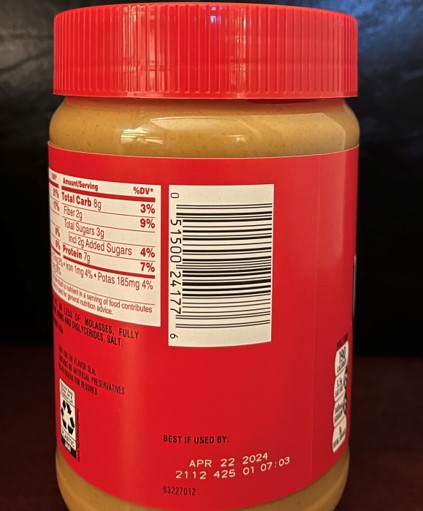
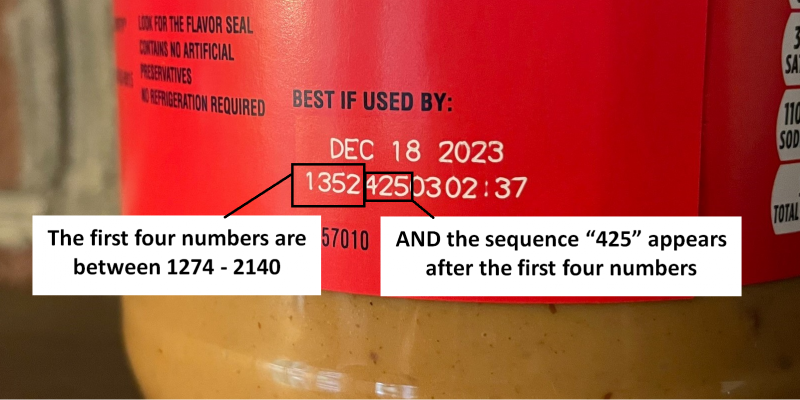
  2. Locate the lot code on the back of the jar, under the Best If Used By Date (the lot code may be next to the Best If Used By Date for cups or squeeze pouches).
  3. In the lot code, if the first four digits are between 1274 and 2140, and if the next three numbers after that are ‘425’, this product has been recalled and you should not consume this product. An example is below.

If you are unsure what to do with your recalled product, you can call or email J.M. Smucker Company for more information:

The J.M. Smucker Co. Hotline: 800-828-9980
Website: jif.com/contact-usExternal Link Disclaimer

FDA recommends that if you have used the recalled Jif brand peanut butter that have lot code numbers 1274425 through 2140425 and the first seven digits end with 425, you should wash and sanitize surfaces and utensils that could have touched the peanut butter. If you or someone in your household ate this peanut butter and have symptoms of salmonellosis, please contact your healthcare provider.

For Retailers, Re-packers, and Manufacturers

In addition to the steps above, FDA recommends referring to the firm’s recall press for the UPC codes and other retailer information. Do not sell or serve recalled peanut butter or products containing recalled peanut butter.

Product Images

Outbreak Investigation of Salmonella in Peanut Butter (May 2022) - Sample Recalled Product Label
Outbreak Investigation of Salmonella in Peanut Butter (May 2022) - Sample Label

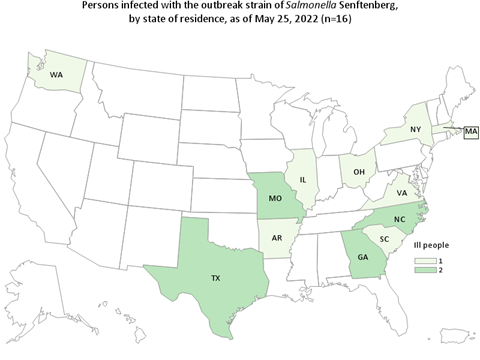
Case Count Map Provided by CDC

Outbreak Investigation of Salmonella in Peanut Butter (May 2022) - CDC Case Count Map as of May 25, 2022

Case Counts

Total Illnesses: 16
Hospitalizations: 2
Deaths: 0
Last Illness Onset: May 2, 2022
States with Cases: AR (1), GA (2), IL (1), MA (1), MO (2), OH (1), NC (2), NY (1), SC (1), TX (2), VA (1), WA (1)
Product Distribution: Nationwide and International (see below)

International Distribution for Recalled Products

The recall impacts markets outside of the U.S.

Customer information provided by J.M. Smucker on May 23, 2022 shows that it was distributed to the following countries and locations: Canada, Dominican Republic, Singapore, Malaysia, Taiwan, Korea, Thailand, Honduras, Spain, Japan.

For additional information, international officials and customers can visit the company’s recall page.

USA – FDA Core Investigation Table Update

FDA

Date
Posted
Ref Pathogen or
Cause of Illness

Product(s)
Linked to
Illnesses

(if any)
Total
Case Count

Status
6/22/

2022

1075 Salmonella
Braenderup
Not Yet Identified 40 Active
6/22/

2022

1072 Salmonella
Paratyphi B var. L(+) tartrate+
Not Yet Identified 13 Active
6/15/

2022

1070 Listeria
monocytogenes
Not Yet Identified 12 Active
6/8/

2022

1068 E. coli
O157:H7
Not Yet Identified 10 Active
6/1/

2022

1066 Hepatitis A Virus Strawberries See Outbreak
Advisory
Active
5/25/

2022

1067 Salmonella 
Senftenberg
Peanut Butter See Outbreak Advisory Active
4/20/

2022

1064 Not Yet
Identified
Dry Cereal 558 adverse
event reports
Active
4/13/

2022

1057 Listeria
monocytogenes
Not Yet
Identified
21 Active
3/30/

2022

1060 None
Identified
Meal Replacement
Drink
6 adverse
event reports
Closed
3/16/

2022

1055 Salmonella
Saintpaul
Not Identified 60 Closed
2/17/

2022

1056 Cronobacter
sakazakii
Powdered
Infant
Formula
See
Advisory
Active (IMG)
2/9/

2022

1040 Listeria
monocytogenes
Not Identified 20 Closed
2/2/

2022

1054 Enteroinvasive
E. coli
O143:H26
Not
Identified
16 Closed
1/10/2022 1050 E. coli
O121:H19
Romaine 4 Closed