Category Archives: Research

Research – Nisin-based antimircobial combination with cold plasma treatment inactivate Listeria monocytogenes on Granny Smith apples

Science Direct

Abstract

A nisin-based antimicrobial and cold plasma combination treatments in reducing Listeria monocytogenes inoculated on apple surfaces purchased from a New Jersey farm and a supermarket in Philadelphia area was investigated. All apples were spot inoculated or by submersion in 107 CFU/ml L. monocytogenes inoculum. Populations of L. monocytogenes recovered on farm and supermarket apples after spot inoculation averaged 5.8 ± 0.24 log CFU/g and 4.6 ± 0.12 log CFU/g, respectively and 4.1 ± 0.22 log CFU/g and 3.6 ± 0.12 log CFU/g, respectively on submerged apples. All apples were treated with antimicrobial solution for 30 s, 40 s, 3 min (180s) and 1 h (3600 s), cold plasma treatments for 30 and 40s, and a combination of antimicrobial and cold plasma treatments and the surface structure of apples were examined using scanning electron microscopy (SEM). Cold plasma treatment at 40s, followed immediately with antimicrobial treatments at 180s and 3600 s led to 2.5 and 4.6 log CFU/g inactivation of L. monocytogenes, respectively. SEM observation showed changes on apple surface structures but not on bacterial cell structure. This result suggests that this combination treatments is effective in killing L. monocytogenes on apple surfaces.

Research – Heatwave-associated Vibrio infections in Germany, 2018 and 2019

Eurosurveillance

Food Illness

The genus , which belongs to the family  and the class , includes many species that are potential human pathogens [1].  is a highly diverse species that consists of more than 200 serogroups [2]. Strains within the serogroups O1 and O139 produce cholera toxin and are the causative agents of endemic and epidemic cholera, which represent an important cause of morbidity and mortality in countries with inadequate access to clean water and sanitation facilities [3].  strains not included in these serogroups as well as other  spp. are referred to as non-cholera  spp. and are ubiquitous aquatic bacteria with a worldwide distribution, especially in warm estuarine and marine ecosystems [2]. These halophilic bacteria prefer low to moderate salinity (less than 25 parts per thousand (ppt) NaCl) [4]. The abundance of  spp. in marine and estuarine waters closely corresponds with the sea surface temperatures (SSTs) since they proliferate in warm water [5]. Thus, regional variations in environmental conditions are paramount importance in understanding the ecology of  spp.

Human infections with non-cholera  spp. can manifest as wound infections, ear infections, gastroenteritis, and primary septicaemia and have been predominantly reported in tropical and subtropical regions [6]. In Europe, cases are rare, and infections associated with the Mediterranean Sea [79], the Atlantic Ocean [1012], or the Baltic Sea [13,14] have only been sporadically reported. However, a rapidly warming marine environment accompanied by an increase in extreme weather events such as heatwaves has resulted in unprecedented peak SSTs favouring the spread of  spp. worldwide. Recently, larger  spp. outbreaks have been reported in temperate regions such as Spain [15], Sweden, and Finland [16]. In Germany,  spp. other than toxigenic  strains were not classified as reportable pathogenic agents before March 2020; to date, only a few cases have been reported and few case series of autochthonous infections have been published [1720]. Over the last decades, resistance to various antibiotics, including to ampicillins, tetracyclines, and carbapenems, has emerged among  spp [21,22]. As a result of resistant isolates, the monitoring of antibiotic profiles of clinical and environmental  spp. has become of increasing importance. However, information on the number of human cases and the abundance of  spp. in coastal waters is scarce in most other European countries.

When we became aware of a high number of human infections with virulent  strains contracted in the Baltic Sea during the summer months of 2018 and 2019 (data not shown), we decided to conduct an observational retrospective multi-centre cohort study of domestically-acquired  infections. This study describes the epidemiology and the clinical impact of those infections and assesses antibiotic resistance patterns and phylogenetic relationships among clinical isolates. To determine the association between  infections and SST anomalies, we analysed the degree of warming in the south-western Baltic Sea, where the majority of the infections occurred.

Research – Use of Acetic Acid to Partially Replace Lactic Acid for Decontamination against Escherichia coli O157:H7 in Fresh Produce and Mechanism of Action

MDPI

Escherichia coli O157:H7 is frequently detected in ready-to-eat produce and causes serious food-borne diseases. The decontamination efficacy of lactic acid (LA) is clearly established. In this study, LA was mixed with acetic acid (AA) to reduce costs while achieving consistent or better inhibitory effects. Time-kill curves and inoculation experiments using fresh-cut spinach and arugula indicated that 0.8%LA+0.2%AA shows similar antibacterial effects to those of 1%LA. To determine whether 1%LA and 0.8%LA+0.2%AA exert antibacterial effects by similar mechanisms, proteomics analysis was used. The proteins related to macromolecule localization, cellular localization, and protein unfolding were uniquely altered after the treatment with 1%LA, and the proteins related to taxis, response to stress, catabolic process, and the regulation of molecular function were uniquely altered after the treatment with 0.8%LA+0.2%AA. Based on these findings, combined with the results of a network clustering analysis, we speculate that cell membrane damage is greater in response to LA than to 0.8%LA+0.2%AA. This prediction was supported by cell membrane permeability experiments (analyses of protein, nucleotide, ATP, and alkaline phosphatase leakage), which showed that LA causes greater membrane damage than 0.8%LA+0.2%AA. These results provide a theoretical basis for the application of an acid mixture to replace LA for produce decontamination. View Full-Text

Research – Application of Whole Genome Sequencing to Understand Diversity and Presence of Genes Associated with Sanitizer Tolerance in Listeria monocytogenes from Produce Handling Sources

MDPI

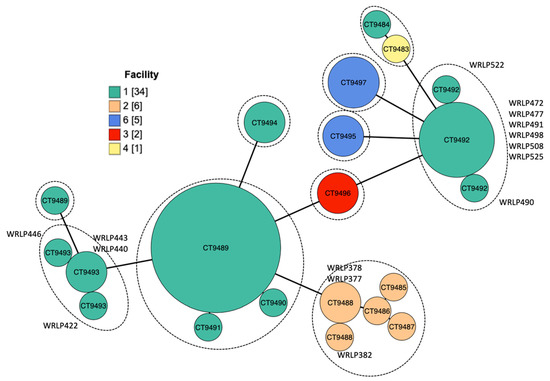
Recent listeriosis outbreaks linked to fresh produce suggest the need to better understand and mitigate L. monocytogenes contamination in packing and processing environments. Using whole genome sequencing (WGS) and phenotype screening assays for sanitizer tolerance, we characterized 48 L. monocytogenes isolates previously recovered from environmental samples in five produce handling facilities. Within the studied population there were 10 sequence types (STs) and 16 cgMLST types (CTs). Pairwise single nucleotide polymorphisms (SNPs) ranged from 0 to 3047 SNPs within a CT, revealing closely and distantly related isolates indicative of both sporadic and continuous contamination events within the facility. Within Facility 1, we identified a closely related cluster (0–2 SNPs) of isolates belonging to clonal complex 37 (CC37; CT9492), with isolates recovered during sampling events 1-year apart and in various locations inside and outside the facility. The accessory genome of these CC37 isolates varied from 94 to 210 genes. Notable genetic elements and mutations amongst the isolates included the bcrABC cassette (2/48), associated with QAC tolerance; mutations in the actA gene on the Listeria pathogenicity island (LIPI) 1 (20/48); presence of LIPI-3 (21/48) and LIPI-4 (23/48). This work highlights the potential use of WGS in tracing the pathogen within a facility and understanding properties of L. monocytogenes in produce settings. View Full-Text

Research – Healthcare-associated foodborne outbreaks in high-income countries: a literature review and surveillance study, 16 OEDC countries, 2001 to 2019

Eurosurveillance

Yearly, 23 million foodborne disease illnesses and 5,000 deaths are estimated in the World Health Organization (WHO) European Region, and 41 foodborne Disability Adjusted Life Years (DALYs) per 100,000 population were estimated for the WHO Sub-Region EUR A in 2010 [1]. In Europe, a total of 5,146 foodborne and waterborne outbreaks, including 48,365 cases of illness and 40 deaths were reported to the European Food Safety Authority (EFSA) in 2018 [2]. Vulnerable populations, including elderly patients, immunocompromised patients, children younger than five years old and pregnant women are more susceptible to foodborne infections and are more prone to develop severe courses of disease compared with healthy people [3]. Therefore, healthcare is a setting where foodborne outbreaks (FBO) can cause considerable morbidity and mortality. In 2020, 20.6% of the European Union (EU) population was aged 65 years and older [4]. As the proportion of elderly people is projected to further increase, the share of the vulnerable population as patients in healthcare facilities (HCF) is likely to increase and thereby the risk associated with healthcare-associated foodborne outbreaks (HA-FBO). Personnel (medical and non-medical staff, food handlers etc) of HCF may also be at risk for HA-FBO and be a source of further spread in healthcare settings and elsewhere. This can cause major disruption of services [5].

So far, literature reviews have covered pathogens responsible for HA-FBO, including  [6],  [79] and norovirus [10,11] and focused on microbiological food safety issues in healthcare settings [5,12]. Between 2014 and 2019, a listeriosis outbreak in Germany affected 13 cases who had an inpatient stay in 12 different HCF during the incubation period [13]. In the United Kingdom (UK) in 2019, nine listeriosis cases of which seven died, had consumed sandwiches in seven HCF during the incubation period [14].

We conducted a literature review to describe the causative agents including bacteria, viruses, parasites and fungi, the incriminated food vehicles and other outbreak characteristics of HA-FBO in 37 countries that are members of the Organisation for Economic Cooperation and Development (OECD) [15]. Furthermore, we analysed German surveillance data and data from the EFSA on HA-FBO. The aim of this article is to describe the current status of HA-FBO in order to improve surveillance and provide public health recommendations for prevention.

UK – Retailer’s Campylobacter test results in maximum FSA category

Food Safety News

Marks and Spencer has recorded the highest Campylobacter in chicken results in the most recent quarterly figures reported in the United Kingdom.

The newest data covers April to June for nine retailers on Campylobacter in fresh, shop-bought UK-produced chickens.

For Marks and Spencer, 5 percent were in the maximum category in April, 9 percent in May, and 9 percent in June based on a sample of 376 chickens taken from store shelves across the United Kingdom. This compares to 2 percent above 1,000 CFU/g in January, 3 percent in February and 4 percent in March based on tests of 292 chickens.

The Food Standards Agency (FSA) maximum level is 7 percent of birds with more than 1,000 colony forming units per gram (CFU/g) of Campylobacter.

Waitrose has not updated its results from the first quarter of this year or provided them to Food Safety News when asked to do so. Levels at the supermarket for the previous quarter were zero percent in the above 1,000 CFU/g category.

Results of chickens in the highest contamination bracket went up for all other retailers except Tesco.

Research – O148 Shiga toxin-producing Escherichia coli outbreak: microbiological investigation as a useful complement to epidemiological investigation

Core

An outbreak of Shiga toxin-producingEscherichia coli(STEC) O148 infection occurred among weddingattendees in France in June 2002. A retrospective cohort study was performed and ten cases wereidentified, including two adults with haemolytic uraemic syndrome (HUS). The analytical studyrevealed that > 80%of affected individuals had eaten lightly roasted mutton and poultry paˆte ́, but onlythe consumption of paˆte ́tended to be associated with illness (relative risk 3.4; 95%CI 0.8–14.4). Left-overs (cooked mutton and raw offal) and processed foods (paˆte ́) from the same batches as served at theparty were sampled. Human, food and environmental samples were examined for the Shiga toxin (stx)gene and virulence traits by PCR.Stx-positive samples were cultured for STEC. HUS cases were testedfor serum antibodies against 26 major STEC serogroups. An STEC O26 strain (stx1,eae,ehxA) wasisolated from one case with diarrhoea, and an STEC O148 strain (stx2c) from one case of HUS. Serumantibodies against O26 were not detected in either of these patients; antibodies against O148 were nottested. Three STEC strains were isolated from the mutton and the offal (stx2c, O148), and two from thepaˆte ́(stx2c, O-X and O-Y). The isolates from the mutton were indistinguishable from the humanstx2cisolate, whereas the paˆte ́isolates differed. Although four different STEC strains were identified inpatients and foods, the results of molecular subtyping, in conjunction with analysis of food consumptionpatterns, strongly suggested that this outbreak was caused by mutton contaminated with STEC O148.

USA – Research- FSIS/USDA Outbreak Investigations: Response

FSIS USDA

During investigations, FSIS may respond by posting recalls of FSIS-regulated products linked to illness or by issuing public health alerts. Following outbreak investigations, FSIS conducts after-action reviews to identify, share, and apply lessons learned with public health, industry partners, and consumers to help prevent future illness and improve future outbreak response.

The Outcomes & References column includes links to recall notices, public health alerts, and after-action review reports, as well as CDC outbreak notices for selected multistate foodborne outbreaks, which provide additional information. For a list of all foodborne outbreaks reported to CDC since 1998, please use the CDC National Outbreak Reporting System Dashboard.

Outbreak Year Pathogen Product Outcomes & References Active
2021 Escherichia coli O157:H7 (E. coli) Beef, ground (suspect) No
2021 Salmonella Hadar Turkey, ground FSIS Public Notification: FSIS Issues Public Health Alert for Raw Ground Turkey Products Linked to Salmonella Hadar Illness

CDC Notice: Salmonella Outbreak Linked to Ground Turkey

No
2021 Salmonella Enteritidis Chicken, raw, frozen, breaded, stuffed FSIS Public Notification: Serenade Foods Recalls Frozen Raw Breaded Stuffed Chicken Products due to Possible Salmonella Enteritidis Contamination
FSIS Public Notification: FSIS Issues Public Health Alert for Frozen Raw Breaded Stuffed Chicken Products Due to Possible Salmonella Contamination

CDC Notice: Investigation Details | Salmonella Outbreak Linked to Raw Frozen Breaded Stuffe…

No

USA Research – National Outbreak Reporting System (NORS)

CDC

Use NORS Dashboard to search and access data from reports of foodborne and waterborne disease outbreaks and enteric (intestinal) disease outbreaks spread by contact with environmental sources, infected people or animals, and other means.

NORS

ECDC -Cryptosporidiosis – Annual Report 2018

Click to access CRYP_AER_2018_Report.pdf