Category Archives: Microbiology Risk

Research – Dangerous pathogens lurk in wet areas

Science Daily

Hospitals and homes are havens for germs and disease — but a well-regulated hot water system can prevent the spread of waterborne pathogens, including an emerging infectious disease problem from ‘superbugs’ which can be resistant to most antibiotics.

However, Flinders University experts warn that some drinking water treatment methods may be ineffective against some waterborne pathogens that pose a threat to immune-compromised individuals — and point-of-use devices such as taps and showerheads may create havens for these microorganisms to grow.

The elderly, newborns and those with compromised immune systems are especially vulnerable to waterborne infections. Numbers are rising of people with conditions such as advanced age, cancer and immunodeficiency issues who may be more at risk of ‘opportunistic premise plumbing pathogens’ (OPPP) infection.

Regular changes to tap and outlet filters, hot water service maintenance checks (for heat and pressure) and effective cleaning of shower and tap faucets are recommended for immune-compromised patients receiving healthcare at home or post-surgical management.

Healthcare at home has emerged as an alternative to extensive inpatient hospital stays — especially through the COVID-19 pandemic, to reduce the burden on the healthcare system and to support those with potential long term respiratory side effects.

“These measures can help reduce the risk of waterborne infections in home care, along with quality treatments of mains water to provide safe drinking water,” says lead researcher Claire Hayward, from Flinders University’s College of Science and Engineering.

A new study published in the journal Current Opinion in Infectious Diseases, by environmental health experts at Flinders University, found evidence of hospital water as a source of potential infection and even antimicrobial and multidrug resistant organisms.

“Biofilms formed on taps, showers, drains and other outlets provide an ideal niche to harbour these dangerous antibiotic resistant pathogens originating from the supply water or the human microbiota from washing contaminated hands,” says Ms Hayward.

OPPP infections such as Legionella pneumophila, Pseudomonas aeruginosa and Mycobacterium avium are a group of waterborne pathogens that are slowly receiving increased public health attention in infection control guidelines.

“However, drinking water as a source of healthcare-associated infections continues to be overlooked or underestimated in this monitoring,” Ms Hayward says.

The OPPP waterborne pathogens can be disinfectant resistant and persist in refuges with low nutrients, then form biofilms capable of supporting other clinically relevant pathogens such as Staphylococcus aureus, Enterobacteriaceae, Klebsiella pneumoniae and Escherichia coli.  

Once these biofilms are established on plumbing surfaces, there are many ways for contamination and transmission. The design of outlet devices that result in splashing and aerosolising of water can also increase the risk of contaminating nearby areas.

“The rise of these resistant pathogens has been identified by the World Health Organization and US Centers for Disease Control and Prevention as one of the most significant threats to global public health,” says research co-author, Flinders University microbiology expert Professor Melissa Brown.

“While the COVID-19 pandemic has increased the use of disinfectants and sanitisers, particularly in healthcare facilities, these antiseptic soaps do not tackle what’s going on behind the scenes in the water supply pipes and faucets,” she says.

The researchers recommend broad, universal surveillance guidelines to understand the role of drinking water and water-related devices to reduce healthcare associated infections and the rise of possible antimicrobial resistance that poses a threat to at risk individuals in residential and healthcare settings.

Belgium – Belgium reports large rise in foodborne illness outbreaks in 2021

Food Safety News

An additional 200 outbreaks were recorded in Belgium in 2021 versus the year before, according to the Federal Agency for the Safety of the Food Chain (FASFC).

There was a significant increase in the number of food poisoning outbreaks from 333 in 2020 to 547 in 2021. The number of people affected in them went from 1,262 with 27 hospitalizations and two deaths to 2,070 sick, 78 hospitalizations but no deaths in 2021.

FASFC, also known as AFSCA and FAVV, said it was important to remember 2020 was an exceptional year because of the closure of many food businesses caused by COVID-19 related restrictions.

Figures for the past year are still slightly lower than 2019, when 571 outbreaks were recorded and 2,457 people were affected.

The agent was unknown in 512 outbreaks with almost 1,700 illnesses in 2021, according to data from Sciensano, the national public health institute.

Read more at the link above.

USA – FDA Core Investigation Table

FDA

What’s New

  • For the Salmonella Senftenberg outbreak in Peanut Butter (ref# 1067), the outbreak status has ended and the investigation status is now closed.
  • A new outbreak has been added to the table: Cyclospora in a not yet identified food (ref #1084).
  • For the Salmonella Paratyphi B var. L(+) tartrate+ outbreak (ref# 1072) in a not yet identified food, the outbreak status has ended. FDA’s investigation status is still ongoing.
Date
Posted
Ref Pathogen or
Cause of Illness

Product(s)
Linked to
Illnesses

(if any)
Total
Case Count

Status
7/27/

2022

1084 Cyclospora Not Yet Identified 51 Active
6/29/

2022

1076 Not Yet Identified Frozen Food See Outbreak
Advisory
Active
6/22/

2022

1075 Salmonella
Braenderup
Not Yet Identified 70 Active
6/22/

2022

1072 Salmonella
Paratyphi B var. L(+) tartrate+
Not Yet Identified 14 Active
6/15/

2022

1070 Listeria
monocytogenes
Not Yet Identified 12 Active
6/8/

2022

1068 E. coli
O157:H7
Not Identified 10 Closed
6/1/

2022

1066 Hepatitis A Virus Strawberries See Outbreak
Advisory
Active
5/25/

2022

1067 Salmonella 
Senftenberg
Peanut Butter See Outbreak Advisory Closed
4/20/

2022

1064 Not Yet
Identified
Dry Cereal 558 adverse
event reports
Active
4/13/

2022

1057 Listeria
monocytogenes
Ice Cream See Outbreak Advisory Active
3/30/

2022

1060 None
Identified
Meal Replacement
Drink
6 adverse
event reports
Closed
3/16/

2022

1055 Salmonella
Saintpaul
Not Identified 60 Closed
2/17/

2022

1056 Cronobacter
sakazakii
Powdered
Infant
Formula
See
Advisory
Active (IMG)
2/9/

2022

1040 Listeria
monocytogenes
Not Identified 20 Closed
2/2/

2022

1054 Enteroinvasive
E. coli
O143:H26
Not
Identified
16 Closed
1/10/

2022

1050 E. coli
O121:H19
Romaine 4 Closed

India – 40 students fall sick after mid-day meal in AP

New Indian Express

KURNOOL: As many as 40 students of a Mandal Parishad upper primary school fell sick after reportedly eating mid-day meal on Tuesday. The school is located at Chakrala village in Pathikonda mandal of Kurnool district.All the students were immediately admitted to the Pathikonda government hospital, where the condition of five was stated to be critical.

According to reports, the authorised agency served mid-day meal to the students as usual in the afternoon. Out of the total strength of 220, 160 students had their lunch at the school. Later, they developed stomach ache, vomiting and motions.

Samples of water and food were collected for lab testing.

Canada – Canada sets regulations for some romaine grown in certain parts of California

Food Safety News

The Canadian Food Inspection Agency (CFIA) has announced the fall 2022 import requirements for U.S. romaine lettuce with special requirements for certain lettuce produced in California’s Salinas Valley.

Whole-head romaine lettuce and products containing romaine lettuce such as bagged salads that were produced in the four Salinas Valley counties of Santa Cruz, Santa Clara, San Benito, and Monterey must “submit an attestation form and Certificates of Analysis for each shipment to demonstrate that the romaine lettuce does not contain detectable levels of E. coli O157:H7,” according to the Canadian Food Inspection Agency (CFIA).

Denmark – Denmark searches for source of Salmonella outbreak

Food Safety News

kswfoodworld salmonella

Danish officials are trying to find the source of a Salmonella outbreak that has affected 16 people.

The sick people have been infected with the same type of Salmonella Enteritidis, according to the Statens Serum Institut (SSI).

Patients fell ill between March 31 and June 23. They are 11 men and five women between the ages of 8 to 59 years old with a median of 28.

USA – FDA Is Focusing on Safety of Frozen Berries

Food Safety Tech

From 1983 to 2018, there were 50 outbreaks globally that were attributed to frozen berries: 36 caused by Norovirus and 14 by Hepatitis A.

On July 22, the FDA announced that it is developing a food safety prevention strategy to enhance the safety of fresh and frozen berries. The move comes in response to multiple hepatitis A (HAV) and norovirus (NoV) outbreaks linked to the consumption of both fresh and frozen berries.

The FDA reports that there have been four HAV outbreaks and three NoV outbreaks linked to frozen berries from 1990 to 2016 in the U.S., and since 2011, there have been three HAV outbreaks linked to fresh berries, including a current outbreak linked to fresh organic strawberries.

In addition, from 1983 to 2018, there were 50 outbreaks globally that were attributed to frozen berries: 36 caused by NoV and 14 by HAV. The FDA noted that although freezing preserves berries it generally does not inactivate viruses that may be introduced at various points in the supply chain, such as by infected workers, contaminated water or contaminated food contact surfaces. In addition, fresh berries are generally eaten raw without a kill-step that could eliminate pathogens.

In August, the FDA plans to resume an assignment to collect and test frozen berries that it paused at the start of the COVID-19 pandemic. The assignment seeks to estimate the prevalence of HAV and NoV in frozen strawberries, raspberries and blackberries and help the FDA identify sites where practices or conditions may exist that constitute safety vulnerabilities.

The FDA also plans to work collaboratively with industry, academia and regulatory partners in the development of a food safety prevention strategy to identify measures that can be taken to limit or prevent contamination from occurring throughout the berry supply chain, approaches to re-enforce control measures and their application as well as areas where additional research is needed.

France – French E. coli outbreak linked to dairy

Food Safety News

At least a dozen children have been sickened in France with officials linking illnesses to a dairy company.

Since early June, 12 cases of haemolytic uremic syndrome (HUS) have been reported in the Provence-Alpes-Côte d’Azur and Occitanie regions. HUS is a severe complication associated with E. coli infection that causes kidney failure and sometimes death.

Seven boys and five girls aged 11 months to 9 years old are sick. They fell ill from June 4 to July 18.

In France, Shiga toxin-producing E. coli (STEC) surveillance is only based on HUS in children younger than 15, so it only catches the most severe cases.

Santé publique France, the Directorate General for Food (DGAL) and Directorate General for Health (DGS) are part of the investigation.

USA – FDA Shares Updates on Cyclospora Action Plan

Food Safety Magazine

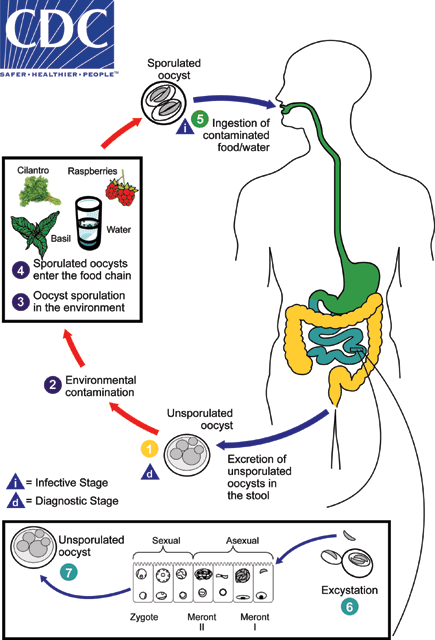
The U.S. Food and Drug Administration (FDA) recently updated its constituents about the agency’s ongoing Cyclospora cayetanensis prevention and research efforts. In 2021, FDA released its “Cyclospora Prevention, Response and Research Action Plan.” The action plan was developed by the agency’s Cyclospora Task Force and details FDA’s strategy for reducing the public health burden of foodborne cyclosporiasis in the U.S. It also defines the agency’s priorities for Cyclospora food safety research and supports ongoing efforts to combat foodborne illness in alignment with FDA’s New Era of Smarter Food Safety initiative.

Since releasing the Cyclospora action plan, FDA has made progress on several goals. The agency’s activities related to the Cyclospora action plan include:

  • Collaboration with the National Advisory Committee on Microbiological Criteria for Foods to develop a charge document that will inform FDA’s prioritization of Cyclospora research and propose novel food safety research projects in collaboration with stakeholders
  • Implementation of a genotyping approach for Cyclospora in environmental and food samples based on the same method published by the U.S. Centers for Disease Control and Prevention (CDC)
  • Implementation of a distance learning plan and a series of Cyclospora methodology training webinars on the “Bacteriological Analytical Manual (BAM) Chapter 19b – Detection of C. cayetanensis in Fresh Produce” using a real-time PCR-analytical method in Spanish for regulatory lab personnel at food safety authorities in Mexico through the FDA-SENASICA-Cofepris Food Safety Partnership
  • Collaborated with the U.S. Centers for Disease Control and Prevention (CDC) to publish an article in Food Safety Magazine summarizing the data on all cyclosporiasis outbreaks from 2013 to 2020
  • Delivered eight webinars directed to the fresh produce industry, regulators, and other stakeholders for Cyclospora outreach and educational purposes
  • Completed a microbial survey of fresh herbs that included over 800 samples tested for C. cayetanensis.

Canada – Magnesium Citrate Oral Solution; Microbial contamination

Gov Canada

Summary

Product
Magnesium Citrate Oral Solution
Issue
Health products – Product quality
What to do
  • Stop using the products listed. Consult your health care professional if you have used these products and have health concerns, and for advice on which health products are best for you and your family.
  • Report any health product adverse events or complaints to Health Canada.

Affected products

Issue

Presence of Gluconacetobacter liquefaciens in affected lots.

What you should do

  • Stop using the products listed. Consult your health care professional if you have used these products and have health concerns, and for advice on which health products are best for you and your family.
  • Report any health product adverse events or complaints to Health Canada.