Category Archives: Microbiology Investigations

Research – Detrimental Effect of Ozone on Pathogenic Bacteria

MDPI

Background: Disinfection of medical devices designed for clinical use associated or not with the growing area of tissue engineering is an urgent need. However, traditional disinfection methods are not always suitable for some biomaterials, especially those sensitive to chemical, thermal, or radiation. Therefore, the objective of this study was to evaluate the minimal concentration of ozone gas (O3) necessary to control and kill a set of sensitive or multi-resistant Gram-positive and Gram-negative bacteria. The cell viability, membrane permeability, and the levels of reactive intracellular oxygen (ROS) species were also investigated;

Material and Methods: Four standard strains and a clinical MDR strain were exposed to low doses of ozone at different concentrations and times. Bacterial inactivation (cultivability, membrane damage) was investigated using colony counts, resazurin as a metabolic indicator, and propidium iodide (PI). A fluorescent probe (H2DCFDA) was used for the ROS analyses;

Results: No reduction in the count colony was detected after O3 exposure compared to the control group. However, the cell viability of E. coli (30%), P. aeruginosa (25%), and A. baumannii (15%) was reduced considerably. The bacterial membrane of all strains was not affected by O3 but presented a significant increase of ROS in E. coli (90 ± 14%), P. aeruginosa (62.5 ± 19%), and A. baumanni (52.6 ± 5%);

Conclusion: Low doses of ozone were able to interfere in the cell viability of most strains studied, and although it does not cause damage to the bacterial membrane, increased levels of reactive ROS are responsible for causing a detrimental effect in the lipids, proteins, and DNA metabolism. View Full-Text

Research – Assessment of Food and Waterborne Viral Outbreaks by Using Field Epidemiologic, Modern Laboratory and Statistical Methods—Lessons Learnt from Seven Major Norovirus Outbreaks in Finland

MDPI

Food Borne Illness - Norovirus -CDC Photo

Seven major food- and waterborne norovirus outbreaks in Western Finland during 2014–2018 were re-analysed. The aim was to assess the effectiveness of outbreak investigation tools and evaluate the Kaplan criteria. We summarised epidemiological and microbiological findings from seven outbreaks. To evaluate the Kaplan criteria, a one-stage meta-analysis of data from seven cohort studies was performed. The case was defined as a person attending an implicated function with diarrhoea, vomiting or two other symptoms. Altogether, 22% (386/1794) of persons met the case definition. Overall adjusted, 73% of norovirus patients were vomiting, the mean incubation period was 44 h (4 h to 4 days) and the median duration of illness was 46 h. As vomiting was a more common symptom in children (96%, 143/149) and diarrhoea among the elderly (92%, 24/26), symptom and age presentation should drive hypothesis formulation. The Kaplan criteria were useful in initial outbreak assessments prior to faecal results. Rapid food control inspections enabled evidence-based, public-health-driven risk assessments. This led to probability-based vehicle identification and aided in resolving the outbreak event mechanism rather than implementing potentially ineffective, large-scale public health actions such as the withdrawal of extensive food lots. Asymptomatic food handlers should be ideally withdrawn from high-risk work for five days instead of the current two days. Food and environmental samples often remain negative with norovirus, highlighting the importance of research collaborations. Electronic questionnaire and open-source novel statistical programmes provided time and resource savings. The public health approach proved useful within the environmental health area with shoe leather field epidemiology, combined with statistical analysis and mathematical reasoning.

Research – Salmonella Serotypes Associated with Illnesses after Thanksgiving Holiday, United States, 1998–2018

CDC

Abstract

We sought to determine which Salmonella serotypes cause illness related to the Thanksgiving holiday in the United States and to foods disproportionately eaten then (e.g., turkey). Using routine surveillance for 1998–2018 and a case-crossover design, we found serotype Reading to be most strongly associated with Thanksgiving.

Thanksgiving, celebrated annually in the United States on the fourth Thursday of November, often brings together family and friends who eat specific traditional foods, such as mashed potatoes, cranberry sauce, and pumpkin pie; the most prominent food eaten is turkey (1). In 2017, ≈45 million turkeys were produced for Thanksgiving, ≈18% of annual production (2). Turkey is popular across regions, races, sexes, and generations; 88% of persons in the United States report eating turkey during their Thanksgiving meal (1,3,4).

Foodborne Salmonella infections cause substantial illness and death in the United States: an estimated 1 million cases, 20,000 hospitalizations, and 400 deaths occur annually (5). Typical illness consists of diarrhea, fever, and abdominal pain lasting 3–7 days; only a minority of persons seek health care. Incubation typically ranges from 6 hours to 6 days (5). Salmonella outbreaks caused by serotypes Hadar and Saint Paul have been most commonly attributed to turkey, and serotypes Enteritidis, Heidelberg, and Typhimurium have been frequent causes of turkey-associated outbreaks (6). During 2015‒2020, Reading and Hadar were the serotypes most often isolated from turkeys (7); less is known about which serotypes cause turkey-associated sporadic Salmonella infections. We aimed to determine which Salmonella serotypes cause sporadic enteric infections after the Thanksgiving holiday and are most likely related to foods disproportionately eaten then, particularly turkey.

USA- Raw Pet Food Recalled due to Salmonella

Food Poison Journal

Woody’s Pet Food Deli of Minneapolis, MN is recalling Raw Cornish Hen pet food “With Supplements” sticker due to a Salmonella health risk.

The product was distributed in the company’s retail stores in Minneapolis, Saint Paul, and Woodbury, Minnesota.

Salmonella can affect animals eating the product and there is risk to humans from handling contaminated products, especially if they have not thoroughly washed their hands after having contact with the products or any surfaces exposed to these products.

Research – Understanding and predicting food safety risks posed by wild birds

Centre For Produce Safety

Summary

Click to access SHARIAT_%20FINAL.pdf

Co-existence of fresh produce with animal agriculture has come under increased scrutiny, given multiple recent outbreaks where pathogen strains on produce have been linked to livestock. An important consideration in this co-existence is understanding how pathogens are vectored from animals and their environments to fresh produce. This proposal centers on understanding the risks posed by wild birds and how their fecal pathogen content is influenced by nearby animal agriculture. Previous studies examining wild birds have been focused in the western US, where ‘cattle is king’ in terms of animal agriculture. The southeast has a $4 billion fresh produce and nut industry and, while also having beef and dairy cattle, in this region, ‘poultry is king.’ Campylobacter and Salmonella are the top bacterial causes of foodborne illness in the US, are frequently isolated from food animals, and have been linked to outbreaks in fresh produce. This study will examine the role of poultry and cattle in influencing the pathogens deposited onto fresh produce by wild birds. Mapping and modeling technologies will be implemented to develop risk profiles resulting from links between integrated/proximal animal agriculture and wild bird feces containing viable pathogens that are deposited on produce foliage. High-resolution molecular tools will be used to generate pathogen population profiles and, alongside genomic analyses, will be used to attribute pathogen source to zoonotic reservoirs associated with animal agriculture.

Technical Abstract

There is abundant evidence that wildlife often carries potential foodborne pathogenic bacteria. Indeed, wildlife sources have been associated with several outbreaks, leading to calls to remove natural habitats from farms to discourage wildlife visits. Thus, it was surprising that a recent study found that the likelihood of produce contamination actually increased, rather than decreased, in leafy greens fields where natural habitats had been removed (31). Consistent with this, we found that wild bird feces collected from broccoli were more likely to carry Campylobacter when those fields were surrounded by intensified livestock and crop production, rather than more-natural habitats (52). Pathogens were associated with invasive starlings and house sparrows, known to frequent feedlots and other high-density livestock areas, but also with many native birds (e.g., American robins) that also are associated with pastures and cropping fields. Altogether, work to-date suggests three interacting links between wild bird-associated food safety problems: (i) intensive livestock production that provides a pathogen reservoir, (ii) heavily farmed landscapes that support large numbers of invasive birds, and (iii) simple on-farm habitats that draw livestock-associated birds to a particular field. However, thus far these links have been drawn from circumstantial, rather than direct, evidence of pathogen movement. This limits the ability of fresh produce growers to definitively assess food safety risks associated based on local and regional land-use patterns, or to manipulate on-farm habitats to mediate these risks.

Fortunately, recent advances in pathogen tracking, using fine-scale genetic differences in pathogen genomes, is providing a means to directly separate different animal agriculture, wildlife, and environmental pathogen sources. For example, Salmonella Typhimurium isolates have been attributed to different zoonotic sources based on their genome sequences (59). PI Shariat has been a leader in using next-generation sequencing approaches to assess pathogen populations, having developed CRISPR-SeroSeq as a tool to produce high-resolution population profiles of Salmonella serotypes. Here, we propose to definitively establish links between livestock/poultry pathogen reservoirs and pathogens in bird feces on produce foliage growing in the field. We will also examine how likely pathogens in bird feces are to move from deposition points to surrounding produce and plants. We propose two primary research objectives focusing on bird fecal samples collected directly from the fields of our cooperating growers: In Obj. 1 we will assess the risk posed by wild bird feces on fresh produce plants and the influence of proximal animal agriculture on pathogen presence in wild bird feces. In Obj. 2, we will determine the diversity, not just the dominant species or serotype, of Campylobacter and Salmonella in bird feces and perform fine-scale tracking and source attribution using whole genome sequencing. Both of these research objectives will be directly paired with outreach products/strategies that move our findings directly to the hands of growers, processors, and others in the industry that critically need this information. Altogether, we seek to provide produce growers with the science-based knowledge and tools to assess the risk that wild birds pose to food safety on their farms, based on farm-specific local and landscape farming practices.

Research – Investigating the Campylobacter enteritis winter peak in Germany, 2018/2019

Nature.com

Campylobacter kswfoodworld

Surveillance of notified Campylobacter enteritis in Germany revealed a recurrent annual increase of cases with disease onset several days after the Christmas and New Year holidays (“winter peak”). We suspected that handling and consumption of chicken meat during fondue and raclette grill meals on the holidays were associated with winter peak Campylobacter infections. The hypothesis was investigated in a case–control study with a case-case design where notified Campylobacter enteritis cases served as case-patients as well as control-patients, depending on their date of disease onset (case-patients: 25/12/2018 to 08/01/2019; control-patients: any other date between 30/11/2018 and 28/02/2019). The study was conducted as an online survey from 21/01/2019 to 18/03/2019. Adjusted odds ratios (aOR) were determined in single-variable logistic regression analyses adjusted for age group and sex. We analysed 182 data sets from case-patients and 260 from control-patients and found associations of Campylobacter infections after the holidays with meat fondue (aOR 2.2; 95% confidence interval (CI) 1.2–3.8) and raclette grill meals with meat (aOR 1.5; 95% CI 1.0–2.4) consumed on the holidays. The associations were stronger when chicken meat was served at these meals (fondue with chicken meat: aOR 2.7; 95% CI 1.4–5.5; raclette grill meal with chicken meat: aOR 2.3; 95% CI 1.3–4.1). The results confirmed our initial hypothesis. To prevent Campylobacter winter peak cases in the future, consumers should be made more aware of the risks of a Campylobacter infection when handling raw meat, in particular chicken, during fondue or raclette grill meals on the holidays.

RASFF Alert- Animal Feed – Salmonella – Raw Petfood

RASFF

Salmonella Typhimurium in raw petfood from the Netherlands in Belgium

Denmark – Denmark searches for source of new E. coli outbreak (EIEC)

Food Safety News

Denmark is investigating an increase in the number of registered cases of a type of E. coli reported in the past month.

Enteroinvasive E. coli (EIEC) is usually associated with travel diarrhea but the patients in the current outbreak have not been abroad, which suggests a common food may have made people sick, according to the Statens Serum Institut (SSI).

Between Nov. 23 and Dec. 16, 63 infected people with EIEC or ipaH-positive were registered at the Statens Serum Institut and 18 of them have been hospitalized.

EIEC was isolated from 22 patients and the remaining 41 are PCR positive for the invasion plasmid antigen H (ipaH) gene, which is specific to Shigella species and EIEC.

Patients live all over the country, and there are 43 women and 20 men sick. They are aged from 1 to 91 years old with a median age of 53.

Hovedstaden has the most cases with 23, Sjælland has 19, Midtjylland has 14 and seven live in Syddanmark.

The Statens Serum Institut, Danish Veterinary and Food Administration (Fødevarestyrelsen) and DTU Food Institute are trying to find the source of infection.

USA – FDA Core Outbreak Table – 5 Active Outbreaks

FDA

Date
Posted
Reference
#
Pathogen
Product(s)
Linked to
Illnesses

(if any)
12/20/2021 1039 Listeria
monocytogenes
Packaged Salad
12/15/2021 1048 Listeria
monocytogenes
Packaged Salad
11/24/2021 1044 Salmonella Javiana Not Yet
Identified
11/17/2021 1043 E. coli
O157:H7
Spinach

USA – Outbreak Investigation of Listeria monocytogenes: Dole Packaged Salad (December 2021)

FDA

The FDA, along with CDC and state and local partners, is investigating a multistate outbreak of Listeria monocytogenes infections potentially linked to Dole packaged leafy greens. According to the CDC, as of December 22, 2021, 16 people infected with the outbreak strain of Listeria monocytogenes have been reported from 13 states. Illnesses started on dates ranging from August 16, 2014 to October 17, 2021 (one case occurred in 2014 and the remaining cases occurred between 2018 and 2021).

CDC investigated this outbreak in 2019 and 2020 but was unable to gather enough data to identify the source in the past. CDC reopened the investigation in November 2021 when four new illnesses were reported since the end of August.

In October 2021, as a part of routine retail sampling, the Georgia Department of Agriculture collected a product sample of prepackaged salad mix from a grocery store for testing. The sample tested positive for Listeria monocytogenes. In response to the sample results, Dole initiated a recall of packaged garden salads in October 2021. These products are now past their “Best if Used By” dates. The positive sample was later sent for whole genome sequencing (WGS) analysis; and in December 2021, WGS analysis was completed. The results show that the Listeria monocytogenes in the product sample was a match to the outbreak strain. FDA is conducting an inspection at the facility that produced the product that tested positive for Listeria monocytogenes.

The Michigan Department of Agriculture and Rural Development also recently initiated retail sampling of Dole products in their state as part of this investigation. One product containing lettuce from the Dole facility in Yuma, AZ, tested positive for Listeria monocytogenes. WGS analysis showed that the Listeria monocytogenes in the product sample is also a match to the outbreak strain.

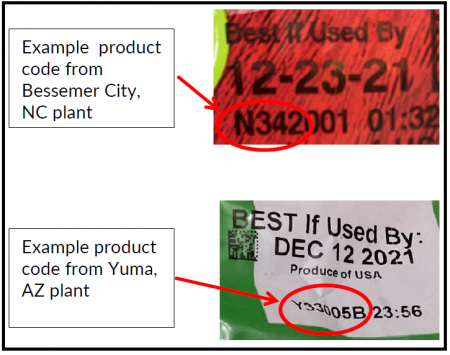
In response to the sample analyses and the ongoing outbreak investigation, Dole has agreed to voluntarily suspend operations at both the Bessemer City, NC, facility and Yuma, AZ, facility and has voluntarily recalled all products and brands from those facilities. Those products have production lot codes beginning with either the letter “N” or “Y” in the upper right-hand corner of the package and Best if Used By dates from November 30, 2021 to January 8, 2022.

This recall does not include whole head packaged lettuce. A full list of recalled products is available on FDA’s website.

This investigation is ongoing, and additional information will be provided as it becomes available.

Recommendation

Consumers, restaurants, and retailers, should not eat, sell, or serve recalled Dole packaged salads. A full list of recalled products is available on FDA’s website.

FDA recommends that anyone who received recalled products use extra vigilance in cleaning and sanitizing any surfaces and containers that may have come in contact with these products to reduce the risk of cross-contamination. Listeria can survive at refrigeration temperatures and can easily spread to other foods and surfaces.

Recall Information

In response to the sample analyses and the ongoing outbreak investigation, Dole has agreed to voluntarily suspend operations at both the Bessemer City, NC, facility and Yuma, AZ, facility and has voluntarily recalled all products and brands from those facilities. Those products have production lot codes beginning with either the letter “N” or “Y” in the upper right-hand corner of the package and Best if Used By dates from November 30, 2021 to January 8, 2022.

This recall does not include whole head packaged lettuce.

The following images are of example labels from recalled products highlighting where to find product codes. View a full list of recalled products

Outbreak Investigation of Listeria monocytogenes from Dole Packaged Salad - Sample Product Codes (December 22, 2021)

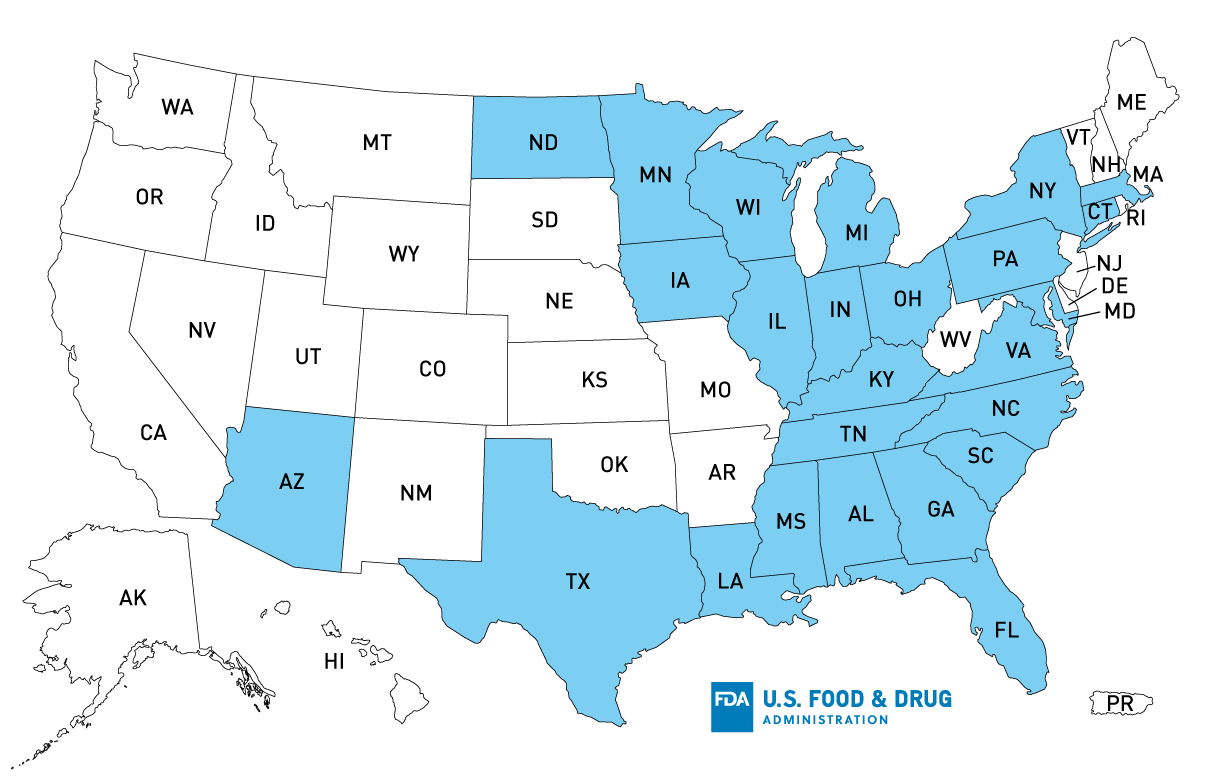
Map of U.S. Distribution of Recalled Packaged Salad

Outbreak Investigation of Listeria monocytogenes from Dole Packaged Salad - Map of U.S. Distribution of Recalled Packaged Salas (December 22, 2021)

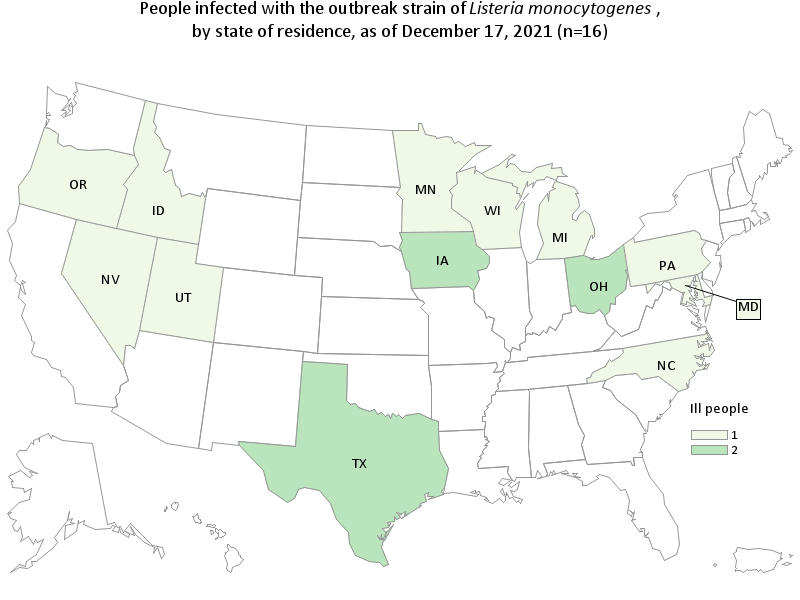
Case Count Map Provided by CDC

Outbreak Investigation of Listeria monocytogenes from Dole Packaged Salad - CDC Case Count Map (December 22, 2021)

Case Counts

Total Illnesses: 16
Hospitalizations: 12
Deaths: 2
Last Illness Onset: October 17, 2021
States with Cases: IA, ID, MD, MI, MN, NC, NV, OH, OR, PA, TX, UT, WI
Product Distribution*: AL, AZ, CT, FL, GA, IA, IL, IN, KY, LA, MA, MD, MI, MN, MS, NC, ND, NY, OH, PA, SC, TN, TX, VA, WI

*Distribution has been confirmed for states listed, but product could have been distributed further, reaching additional states