Category Archives: microbial contamination

Australia P&O sued over Norovirus-ravaged cruises

The Bharat Express

P&O passengers claim they suffered from diarrhea and vomiting and had to self-isolate in unsanitary conditions after being exposed to norovirus on a number of Australian cruises.

A class action filed in federal court on Tuesday seeks compensation and damages from Carnival, trading as P&O Cruises, for outbreaks of the highly contagious gastrointestinal virus on eight separate voyages from December 2016 to February 2017.

Australia – Investigations into Central Coast Salmonella outbreak continue

NSW GOV AU

NSW Health and the NSW Food Authority are continuing to investigate a significant foodborne outbreak following a conference on the Central Coast last week.

At least 69 people from across NSW, the Northern Territory and Queensland are known to have become unwell with symptoms of food poisoning, of which 27 people have confirmed Salmonella infections to date.

Dr Jeremy McAnulty, NSW Health Executive Director of Public Health, said public health officials from across NSW have been working to speak to all those who have become unwell after attending or working at the conference.

“Close to 230 people attended or worked at the two-day conference, and so far at least 31 of them are known to have attended Emergency Departments,” Dr McAnulty said.

“NSW Health is working closely with the NSW Food Authority to investigate the cause of the outbreak.

“Our public health experts continue to contact people associated with the event, including attendees from the Aboriginal Languages Trust and we thank all of those who have assisted us so far.

Australia – Donuts for weight loss? A norovirus outbreak associated with a bakery in the Australian Capital Territory

Gov Au

Three hundred and one people were surveyed, and 215 individuals (71.4%) reported vomiting and/or diarrhoea following consumption of a donut purchased from the business over a five-day period.
 
All ill respondents reported eating a donut. The medians of incubation period and illness duration were 34 hours (interquartile range, IQR: 29–42 hours) and 48 hours (IQR: 29–72 hours) respectively. Diarrhoea, vomiting and abdominal pain were the most commonly reported symptoms.
 
Eight out of 11 specimens collected from ill individuals were positive for norovirus. For the case-control study, data from 59 attendees were collected, with an attack rate of 46% (27/59). Eating any kind of filled donut was associated with a person becoming ill (odds ratio: 10.4; 95% confidence interval: 1.18–478.13).
 
No single flavour was identified as the likely source of infection.
 
Elevated levels of coliforms were present in two samples of donut filling obtained during the food safety inspection.
 
Conclusion
Donuts are a novel vehicle for norovirus infection. This implicated pathogen, plus evidence collected at the food premises suggestive of faecal contamination, indicates the source of this outbreak was likely an ill food handler. The findings of this outbreak highlight the importance of excluding food


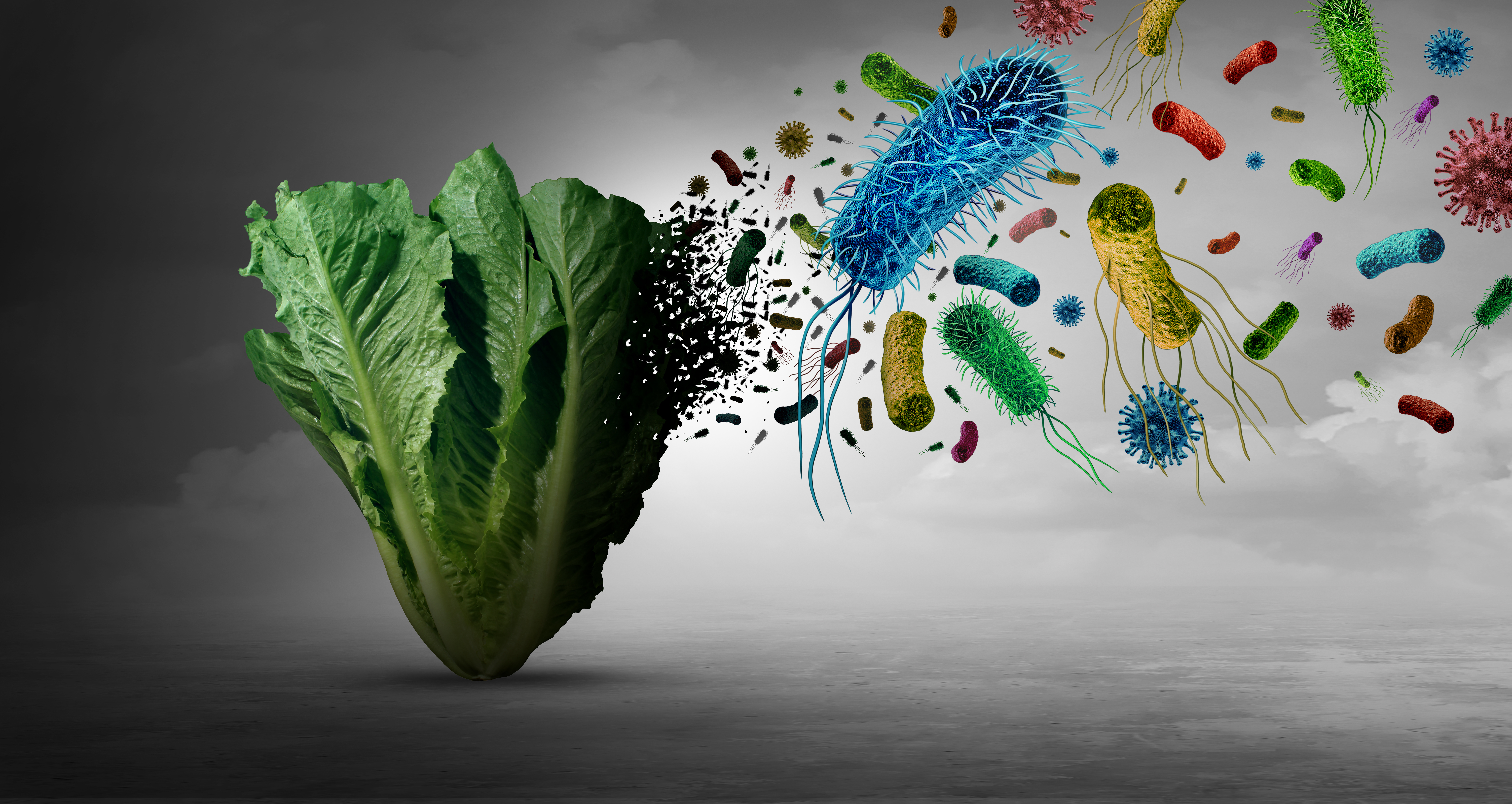
More than 250 ill in UK E. coli outbreak linked to salad

Food Safety News

Vegetable Bacteria Danger

More than 250 people are sick in an E. coli O157 outbreak in the United Kingdom that may have been caused by salad.

There have been 259 confirmed cases in the UK with sample dates ranging from late August to the end of October, although most people fell ill in August and early September.

Shiga toxin-producing E. coli (STEC) O157 has affected people in England, Scotland, Northern Ireland, and Wales. The majority of those sick are adults.

Food Standards Scotland (FSS), the UK Health Security Agency (UKHSA) and Food Standards Agency (FSA) are investigating the outbreak.

It is the largest E. coli outbreak since Whole Genome Sequencing (WGS) started to be used in 2014, according to UKHSA.

Research – The European Scientific Conference on Applied Infectious Disease Epidemiology (ESCAIDE)

Escaide

Abstracts

Page 71 – An Easter Surprise: Salmonella Typhimurium outbreak linked to chocolate products in the United Kingdom, 2022; a case control study

Page 72  – International outbreak of Salmonella Typhimurium linked to a chocolate factory in 2022: Belgian findings

Page 73 – Whole Genome Sequencing identified a prolonged Salmonella Poona nursery outbreak (2016-2021) in North West England, UK

Page 74 – Climate Warming and increasing Vibrio vulnificus infections in North America

Page 106 – Timely and reliable outbreak investigation using a non-probabilistic online panel as a source of controls – two parallel case-control studies investigating a Salmonella Braenderup outbreak in Germany

Page 107 – An outbreak of Escherichia coli-associated haemolytic uremic syndrome linked to consumption of an unexpected food vehicle, France 2022

Page 108 – Outbreak investigation of cholera in a peri-urban village of Panchkula district, Haryana, India, 2021

Page 109 – Cholera Outbreak Investigation, Ballo Adda Mohalla, Lucknow District, Uttar Pradesh 2021

Page 110 – Norovirus GII.3[P12] outbreak associated with the drinking-water supply in a rural area in Galicia, Spain, 2021

Page 111 – Impact of COVID-19 restrictions on the epidemiology of Cryptosporidium spp. in England and Wales

Page 149 – Monophasic Salmonella Typhimurium outbreak linked to chocolate products, Ireland, 2022

Page 151 – Successful containment of a Listeria monocytogenes outbreak caused by shredded vegetables, Hesse/Germany, 2021-2022

Page 152 – Outbreak of monophasic Salmonella Typhimurium linked to fresh small tomatoes, Sweden, 2021

Page 194 – Cholera Outbreak Investigation, Kamarhati-Municipality, North-24-Parganas District, West Bengal, India 2021

Page 195 – Botulism outbreak and response in Dangara District Tajikistan, October 2020

Page 196 – Outbreak of suspected Clostridium perfringens associated with consumption of roast beef in a restaurant, January 2022 South West England

Page 198 – Doughnuts for weight loss? A norovirus outbreak in the Australian Capital Territory, November 2021

Page 212 – Outbreak of Legionnaires’ disease linked to unregistered cooling towers, West Midlands, England, July-September 2020



Australia – Suspected mass food poisoning at Aboriginal languages conference

SBS

A gathering of Aboriginal language educators on the Central Coast has ended with a number of attendees hospitalised after a case of suspected food poisoning at their hotel.

Participants of the Aboriginal Languages Trust conference attended a gala dinner last Wednesday at the restaurant of the Crowne Plaza Terrigal.

Gamilaraay Yuwaalaraay man Ted Fields told NITV his partner Michelle O’Leary became violently ill just 20 minutes after dinner.
 
The number of attendees taken ill is unconfirmed but some people on social media have said there had been dozens of cases.

Speaking to NITV from Gosford Hospital, where he is still a patient, Mr Fields, 51, said he witnessed multiple attendees being admitted.
 
In a statement to NITV, NSW Health confirmed an investigation into the incident is underway.

“Aboriginal Languages Trust is aware of a number of cases of a gastro-like illness in people who attended a two-day conference held at a Terrigal venue on Wednesday.

“NSW Health is urgently investigating the situation to identify the cause of illness, in collaboration with the NSW Food Authority.”

Research – Microphone-equipped toilet will detect diseases and give you advice – What more can I say :)

Interesting Engineering

In order for patients to be treated for cholera, they must know that they have the disease first. However, it can be a sensitive and difficult task to monitor bowel diseases, such as cholera. Maia Gatlin, a research engineer at the Georgia Institute of Technology, created a way to use artificial intelligence to detect diarrhea. She calls her presentation The Feces Thesis: Using Machine Learning to Detect Diarrhea.

A noninvasive microphone sensor can detect disease in bowels

Gatlin will be presenting her thesis and the sensor tool today, Dec. 5, at the annual Meeting of the Acoustical Society of America, explaining her findings on how machine learning can be used to detect diseases in the bowel. She uses a noninvasive microphone sensor to identify bowel diseases, without necessarily collecting identifiable information, meaning the AI can determine the infection without having to be examined in a medical facility to collect additional data.

USA – Kraft Heinz Foods Company Recalls Ready-To-Eat Ham and Cheese Loaf Products Due to Possible Cross-Contamination From Under-Processed Products

FSIS USDA

WASHINGTON, Dec. 5, 2022 – Kraft Heinz Foods Company, a Kirksville, Mo. establishment, is recalling approximately 2,400 pounds of ready-to-eat ham and cheese loaf products due to possible cross-contamination with under-processed products, the U.S. Department of Agriculture’s Food Safety and Inspection Service (FSIS) announced today.

The ready-to-eat ham and cheese loaf products were produced on Oct. 10, 2022. The following products are subject to recall [view labels]:

  • 16-oz. rigid vacuum-packed packages containing “Oscar Mayer Ham & Cheese LOAF” with codes from “07 Feb 2023 20:40 7B” through “07 Feb 2023 22:16 7B” on the label.

The products subject to recall bear establishment number “Est. 537V” inside the USDA mark of inspection. These items were shipped to distribution centers in Ohio and Virginia, and further distributed for retail sales.

The problem was discovered when the establishment notified FSIS that the product was sliced on the same equipment as product that had been under processed, and the equipment was not cleaned between runs of the under-processed and fully cooked product. This has led to concerns of possible cross-contamination of the fully cooked ham and cheese loaf product.

There have been no confirmed reports of adverse reactions due to consumption of these products. Anyone concerned about an injury or illness should contact a healthcare provider.  

FSIS is concerned that some product may be in consumers’ refrigerators or freezers. Consumers who have purchased these products are urged not to consume them. These products should be thrown away or returned to the place of purchase.

Click to access Recall-043-2022-label.pdf

Research – German testing finds E. coli in beef, salad, and dough

Food Safety News

E. coli has been found in ground beef, pre-packaged salads, and ready-made dough and baking mixes, according to results of food controls in Germany.

In 2021 risk-based monitoring, samples of ground, or minced, beef was examined. Shiga toxin-producing E. coli were detected in 28 of 420 samples. It was also found in two of 86 tests on fresh beef at retail.

German officials said at-risk consumer groups such as small children, the elderly, immunocompromised people, and pregnant women should only consume ground meat that has been sufficiently cooked.

A total of 88 of 410 ground beef samples tested for Listeria monocytogenes were also positive. Levels were low but can still pose a health risk to vulnerable people. One sample had levels near the legal limit.

India – 17 students suffer from food poisoning

The Live Nagpur

Seventeen students of Madan Gopal High-school suffered from food poisoning after they consumed chocolates given by an unknown person.

The students were admitted at Lata Mangeshkar Hospital. Their condition is stated to be stable, Medical Superintendent Dr Harsh Deshmukh stated.

After eating the chocolate the students started having nautic feeling.
Sitabuldi police was informed about the incident. Investigation are in progress.