Category Archives: foodbourne outbreak

USA – FDA – Core Outbreak Table

FDA

What’s New

  • For the outbreak of Listeria monocytogenes (reference #1057) in Ice Cream, the outbreak has ended, and FDA’s investigation has closed.
  • For the outbreak of E. coli (reference #1121) in a not yet identified food, the case count has increased from 10 to 11 cases.

USA – E. coli O157 Outbreak Linked to Ground Beef is over.

CDC

October 28, 2022

CDC, public health and regulatory officials in several states, and the U.S. Department of Agriculture’s Food Safety and Inspection Service (USDA-FSIS) investigated a multistate outbreak of E. coli O157:H7 infections.

Epidemiologic and traceback data showed that ground beef sold in some HelloFresh meal kits made people sick.

As of October 28, 2022, this outbreak is over.

Epidemiologic and Traceback Data

A total of seven people infected with the outbreak strain of E. coli O157:H7 were reported from six states (see map). Illnesses started on dates ranging from June 8, 2022, to August 17, 2022 (see timeline).

Sick people ranged in age from 17 to 69 years, with a median age of 25, and 43% were female. Six people were hospitalized and none developed hemolytic uremic syndrome, a serious condition that can cause kidney failure. No deaths were reported.

The true number of sick people in this outbreak is likely much higher than the number reported, and this outbreak may not have been limited to the states with known illnesses. This is because many people recover without medical care and are not tested for E. coli.

State and local public health officials interviewed people about the foods they ate in the week before they got sick. Of the six people interviewed, all six (100%) reported eating ground beef from HelloFresh meal kits.

Traceback conducted by USDA-FSIS identified that multiple sick people received ground beef in HelloFresh meal kits that was produced at establishment M46841.

Laboratory Data

Public health investigators used the PulseNet system to identify illnesses that were part of this outbreak. CDC PulseNet manages a national database of DNA fingerprints of bacteria that cause foodborne illnesses. DNA fingerprinting is performed on bacteria using a method called whole genome sequencing (WGS).

WGS showed that bacteria from sick people’s samples were closely related genetically. This suggests that people in this outbreak got sick from the same food.

WGS analysis of bacteria from seven people’s samples did not predict resistance to any antibiotics. Standard antimicrobial resistance testing by CDC’s National Antimicrobial Resistance Monitoring System (NARMS) laboratory is currently underway. These findings do not affect treatment guidance since antibiotics are not recommended for patients with E. coli O157:H7 infections.

Public Health Actions

CDC is advising people to check their freezer if they froze any of the ground beef in HelloFresh meal kits shipped from July 2 to July 21, 2022. Do not eat the ground beef if it has “EST.46841” inside the USDA inspection mark and “EST#46841 L1 22 155” or “EST#46841 L5 22 155” on the side of the packaging.

Research – Barry Callebaut takes $77 million hit in Salmonella incident

Food Safety News

A Salmonella contamination incident cost candy producer Barry Callebaut $77 million, according to the company’s full-year results.

The impact of the problem was CHF 76.9 million Swiss Francs ($77.3 million) in the fiscal year 2021/22, which ended on Aug. 31, 2022.

The Salmonella incident at the Wieze factory in Belgium and temporary production stoppage, followed by a gradual ramp-up toward the end of the fiscal year, had a “notable impact” on volume and profit in Europe, the Middle East, and Africa region. There was a loss because operations were paused at the factory.

As of October, cleaning of the factory was nearing completion and it began operating again at normal capacity after production was stopped in late June.

Research – Jif Salmonella outbreak much larger than reported by CDC

EFOOD ALERT

In the weeks and months following the May 20, 2022, recall of Jif peanut butter products, the US Food and Drug Administration (FDA) received more than 200 reports from consumers complaining of illness after consuming the recalled products.

This information was supplied to eFoodAlert by the FDA in response to a Freedom of Information Act request.

In comparison, the US Centers for Disease Control and Prevention (CDC) reported just twenty-one confirmed cases of Salmonella Senftenberg linked to consumption of Jif peanut butter.

It is usual for an outbreak of foodborne illness to be significantly larger than indicated by CDC statistics. Indeed, the CDC reminded the public of this in its investigation report, saying, “The true number of sick people in this outbreak was likely much higher than the number reported. This is because many people recover without medical care and are not tested for Salmonella.”

Research – The number affected in the Italian Listeria outbreak climbs to 90; three dead

Food Safety News

At least 90 people have been affected and three have died in a major Listeria outbreak in Italy.

The Ministry of Health (Ministero della Salute) said the most recent patient was reported in mid-September.

Deaths occurred in December 2021 and March and June 2022 in Lombardy, Piedmont, and Emilia Romagna. The patients were immunocompromised or particularly vulnerable to infection. One woman lost her baby in the outbreak.

Patients live in Piedmont, Lombardy, Veneto, Emilia Romagna, Liguria, Umbria, Tuscany, Calabria, Lazio, Puglia, Valle D’Aosta and Abruzzo.

USA – Norovirus Sickened 173 at D. C. Cobb’s Restaurant in Illinois

Food Poisoning Bulletin

Eurofins

A norovirus outbreak sickened 173 people at D. C. Cobb’s restaurant in McHenry, Illinois in August 2022, according to an investigation by the McHenry County Department of Health (MCDH). Two of those patients were hospitalized. The last time this investigation was updated was on September 16, 2022, when it was reported that 16 people were sick after eating at that restaurant. The restaurant is located at 1204 North Green Street in McHenry.

Denmark – Outbreak with invasive Listeria infection sequence type 7 in Denmark

SSI

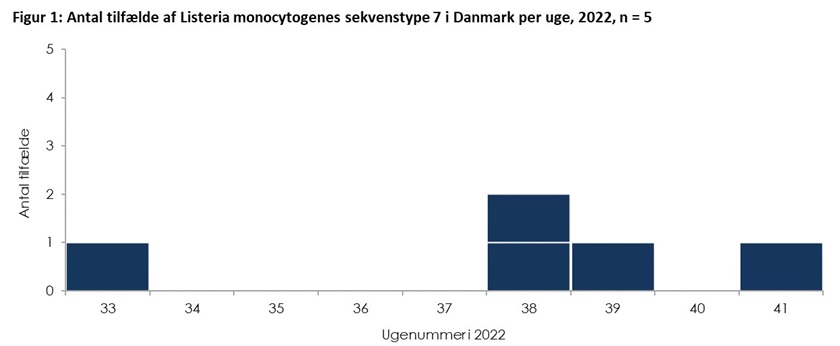
Between 18 August and 13 October 2022, five cases of Listeria monocytogenes have been registered at the Statens Serum Institut . The Statens Serum Institut, the Danish Veterinary and Food Administration and the Norwegian Food Institute DTU are investigating the disease outbreak.

Last edited on October 31, 2022

About the disease outbreak

Between 18 August and 13 October 2022, the Statens Serum Institut registered five people who are infected with the same type of Listeria monocytogenes (figure 1). Among the sick are 2 men and 3 women. The patients are between 6-83 years old (median age is 75 years). The patients are infected throughout the country (table 1).

Figure 1 Number of cases of Listeria monocytogenes sequence type 7 per week 2022 in Denmark

Table 1. Patients with the same type of Listeria monocytogenes in Denmark, August to October 2022, per region (n=5)

Region

Number of patients

The capital  1
Central Jutland  1
Northern Jutland 0
Zealand 1
Southern Denmark 2
Total 5

The investigation of the outbreak

The outbreak is handled by the Central Outbreak Group, which consists of SSI, the Danish Veterinary and Food Administration and the DTU Food Institute. SSI stands for whole-genome sequencing of listeria isolates from the patients and interviews with patients or relatives with a view to identifying a possible source of infection.

The outbreak strain

The bacteria is of the type Listeria monocytogenes . By whole-genome sequencing of the Listeria monocytogenes bacteria isolated from the patients, it can be seen that they are very closely related and belong to sequence type 7.

Research – Listeriosis outbreak caused by contaminated stuffed pork, Andalusia, Spain, July to October 2019

Eurosurveillance

On 5 August 2019, local primary care epidemiologists at the Aljarafe Health District in the province of Seville, Andalusia, notified to the SVEA three cases of food poisoning that had occurred in the previous week. One case was hospitalised; this patient’s blood culture later revealed  growth. In the following days, five additional clusters comprising a total of 32 cases were notified in Seville and one adjacent Andalusian province, and the same pathogen was identified in two of those clusters. These events prompted the local health authorities’ response on 7 August, with instructions to intensify the epidemiological surveillance and environmental sampling in certain food establishments.

By 9 August, the aggregate patient count had reached 22, which included four other cases requiring hospitalisation. In the following days, given the information from epidemiological interviews, in conjunction with microbiological results from non-human samples, the regional government constituted a multidisciplinary committee to investigate the outbreak, comprised of professionals from epidemiological surveillance, healthcare (including urgent care and infectious diseases), microbiology, food safety, and health authorities.

The aim of the outbreak investigation was twofold: (i) to identify the causative agent and the source of infection in order to prevent any further cases and (ii) to discover the reasons behind such a rapid progression of the outbreak. Here, we describe the outbreak and the epidemiological, microbiological and environmental investigations that were carried out to answer these questions.

New Zealand – 21 Hepatitis A cases now linked to New Zealand Berries

Food Poison Journal

Since 28 June 2022, 21 locally-acquired cases of hepatitis A associated with frozen berry consumption have been identified, including three in the past week. All New Zealand cases have reported significant consumption of uncooked imported frozen berries. Nine (43%) cases were hospitalised.

Of all New Zealand cases, 17 have an identical sequence profile, which indicates they likely came from the same source.

USA – Health Department Probing Possible Foodborne Illness Outbreak In Brooklyn

Patch

Campylobacter kswfoodworld

City health officials are investigating a potential outbreak of campylobacter, a bacterial infection that causes flu-like stomach symptoms.

City health officials are investigating a potential outbreak in Brooklyn of campylobacter, a bacterial infection that causes flu-like stomach symptoms.

Campylobacter is a gastrointestinal bug that can come from eating raw or undercooked poultry or something that comes in contact with it, according to the Centers for Disease Control and Prevention. People can also get it from contact with animals that carry the bacteria and by drinking contaminated water.

In Brooklyn, health officials said approximately 50 cases have been reported in the borough since the start of the month. A spokesperson for the city’s Department of Health and Mental Hygiene (DOHMH) declined to detail which neighborhoods have seen the spike.