Category Archives: Food Poisoning

USA – Factors Potentially Contributing to the Contamination of Leafy Greens Implicated in the Fall 2020 Outbreak of E. coli O157:H7

FDA

Executive Summary

Between August and December 2020, the U.S. Food and Drug Administration (FDA) and multiple state and federal partners were involved in an outbreak investigation related to E. coli O157:H7 illnesses and the consumption of leafy greens. The outbreak, which caused 40 reported domestic illnesses, was linked via whole genome sequencing (WGS) and geography to outbreaks traced back to the California growing region associated with the consumption of leafy greens in 2019 and 2018. FDA, alongside state and federal partners, investigated the outbreak to identify potential contributing factors that may have led to leafy green contamination with E. coli O157:H7. The E. coli O157:H7 outbreak strain was identified in a cattle faeces composite sample taken alongside a road approximately 1.3 miles upslope from a produce farm with multiple fields tied to the outbreaks by the traceback investigations. In addition, several potential contributing factors to the 2020 leafy greens outbreak were identified.

Isolates within this cluster of illnesses are part of a reoccurring strain of concern and are associated with outbreaks that have occurred in leafy greens each fall since 2017. The two most recent outbreaks associated with this strain were an outbreak in 2018 (linked to romaine lettuce from the Santa Maria growing region of California) and an outbreak in 2019 (linked to romaine lettuce from the Salinas growing region of California). Clinical isolates from cases in this 2020 outbreak appear more closely related to those from the 2019 outbreak than the 2018 outbreak. In addition, several specific food and environmental isolates that appear to be highly related to this 2020 outbreak include a faecal-soil composite sample collected by FDA in February 2020 from the Salinas growing region and two leafy green samples collected in 2019 by state partners as a part of the 2019 investigation that traced back to the Salinas growing region.

As part of this investigation, tracebacks of leafy greens consumed by ten ill individuals from eleven points of service were conducted. Although that traceback investigation was based on a relatively small number of the total cases, it was based on those cases which presented the strongest evidence via purchase card information, invoices, bills of lading, and electronic data. The traceback investigation identified the Salinas growing region of California as a geographical region of interest.

In light of this most recent finding, combined with previous outbreak investigation findings in the region, FDA has identified key trends regarding the issues of a reoccurring strain, a reoccurring region, and reoccurring issues around adjacent and nearby land use of primary importance in understanding the contamination of leafy greens by E. coli O157:H7 that occurred in 2020 and previous years.

FDA also recognizes the interconnection between people, animals, plants, and their shared environment when it comes to public health outcomes. As such, we strongly encourage collaboration among various groups in the broader agricultural community (i.e. livestock owners; leafy greens growers, state and federal government agencies, and academia) to address this issue. With this collaboration, the agricultural community, alongside academic and government partners, can work to identify and implement measures to prevent contamination of leafy greens. FDA recommends that these parties participate in efforts to understand and address the challenge of successful coexistence of various types of agricultural industries to ensure food safety and protect consumers against foodborne illnesses.

Download the Full Report (PDF 563KB)

France – Product recall: Fromagerie des Frisonnes brand Marguerite’s Delight – E.coli

Oulah

Product recall: Fromagerie des Frisonnes brand Marguerite's Delight

ENCOUNTERED PROBLEM

Presence of Escherichia Coli

PROPOSED SOLUTION

People who hold the product in question are asked not to consume them – and more particularly young children, pregnant women, immunocompromised people and the elderly – and to return them to the point of sale where they were purchased.

People who have consumed it and who present symptoms such as diarrhea, abdominal pain or vomiting should consult their doctor as soon as possible, mentioning this consumption and the possible link with the bacterium Escherichia coli.

In the absence of symptoms within 10 days after consuming the affected products, there is no need to worry and consult a doctor.

The bacterium E. coli is naturally present among the digestive microflora of humans and warm-blooded animals. Some strains of E. coli are pathogenic, and can be responsible in humans for various disorders ranging from mild diarrhea to more serious forms such as hemorrhagic diarrhea or severe kidney damage such as HUS, mainly in young children.

FURTHER INFORMATION

▸ Lot
100221

▸ DDM
04/25/2021

▸ Packaging individually
wrapped in paper

▸ Start date / End of marketing
From 03/15/2021 to 04/16/2021

▸ Health mark
FR 86 042 001 CE

▸ Geographical sales area
• INDRE-ET-LOIRE (37)
• VIENNE (86)

▸ Distributors
• Retailers on 86 and 37,
• Amap at 37,
• Tours Beaujardin market
• farm gate sale

▸ Consumer service contact
0247920402

▸ Source
EARL DES FRISONNES EARL des Frisonnes

Research – Prevalence and Epidemiology of Non-O157 Escherichia coli Serogroups O26, O103, O111, and O145 and Shiga Toxin Gene Carriage in Scottish Cattle, 2014–2015

ASM

ABSTRACT

Cattle are a reservoir for Shiga toxin-producing Escherichia coli (STEC), zoonotic pathogens that cause serious clinical disease. Scotland has a higher incidence of STEC infection in the human population than the European average. The aim of this study was to investigate the prevalence and epidemiology of non-O157 serogroups O26, O103, O111, and O145 and Shiga toxin gene carriage in Scottish cattle. Fecal samples (n = 2783) were collected from 110 herds in 2014 and 2015 and screened by real-time PCR. Herd-level prevalence (95% confidence interval [CI]) for O103, O26, and O145 was estimated as 0.71 (0.62, 0.79), 0.43 (0.34, 0.52), and 0.23 (0.16, 0.32), respectively. Only two herds were positive for O111. Shiga toxin prevalence was high in both herds and pats, particularly for stx2 (herd level: 0.99; 95% CI: 0.94, 1.0). O26 bacterial strains were isolated from 36 herds on culture. Fifteen herds yielded O26 stx-positive isolates that additionally harbored the intimin gene; six of these herds shed highly pathogenic stx2-positive strains. Multiple serogroups were detected in herds and pats, with only 25 herds negative for all serogroups. Despite overlap in detection, regional and seasonal effects were observed. Higher herd prevalence for O26, O103, and stx1 occurred in the South West, and this region was significant for stx2 at the pat level (P = 0.015). Significant seasonal variation was observed for O145 prevalence, with the highest prevalence in autumn (P = 0.032). Negative herds were associated with Central Scotland and winter. Herds positive for all serogroups were associated with autumn and larger herd size and were not housed at sampling.

IMPORTANCE Cattle are reservoirs for Shiga toxin-producing Escherichia coli (STEC), bacteria shed in animal feces. Humans are infected through consumption of contaminated food or water and by direct contact, resulting in serious disease and kidney failure in the most vulnerable. The contribution of non-O157 serogroups to STEC illness was underestimated for many years due to the lack of specific tests. Recently, non-O157 human cases have increased, with O26 STEC of particular note. It is therefore vital to investigate the level and composition of non-O157 in the cattle reservoir and to compare them historically and by the clinical situation. In this study, we found cattle prevalence high for toxin, as well as for O103 and O26 serogroups. Pathogenic O26 STEC were isolated from 14% of study herds, with toxin subtypes similar to those seen in Scottish clinical cases. This study highlights the current risk to public health from non-O157 STEC in Scottish cattle.

USA – New E. coli O145:H28 Outbreak Sickens 15; Little Information Provided

Food Poisoning Bulletin

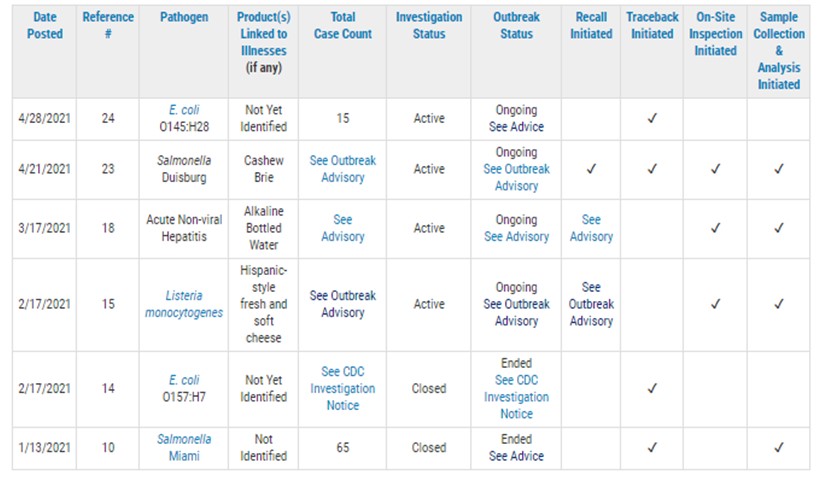
new E. coli O145:H28 outbreak has been posted on the FDA’s CORE Investigation outbreak table. This new outbreak has sickened at least 15 people. There is no more information provided, which is typical for a posting on that table. The FDA only gives out more information about these outbreaks when they believe there are actionable steps that consumers can take to protect themselves, such as a recall.

USA – FDA Core Investigation Table Update

FDA

USA – Notes from the Field: Multistate Outbreak of Escherichia coli O26 Infections Linked to Raw Flour — United States, 2019

CDC

On February 20, 2019, PulseNet, the molecular subtyping network for foodborne disease surveillance, identified six Shiga toxin–producing Escherichia coli (STEC) O26:H11 infections with the same pulsed-field gel electrophoresis (PFGE) pattern combination. This PFGE pattern combination matched that of infections from a July 2018 outbreak that was associated with ground beef. In response, CDC initiated an investigation with federal, state, and local partners to identify the outbreak source and implement prevention measures.

CDC defined a case as STEC O26 infection with an isolate matching the outbreak strain by PFGE or related by core genome multilocus sequence typing scheme (cgMLST), with dates of illness onset during December 11, 2018–May 21, 2019. Investigators initially hypothesized that ground beef was the outbreak cause because of the PFGE match to the July 2018 outbreak and because in early interviews, patients commonly reported eating ground beef and leafy greens. Investigators used cgMLST to compare the genetic sequences of isolates from both outbreaks and determined that they fell into separate genetic clades (differing by 6–11 alleles), suggesting that something other than ground beef caused the illness in 2019. CDC noted that one patient consumed raw cookie dough and that most patients were young adult females, similar to demographic distributions of past flour-associated STEC outbreaks (13). Investigators developed a supplemental questionnaire focusing on beef, leafy greens, and flour exposures.

Twenty-one cases were reported from nine states (Figure). The median age of patients was 24 years (range = 7–86 years); 71% were female. Three patients were hospitalized, and none died. Among 13 patients asked about flour exposures, six reported eating, licking, or tasting raw homemade dough or batter during the week before illness onset. Three patients reported eating raw dough or batter made with the same grocery store brand of all-purpose flour, including a patient who reported eating raw dough at a bakery in Rhode Island. Overall, of 18 patients with store information, 11 reported shopping at this same grocery store chain.

The Rhode Island Department of Health visited the bakery reported by the patient and collected flour for testing. On May 21, 2019, testing identified STEC O26 from an intact bag of all-purpose flour, which was the same grocery store brand reported by other patients. PulseNet confirmed that the STEC O26 isolated from the flour was highly related to clinical isolates using cgMLST (0–1 alleles). Product distribution records collected by the Food and Drug Administration indicated that the store brand flour purchased by six patients in three states was produced in a single milling facility in Buffalo, New York. Based on results of the investigation, the store chain recalled all lots of product from its retail locations in 11 states. The milling company also recalled all lots of this product and several other lots of flour produced in that facility, resulting in the recall of additional brands and products distributed to multiple states.

Flour is increasingly recognized as a cause of STEC outbreaks (15). Raw flour is not a ready-to-eat product, and this outbreak highlights the continuing risk for illness associated with consumption of flour and raw dough or batter. The investigation was aided by considering demographic information early in the investigation because these characteristics were similar to those in past flour-associated outbreaks (13). These similarities, coupled with the discriminatory power of cgMLST, helped to guide the consideration of alternative hypotheses regarding the outbreak source and the successful identification of flour as the cause of this outbreak.

Research – Outbreak of Shiga toxin-producing Escherichia coli O157 linked with consumption of a fast-food product containing imported cucumbers, United Kingdom, August 2020

IJID Online

Background

In August 2020, an outbreak of Shiga toxin-producing Escherichia coli (STEC) O157:H7 occurred in the United Kingdom. Whole genome sequencing revealed these cases formed a genetically distinct cluster.

Methods

Hypotheses generated from case interviews were tested in analytical studies, and results informed environmental sampling and food chain analysis. A case-case study used non-outbreak ‘comparison’ STEC cases; a case-control study used a market research panel to recruit controls.

Results

A total of 36 cases were identified; all cases reported symptom onset between 3rd and 16th August 2020. The majority of cases (83%) resided in the Midlands region of England or Wales. A high proportion of cases reported eating out, with one fast-food restaurant chain mentioned by 64% (n = 23) of cases. Both case-case (adjusted odds ratio (aOR) 31.8, 95% confidence interval (CI) 1.6 – 624.9) and case-control (aOR 9.19, 95% CI 1.0 – 82.8) studies provided statistically significant results that consumption of a specific fast-food product was independently associated with infection.

Singapore – 151 get food poisoning after eating from International French School canteen

Straits Times

SINGAPORE – More than 150 students and staff from the International French School in Ang Mo Kio have contracted food poisoning after eating from its canteen.

The cafeteria has been closed this week as a precaution, said the school.

As at noon on Friday (April 23), 151 people had reported symptoms of gastroenteritis, the Ministry of Health and Singapore Food Agency told The Straits Times.

According to its website, catering is provided by Chartwells – a company which was also involved in cases of food poisoning at the residential colleges of the National University of Singapore in 2019.

USA – Black Beans brought back because of Botulism risk

Food Poison Journal

kswfoodworld

Faribault Foods, Inc. is voluntarily recalling 15 ounce cans of S&W Organic Black Beans, 15 ounce cans of O Organic Brand Black Beans and 15 ounce cans of O Organic Brand Chili Beans because the cans may have a compromised hermetic seal.  The compromised hermetic seal may affect can integrity and may cause the cans to leak, bloat or allow bacteria to grow inside the product which could lead to serious illness.  Clostridium botulinum poisoning in humans can begin from six hours to two weeks after eating food that contains the toxin. Symptoms may include double vision, blurred vision, drooping eyelids, slurred speech, difficulty swallowing, and muscle weakness. Botulism poisoning can cause paralysis of the breathing muscles, which can result in death unless assistance with breathing (mechanical ventilation) is provided.

The recalled products were distributed nationwide in retail stores.

This event only affects the lot codes listed below:  The lot codes are printed on the bottom of the can.

Product

Lot Number

Distribution Dates

S&W Organic Black Beans, 15 oz. Best By JAN 31 2023  1329A 032 21 February 2021-April 2021
S& W Organic Black Beans, 15 oz. Best By FEB 01 2023 1329A 033 21 February 2021-April 2021
S&W Organic Black Beans, 15 oz. Best By FEB 02 2023 1329A 034 21 February 2021-April 2021
S&W Organic Black Beans, 15 oz. Best By FEB 03 2023 1329A 035 21 February 2021-April 2021
O Organic Organic Black Beans, 15 oz. Best By FEB 03 2023 981A 035 21 February 2021-April 2021
O Organic Organic Chili Beans, 15 oz. Best By FEB 04 2023 978A 036 21 February 2021-April 2021

No other production codes, sizes or brands of Faribault Foods, Inc. products are affected by this recall.

Consumers who may have purchased the products listed above should return them to the store where purchased for a refund or replacement.

The recall was initiated after the firm had received consumer and customer complaints regarding failure of the hermetic seal.  The problem related to the hermetic seal failure was corrected and no other product is affected.

Denmark – Risk of mold growth in sliced ​​Spanish cheese

DVFA

BIGFOOD Danmark ApS is recalling Spanish hard cheese in slices after the company has found leaks in individual packages, and there is thus a risk of mold growth in the product. Food with skim growth is unsuitable as food.

Recalled Foods , Published: April 23, 2021

Which food:
Palancares Semi-Curado / Spanish hard cheese in slices
Net content: 90 grams
Best before date: 25.06.2021
Lot number: 0563660421

Palancares Curado / Spanish hard cheese in slices
Net content: 90 grams
Best before date: 26.06.2021
Lot number: 0573660121

Sold in:
FACTS stores across the country

Company recalling:
BIGFOOD Danmark ApS

Cause:
There is a risk of mold growth in the product.

Risk:
Mold growth means that the product is considered unsuitable as food.

Advice for consumers: The Danish
Veterinary and Food Administration advises consumers to deliver the product back to the store where it was purchased or to discard it.