Category Archives: Food Microbiology Research

Research – Netherlands records more than 800 outbreaks in 2021

Food Safety News

The number of foodborne outbreaks in the Netherlands passed 800 in 2021, according to the National Institute for Public Health and the Environment (RIVM).

A total of 838 outbreaks, affecting 3,517 people, were reported in 2021. This is an increase compared with 559 outbreaks in 2020 affecting 1,907 people and is also up from 735 outbreaks in 2018 and 756 in 2019.

Salmonella and Campylobacter were still responsible for most outbreaks and illnesses this past year. Norovirus was reported far less than in previous years for the second year in a row.

Figures come from the Netherlands Food and Consumer Product Safety Authority (NVWA) and Municipal Health Service (GGD).

Pathogen unknown for most outbreaks
Based on NVWA statistics, most outbreaks involved two to four and five to nine patients. Twenty or more sick people were registered in 13 outbreaks, with 71 and 79 patients in two norovirus incidents. More than 400 people were affected in one outbreak caused by an unknown pathogen. From GGD figures, in 28 outbreaks, four people died from listeriosis.

A pathogen was found in patients, food or environmental samples for only 28 of the 838 outbreaks. Experts said the percentage of outbreaks where a pathogen was identified continues to decrease but the reason for this is uncertain.

Malawi bans sale of food in primary, secondary schools as cholera death toll hits 117

China Org

LILONGWE, Oct. 9 (Xinhua) — Malawi has banned sale of food in primary and secondary schools ahead of the new school year, which starts Monday, as cholera outbreak continues with 117 cumulative deaths recorded as of Sunday.

Requesting parents to pack homemade food for students, the education ministry “is directing that selling of food in primary and secondary schools is banned with immediate effect until further notice,” said a statement signed by Secretary for Education Chikondano Mussa.

Universities and colleges are advised to ensure that food vendors and suppliers are oriented and adhere to the standard operating procedures issued by the ministry to all learning institutions.

Cholera has been spreading sporadically across the country since the first cases were recorded in the south-eastern border district of Machinga in March.

As of Sunday, 23 districts have reported cases with 17 districts coming on board in the past 14 days, bringing the caseload and death toll to 4,223 and 117 respectively. Enditem

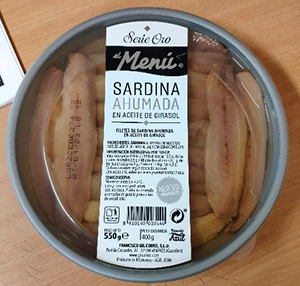
Spain – Presence of Histamine in sardines smoked in sunflower oil.

ACSA

The Spanish Agency for Food Safety and Nutrition (AESAN) has become aware, through the Coordinated System of Rapid Information Exchange (SCIRI), of an alert notification sent by the health authorities in Madrid regarding the presence of ‘histamine in smoked sardines in sunflower oil .

The data of the product involved are:

  • Product name on the label: Smoked sardine in sunflower oil
  • Brand: Serie Oro The Menu
  • Product appearance: Semi-preserved
  • Lot number : L202CEB0 234 60
  • Best before date: 21/01/2023
  • Unit weight: 550 g
  • Temperature: Refrigeration

According to the current information, the product has not been distributed in Catalonia , it has been distributed in the autonomous communities of Andalusia, Castile-La Mancha, Cantabria, Castile and León, Madrid and the Valencian Country, although it is not ruled out that it may have redistributions to other autonomous communities.

AESAN has transferred this information to the competent authorities of the autonomous communities through the SCIRI in order to verify the withdrawal of the affected products from the marketing channels.

With the information available , there is NO evidence in Spain of any notified case associated with this alert.

People who have products affected by this alert at home are advised to refrain from consuming them and return them to the point of purchase.

Research – Cultivation Conditions of Spinach and Rocket Influence Epiphytic Growth of Listeria monocytogenes

MDPI

Leafy vegetables are associated with Listeriosis outbreaks due to contamination with Listeria monocytogenes. To date, contradictory findings were reported on spinach, rocket, and kale, where some studies reported growth of L. monocytogenes, while others did not. Thus, the current study investigated the reason for conflicting findings by producing leafy vegetables, where cultivation factors were known for growth potential studies. Of all polytunnel produce, kale Nero di Toscana demonstrated the highest growth potential (2.56 log cfu g−1), followed by spinach F1 Cello (1.84 log cfu g−1), rocket Buzz (1.41 log cfu g−1), spinach F1 Trumpet (1.37 log cfu g−1), and finally rocket Esmee (1.23 log cfu g−1). Thus, plant species and variety influenced L. monocytogenes growth potentials. Moreover, significantly lower growth potentials of 0.3 log cfu g−1 were identified when rocket Buzz was cultivated in open fields (1.11 log cfu g−1) instead of a polytunnel. The opposite effect was observed for spinach F1 Trumpet, where growth potentials increased significantly by 0.84 log cfu g−1 when cultivated in open fields (2.21 log cfu g−1). Furthermore, a significant seasonality effect between batches was found (p < 0.05). This study revealed that spinach and rocket cultivation conditions are at least co-factors in the reporting of differing growth potentials of L. monocytogenes across literature and should be considered when conducting future growth potential studies.

Research – Effects of nonthermal dielectric barrier discharge plasma against Listeria monocytogenes and quality of smoked salmon fillets

Wiley Online

The objective was to explore the effects of dielectric barrier discharge (DBD) plasma on bacterial reduction, physiological characteristics (pH and moisture), and sensorial quality against Listeria monocytogenes on the surface of smoked salmon. Reductions were treated with 5, 10, 20, 30, 40, 50, and 60 min with DBD plasma varied from 0.17, 0.25, 0.32, 0.70, 0.81, 1.05, and 1.25 log10 CFU/g, respectively. The R2 and D-value of L. monocytogenes was .98 and 49.01 min, respectively. However, moisture levels were significantly different after 30 and 60 min of treatment compared with the control but pH and the sensory qualities were not. This study found that treated with 60 min DBD plasma reduced L. monocytogenes by more than 90% without negatively affecting the smoked salmon. Based on these results, antibacterial treatment for smoked salmon, and this strategy could be explored in the seafood industry to increase food safety.

Research – Efficacy of Repeated Applications of Bacteriophages on Salmonella enterica-Infected Alfalfa Sprouts during Germination

MDPI

Nontyphoidal Salmonella enterica is one of the leading pathogens for foodborne outbreaks in a multitude of food commodities, including alfalfa sprouts, which are commonly consumed raw. The food industry has commonly used chlorinated washes, but such methods may not be perceived as natural; this can be a detriment as a large portion of sprouts are designated for the organic market. A natural and affordable antimicrobial method that has been acquiring popularity is the use of bacteriophages. This study compared the efficacy of repeated daily applications and a single application of two separate bacteriophage cocktails (SE14, SE20, SF6 and SE14, SF5, SF6) against four Salmonella enterica (S. enterica) strains on germinating alfalfa sprout seeds from days 0 to 7. The results show S. Enteritidis to be the most susceptible to both cocktails with ~2.5 log CFU/mL decrease on day 0 with cocktail SE14, SF5, and SF6. S. enterica populations on all strains continued to grow even with repeated daily bacteriophage applications but in a significantly decreased rate (p < 0.05) compared with a single bacteriophage application. The extent of the reduction was dependent on the S. enterica strain, but the results do show benefits to using repeated bacteriophage applications during sprout germination to reduce S. enterica populations compared with a single bacteriophage application.

Serbia – Lidl withdraws certain brand of waflles from its shelves as a precautionary measure- Salmonella

Serbian Monitor

Lidl in Serbia has informed consumers that, as a precautionary measure, it has withdrawn from sale the products of Pak Rampart (from Visoko, Bosnia and Herzegovina).

The Lidl Company is urging shoppers not to consume them, but rather to return them (there is no need to show the receipt) and they will be reimbursed for the money spent.

The following wafers were withdrawn:

Cocoa-flavoured wafers – a product with 72% cocoa filling, 800g pack,

Hazelnut-flavoured wafers – a product with 72% hazelnut-flavoured filling, 800g pack,

Waffle with cocoa filling – produced with 80% cocoa filling, 200-gram pack,

Waffle with hazelnut-flavoured filling – produced with 80% hazelnut-flavoured filling, 200-gram pack

Waffle with cocoa topping – the product with 57% cocoa filling, coated with 20% cocoa topping, 200-gram pack.

“The products were withdrawn due to the possibility of the presence of Salmonella Typhimurium bacteria, as regular checks in Croatia determined its presence in two production batches,” announced Lidl.

Samples of products from the shelves in Serbia were, as mentioned, sent to local laboratories for thorough testing, and the relevant institutions were also informed.

The retailer and the manufacturer have apologised to all consumers who bought the mentioned products for the inconvenience.

(Seebiz.eu, 05.10.2022)

https://www.seebiz.eu/tvrtke/lidl-u-srbiji-povlaci-pet-proizvoda-zbog-moguceg-prisustva-salmonele/282444

Research – Salmonella rising in British raw meat pet food

Pet Food Industry

The occurrence of Salmonella in raw pet food seems to be rising in Great Britain. Raw meat pet food had the highest number of Salmonella contaminated samples of all the feeds tested by the UK’s Animal and Plant Health Agency scientists. The agency report “Salmonella in Animals and Feed in Great Britain 2021” documented an upward trend.

In 2021, the agency’s laboratories isolated 295 instances of Salmonella from raw pet food available on the British market. That’s up 8.1% from 2020’s 273 isolations, and 20.4% higher than 2019 with 245 isolations.

Some of these Salmonella bacteria were from strains with resistance to drugs used to fight infection. These potentially dangerous pathogens were found in 71 of the samples taken in 2021. These made up 57.3% of the total regulated varieties of Salmonella found by the Animal and Plant Health Agency in 2021 among all feeds and locations tested. The proportion of drug-resistant Salmonella in British raw meat pet food didn’t increase much over 2020, but did show an upward tendency compared to 2019.

“Contaminated raw meat pet food, which does not undergo any heat treatment to deactivate pathogens, may therefore represent a potential source of infection to both the dogs consuming it and people who handle it, especially if insufficient hygiene measures are adopted,” the report authors wrote.

Research – History of Food Poisoning Outbreaks Linked to Cantaloupe

Food Poisoning Bulletin

In the latest update to the FDA‘s CORE Outbreak Investigation Table, that agency stated that a Salmonella Typhimurium outbreak that has ended is linked to cantaloupe. This is not the first time that this fruit has caused illnesses. What is the history of food poisoning outbreaks linked to cantaloupe?

While the outbreak is over, the FDA says that more information is forthcoming. We do not know the case count by state, but there are at least 87 people who are sick. We also do not know the patient age ranges, or illness onset dates.

History of Food Poisoning Outbreaks Linked to Cantaloupe

There have been six other multistate food poisoning outbreaks since 2011 that were linked to cantaloupe. Many of these outbreaks were deadly.

Read more in the link above.

Quebec -Notice not to consume any type of spices, nuts or dried fruits sold in bulk by Marché Mon Village

Quebec

QUEBEC CITY , Oct. 6, 2022 /CNW Telbec/ – The Ministry of Agriculture, Fisheries and Food (MAPAQ), in collaboration with the Food Inspection Division of the City of Montreal and the company Marché Mon Village, located at 1689, rue Poirier, in Montreal, advises the public not to consume the products indicated in the table below, because they have not been preserved in such a way as to ensure their safety.

Product name

Format

Affected lot

Various spices

in bulk

Sold until October 6, 2022

various nuts

Various dried fruits

The products that are the subject of this warning were offered for sale until October 6, 2022, and this, only at the establishment designated above. Products were sold in bulk and stored at room temperature.

The operator is voluntarily recalling the products in question. It has agreed with MAPAQ and the Food Inspection Division of the City of Montreal to distribute this warning as a precautionary measure. Also, people who have any of these products in their possession are advised not to consume it. They must return it to the establishment where they bought it or throw it away. Even if the affected products show no signs of tampering or suspicious odors, their consumption may represent a health risk.

It should be noted that no case of illness associated with the consumption of these foods has been reported to MAPAQ to date.