Category Archives: Food Microbiology Research

Research – Phenotypic and genotypic characterization of salmonella Enteritidis isolated from two consecutive Food-Poisoning outbreaks in Sichuan, China

Wiley Online

Abstract

Salmonella enterica serotype Enteritidis (SE) is a primary pathogen that causes foodborne diseases in humans. Although whole-genome sequencing (WGS) -based typing analyses have been increasingly used to investigate food-poisoning outbreaks, they are rarely applied to the epidemiology of multiple Salmonella outbreaks in Sichuan, China. This study therefore isolated SE from patients and food of two consecutive food-poisoning outbreaks during 2020 in Sichuan, China. We tracked outbreak origin using epidemiological investigation, serotyping, antimicrobial susceptibility testing (AST), pulsed-field gel electrophoresis (PFGE), and WGS. We also determined phylogenetic relationships using PFGE, whole and core genome multilocus sequence typing (wg/cgMLST), and whole-genome single nucleotide polymorphism (wgSNP) analyses. Epidemiological investigations identified a correlation between cake consumption and food poisoning. Thirteen strains isolated from patients and one strain isolated from the cake were confirmed as SE. Among the 14 strains, only six shared the same AST pattern (AMP-AMS-Sul-STR). Isolates from patients and cakes were indistinguishable in PFGE results. All four methods, namely PFGE, wgMLST, cgMLST, and wgSNP were appropriate for bacterial typing in SE-related outbreak investigation. However, wgSNP can assign 12 SE strains from the first outbreak to one cluster and assign two SE strains from the second outbreak to another cluster, while PFGE, wgMLST, cgMLST did not successfully distinguish the SE strains from different outbreaks. Thus, we conclude that SNP-based phylogenetic analysis might be a viable method for differentiating SE strains at the outbreak level.
Sweden – Salmonella sickens more than 50 in Sweden

Food Safety News

More than 50 people have fallen ill in a national outbreak of Salmonella in Sweden with the source yet to be identified.

A total of 54 confirmed cases of Salmonella Typhimurium have been reported from 20 different regions in the country from Sept. 17 to Oct. 5.

Patients are aged between 8 and 86 years old; 31 of them are women.

Cases have been connected by whole genome sequencing of patient samples. This means they are suspected of having been infected by a common source, according to the Public Health Agency of Sweden (Folkhälsomyndigheten).

Local infection control units, the Swedish Food Agency (Livsmedelsverket) and Folkhälsomyndigheten are investigating the outbreak to identify the source of infection, which is suspected to be a food with wide distribution in Sweden.

Patient interviews to compile information about what those sick have eaten before falling ill are ongoing. Answers will be used to form a hypotheses about the source and compared to what people in a control group that are not part of the outbreak have eaten.

The incident doesn’t appear to be connected to a Salmonella Typhimurium outbreak that is ongoing in Denmark. Officials believe the outbreak in Sweden is caused by a different source because the strains don’t cluster.

USA – Old Europe Cheese Listeria Outbreak holds at six sick in six States

Food Poison Journal

Epidemiologic and Traceback Data

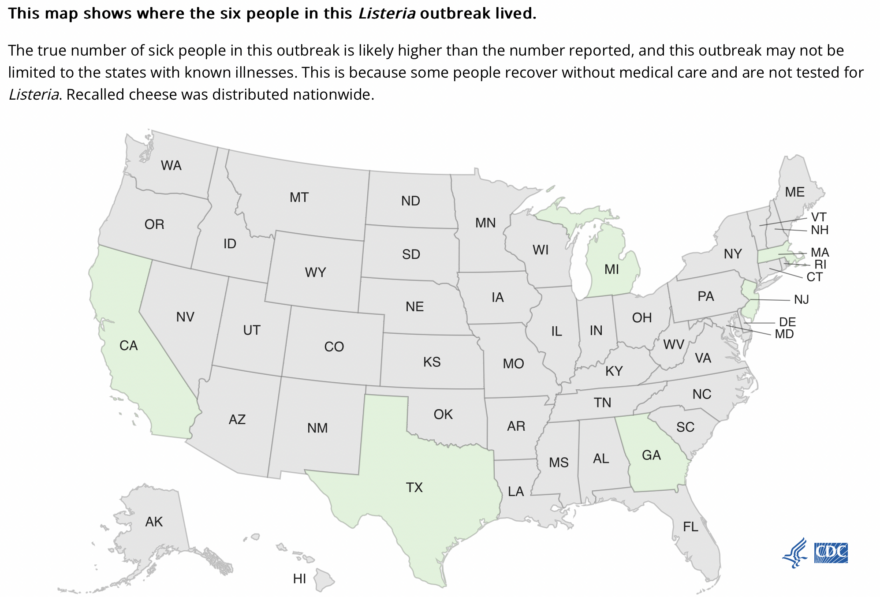
As of September 28, 2022, six people infected with the outbreak strain of Listeria have been reported from six states (see map). Sick people’s samples were collected from August 6, 2017, to August 5, 2022 (see timeline).

Sick people range in age from 56 to 83 years, with a median age of 78, and 67% are female. Five people have been hospitalized, and no deaths have been reported.

The true number of sick people in this outbreak is likely higher than the number reported, and the outbreak may not be limited to the states with known illnesses. This is because some people recover without medical care and are not tested for Listeria. In addition, recent illnesses may not yet be reported as it usually takes 3 to 4 weeks to determine if a sick person is part of an outbreak.

USA – Big Olaf’s Ice Cream Listeria Outbreaks stands at 25 sick with 24 hospitalized with 1 death

Food Poison Journal

Epidemiologic Data

Since the last update on July 13, 2022, two more illnesses have been reported. As of August 2, 2022, a total of 25 people infected with the outbreak strain of Listeria monocytogenes have been reported from 11 states (see map). Thirteen sick people are residents of Florida and ten reported traveling to Florida before getting sick. Illnesses started on dates ranging from January 24, 2021, to June 24, 2022 (see timeline).

Sick people range in age from less than one to 92 years, with a median age of 72, and 56% are male. Of 25 people with information available, 24 have been hospitalized. One death in a person who was not pregnant has been reported from Illinois. Five people got sick during their pregnancy, and one person’s illness resulted in a fetal loss.

The true number of sick people in an outbreak is likely higher than the number reported, and the outbreak may not be limited to the states with known illnesses. This is because some people recover without medical care and are not tested for Listeria. In addition, recent illnesses may not yet be reported as it usually takes 3 to 4 weeks to determine if a sick person is part of an outbreak.

USA – Michigan hit hardest in Falafel E. coli Outbreak

Food Poison Journal

As of October 7 2022, 20 people infected with the outbreak strain of E. coli O121 have been reported from 6 states (see map). Illnesses started on dates ranging from July 13, 2022, to September 13, 2022 (see timeline).


Sick people range in age from less than 1 to 71 years, with a median age of 31, and 79% are female. Of 14 people with information available, 5 have been hospitalized, including 1 who developed hemolytic uremic syndrome, a serious condition that can cause kidney failure. No deaths have been reported.

The true number of sick people in this outbreak is likely higher than the number reported, and the outbreak may not be limited to the states with known illnesses. This is because some people recover without medical care and are not tested for E. coli. In addition, recent illnesses may not yet be reported as it usually takes 3 to 4 weeks to determine if a sick person is part of an outbreak.

State and local public health officials are interviewing people about the foods they ate in the week before they got sick. Among 18 people interviewed, 15 reported shopping at ALDI stores. Among these 15 ALDI shoppers, 6 reported eating Earth Grown brand frozen falafel purchased from ALDI in the week before getting sick.

Denmark – Fermentation in damaged cans with kidney beans and white beans – Microbial Contamination

DVFA

REMA Distribution A/S is recalling several lots of tins of kidney beans in brine and kidney beans in chilli sauce as well as white beans in tomato sauce.

Small perforations in the cans means that there is a risk of microbiological contamination of the contents and fermentation in the cans.

Recalled Foods , Published: October 14, 2022

Modified October 14, 2022

​​​​​​​Which food:
REMA1000 Kidney Beans in brine, 420g

Lot no: LU052../ LU053../ LU054../ LU055..

Best-before date: 30.11.2025

EAN barcode: 5705830004307

REMA1000 Kidney Beans in Chilli Sauce, 420g

Lot no: LU080../ LU081..

Best-before date: 30.11.2025

EAN barcode: 5705830004321

REMA1000 White Beans in Tomato Sauce, 420g

Lot no: LU089…/ LU090…/ LU091…/ LU159….

Best-before date: 30.11.2025

EAN barcode: 5705830004314

Sold in:
REMA1000 stores throughout the country

Company that is recalling:
REMA Distribution A/S

Reason:
An error occurred during the packaging of the products, which means that the cans may be perforated and thus contaminated. The products are therefore unsuitable as food.

Risk:
The small perforations in the cans create a risk that fermentation may occur in the products and that the contents of the cans may be exposed to microbiological contamination with e.g. bacteria. The perforation can also mean that the products can develop a different smell.

Advice to consumers:
The Danish Food and Food Administration advises consumers to return the products to the store where they were bought, or to discard them.

Luxembourg – RICHELIEU PISTACHIO CRUST PÂTÉ 2 SLICES OF THE AUCHAN BRAND- Listeria monocytogenes

SAP

Last name Richelieu pistachio pie crust 2 slices
Mark Auchan
Unity 190g
Use-by dates (DLC) and batches 03/11/2022 – 227201;

04/11/2022 – 227301;

08/11/2022 – 227701;

09/11/2022 – 227801

Danger  : Potential presence of Listeria monocytogenes

Listeria monocytogenes can cause fever, headache and gastroenteritis. Vulnerable people such as immunocompromised and elderly people and young children may present with neurological symptoms due to meningitis. Pregnant women should also be especially alert to these symptoms. Gastroenteritis can appear between a few hours and 3 days after consumption, while neurological symptoms can only appear after 3 months. People who have consumed these products and have these symptoms are invited to consult a doctor and report this consumption to him.

Sale in Luxembourg by: Auchan

Source of information: Auchan recall notification

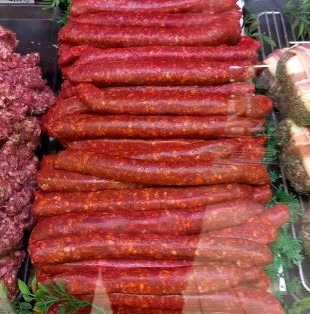
France – MERGUEZ – Listeria monocytogenes

Gov france

Identification information of the recalled product

  • Product category Feed
  • Product subcategory Meats
  • Product brand name Unbranded
  • Model names or references– Bulk sale in the traditional department between 04/10/2022 and 08/10/2022 – In LS: trays of 6 units with a DLC on 08/10/2022
  • Identification of products
    Batch Date
    MERGUEZ product sold in the traditional department and in self-service Use-by date 08/10/2022
  • Products ListPoster_consumer.pdfAttachment
  • Packaging Sold in the traditional department and in self-service
  • Marketing start/end date From 04/10/2022 to 08/10/2022
  • Storage temperature Product to be stored in the refrigerator
  • Geographic area of ​​sale Super U Limoges Corgnac (Manufacture store)
  • Distributors Super U Limoges Corgnac

Practical information regarding the recall

  • Reason for recall Microbiological contamination
  • Risks incurred by the consumer Listeria monocytogenes (causative agent of listeriosis)

France- Organic aioli- Microbial Growth

Gov france

Identification information of the recalled product

  • Product category Feed
  • Product subcategory Soups, sauces and condiments
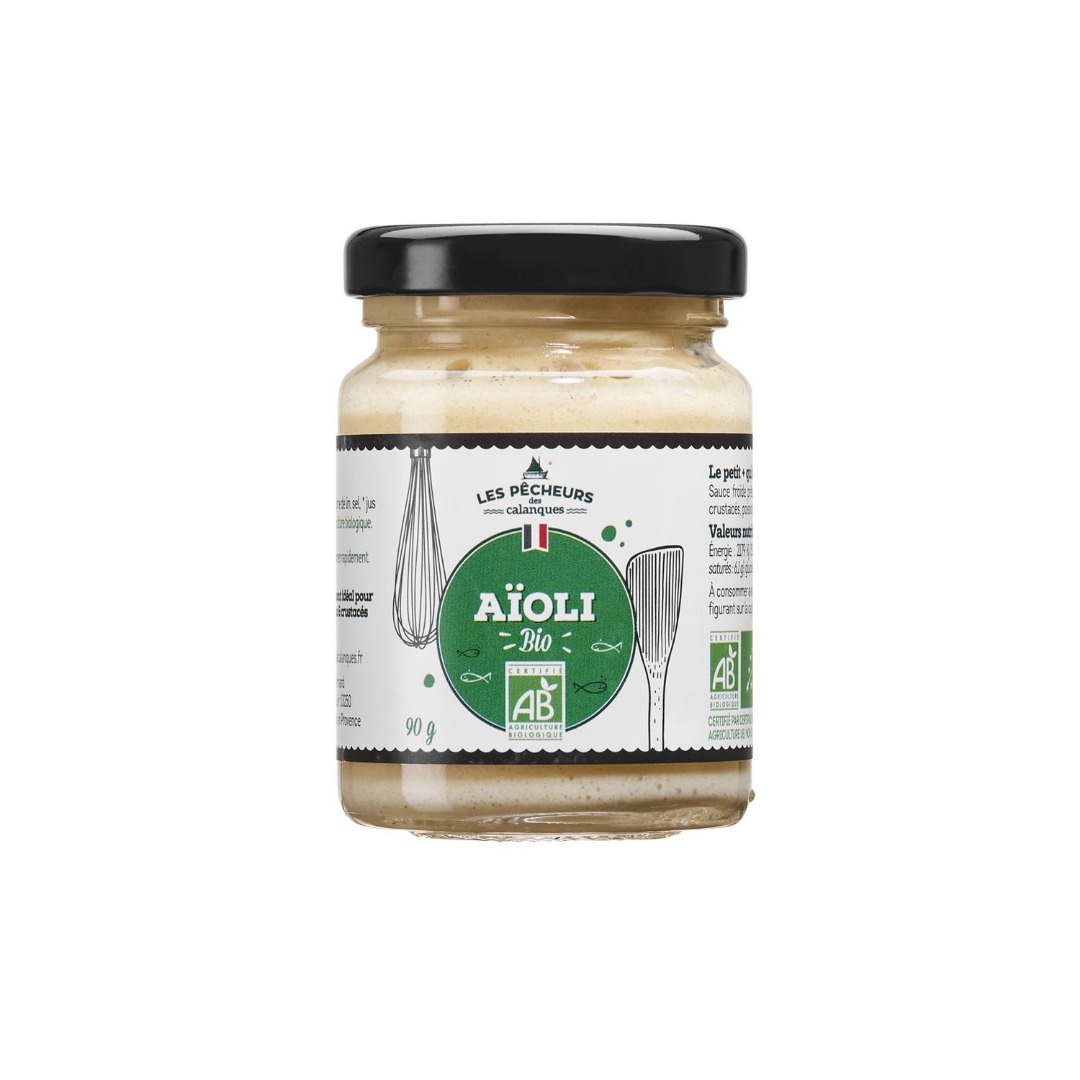
  • Product brand name The fishermen of the Calanques
  • Model names or references Organic aioli
  • Identification of products
    GTIN Batch Date
    3183811011940 ORGANIC: 1209F1189 Date of minimum durability 09/12/2024
  • Packaging Jar 90g
  • Marketing start/end date From 09/16/2022 to 10/10/2022
  • Storage temperature Product to be stored at room temperature
  • Health mark yes
  • Geographic area of ​​sale Whole France
  • Distributors Retail
  • List of points of sale1194_BIO_Aioli_12.09.pdf

Practical information regarding the recall

  • Reason for recall Suspicion of microbial growth
  • Risks incurred by the consumer Other biological contaminants

Denmark searches for source of Salmonella outbreak with 14 sick

Food Safety News

Danish officials are trying to find the source of a Salmonella outbreak that has sickened 14 people in a month.

Between Aug. 15 and Sept. 16, more than a dozen cases with the same type of Salmonella Typhimurium have been registered at the Statens Serum Institut.

Patients are seven men and seven women aged between 4 and 84 years old, with a median age of 61. Ten cases were reported in one week. Six sick people live in Midtjylland, five in Hovedstaden and three in Syddanmark.

The Statens Serum Institut (SSI), Danish Veterinary and Food Administration (Fødevarestyrelsen) and DTU Food Institute are investigating the outbreak.