Archives
-
Join 347 other subscribers
KSWFoodWorld
Blog Stats
- 487,337 Views

Monkfield Nutrition is extending the recall to all batches of frozen feeder mice products for feeding reptiles because Salmonella has been found in the products.
| Mouse Pinkies Small | |
|---|---|
| Pack size | 25 pack (1g per mouse) |
| Batch code | All batches |
| Mouse Pinkies Large | |
|---|---|
| Pack size | 25 pack (2-3g per mouse) |
| Batch code | All batches |
| ‘Pets at Home’ Mouse Fluff | |
|---|---|
| Pack size | Individual and 20 pack (3-5g per mouse) |
| Batch code | All batches |
| ‘Pets at Home’ Small Mice | |
|---|---|
| Pack size | Individual and 20 pack (10-15g per mouse) |
| Batch code | All batches |
| ‘Pets at Home’ Medium Mice | |
|---|---|
| Pack size | Individual and 20 pack (16-20g per mouse) |
| Batch code | All batches |
| ‘Pets at Home’ Large Mice | |
|---|---|
| Pack size | Individual and 20 pack (21-30g per mouse) |
| Batch code | All batches |
| ‘Pets at Home’ X Large Mouse | |
|---|---|
| Pack size | Individual and 15 pack (>31g per mouse) |
| Batch code | All batches |
| Mouse Fluff | |
|---|---|
| Pack size | 25 pack (4-6g per mouse) |
| Batch code | All batches |
| Mouse Crawlers Small | |
|---|---|
| Pack size | 25 pack (7-9g per mouse) |
| Batch code | All batches |
| Small Mice | |
|---|---|
| Pack size | 10 pack (10-15g per mouse) |
| Batch code | All batches |
| Medium Mice | |
|---|---|
| Pack size | 10 pack (16-20g per mouse) |
| Batch code | All batches |
| Large Mice | |
|---|---|
| Pack size | 10 pack (21-30g per mouse) |
| Batch code | All batches |
| Jumbo Mice | |
|---|---|
| Pack size | 10 pack (>31g per mouse) |
| Batch code | All batches |
| ‘Pets at Home’ Mouse Pinkies Small | |
|---|---|
| Pack size | Individual, 20 pack and 100 pack (1g per mouse) |
| Batch code | All batches |
| ‘Pets at Home’ Mouse Pinkies Large | |
|---|---|
| Pack size | Individual, 20 pack and 100 pack (2-3g per mouse) |
| Batch code | All batches |
The presence of Salmonella in the products listed above. Salmonella is a bacterium that can cause illness in humans and animals. The product could therefore carry a potential risk, because of the presence of Salmonella, either through direct handling of the products, or indirectly, for example from handling infected reptiles, their vivarium, utensils or contact with the faeces of these animals.
In humans, symptoms caused by salmonella usually include fever, diarrhoea and abdominal cramps. Infected animals may not necessarily display signs of illness, but symptoms can include diarrhoea.
In June 2020, a large-scale food poisoning outbreak involving about 3000 elementary and junior high school students occurred in Yashio, Saitama, Japan. A school lunch was the only food stuff ingested by all of the patients. Escherichia coli serotype O7:H4 carrying the astA gene for enteroaggregative E. coli (EAggEC) heat-stable enterotoxin 1 (EAST1) was detected in faecal specimens from the patients, and sample inspection revealed its presence in a seaweed salad and red seaweed (Gigartina tenella) as one of the raw materials. Analysis of the antibiotic sensitivity of the isolates revealed resistance to ampicillin and cefotaxime. All isolates were confirmed to be of the same origin by pulsed-field gel electrophoresis after digestion with the restriction enzyme XbaI, and single nucleotide polymorphism analysis using whole genome sequencing. To our knowledge, this is the first report of a large-scale food poisoning caused by E. coli O7:H4, which lacks well-characterized virulence genes other than astA.
Posted in E.coli O7:H4, food bourne outbreak, food contamination, food handler, Food Hazard, Food Hygiene, Food Illness, Food Inspections, Food Micro Blog, Food Microbiology, Food Microbiology Blog, Food Microbiology Testing, Food Pathogen, Food Poisoning, food recall, Food Safety, Food Safety Alert, Food Testing, Food Toxin, Foodborne Illness, foodborne outbreak, foodbourne outbreak, Illness, outbreak, STEC, STEC E.coli
The consumption of cheese in China is increasing rapidly. Little is known about the microbiota, the presence of antibiotic-resistant bacteria, or the distribution of antibiotic resistance genes (ARGs) in commercially-produced cheeses sold in China. These are important criteria for evaluating quality and safety. Thus, this study assessed the metagenomics of fifteen types of cheese using 16S rRNA gene sequencing. Fourteen bacterial genera were detected. Lactococcus , Lactobacillus , and Streptococcus were dominant based on numbers of sequence reads. Multidrug-resistant lactic acid bacteria were isolated from most of the types of cheese. The isolates showed 100% and 91.7% resistance to streptomycin and sulfamethoxazole, respectively, and genes involved in acquired resistance to streptomycin ( strB) and sulfonamides ( sul2) were detected with high frequency. To analyze the distribution of ARGs in the cheeses in overall, 309 ARGs from eight categories of ARG and nine transposase genes were profiled. A total of 169 ARGs were detected in the 15 cheeses; their occurrence and abundance varied significantly between cheeses. Our study demonstrates that there is various diversity of the bacteria and ARGs in cheeses sold in China. The risks associated with multidrug resistance of dominant lactic acid bacteria are of great concern.
Posted in Faecal Streptpcocci, Food Micro Blog, Food Microbiology Blog, Food Microbiology Research, Food Microbiology Testing, Group B Streptococcus, lactic acid bacteria, Lactobacillus, Lactococcus, microbial contamination, Microbiological Risk Assessment, Microbiology, Microbiology Investigations, Research

This study aimed to investigate effects of plasma-activated solution (PAS) on the cell biology of Staphylococcus aureus and qualities of fresh lettuce leaves. PAS was prepared by dielectric barrier discharge plasma and incubated with S. aureus for 10–30 min or with lettuces for 10 min. Effects on cell biology were evaluated with microscopic images, cell integrity, and chemical modification of cellular components. Effects on lettuce quality were estimated with the viable microbial counts, color, contents of vitamin C and chlorophyll, and surface integrity. PAS reduced S. aureus population by 4.95-log and resulted in increased cell membrane leakage. It also resulted in increased contents of reactive oxygen species in cells, C=O bonds in peptidoglycan, and 8-hydroxydeoxyguanosine content in cellular DNA, and reduced ratios of unsaturated/saturated fatty acids in the cell membrane. PAS treatment reduced bacterial load on fresh lettuce and had no negative effects on the quality. Data suggest that PAS can be used for the disinfection of ready-to-eat fresh vegetables. View Full-Text
Composted or heat-treated Biological Soil Amendments of Animal Origin (BSAAO) can be added to soils to provide nutrients for fresh produce. These products lower the risk of pathogen contamination of fresh produce when compared with use of untreated BSAAO; however, meteorological conditions, geographic location, and soil properties can influence the presence of pathogenic bacteria, or their indicators (e.g., generic E. coli) and allow potential for produce contamination. Replicated field plots of loamy or sandy soils were tilled and amended with dairy manure compost (DMC), poultry litter compost (PLC), or no compost (NoC) over two different field seasons, and non-composted heat-treated poultry pellets (HTPP) during the second field season. Plots were inoculated with a three-strain cocktail of rifampicin-resistant E. coli (rE.coli) at levels of 8.7 log CFU/m2. Direct plating and most probable number (MPN) methods measured the persistence of rE.coli and Listeria spp. in plots through 104 days post-inoculation. Greater survival of rE. coli was observed in PLC plots in comparison to DMC plots and NoC plots during year 1 (P < 0.05). Similar trends were observed for year 2, where rE. coli survival was also greater in HTPP amended plots (P < 0.05). Survival of rE. coli was dependent on soil type, where water potential and temperature were significant covariables. Listeria spp. were found in NoC plots, but not in plots amended with HTPP, PLC or DMC. Radish data demonstrate that PLC treatment promoted the greatest level of rE.coli translocation when compared to DMC and NoC treatments (P < 0.05). These results are consistent with findings from studies conducted in other regions of the US and informs Northeast produce growers that composted and non-composted poultry-based BSAAO supports greater survival of rE. coli in field soils. This result has the potential to impact the food safety risk of edible produce grown in BSAAO amended soils as a result of pathogen contamination.
Posted in Decontamination Microbial, E.coli, Food Micro Blog, Food Microbiology, Food Microbiology Blog, Food Microbiology Research, Food Microbiology Testing, Food Pathogen, Food Technology, microbial contamination, Microbiological Risk Assessment, Microbiology, Microbiology Investigations, Pathogen, pathogenic, Research, Technology
Salmonella enterica is well-known for its ability to survive and persist in low-moisture environments. Previous studies have indicated a link between the initial cell concentration and the population of Salmonella that survive upon desiccation and subsequent storage; however, how the initial cell concentration affects survival is unknown. This study examined the basis of this phenomena and whether it occurred in other microorganisms, specifically Shiga toxigenic Escherichia coli (STEC), and Enterococcus faecium . Salmonella, STEC, and E. faecium were grown as lawns on TSAYE and harvested using buffered peptone water (BPW). To determine recovery at different initial cell levels, cultures were diluted to 9, 7, and 5 log CFU/mL and applied to filters. Filters were dried for 24 h, then stored for 28 d at 25°C/33% RH. During storage, cells were recovered from filters using BPW and cultivated on TSAYE. Both Salmonella and E. coli , but not E. faecium , showed non-proportional recovery. Less viability remained with lower initial starting population after 24 h desiccation such that ≥10 log CFU/mL were recovered when 11 log CFU/mL was desiccated, but ❤ log CFU/mL were recovered when 5 log CFU/mL was desiccated. Once dried, persistence did not appear affected by initial cell concentration. When dead cells (heat-treated) were added to the diluent, recovery of Salmonella was proportional with respect to the initial cell concentration. To further examine the response on desiccation, Salmonella was diluted in BPW containing one of 11 different test cell components related to quorum sensing or known to affect desiccation resistance to assess recovery and persistence. Of the 11 additions only cell debris fractions, cell-free extract, and peptidoglycan improved recovery of Salmonella . Desiccation survival appears related to cell wall components, however, the exact mechanism affecting survival remains unknown.
Posted in Decontamination Microbial, E.coli O157, E.coli O157:H7, Enterococcus, Enterococcus faecium, Food Micro Blog, Food Microbiology, Food Microbiology Blog, Food Microbiology Research, Food Microbiology Testing, microbial contamination, Microbiological Risk Assessment, Microbiology, Microbiology Investigations, Research, Salmonella, Shigatoxin, STEC, STEC E.coli

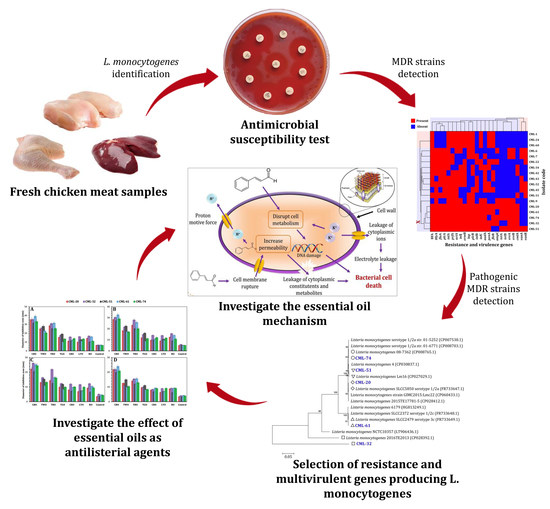
Listeria monocytogenes is one of the most severe foodborne pathogens found in several habitats. Therefore, this study aims to investigate the antilisterial activity of different essential oils (EOs) against multidrug-resistant (MDR) L. monocytogenes strains isolated from fresh chicken meat. Our results showed that the prevalence of L. monocytogenes in the examined samples was 48%. Seventy-eight isolates were identified as L. monocytogenes. Out of these, 64.1% were categorized as MDR and were categorized in 18 patterns with 50 MDR isolates. One isolate was selected randomly from each pattern to investigate their biofilm-forming ability, resistance, and virulence genes incidence. Out of 18 MDR isolates, 88.9% showed biofilm-forming ability. Moreover, the most prevalent resistance genes were ermB (72%), aadA (67%), penA (61%), and floR genes (61%). However, the most prevalent virulence genes were inlA (94.4%), prfA (88.9%), plcB (83.3%), and actaA (83.3%). The antilisterial activity of EOs showed that cinnamon bark oil (CBO) was the most effective antilisterial agent. CBO activity could be attributed to the bioactivity of cinnamaldehyde which effects cell viability by increasing the bacterial cell electrical conductivity, ion leakage, and salt tolerance capacity loss. Therefore, CBO could be an effective alternative natural agent for food safety applications. View Full-Text
Pregnant women are at increased risk of food poisoning, so take extra care if you’re pregnant or preparing food for someone who is.
Pregnant women are 10 times more likely than others to get listeriosis, a rare but deadly foodborne infection caused by the bacteria Listeria. Learn how to protect yourself from this harmful germ.