Category Archives: Food Illness

USA – Outbreak Investigation of Listeria monocytogenes: Enoki Mushrooms (March 2020)

FDA

Recommendation

Consumers should not eat and should check their refrigerators and throw away any recalled enoki mushrooms from Sun Hong Foods, Inc., Guan’s Mushroom Co., and H&C Food, Inc. because they may be contaminated with Listeria monocytogenes.

Restaurants and retailers should not sell or serve recalled enoki mushrooms distributed by Sun Hong Foods, Inc., Guan’s Mushroom Co., and H&C Food, Inc.

FDA recommends that anyone who received recalled products use extra vigilance in cleaning and sanitizing any surfaces and containers that may have come in contact with these products to reduce the risk of cross-contamination. Listeria can survive in refrigerated temperatures and can easily spread to other foods and surfaces.

At this time, high risk groups, including the elderly, people with weakened immune systems or chronic diseases, pregnant women and their newborn babies, should not eat enoki mushrooms from Korea (Republic of Korea), even if they were not part of the recalls.

Consumers, restaurants, retailers, and high risk groups should discard and not eat, sell, or serve enoki mushrooms if they cannot tell where they came from.
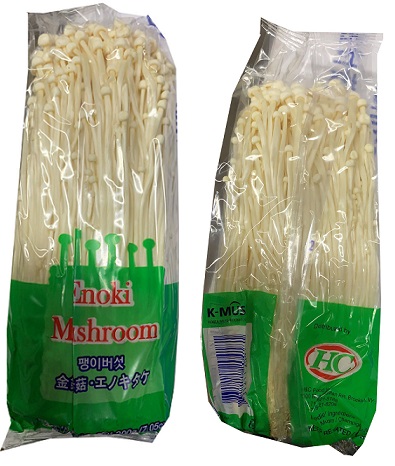
H&C Food Inc Enoki Mushrooms


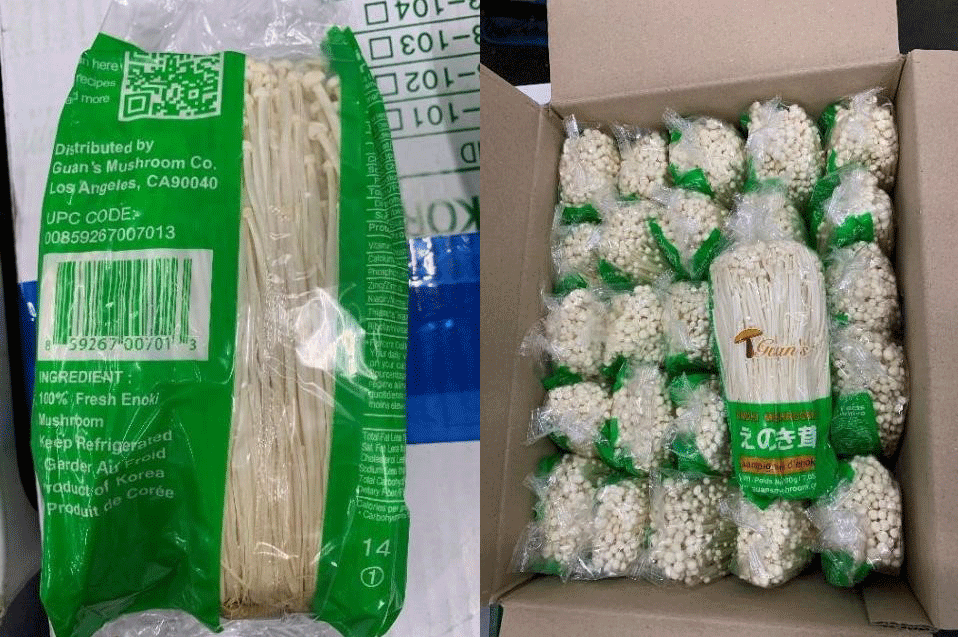
Guan’s Mushroom Co.
Guan’s Mushroom Co.
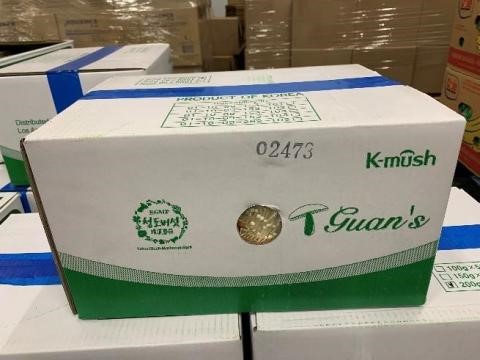
Picture of enoki mushroom case
Sample Enoki Mushrooms Imported from Korea
Company Size UPC Code Retailers* Distribution*
Sun Hong Foods, Inc. 200 g/ 7.05 oz. 7 426852 625810 J&L Supermarket, Jusgo Supermarket, ZTao Market, New Sang Supermarket, Galleria Market, Distributors CA, FL, IL, OR, TX, WA
Guan’s Mushroom Co. 200 g/ 7.05 oz. 859267007013 Sold to Distributors and Wholesalers CA, NY, PA
H&C Food Inc. 200 g/ 7.05 oz. 831211204181 Great Wall Supermarket NY, MD, VA

*This includes confirmed distribution information from companies; products could have been further distributed and sent to additional retailers and states.

Update

FDA, CDC, and state and local partners are currently investigating a multistate outbreak of Listeria monocytogenes infections linked to enoki mushrooms. Enoki mushrooms are a long thin white mushroom, usually sold in clusters. They are especially popular in East Asian cuisine and are also known as enokitake, golden needle, futu, or lily mushrooms.

On April 7, 2020, H&C Foods Inc. recalled 200 g/7.05 oz packages of enoki mushrooms imported from Green Co. LTD of the Republic of Korea. FDA import samples of enoki mushrooms from Green Co. LTD tested positive for Listeria monocytogenes and on April 6, 2020, whole genome sequencing analysis determined that the Listeria monocytogenes found in the positive samples matched the outbreak strain. As a result, On April 7, 2020, Green Co. LTD was placed on Import Alert 99-23, which flags imported shipments from this firm for potential detention without physical examination. The FDA is encouraging the international community to consult the Import Alert.

The investigation is ongoing to determine the source of contamination and if additional products are linked to illness. Additional information will be provided as it becomes available.


Case Counts

Total Illnesses: 36
Hospitalizations: 30
Deaths: 4
Illness Onset Date Range: November 23, 2016 – December 13, 2019
States with Cases: AZ (2), CA (9), FL (2), HI (3), IN (1), KY (1), MA (2), MD (2), MI (1), MO (1), NC (1), NJ (1), NV (1), NY (4), RI (1), TN (1), VA (3)
Product Distribution*: CA, FL, IL, NY, MD, OR, PA, TX, VA, WA
*States with confirmed distribution; product could have been distributed further

Afganistan – Afghan Authorities Say 26 Police Officers Poisoned In Laghman Province

Urdu Point

Police in Afghanistan had 26 of its officers sustain food poisoning after consuming lunch in the eastern Laghman province, the provincial governor‘s spokesman Asadullah Dawlatzai told Sputnik on Saturday.

According to the spokesman, the police are now probing the food contractor, and an investigation is underway to determine how officers were poisoned.

Netherlands – Dutch Salmonella illnesses linked to Brazilian poultry

Food Safety News

Chicken meat from Brazil is being investigated as the source of Salmonella illnesses in the Netherlands.

Between the end of 2019 and mid-February 2020, the National Institute for Public Health and the Environment (RIVM) identified a cluster of six Salmonella Virchow infections distributed across the country using whole genome sequencing (WGS) but no epidemiological link among them was reported.

An outbreak investigation by RIVM and the Netherlands Food and Consumer Product Safety Authority (NVWA) identified six food isolates as genetically closely related to cases and associated with the source of the infection.

These isolates came from poultry meat, including frozen poultry imported from Brazil.


USA – Outbreak Investigation of Listeria monocytogenes: Enoki Mushrooms (March 2020)

FDA

Case Counts

Total Illnesses: 36
Hospitalizations: 30
Deaths: 4
Illness Onset Date Range: November 23, 2016 – December 13, 2019

Recommendation

Consumers should not eat and should check their refrigerators and throw away any recalled enoki mushrooms from Sun Hong Foods, Inc., Guan’s Mushroom Co., and H&C Food, Inc. because they may be contaminated with Listeria monocytogenes.

Restaurants and retailers should not sell or serve recalled enoki mushrooms distributed by Sun Hong Foods, Inc., Guan’s Mushroom Co., and H&C Food, Inc.

FDA recommends that anyone who received recalled products use extra vigilance in cleaning and sanitizing any surfaces and containers that may have come in contact with these products to reduce the risk of cross-contamination. Listeria can survive in refrigerated temperatures and can easily spread to other foods and surfaces.

At this time, high risk groups, including the elderly, people with weakened immune systems or chronic diseases, pregnant women and their newborn babies, should not eat enoki mushrooms from Korea (Republic of Korea), even if they were not part of the recalls.

Consumers, restaurants, retailers, and high risk groups should discard and not eat, sell, or serve enoki mushrooms if they cannot tell where they came from.
H&C Food Inc Enoki Mushrooms


Guan’s Mushroom Co.
Guan’s Mushroom Co.
Picture of enoki mushroom case
Sample Enoki Mushrooms Imported from Korea
Company Size UPC Code Retailers* Distribution*
Sun Hong Foods, Inc. 200 g/ 7.05 oz. 7 426852 625810 J&L Supermarket, Jusgo Supermarket, ZTao Market, New Sang Supermarket, Galleria Market, Distributors CA, FL, IL, OR, TX, WA
Guan’s Mushroom Co. 200 g/ 7.05 oz. 859267007013 Sold to Distributors and Wholesalers CA, NY, PA
H&C Food Inc. 200 g/ 7.05 oz. 831211204181 Great Wall Supermarket NY, MD, VA

*This includes confirmed distribution information from companies; products could have been further distributed and sent to additional retailers and states.

Update

FDA, CDC, and state and local partners are currently investigating a multistate outbreak of Listeria monocytogenes infections linked to enoki mushrooms. Enoki mushrooms are a long thin white mushroom, usually sold in clusters. They are especially popular in East Asian cuisine and are also known as enokitake, golden needle, futu, or lily mushrooms.

On April 7, 2020, H&C Foods Inc. recalled 200 g/7.05 oz packages of enoki mushrooms imported from Green Co. LTD of the Republic of Korea. FDA import samples of enoki mushrooms from Green Co. LTD tested positive for Listeria monocytogenes and on April 6, 2020, whole genome sequencing analysis determined that the Listeria monocytogenes found in the positive samples matched the outbreak strain. As a result, On April 7, 2020, Green Co. LTD was placed on Import Alert 99-23, which flags imported shipments from this firm for potential detention without physical examination. The FDA is encouraging the international community to consult the Import Alert.

The investigation is ongoing to determine the source of contamination and if additional products are linked to illness. Additional information will be provided as it becomes available.

Information – Common Symptoms of All of the Food Poisoning Pathogens

Food Poisoning Bulletin

Food poisoning outbreaks occur every year in the United States. These outbreaks can be caused by bacteria such as E. coli, Salmonella, Listeria Monocytogenes, Clostridium botulinum, Campylobacter, Shigella, Staphylococcus aureus, Brucella, Vibrio, and Bacillus cereus; and viruses such as norovirus and hepatitis A. At least 48,000,000 Americans are sickened with food poisoning every year. Do you know the common symptoms of all of the food poisoning pathogens? Follow the link above to find out.


USA – Salmonella outbreak traced to food ordered online

Food Safety News kswfoodworld Salmonella

Ten people were sickened by Salmonella from chicken legs in a Chinese city after eating food ordered online in mid-2018, according to a new report.

Researchers said the investigation highlights the role of online food delivery platforms as a new mode of foodborne disease transmission. Collaboration between public health agencies and online food delivery platforms is essential for timely intervention and to limit the scale of outbreaks.

From late June to early July 2018, 10 cases of diarrheal disease were reported at two hospitals in the Nanshan District of Shenzhen, China. This outbreak was suspected to be foodborne and was notified to the Shenzhen Center for Disease Control and Prevention (Shenzhen CDC), according to the study published in Emerging Infectious Diseases.

All 10 patients were university students who had diarrhea and fever. Seven of them also reported nausea and vomiting. Cases were from six different colleges of the same university but lived in different dormitories and did not know each other.

India – Kuttu causes food poisoning in Haryana, leaves 180 people ill

The Print

Yamunanagar: At least 180 people were taken ill due to food poisoning in Yamunanagar and Jagadhri towns of this district, health officials said on Thursday.

The officials said the people were admitted to civil hospitals at Jagadhri and Yamunanagar after they complained of vomiting and abdominal pain.

USA – Outbreak Investigation of Listeria monocytogenes: Enoki Mushrooms (March 2020)

FDA

Total Illnesses: 36
Hospitalizations: 30
Deaths: 4
Illness Onset Date Range: November 23, 2016 – December 13, 2019
States with Cases: AZ (2), CA (9), FL (2), HI (3), IN (1), KY (1), MA (2), MD (2), MI (1), MO (1), NC (1), NJ (1), NV (1), NY (4), RI (1), TN (1), VA (3)

Recommendation

Consumers should not eat and should check their refrigerators and throw away any recalled enoki mushrooms from Sun Hong Foods, Inc. and Guan’s Mushroom Co., because they may be contaminated with Listeria monocytogenes.

Restaurants and retailers should not sell or serve recalled enoki mushrooms distributed by Sun Hong Foods, Inc. and Guan’s Mushrooms Co.

FDA recommends that anyone who received recalled products use extra vigilance in cleaning and sanitizing any surfaces and containers that may have come in contact with these products to reduce the risk of cross-contamination. Listeria can survive in refrigerated temperatures and can easily spread to other foods and surfaces.

At this time, high risk groups, including the elderly, people with weakened immune systems or chronic diseases, pregnant women and their newborn babies, should not eat enoki mushrooms from Korea (Republic of Korea), even if they were not part of the recalls by Sun Hong Foods, Inc. and Guan’s Mushroom Co.

Consumers, restaurants, retailers, and high risk groups should discard and not eat, sell, or serve enoki mushrooms if they cannot tell where they came from.

Enoki mushrooms from Sun Hong Foods were sold in 200 g/7.05 oz clear plastic packaging with a green label; Sun Hong Foods, Inc. is labeled on the back of the packaging underneath the bar code. These products can also be identified by the UPC code: 7 426852 625810. Recalled product was sold to distributors in California, Florida, Illinois, Oregon, and Texas; and was sold to the following retailers: J&L Supermarket, Jusgo Supermarket, ZTao Market, New Sang Supermarket, Galleria Market. This distribution information has been confirmed by the firm, but product could have been distributed further, reaching additional states and retail locations. Laboratory analysis of a sample of these mushrooms found the presence of Listeria monocytogenes, and whole genome sequencing analysis of the sample found that the Listeria monocytogenes found in these mushrooms matched the outbreak strain.

Enoki mushrooms from Guan’s Mushroom Co. were sold in 200 g/7.05 oz clear plastic packaging with the description “Enoki Mushroom” in English, Korean, and French; Guan’s logo is on the front. On the back of the packaging, the UPC code 859267007013 and package code 14-1 are on the lower right corner. Recalled product was sold to distributors and wholesalers in California, New York, and Pennsylvania in white cardboard boxes with Guan’s logo in green color and code “#02473,” but could have been distributed further. Whole genome sequencing analysis is currently being conducted to determine if these products are linked to this outbreak.

Update

FDA, CDC, and state and local partners are currently investigating a multistate outbreak of Listeria monocytogenes infections linked to enoki mushrooms. Enoki mushrooms are a long thin white mushroom, usually sold in clusters. They are especially popular in East Asian cuisine and are also known as enokitake, golden needle, futu, or lily mushrooms.

On March 23, 2020 Guan’s Mushroom Co. recalled all cases of its 200 g/7.05 oz packages of enoki mushrooms imported from Korea (Republic of Korea). The firm recalled product and ceased distribution after the California Department of Public Health found that a sample of these mushrooms was positive for Listeria monocytogenes. At this time, whole genome sequencing analysis is being conducted to determine whether or not enoki mushrooms from Guan’s Mushroom Co. are linked to this outbreak.

On March 18, 2020, the Korean Ministry of Food and Drug Safety (MFDS) issued a press release on their findings related to Listeria monocytogenes and enoki mushrooms. The government of the Republic of Korea investigated four companies that export enoki mushrooms to the United States and detected Listeria monocytogenes in enoki mushrooms produced by two firms in Korea. The Korean MFDS did not name the firms in the press release; the FDA is working to obtain this information. The Korean MFDS did not link product to any illnesses in Korea.

The Korean MFDS has recommended that enoki mushrooms should be cooked before being consumed and starting March 23, 2020, the Korean MFDS will require large production companies of enoki mushrooms to include additional labelling indicating that they should be cooked.

On March 9, 2020, Sun Hong Foods, Inc. recalled all enoki mushrooms imported from Korea (Republic of Korea). The firm recalled product after the Michigan Department of Agriculture and Rural Development found that a sample of these mushrooms was positive for Listeria monocytogenes. Whole genome sequencing analysis of the sample found that the Listeria monocytogenes found in these mushrooms matched the outbreak strain.

The investigation is ongoing to determine the source of contamination and if additional products are linked to illness. Additional information will be provided as it becomes available.

Research – Root Cause Analyses Are ‘Critical to Preventing Foodborne Illnesses’

PEW Trusts

When foodborne illnesses are linked to products regulated by the Food and Drug Administration, the agency’s top priority is limiting harm to consumers with swift removal of unsafe items from the market. But FDA’s work doesn’t end there. The agency increasingly uses an investigative approach called root cause analysis (RCA) to identify how and why dangerous bacteria or other pathogens contaminated specific products and what steps could help businesses prevent a recurrence of these problems. The FDA publicly shares findings and recommended corrective actions from each RCA so that food growers and manufacturers across an industry can apply them to their food safety systems.

Frank Yiannas, deputy commissioner for food policy and response, heads FDA’s efforts to reduce food contamination risks and respond to foodborne outbreaks. He spoke with The Pew Charitable Trusts about the importance of RCA in this work and cited a new Pew report that offers guidance for effective analyses to food companies and government agencies. His responses have been edited for clarity and length.

Research – Human foodborne listeriosis in England and Wales, 1981 to 2015

Cambridge Press

Almost all cases of human listeriosis are foodborne, however the proportion where specific exposures are identified is small. Between 1981 and 2015, 5252 human listeriosis cases were reported in England and Wales. The purpose of this study was to summarise data where consumption of specific foods was identified with transmission and these comprised 11 sporadic cases and 17 outbreaks. There was a single outbreak in the community of 378 cases (7% of the total) which was associated with pâté consumption and 112 cases (2% of the total) attributed to specific foods in all the other incidents. The proportion of food-attributed cases increased during this study with improvements in typing methods for Listeria monocytogenes. Ten incidents (one sporadic case and nine outbreaks of 2–9 cases over 4 days to 32 months) occurred in hospitals: all were associated with the consumption of pre-prepared sandwiches. The 18 community incidents comprised eight outbreaks (seven of between 3 and 17 cases) and 10 sporadic cases: food of animal origin was implicated in 16 of the incidents (sliced or potted meats, pork pies, pâté, liver, chicken, crab-meat, butter and soft cheese) and food of non-animal origin in the remaining two (olives and vegetable rennet).