Category Archives: Food Illness

Australia – Salmonella explosion as 12 farms that sell produce to supermarkets are found to be infected – Eggs

Brinkwire hazegg.jpg

At least three people have come down with salmonella poisoning after purchasing eggs from a popular supermarket.

The infection is believed to have come from eggs bought in the Melbourne suburb of Werribee.

The Weekly Times reported the eggs were supplied from farms in New South Wales.

However, a spokesman for the NSW Department of Primary Industries disputed those claims.

‘There is no evidence to suggest the reported illnesses in Victoria are connected to NSW eggs, or even eggs. The matter is an active investigation being undertaken by Victorian authorities.

‘There are no current recalls of eggs in NSW and no warnings with regards to eggs.’


Denmark – Campylobacter outbreak linked to milk sickens more than 100

Food Safety News

More than 100 people are sick in a Campylobacter outbreak in Denmark linked to a local dairy.

The Danish Veterinary and Food Administration (Fødevarestyrelsen), DTU Food Institute and Statens Serum Institut (SSI) are investigating illnesses that began in Bornholm in late May.

Patient interviews point toward pasteurized milk from Bornholms Andelsmejeri (Bornholm Dairy) as the source of infection but product testing has been negative for Campylobacter. Bornholm Dairy is a cooperative owned by Bornholm milk producers.

USA – Outbreak Investigation of Listeria monocytogenes: Enoki Mushrooms (March 2020)

FDA

The FDA, along with CDC and state and local partners investigated a multistate outbreak of Listeria monocytogenes infections linked to enoki mushrooms from Green Co, LTD. of the Republic of Korea. Enoki mushrooms are a long thin white mushroom, usually sold in clusters. They are especially popular in East Asian cuisine and are also known as enokitake, golden needle, futu, or lily mushrooms.

Recommendations

Recalled enoki mushrooms from Sun Hong Foods, Inc., Guan’s Mushroom Co., and H&C Food, Inc. are past their shelf-life and should no longer be available.

FDA recommends that anyone who received recalled products use extra vigilance in cleaning and sanitizing any surfaces and containers that may have come in contact with these products to reduce the risk of cross-contamination. Listeria can survive in refrigerated temperatures and can easily spread to other foods and surfaces.

Investigation Update

June 9, 2020

As of June 9, 2020, the CDC declared that this outbreak appears to be over.

Previous Updates


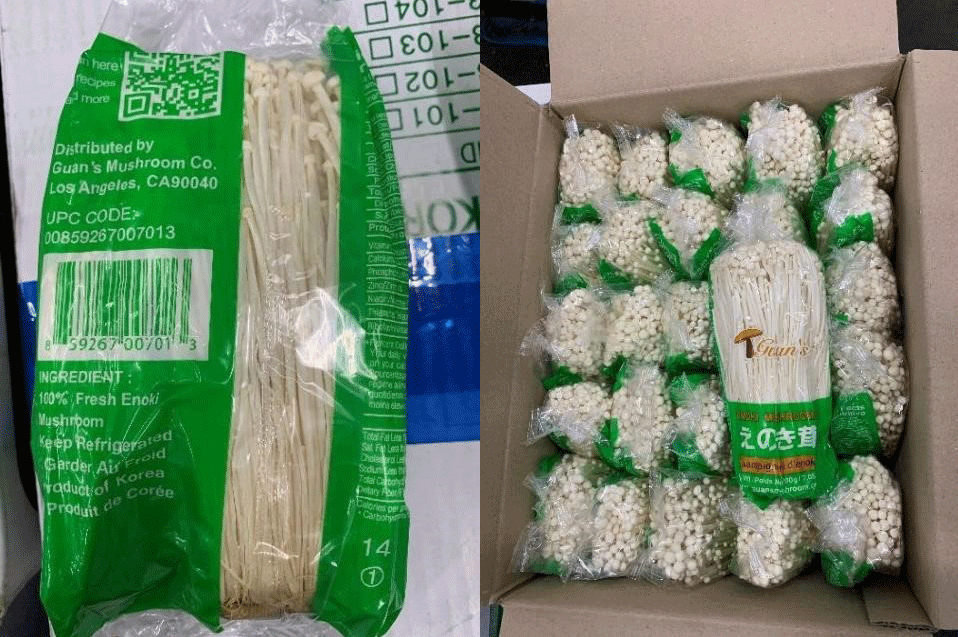
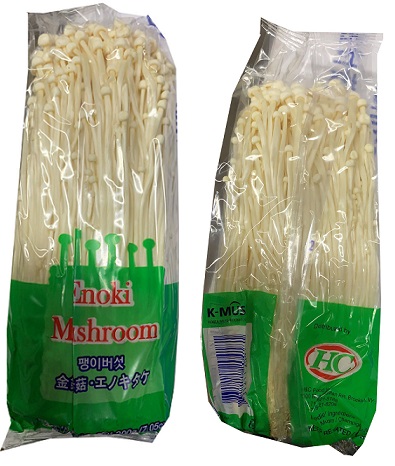
Product Images

Guan’s Mushroom Co.
Guan’s Mushroom Co.
Picture of enoki mushroom case
Sample Enoki Mushrooms Imported from Korea
H&C Food Inc Enoki Mushrooms

Research – Australia sees decline in Campylobacter and Salmonella

Food Safety News

Rates of Campylobacter and Salmonella infections in Australia have almost halved since the lockdown because of the Coronavirus pandemic that began in March.

The Food Safety Information Council revealed that since the COVID-19 shutdown started, reported rates of these infections per 100,000 people have declined compared to the past two years.

This shows the effectiveness of good handwashing, and that there has been less bulk catering as fewer people have been eating out or entertaining, according to the health promotion charity.

In April, 839 Salmonella infections were recorded compared to 1,383 in 2019. For May, 818 cases were reported versus 1,172 in the same period the year before, according to the Australian Department of Health’s National Notifiable Diseases Surveillance System. These figures convert to a reporting rate of 3.4 in April compared to 5.5 in April 2019 and 3.3 in May versus 4.7 in May 2019.

New Zealand -Ciguatera cases linked to imported fish in New Zealand

Food Safety News

Five people from two households in New Zealand became ill with ciguatera poisoning after eating fish imported from Fiji earlier this year.

The outbreak in Christchurch affected three males of 19 to 58 years old and two females – one aged in her 40s and the other in her 50s. One person was hospitalized and diagnosed with ciguatera poisoning but has since recovered.

In late May, Krazy Price Mart Ltd recalled a batch of frozen camouflage grouper (kawakawa) due to ciguatoxin. The item was sold as an individual whole gutted fish wrapped in clear plastic but was not labelled so had no date marking. It was available between March 10 and May 21, 2020 only at Krazy Price Mart Ltd in Christchurch.


India – Kids among 45 fall sick after eating chaat in Shahjahanpur

Times of India

A large number of children were among 45 people taken ill after eating ‘chaat’ from a local street vendor at Dalipur village.
Three of them are said to be in a critical condition. Doctors said that it is a case of food poisoning and most of the people are suffering from diarrhoea.

Denmark -DTU is helping to investigate outbreaks of disease on Bornholm – Campylobacter

DTU

The Danish Veterinary and Food Administration, DTU The Danish Food Institute and the Swedish Serum Institute, SSI, have jointly investigated an ongoing disease outbreak on Bornholm since June 2, 2020. Currently, there are reports of up to 100 people with symptoms similar to a campylobacter infection.

So far, 54 people aged 9 months to 97 years have tested positive for campylobacter and several patient samples are being investigated. The sick live on Bornholm or have visited the island recently. SSI is also investigating whether it is the same type of campylobacter that has made patients sick.

The goal of the collaboration is to identify the source of infection. At present, there is no trace of a particular source, but one suspects a locally produced food – presumably a ready-to-eat product.

Read more

The details of the outbreak and the work on finding the source of infection are described in more detail in a news from the Danish Veterinary and Food Administration: Several sufferers of campylobacter on Bornholm . The news also provides good advice on how consumers best avoid getting infected with campylobacter.

Research – Emerging Foodborne Pathogens

Pub Med

The broad spectrum of foodborne infections has changed dramatically over time, as well-established pathogens have been controlled or eliminated, and new ones have emerged. The burden of foodborne disease remains substantial: one in four Americans is estimated to have a significant foodborne illness each year. The majority of these illnesses are not accounted for by known pathogens, so more must remain to be discovered. Among the known foodborne pathogens, those more recently identified predominate, suggesting that as more and more is learned about pathogens, they come under control. In addition to the emergence or recognition of new pathogens, other trends include global pandemics of some foodborne pathogens, the emergence of antimicrobial resistance, the identification of pathogens that are highly opportunistic, affecting only the most high-risk subpopulations, and the increasing identification of large and dispersed outbreaks. New pathogens can emerge because of changing ecology or changing technology that connects a potential pathogen with the food chain. They also can emerge de novo by transfer of mobile virulence factors, often through bacteriophage. Though this is rarely observed, it can be reconstructed. Better understanding of the ecology and dynamics of phage transmission among bacteria will help us to understand the appearance of new pathogens in the future. One may look for emerging foodborne pathogens among the silent zoonoses, and among the severe infections affecting the immunocompromised humans. We should expect the unexpected. In the past, separating human sewage and animal manure from human food and water supplies was critical to improving public health. Now, our health depends increasingly on the safety of the feed and water supplies for the animals themselves. The successes of the 20th century and the new challenges we face mean that public health vigilance, careful investigation of new problems, responsible attention to food safety from farm to table, and partnerships to bring about new foodborne disease control measures will be needed for the foreseeable future.


Malaysia – Terengganu ‘puding buih’ food poisoning case claims first victim

Malay Mail

KUALA TERENGGANU, June 3 — A victim of the puding buih food poisoning incident in Terengganu has died at the Sultanah Nur Zahirah Hospital (HSNZ), said state Health director Dr Nor Azimi Yunus.

He said the 25-year-old woman, who was admitted to the hospital on May 24, died at 10.40am today.

“She was treated for 10 days at the Intensive Care Unit of HSNZ. The death was caused by septicaemia shock and multi-organ failure,” he told reporters via WhatsApp.

It had been reported that 99 people in Terengganu were treated at HSNZ and other healthcare facilities for diarrhoea, vomiting and fever after consuming puding buih which they bought online on May 22.

Viet Nam – Vietnam reports more food poisoning deaths in 5 months

Xinhuanet

HANOI, June 2 (Xinhua) — In the first five months of this year, 694 people in Vietnam suffered from food poisoning, of whom 15 died, according to the country’s Preventive Health Department on Tuesday.

In the same period last year, 806 people were affected by food poisoning, of whom five died.

Between January and May, Vietnam spotted 26,900 dengue fever patients, including three fatalities, 4,921 foot-and-mouth disease cases and 186 viral encephalitis sufferers.

Vietnam currently has 210,500 HIV carriers, of whom 97,154 have become AIDS patients. To date, 98,705 people in the country have died of AIDS-related diseases, the department said. Enditem